

You check your credit score in one app and see 712. Then a lender shows you 684. A week later, your bank shows 701. If you have ever wondered whether FICO vs VantageScore is the reason for the mismatch, the short answer is yes, at least part of the time.
This guide is for borrowers comparing offers, getting ready for a mortgage, or trying to understand which score matters most before they apply. You will learn how FICO and VantageScore differ, why your numbers can move separately, what recent mortgage changes mean, and what to do this week if you want to improve the odds that both scores trend in the right direction.
Contents
- 1 Who should care about FICO vs VantageScore
- 2 FICO and VantageScore are different systems, not competing labels on the same score
- 3 The biggest differences that affect real borrowers
- 4 The numbers and thresholds that matter most
- 5 A realistic example of why the scores can diverge
- 6 What to do first this week if you want both scores to improve
- 6.1 Pull up every score source you already have
- 6.2 List your current utilization using real balances
- 6.3 Set every open account to autopay for at least the minimum
- 6.4 Delay unnecessary new applications for 30 to 90 days
- 6.5 Ask your lender which model they use before applying
- 6.6 Track trends monthly, not daily
- 6.7 Choose one immediate goal and one later goal
- 7 Mistakes that cause confusion or wasted effort
- 8 What many articles miss about this comparison
- 9 FAQ
- 10 Helpful tools and related resources
- 11 The bottom line
Key Takeaway
FICO and VantageScore usually use the same 300 to 850 range, but they are different scoring systems, so the smart move is to manage the habits that help both rather than chasing one number.
Who should care about FICO vs VantageScore
This topic matters most if you are in one of these groups:
- You plan to apply for a mortgage, auto loan, personal loan, or credit card within the next 3 to 12 months.
- You monitor your score through a free app and want to know whether that number matches what a lender will actually use.
- You have a short credit history and want to know whether one model may score you differently from another.
- You are rebuilding after missed payments, high utilization, or a stretch of heavy borrowing.
It may matter less if you are not applying for credit soon and only want a rough trend line. In that case, either score can still be useful as a progress tracker. What matters is consistency. If your score source changes models, comparing month to month gets harder.
If your immediate goal is understanding why your number changed, read this breakdown of common credit score drop causes. If your goal is raising scores by lowering balances, this credit utilization guide is one of the highest-impact places to start.
FICO and VantageScore are different systems, not competing labels on the same score
Here is the practical version. A credit score is a prediction tool. It estimates how likely you are to repay debt based on information in your credit file. According to the Consumer Financial Protection Bureau, FICO and VantageScore are two leading scoring models in the United States, but they are built by different organizations and use different algorithms.
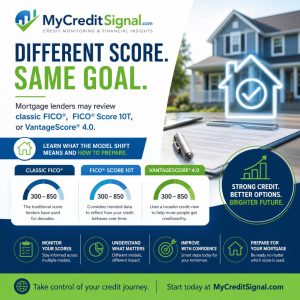
FICO Score is developed by Fair Isaac Corporation. VantageScore was created jointly by Experian, Equifax, and TransUnion. Both generally use a 300 to 850 scale, but that does not mean a 720 FICO automatically equals a 720 VantageScore in risk terms.
Think of them like two teachers grading the same student with different rubrics. The same report card data may produce different final scores because each model weighs timing, recent activity, account mix, and depth of history in its own way.
The CFPB also notes that consumers can see different numbers depending on the data used and the model applied. That means a score difference does not automatically mean something is wrong. Often it simply means you are looking at different formulas, different bureau data, or a different score version.
The biggest differences that affect real borrowers
1. The developer and model design are different
This is the root issue. FICO and VantageScore are separate products. Even when they use the same 300 to 850 range, the scoring logic behind the number is not identical.
2. The data handling can differ
VantageScore 4.0 is positioned as a tri-bureau model, meaning it is designed to use data from all three major bureaus. VantageScore has also emphasized that version 4.0 can be more inclusive for consumers with shorter credit histories, according to VantageScore 4.0 materials. In practice, the impact will vary by borrower profile and lender setup.
By contrast, many lender workflows have historically relied on bureau-specific FICO versions or industry-specific FICO scores. That is one reason a lender may show you a different number than the credit score app on your phone.
3. Lenders do not all use the same version
One of the biggest misconceptions is thinking there is only one FICO score and one VantageScore. In reality, lenders may use FICO 8, FICO 9, FICO 10T, older mortgage versions, or VantageScore 3.0 or 4.0, depending on the product and institution. So the real comparison is often not just FICO vs VantageScore. It is which version, for which lender, for which loan.
4. Mortgage use is changing
Historically, FICO has dominated many lending decisions, especially mortgages. But recent regulatory and agency changes are expanding lender choice. The FHFA announced validation of FICO 10T and VantageScore 4.0 for use by Fannie Mae and Freddie Mac, and subsequent updates moved implementation forward. FHFA and HUD also announced broader use of approved scoring models in government-backed mortgages in 2025 and 2026, which means the market is becoming less one-model-only over time.
The numbers and thresholds that matter most
The shared range is the easiest part. Both major models generally produce scores from 300 to 850. That gives borrowers a false sense that the systems are interchangeable. They are not.
Here is the short decision framework:
- If you are comparing your own scores across apps: check whether both sources use the same model and same bureau.
- If you are applying for a mortgage: ask the lender which score model and version they use, and whether they pull one bureau or multiple.
- If you are rebuilding credit: focus on behaviors that help any major model, like on-time payments and lower utilization.
A few current numbers are worth keeping in mind:
- 300 to 850: the commonly cited base range for both FICO and VantageScore, per the CFPB and model materials.
- 61%: the share of Americans reported with a good VantageScore or better in 2026 reporting context, cited by Kiplinger.
- $4.50: an interim price point cited in FHFA-related reporting for VantageScore 4.0 mortgage scores during an interim period, reflecting efforts to widen competition.
- June 2026: an implementation milestone under FHFA guidance for approved newer mortgage score models.
Those numbers matter because they show two things at once. First, the score range is familiar. Second, the market around credit scoring is changing, especially in housing finance.
For day-to-day score building, the threshold you should care about most is not a magic score cutoff from this article. It is the point where your utilization, payment consistency, and new credit activity stop working against you. If you want to estimate how a payoff or new application could affect your profile, try the credit score simulator.
A realistic example of why the scores can diverge
Imagine Maya has three credit cards with limits of $2,000, $3,000, and $5,000. Her total limit is $10,000. Last month she carried $4,200 across those cards, so her utilization was 42%. This month she pays it down to $1,700, lowering utilization to 17%.
That is a big positive change under almost any major scoring model. But suppose one score source updates after the lower balances report and another source has not refreshed yet. Maya could see a VantageScore move first, while a FICO-based score lags, or the reverse, depending on the source and update cycle. If the data inputs are not identical, the scores will not match exactly.
Now add a new credit card application on top of that. One model may react a little differently to the new inquiry and new account than the other. The result is a normal but confusing spread of numbers.
This is why comparing score changes without knowing the model is like comparing gas mileage from two different test tracks.
What to do first this week if you want both scores to improve
The good news is that you do not need two separate playbooks. Most of the habits that help FICO can help VantageScore too, although results vary by profile, bureau data, and scoring version.
Pull up every score source you already have
Check your bank app, card issuer portal, and any free credit dashboard you use. Write down three things for each one: the score, the date updated, and whether it says FICO or VantageScore. This takes 10 minutes and instantly reduces confusion.
List your current utilization using real balances
Add up your revolving balances and divide by total revolving limits. Example: $1,700 in balances divided by $10,000 in limits equals 17% utilization. If your ratio is high, target the cards with the biggest balances first. Use the credit mix analyzer for context on your broader profile, but focus first on revolving balances because that is often the fastest lever.
Set every open account to autopay for at least the minimum
Payment history matters across models. One missed payment can do more damage than squeezing out a few extra score points from any tactic. If cash flow is tight, autopay the minimum and make manual extra payments when possible.
Delay unnecessary new applications for 30 to 90 days
If you are rate shopping for a major loan soon, avoid adding random store cards or promotional financing. New credit can create short-term score noise. This is especially important before a mortgage preapproval.
Ask your lender which model they use before applying
For a mortgage, ask whether they use FICO, VantageScore, or specific approved mortgage versions. For a card or auto loan, ask whether the decision uses an in-house score, a FICO version, or another model. This keeps you from optimizing the wrong number.
Track trends monthly, not daily
Comparing scores every day usually creates stress without giving you better information. Credit data often updates in cycles. Review your scores once a month and compare them against the same source each time.
Choose one immediate goal and one later goal
Your immediate goal could be lowering utilization from 42% to under 20% this month. Your later goal could be avoiding all new applications for the next 90 days before a loan. This first-versus-later structure keeps your effort focused.
Mistakes that cause confusion or wasted effort
Chasing one score from one app
Behavior: Treating a single free score as the only number that matters. Consequence: You may feel blindsided when a lender uses a different model and gives you a lower number. Fix: Identify the model behind every score you monitor and ask lenders which version they use.
Assuming equal scores across models
Behavior: Expecting your FICO and VantageScore to move in lockstep. Consequence: Normal score differences look like errors or hidden problems. Fix: Expect variation. Compare trends within the same model over time, not across different models on the same day.
Focusing on credit mix before utilization and payment history
Behavior: Opening new accounts just to look more diversified. Consequence: You may add inquiries and new-account risk without improving the fundamentals. Fix: First make every payment on time and reduce revolving balances. Only think about mix later if it fits a real borrowing need.
Applying for a mortgage based on a consumer dashboard score alone
Behavior: Assuming your free score is the same score your mortgage lender will use. Consequence: Your rate or approval odds may be worse than expected. Fix: Confirm the lender’s scoring model and timing before you shop aggressively.
What many articles miss about this comparison
Most articles stop at saying both models use a 300 to 850 range. That is true, but incomplete.
What matters more is context. A score is not a universal identity badge. It is a model output tied to a version, data source, and lending use case. A mortgage lender, credit card issuer, and free monitoring app can all be looking at different score types for the same person.
Another overlooked point is that recent mortgage policy changes do not instantly standardize the market. FHFA’s updates have widened approved options and competition, as shown on the FHFA credit scores policy page, but lenders still need time, systems, and workflows to adopt newer choices.
One more nuance: soft pulls, such as checking your own score, generally do not hurt your credit. So it is fine to monitor your scores. The risk is not the monitoring. The risk is misunderstanding what the number represents.
FAQ
Which score do lenders use today, FICO or VantageScore?
Both are used in the market, but many lenders still rely heavily on FICO for a range of loan types. At the same time, use of VantageScore 4.0 has expanded, especially as mortgage policy changes broaden lender options.
Can I improve my VantageScore faster than my FICO score?
Possibly, but not predictably. Results vary by credit profile, bureau data, update timing, and score version. The practical strategy is the same for both: pay on time, lower utilization, and avoid unnecessary new credit before applying.
Does checking my own score lower it?
Checking your own score is generally a soft pull and does not lower your score. What can affect scores is applying for new credit, which may create a hard inquiry.
If you want to turn this comparison into action, use these next:
- Credit score simulator to estimate how payoff choices or new borrowing could affect your profile.
- Credit mix analyzer to understand whether your account types are balanced or thin.
- Credit utilization guide for the fastest practical score-building lever many borrowers control.
- Why your credit score dropped if you are trying to connect a recent move to a likely cause.
For authoritative outside reading, the most useful sources are the CFPB overview of credit scores, the VantageScore 4.0 explanation, and the FHFA update on mortgage credit score competition.
Get weekly credit tips, tool updates, and practical guides – free.
The bottom line
FICO vs VantageScore is not about one score being universally right and the other being wrong. It is about understanding that different lenders, apps, and loan types can use different models, versions, and data inputs. That is why your numbers may differ even when nothing is broken.
Your next step is simple: identify which score sources you already use, confirm the model behind them, and focus on the habits that help nearly every version of credit scoring. Lower utilization, protect payment history, and pause unnecessary applications before major borrowing. If you do that, you are not just chasing a number. You are building a stronger credit profile that can travel better across models.


Leave a Reply
You must be logged in to post a comment.