
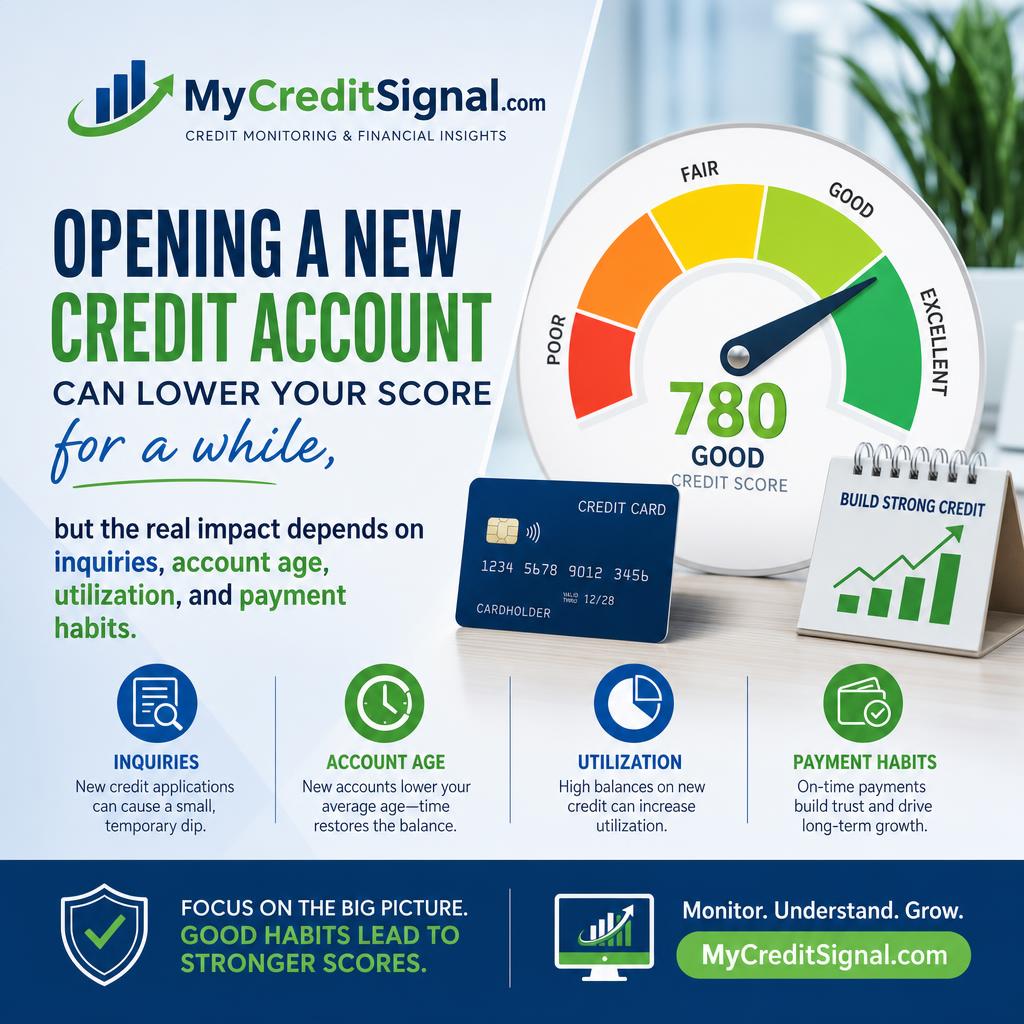
You apply for a new credit card because the bonus looks good, or you open a loan to cover a planned purchase, and then your score drops. That is the moment most people start searching for answers. If you want to understand new account credit impact without guesswork, this article is for you. We will break down what usually changes, why the dip is often temporary, and what actions matter most next. The short version is simple: a new account can hurt your score in the near term, but how you manage that account after approval usually matters more than the application itself.
That means this topic is not just for people with damaged credit. It also matters if you are preparing for a mortgage, trying to qualify for a better card, or simply deciding whether a sign-up offer is worth the tradeoff. Results can vary by credit profile and by scoring model, so treat this as a practical framework rather than a guaranteed point estimate.
Contents
- 1 Who should care about opening a new account right now
- 2 What actually changes when you open a new account
- 3 The numbers and timelines that matter most
- 4 A simple decision framework before you apply
- 5 What to do first this week and what to do later
- 6 A step by step plan after opening a new account
- 6.1 Confirm the approval terms immediately
- 6.2 Set automatic payments on day one
- 6.3 Keep the first reported balance low
- 6.4 Freeze other applications for a while
- 6.5 Track utilization across all revolving accounts
- 6.6 Use the account lightly and predictably
- 6.7 Review your score trends after a few statements
- 7 Mistakes that make new account credit impact worse
- 8 What most articles miss about new accounts
- 9 FAQ
- 10 Helpful tools and related resources
- 11 The bottom line on new account credit impact
Key Takeaway
Opening a new account can cause a short-term score dip from a hard inquiry and younger average account age, but on-time payments and low utilization usually matter more over time.
Who should care about opening a new account right now
This issue matters most for a few groups.
- People planning a major loan soon. If you may apply for a mortgage or auto loan in the near future, even a small score change can affect pricing or lender comfort.
- People rebuilding credit. If your score is already fragile, a new inquiry and reduced average age can feel bigger than it would for someone with a thicker file.
- People chasing rewards. Multiple card applications in a short window can stack up and create more drag than expected.
- People carrying balances. A new account can help if it improves available credit, but it can also backfire if spending rises with the new limit.
Who may need a different approach? Someone rate shopping for a mortgage, student loan, or auto loan is a different case. According to myFICO guidance, multiple hard pulls within a short window may be treated as a single inquiry in many scoring models if they are properly coded. That is very different from applying for several store cards because each offer looked convenient.
If you are still learning how scores are built, it helps to review the moving parts before making a decision. My Credit Signal has a simple guide on FICO vs VantageScore differences that matter so you can understand why one app may show a different number than a lender.
What actually changes when you open a new account
There are four main ways a new account can affect your score.
1. A hard inquiry can trigger a small drop
When you apply for credit, the lender usually makes a hard inquiry. The CFPB explains that scoring models distinguish between hard and soft inquiries, and soft inquiries do not affect lending decisions the same way. Hard inquiries can slightly lower your score, while soft checks generally do not. myFICO notes that this is often a small, short-term effect, not a permanent penalty. See CFPB guidance on inquiries and myFICO scoring factors.
2. Your average account age gets younger
Length of credit history is part of scoring, and myFICO shows it as roughly 15% of a FICO score for illustration. When you add a brand-new account, the average age of your accounts usually drops. That change can matter more if you had only a few accounts to begin with.
3. Your new credit activity increases
New credit commonly makes up about 10% of a FICO score. One recent account is one thing. Several new accounts in a short period can signal higher risk to models and lenders. This is why opening three cards for rewards in the same month often hits harder than opening one and waiting.
4. Utilization may improve or worsen depending on behavior
This is where people get tripped up. A new card can lower utilization if it raises your total limit and your balances stay the same. But if the new account leads to extra spending, the benefit disappears fast. The FTC emphasizes that on-time payments and low utilization remain the biggest score drivers, often outweighing the effect of a single new account. If utilization is still fuzzy, use the credit score simulator and the article on how payment history credit really works to see which factor deserves your attention first.
The numbers and timelines that matter most
You do not need a perfect formula, but you do need the right numbers in front of you.
Hard inquiry timeline: The CFPB says a hard inquiry can remain on your credit report for about two years, though its scoring impact fades over time. That means the visible record lasts longer than the strongest scoring effect.
Possible point movement: myFICO materials are often interpreted to show that a single hard inquiry may have a modest effect, and the research context here uses an illustrative range of up to 30 points depending on the overall profile. The key phrase is depending on the profile. Someone with a long, stable history may barely notice. Someone with a thin file and recent negatives may feel it more.
Score factor weights: New credit is around 10% of FICO scoring, payment history around 35%, and length of credit history around 15%, based on myFICO’s overview. Those percentages do not mean each action maps directly to points, but they do tell you what matters most.
Example: Suppose you have two cards with limits of $2,000 each and total balances of $1,200. Your utilization is $1,200 divided by $4,000, or 30%. If you open a third card with a $2,000 limit and do not add new debt, your utilization drops to $1,200 divided by $6,000, or 20%. That can help. But if you spend another $900 on the new card, total balances become $2,100 on $6,000 of limits, or 35%, and the benefit is gone.
A simple decision framework before you apply
If you are on the fence, use this quick filter.
- Apply now if you need the account for a real purpose, can keep spending steady, and do not expect to apply for major credit soon.
- Wait if you are within the next stretch of preparing for a mortgage or other major financing and every point matters.
- Skip it if the only reason is a weak promotional offer and you are already carrying balances or juggling payments.
This is also where you should separate marketing from math. FTC enforcement around deceptive pre-approved claims is a useful reminder that pre-approved or pre-selected language is not the same as guaranteed approval. Read the offer carefully and make sure the benefit is worth the inquiry.
What to do first this week and what to do later
Priority matters. Not every action belongs on day one.
Do first
- Check whether a major loan application is coming soon.
- Estimate how the new limit changes your utilization before you apply.
- Set autopay for at least the minimum the same day the account opens.
- Make a plan for the first statement balance so you do not accidentally spike utilization.
Do later
- Consider adding another account only after the first one has aged and is being managed well.
- Reevaluate rewards value after 60 to 90 days, not on application day.
- Track score movement across different models, especially if you use both consumer apps and lender pulls.
If you want a broader rebuilding roadmap after a score dip, the guide on raising a credit score from 500 to 700 can help you prioritize the biggest levers first.
A step by step plan after opening a new account
Confirm the approval terms immediately
Check the credit limit, APR, payment due date, and whether the account has annual or monthly fees. Do not wait for the first statement. A higher-than-expected fee or a low limit changes how useful the account really is.
Set automatic payments on day one
Because payment history is the heaviest major factor in FICO scoring at about 35%, protecting that category matters more than obsessing over a small inquiry effect. Set autopay for at least the minimum, then schedule a manual payment if you want to pay in full.
Keep the first reported balance low
Do not confuse the due date with the statement closing date. If you want utilization to stay low, pay part or all of the balance before the statement cuts. This is one of the fastest ways to reduce the visible score impact of a new card.
Freeze other applications for a while
One account is manageable. A cluster of new accounts is where score drag usually grows. Unless you are rate shopping for a properly coded loan type, pause additional applications so models do not read your file as suddenly riskier.
Track utilization across all revolving accounts
A new card changes your total available credit, but individual card balances still matter in many models. If one card is nearly maxed out while the others are empty, you may still see pressure. Use the new account to spread balances carefully, not as an excuse to increase debt.
Use the account lightly and predictably
A good starter pattern is one or two routine charges you already budgeted for, then pay them off on time. That creates positive payment behavior without inflating your balances. If you are not sure whether your mix is helping, review it with the credit mix analyzer.
Review your score trends after a few statements
Do not judge the account in the first week. Give it time to report, then watch what happens after two or three billing cycles. If your utilization is low and payments are on time, many people see the early dip become less important.
Mistakes that make new account credit impact worse
Applying for several cards at once
Behavior: Submitting multiple credit applications over a few days for rewards, financing options, or store discounts. Consequence: More hard inquiries, more new accounts, and a younger average age can combine into a sharper short-term drop. Fix: Space out applications unless you are rate shopping for a loan type that is commonly grouped by scoring models.
Running up the new limit immediately
Behavior: Treating the new card like fresh spending room and carrying a large first statement balance. Consequence: Utilization can rise enough to offset any benefit from the added limit. Fix: Use the account for planned purchases only and pay before the statement closes if needed.
Ignoring the first payment because the balance looks small
Behavior: Assuming a tiny purchase does not need immediate attention. Consequence: A missed payment hurts far more than a hard inquiry because payment history has a much heavier influence. Fix: Turn on autopay and alerts as soon as the account is open.
Opening an account right before a major loan
Behavior: Applying for a credit card or financing offer shortly before seeking mortgage or auto approval. Consequence: Even a modest score dip or extra lender questions can complicate underwriting. Fix: Ask yourself whether the new account can wait until after the major loan closes.
What most articles miss about new accounts
Many articles stop at hard inquiries, but the bigger story is interaction. A new account does not act alone. It interacts with your utilization, your payment habits, your existing file thickness, and the type of credit you are seeking next.
Here are a few overlooked cases:
- Thin credit files: If you only have one or two existing accounts, a new account can change your average age more noticeably.
- High utilization profiles: A new card can help quickly if it lowers your utilization and you avoid new spending.
- Rate shopping windows: Auto, student, and mortgage inquiries may be handled more favorably than multiple unrelated card applications when properly coded, according to FICO guidance.
- Different scoring models: A consumer app score may not react exactly the same way as a lender’s model. That is normal, not proof that one of them is wrong.
Another thing many people miss is that the long-term outcome depends on use. Experian notes that scores can show meaningful short-term fluctuations after opening a new account, but the long-term effect depends on how the account is managed, especially utilization and timely payments. See Experian’s explanation here.
FAQ
How long does a hard inquiry affect my score?
The inquiry can stay on your report for about two years according to the CFPB, but the scoring impact generally fades over time rather than staying equally strong the whole period.
Does opening several new accounts at once hurt more?
Usually yes. Multiple new accounts can add inquiries, increase the new credit factor, and lower average account age faster than one account alone.
What is the fastest way to recover after opening a new account?
Keep utilization low, make every payment on time, and avoid stacking more applications right away. Those habits matter more than trying to guess the exact point loss.
If you want to turn this into a plan instead of a worry spiral, start with these resources:
- Use the credit score simulator to model how balances and account choices may affect your profile.
- Review your credit mix to see whether a new account fits your file or just adds noise.
- Read the FICO vs VantageScore guide if your scores do not match across platforms.
- Review payment history basics so you focus on the factor with the most weight.
Get weekly credit tips, tool updates, and practical guides – free.
The bottom line on new account credit impact
Opening a new account can lower your score in the short term, and that is not a myth. A hard inquiry, newer average age, and more recent credit activity can all contribute. But that is only the first chapter. The bigger factors are still whether you pay on time and keep revolving balances under control.
So the best next step is not to panic over a small drop. It is to decide whether the account serves a real purpose, keep the first few statements clean, and avoid piling on more applications too quickly. If you want to test your next move before you make it, start with the simulator and check how the numbers look before you apply.



Leave a Reply
You must be logged in to post a comment.