
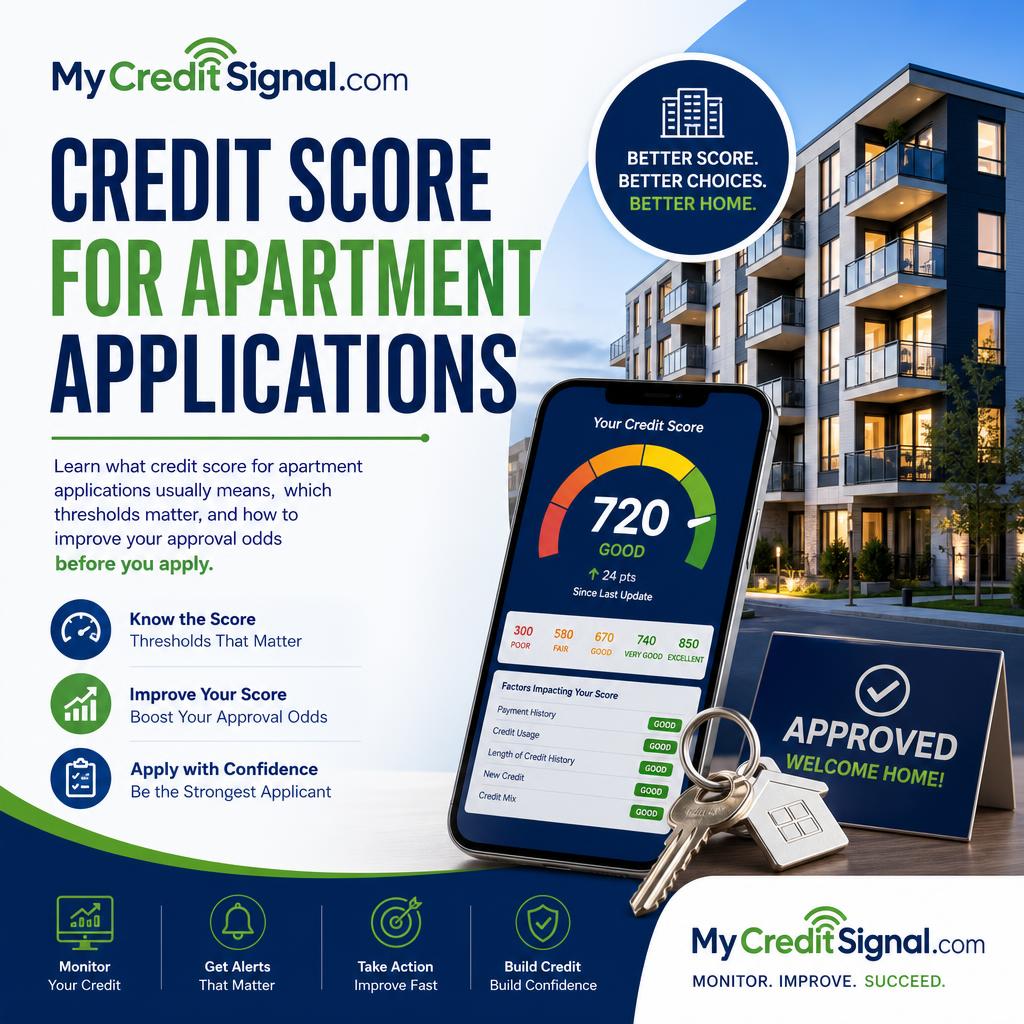
You find an apartment you can actually afford, fill out the application, pay the screening fee, and then hit the question that makes most renters pause: what credit score do I need? That is the real issue behind most searches for credit score for apartment approval. You are not looking for a textbook definition. You want to know whether your number is good enough, what landlords really look at, and what to do this week if your score is borderline.
This guide is for renters who want a practical threshold map, not guesswork. You will see where common score ranges tend to land, why income and rental history can matter just as much, and how to improve your approval odds before you apply. Results can vary by landlord, local market, and scoring model, but you can still prepare strategically.
Contents
- 1 Who should pay close attention to apartment credit standards
- 2 How landlords use your credit score in the real world
- 3 The score ranges that usually shape your odds
- 4 What counts beyond the score number
- 5 A realistic renter example with numbers
- 6 What to do first this week if you plan to apply soon
- 6.1 Check the score and bureau version you can access now
- 6.2 Lower revolving balances before your next statement closes
- 6.3 Build your income proof package
- 6.4 Target properties that fit your current profile
- 6.5 Avoid new hard-pull credit applications
- 6.6 Prepare a backup approval strategy
- 6.7 Consider whether rent reporting helps after move-in
- 7 Mistakes that can hurt your approval odds
- 8 What most apartment credit score articles miss
- 9 FAQ
- 10 Helpful tools and related resources
- 11 The bottom line on credit score for apartment approval
Key Takeaway
There is no single required credit score for apartment approval, but many landlords review your credit alongside income, employment, and rental history, so the smartest move is to strengthen the full application, not just chase one number.
Who should pay close attention to apartment credit standards
This article is especially useful if you are applying for your first apartment, moving to a more competitive city, renting after a score drop, or trying to qualify without a cosigner. It is also relevant if your score sits in the middle range and you are wondering whether to apply now or wait 30 to 60 days and improve your file first.
You may need a different strategy if your biggest issue is not credit but cash flow. A landlord may care more about whether your income covers the rent than whether your score is 640 versus 680. The Federal Trade information on tenant background checks makes clear that landlords commonly use credit reports and scores as part of screening, but exact standards vary widely by landlord, property type, and local market. In practice, that means two buildings on the same block can make different decisions based on the same application.
If you are not sure where you stand, start by checking your current score through a soft-pull method so you do not add unnecessary applications. My Credit Signal explains that process in Check Credit Score Free Without Score Damage. You can also use the credit score simulator to estimate how paying down balances or waiting on a new application might affect your next move.
How landlords use your credit score in the real world
Your credit score is usually a screening shortcut, not the entire decision. It helps a landlord estimate how consistently you have handled past credit obligations. A stronger score may suggest lower risk. A weaker score may trigger a closer look at late payments, collections, higher utilization, or thin credit history.
Landlords do not all use the same bureau or model. Experian notes that housing applications may rely on different scoring products, including FICO or VantageScore, and thresholds vary by landlord and product. That matters because your scores can differ across bureaus. A score that looks solid in one system may appear less competitive in another.
Most landlords also review:
- Income relative to monthly rent
- Employment stability
- Rental history
- Prior evictions or screening records
- Available cash for deposit and move-in costs
- References or a guarantor when needed
There is also a legal framework behind this process. Under the Fair Credit Reporting Act, landlords using consumer reports for screening must follow rules around notice and permissible use. The FTC explains that if a landlord takes adverse action based partly or wholly on a consumer report, they must provide an adverse-action notice. You can review that directly in the FTC guidance on using consumer reports for tenant screening.
The score ranges that usually shape your odds
There is no federal minimum score to rent an apartment. Still, renters want a working framework, so here is a practical way to think about it using the grounded numbers available.
Below about 620
A score under 620 can make approval harder in many conventional apartment settings, especially in tighter markets where landlords can be selective. That does not mean automatic denial. It usually means you should expect more conditions, such as a larger deposit where allowed, proof of strong income, a cosigner, or a request for additional documentation.
Around 620 and above
The number 620 is commonly cited as a lower-bound reference point in some markets, but it is not a universal pass line. Think of it as a range where some mainstream landlords may consider the application while still looking closely at the rest of your file. If you are around this level, the non-score parts of your application become more important.
Around 700
A score near 700 is often discussed as favorable in broad consumer credit conversations. It may improve your odds, especially if your income and rental history are stable, but it is still not a guarantee. Luxury buildings, highly competitive cities, and professionally managed properties may set stricter internal standards than a small independent landlord.
Here is the simplest decision framework:
- If your score is below a commonly cited lower threshold: build a backup plan before applying.
- If your score is in the middle: strengthen income proof, reduce utilization, and target landlords with flexible criteria.
- If your score is already strong: focus on avoiding last-minute mistakes such as new inquiries or missed payments.
If your score changed recently and you are not sure why, read Credit Score Dropped and Here Is Why before you submit rental applications. A 20 to 40 point swing from high utilization or a late payment can change how your file looks to a screening system.
What counts beyond the score number
Many articles stop at score ranges. That misses how apartment approvals often work in practice. In many cases, a landlord is not asking, “Is your score perfect?” They are asking, “Can you reliably pay this rent every month, and does the application show a manageable risk?”
That is why income-to-rent ratio keeps coming up. While the specific ratio depends on the landlord, many property managers look closely at whether your gross monthly income comfortably covers the rent. If the apartment costs 1,800 dollars a month and your income is inconsistent or barely above that payment, a 700 score may not rescue the application. On the other hand, stable income and reserves can help offset a merely average score.
Rental history matters too. An applicant with ordinary credit but a solid record of on-time rent and steady employment may look stronger than someone with a higher score but unstable housing patterns.
There is also a newer angle: rent reporting. Experian explains that some on-time rent payments can be reported through programs tied to RentBureau or other reporting tools, and those payments may help certain credit files depending on bureau and scoring model. That does not mean rent automatically builds credit. Usually, it only counts if you or your landlord enroll in a reporting program. Experian covers that in its rent reporting guidance.
If your balances are the main reason your score is lagging, review A Beginner’s Guide to Credit Utilization. Utilization can affect scores faster than most other factors, which makes it one of the few levers you may be able to improve before an apartment application deadline.
A realistic renter example with numbers
Say Maya wants an apartment renting for 1,600 dollars per month. Her credit score is 624, she earns 5,200 dollars gross monthly, and she has 2 credit cards with a combined limit of 4,000 dollars. Her balances total 2,400 dollars, so her utilization is 60 percent.
On paper, Maya is not in terrible shape, but she is not especially competitive either. Her score sits just above a commonly cited lower-bound threshold, and her utilization is high enough to pressure her score. If she pays 1,200 dollars toward those cards before the statement date, her balances fall to 1,200 dollars total. That drops utilization from 60 percent to 30 percent. Depending on the rest of her profile and the scoring model used, that kind of move may improve her application odds more than opening a new account or arguing over tiny score changes.
Now compare that with Daniel. He has a 705 score but earns variable gig income and cannot show stable recent earnings. Daniel may still face a harder review than Maya if the property manager prioritizes verified income. The lesson is simple: apartment approval is a package, not a single score.
What to do first this week if you plan to apply soon
If your application window is within the next 7 to 30 days, prioritize actions that can change how your file looks quickly. Do not waste time on moves that are unlikely to help before screening.
Check the score and bureau version you can access now
Pull your latest score through a soft inquiry source and note whether the score shown is FICO or VantageScore. Since landlords may use different products, treat this as a reference point, not a promise of the exact score they will see.
Lower revolving balances before your next statement closes
If you carry card balances, focus on reducing utilization. Even moving from 60 percent to 30 percent can help your file look less stretched. Use the credit rebuilding checklist to organize your next 30 days and prioritize what actually affects approval odds.
Build your income proof package
Gather recent pay stubs, bank statements, offer letters, or contract income records. A landlord who sees clear, documented income may be more flexible on a middle-range score.
Target properties that fit your current profile
Do not apply blindly to every building. Ask leasing offices what factors they consider besides credit. Some small landlords weigh rental history and income more heavily than a strict score cutoff.
Avoid new hard-pull credit applications
If you are close to applying for housing, this is not the time to open multiple new accounts unless absolutely necessary. New applications can add inquiries and shorten your average account age. Keep your file stable.
Prepare a backup approval strategy
If your score is below where you want it, line up options before you apply: a qualified cosigner, extra documentation, or a lower-rent unit that produces a stronger income-to-rent picture.
Consider whether rent reporting helps after move-in
If you are approved, look into a legitimate rent-reporting program so future on-time rent may support your credit profile. Experian notes that score impacts vary by bureau and model, so think of this as a longer-term tool rather than an overnight fix.
Mistakes that can hurt your approval odds
Applying before you know your baseline
Behavior: submitting applications without checking your current score or reviewing how stretched your balances are. Consequence: you may waste application fees on properties that were always out of reach for your current profile. Fix: check your score first, estimate your utilization, and apply selectively.
Focusing only on the score and ignoring income proof
Behavior: assuming a decent score is enough while your pay records are incomplete or inconsistent. Consequence: you may be passed over by a landlord who wants clear evidence that rent fits your budget. Fix: organize pay stubs, statements, and employer contact details before the application goes in.
Leaving high card balances in place until after screening
Behavior: planning to pay down cards later instead of before statement reporting. Consequence: your score may still reflect high utilization when the landlord checks. Fix: pay balances down before the next statement date, not just before the due date.
Applying to luxury or highly competitive properties first
Behavior: using your first attempts on buildings that likely have stricter internal standards. Consequence: you rack up fees and lose time. Fix: sequence your applications from best fit to stretch option, based on your current score, income, and rental record.
What most apartment credit score articles miss
The biggest missed point is that rental screening is not standardized the way many borrowers assume. One landlord may care about a single score threshold. Another may use a broader tenant-screening file. Another may care most about stable income and prior landlord references.
There is also an important legal and practical angle: screening data must be accurate enough to support housing decisions. Regulatory action in 2023 and 2024, including a 15 million dollar FTC and CFPB settlement involving tenant-screening data accuracy, shows how seriously regulators take this area. That does not mean every problem disappears, but it does mean screening quality and notices remain under close attention.
This advice also does not apply equally to every renter. If your score is already strong but your debt payments make your monthly budget tight, the better move may be choosing a lower-rent unit rather than trying to squeeze into a payment that looks risky on paper.
FAQ
What credit score do most landlords require to rent an apartment?
There is no universal requirement. A score around 620 is often discussed as a common lower-bound reference point in some markets, while around 700 is often viewed as more favorable. Actual standards vary by landlord, property type, market, and scoring model.
Do rental payments affect my credit score?
Sometimes. Rent usually does not help your credit automatically. It may count if your landlord or a third-party service reports on-time rent payments to a bureau, and the score impact can vary by bureau and model.
Can a landlord deny me even if my score looks good?
Yes. Landlords may also weigh income, employment, rental history, and screening records. A good score improves your odds, but it does not guarantee approval.
If you want to turn this article into an action plan, start with these resources:
- Credit score simulator to model whether paying down balances or waiting could improve your timing
- Credit rebuilding checklist to organize the next 30 days before you apply
- Check Credit Score Free Without Score Damage if you need a safe way to review your score first
- Credit Score Dropped and Here Is Why if your recent score change could affect an apartment application
- A Beginner’s Guide to Credit Utilization if card balances are keeping your score lower than expected
Get weekly credit tips, tool updates, and practical guides – free.
The bottom line on credit score for apartment approval
If you were hoping for one magic number, the honest answer is that apartment approval does not work that neatly. The better answer is more useful: know your current score, understand where 620 and 700 sit as rough reference points, and improve the parts of your application you can control right now. That means lower utilization, stronger income documentation, smarter property targeting, and fewer last-minute credit moves.
Your next step is simple. Check your score, run your scenario through the tools above, and decide whether you should apply now, apply with a backup plan, or spend the next 30 days improving your file first. That decision can save you fees, stress, and rejected applications.



Leave a Reply
You must be logged in to post a comment.