
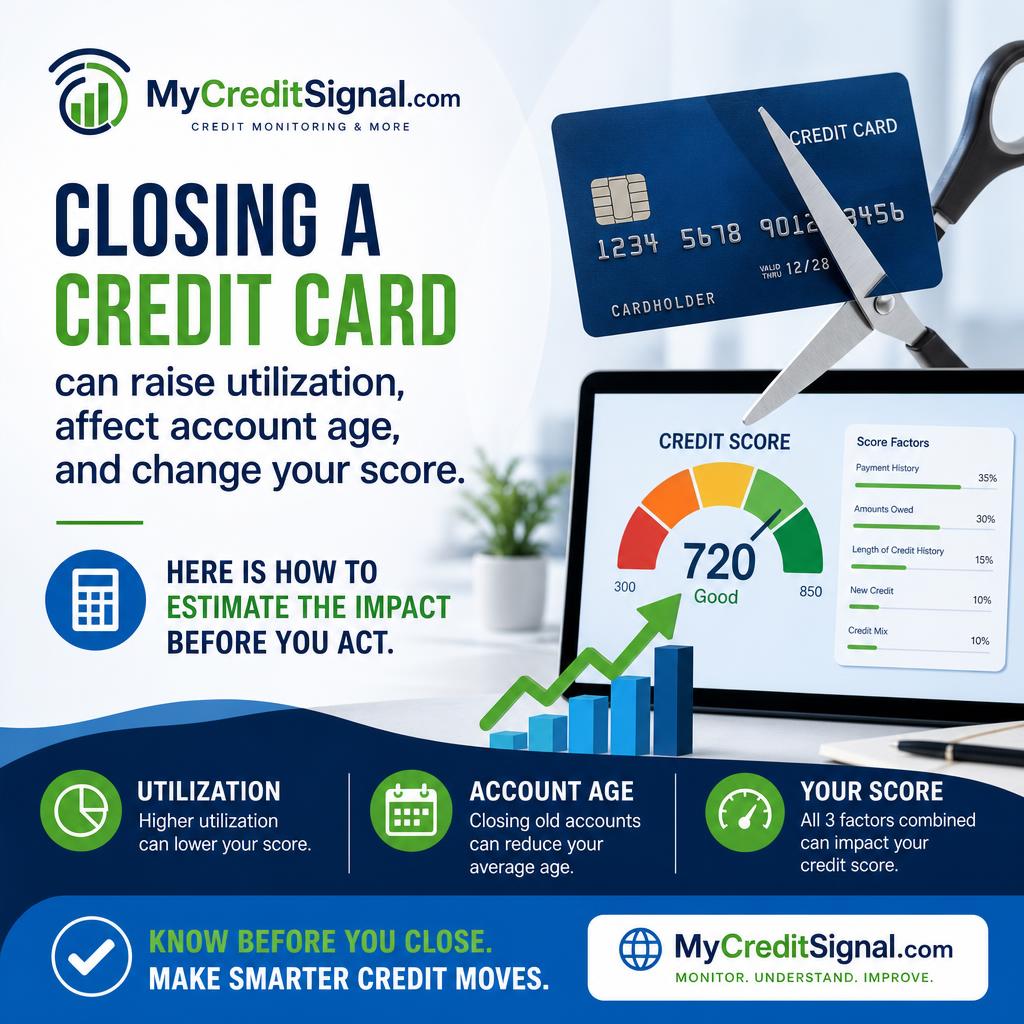
Say you have three credit cards, one of them has a $10,000 limit, and you barely use it. You are tired of managing extra logins and annual-fee decisions, so closing it feels like an easy cleanup move. The problem is that a simple closure can change the math behind your credit score faster than most people expect.
This guide is for anyone weighing whether to shut down an unused or expensive card and wanting to understand the real closing credit card score impact before doing it. You will learn what usually changes first, which numbers matter most, how to estimate your own risk, and what to do this week if closing a card is still the right move.
Contents
- 1 Who should pay close attention before closing a card
- 2 Why the impact usually starts with utilization, not the act of closing
- 3 The three score factors most likely to change
- 4 The numbers to calculate before you cancel anything
- 5 A fast decision framework before you close a card
- 6 A step by step plan to minimize closing credit card score impact
- 6.1 List every open card and write down limits and balances
- 6.2 Calculate your utilization with and without the card
- 6.3 Pay balances down before you close anything
- 6.4 Check whether you are applying for new credit in the next few months
- 6.5 Ask about a product change instead of a closure
- 6.6 Keep one small recurring charge on no-fee cards you want to preserve
- 6.7 Close the least strategic card first, not the oldest or biggest limit by default
- 7 Mistakes to avoid if you are thinking about canceling a card
- 8 What many articles miss about closing a card
- 9 What to do first versus later
- 10 FAQ
- 11 Helpful tools and related resources
- 12 Conclusion
Key Takeaway
Closing a credit card does not trigger a fixed penalty, but it can raise utilization and affect account age or credit mix, so the smartest move is to run the numbers before you close anything.
Who should pay close attention before closing a card
This topic matters most if any of the following sounds like you:
- You carry balances on other cards, even if you pay them down every month.
- You are planning to apply for a mortgage, auto loan, apartment lease, or personal loan soon.
- You have one card with a much higher limit than your other cards.
- You have a thin credit file, meaning only a few open accounts.
- The card you want to close is one of your oldest revolving accounts.
It may matter less if your utilization would still stay low after the closure and the card is a small part of your total available credit. CFPB guidance is clear that the effect can be minor or temporary depending on your overall profile, not automatic or permanent. Still, small changes matter more when you are close to a lending threshold. If you are trying to qualify for better financing soon, read this carefully and compare it with this guide on what score ranges lenders may consider strong.
This advice is not mainly for people dealing with identity theft or report inaccuracies. It is also not mainly for someone choosing between bankruptcy-level debt options. Here, the issue is simpler: whether keeping or closing a card helps your score and your finances more.
Why the impact usually starts with utilization, not the act of closing
A lot of people think credit scores punish you just for closing an account. That is not how the major explanations frame it. The CFPB says there is no universal penalty for closing a credit card. The score impact comes from the factors that may change after closure, especially utilization, age, and sometimes mix. You can see that directly in the CFPB explanation here: Does it hurt my credit to close a credit card?
Utilization means your card balances divided by your available credit. If you owe $2,000 across cards and have $20,000 in total limits, your utilization is 10%. If you close a card with a $10,000 limit and your balance stays $2,000, your utilization jumps to 20% overnight. No new debt was added, but the percentage doubled.
That is a big reason this move can sting. myFICO notes that amounts owed and related utilization factors are a major part of FICO scoring, often described at roughly 30% of the score calculation. Experian also notes that some people aiming for the strongest scores often keep utilization under 10%, even though under 30% is a more common general benchmark. Those are useful thresholds, not guarantees.
If you want to test your own numbers before making a change, use the credit utilization calculator. It is one of the easiest ways to see whether closing a specific card would push you from a safe zone into a riskier one.
The three score factors most likely to change
1. Total utilization
This is usually the first thing to check. Closing a high-limit card can raise both your overall utilization and, depending on your remaining cards, the utilization on each open card. If one card ends up carrying a larger share of your balances, that can create more pressure on your score.
2. Age of accounts
TransUnion notes that closing an account can affect the average age of accounts, and that can feed into scoring. The timing can be misunderstood, though. Experian explains that closed positive accounts may remain on your credit report for about 10 years, so the age effect may not be immediate in every scoring context. But over time, once that account is no longer contributing, average age can become less favorable. If this area confuses you, this article on age of credit history and your credit score gives a practical breakdown.
3. Credit mix
If you have very few accounts, closing one revolving line can slightly narrow your credit mix. For someone with several cards and an installment loan, this may not matter much. For someone with only one open card, it can matter more because your file becomes thinner and less flexible.
The numbers to calculate before you cancel anything
Here is the simple formula:
Credit utilization = total revolving balances divided by total credit limits
Run the formula twice: once with the card open and once with it removed.
Example 1: Closing a high-limit card
You have these cards:
- Card A: $10,000 limit, $0 balance
- Card B: $5,000 limit, $1,000 balance
- Card C: $5,000 limit, $1,000 balance
Total balances are $2,000. Total limits are $20,000. Utilization is 10%.
If you close Card A, your total limits drop to $10,000. Your balances stay $2,000. Utilization becomes 20%.
You went from a level often associated with stronger scores to a clearly weaker ratio without spending a single extra dollar.
Example 2: Closing a low-limit card
You have:
- Card A: $1,000 limit, $0 balance
- Card B: $9,000 limit, $500 balance
- Card C: $10,000 limit, $500 balance
Total balances are $1,000. Total limits are $20,000. Utilization is 5%.
Close Card A and your total limits become $19,000. Utilization becomes a little over 5%. That difference is much smaller and may have little practical impact.
This is why myFICO points out that closing a card may have little to no lasting effect if you still have other high limits and utilization remains low. It is not the closure itself. It is the ratio after the closure.
If you want a second layer of planning, use the credit score simulator to think through possible outcomes before making a move.
A fast decision framework before you close a card
Use this simple order:
- Close now if the card has an annual fee you do not value and your post-closure utilization still stays comfortably low.
- Wait and prepare if closing would push your utilization meaningfully higher or if you plan to apply for credit soon.
- Keep open for now if the card is old, high-limit, no-fee, and easy to manage with a small recurring charge and autopay.
That middle option is where most people land. You do not have to keep every card forever, but you should close accounts on your timetable, not impulsively. If you are wondering whether a recent drop was tied to a card change, compare the patterns in credit score dropped and here is why.
A step by step plan to minimize closing credit card score impact
List every open card and write down limits and balances
Open your issuer apps and make a simple table. You need each card’s credit limit, current balance, annual fee, age, and whether it reports a balance often. This gives you the raw data to compare the score cost versus the financial benefit of closing.
Calculate your utilization with and without the card
Do the math before touching the account. If your ratio jumps from around 10% to around 20%, that is a meaningful difference. If it moves from 5% to roughly 5%, the score risk may be much smaller. Run both total utilization and per-card utilization if one remaining card will carry most of the balance.
Pay balances down before you close anything
If you must close a card, reducing balances first can soften the hit. Even a few hundred dollars moved off your revolving balances can lower the ratio that lenders and scoring models see. This is often the most effective action you can take this week.
Check whether you are applying for new credit in the next few months
If a mortgage, auto loan, or apartment application is coming up, delay any optional account closures. Score changes can be temporary, but temporary is still a problem if your timing is bad. For homebuyers, it is smart to review how to raise your credit score for mortgage approval before making any changes.
Ask about a product change instead of a closure
If the main issue is an annual fee, ask the issuer whether you can switch to a no-fee card. A product change can sometimes let you keep the account history and limit while cutting the cost. Policies vary by issuer, so ask directly before closing.
Keep one small recurring charge on no-fee cards you want to preserve
TransUnion notes that some issuers may close inactive cards after a period of no use, often somewhere in the 12 to 24 month range depending on policy. A small subscription plus autopay can help prevent an unwanted inactivity closure.
Close the least strategic card first, not the oldest or biggest limit by default
If you still want to simplify, start with the card that has the weakest combination of value, age, and credit limit. A newer fee card with a small limit is often easier to part with than an old no-fee card with a large limit.
Mistakes to avoid if you are thinking about canceling a card
Closing your highest-limit card while carrying balances
Behavior: You shut down the card with the largest limit because you do not use it. Consequence: Your available credit falls sharply and utilization jumps, which can pressure your score. Fix: Pay balances down first or keep the card open until utilization is lower.
Closing accounts right before a major loan application
Behavior: You tidy up old accounts a few weeks before applying for a mortgage or auto loan. Consequence: A temporary score drop could affect pricing or approval odds at exactly the wrong time. Fix: Freeze nonessential changes until after underwriting is finished.
Ignoring annual fee alternatives
Behavior: You assume the only choices are pay the fee or close the card. Consequence: You may lose a valuable limit and account age unnecessarily. Fix: Ask about a downgrade or product change first.
Letting a useful card die from inactivity
Behavior: You stop using a no-fee card entirely and forget about it. Consequence: The issuer may eventually close it for inactivity, changing your credit profile on their schedule instead of yours. Fix: Put one controlled charge on the card and set autopay in full.
What many articles miss about closing a card
First, closed accounts do not always vanish from scoring considerations immediately. Experian notes they can remain on your report for about 10 years, which means the age-related effect may unfold over time rather than all at once. That nuance matters.
Second, not every card deserves saving. If a card is expensive, encourages overspending, or creates enough complexity that you miss due dates, score optimization should not be your only goal. A slightly cleaner system that you manage perfectly can beat a theoretically ideal setup that causes mistakes.
Third, closing is different from opening a replacement card. Some people respond to a closure by applying for a new card to restore available credit. That can add a hard inquiry and a new account, which affects score factors differently. If you are considering that route, this explainer on new account credit impact can help you think through the tradeoff.
What to do first versus later
If you are unsure where to start, use this order of operations:
- This week: gather limits and balances, calculate utilization, and check whether an annual fee or inactivity issue is driving the decision.
- Next: pay balances down if the closure would push you higher than your comfort zone.
- Then: call the issuer about a downgrade or retention option.
- Later: if the numbers still work and the card adds no value, close it after any major credit applications are behind you.
This sequencing keeps you from making a score-affecting move before you understand the tradeoffs.
FAQ
Does closing a credit card hurt your score immediately or over time?
It can do either, depending on what changes. Utilization can change right away when the limit disappears. Age-related effects may develop more gradually, and results vary by scoring model and profile.
Will closing a high-limit card affect my score more than closing a low-limit card?
Often yes, because removing a high limit can raise your utilization much more. The real test is your before-and-after ratio, not the card count alone.
How can I reduce the impact if I have to close a card?
Pay down balances first, avoid closing cards before major applications, ask about a product change, and keep your remaining utilization as low as possible.
- Credit utilization calculator to estimate how closing one card changes your ratio.
- Credit score simulator to think through potential score effects before you act.
- Age of credit history and your credit score for the long-term account age side of the decision.
- Credit score dropped and here is why if you already made a change and want to diagnose what happened.
- Raise credit score for mortgage approval if you are preparing for a home loan and want to avoid mistimed moves.
For authoritative reading, review the CFPB on credit card closures, TransUnion on account closing and score effects, and Experian’s explanation of utilization and account history: CFPB, TransUnion, and Experian.
Get weekly credit tips, tool updates, and practical guides – free.
Conclusion
The closing credit card score impact is real, but it is usually driven by math, timing, and account structure, not a mystery penalty. If closing a card would spike your utilization, reduce the value of an old account, or land right before a major application, waiting may be the smarter move. If the card is costly, low-value, and easy to replace without hurting your ratios, closing can make sense.
Your next step is simple: calculate your utilization with the card open and closed, then decide from there. When you run the numbers first, you stay in control of both your score and your budget.



Leave a Reply
You must be logged in to post a comment.