
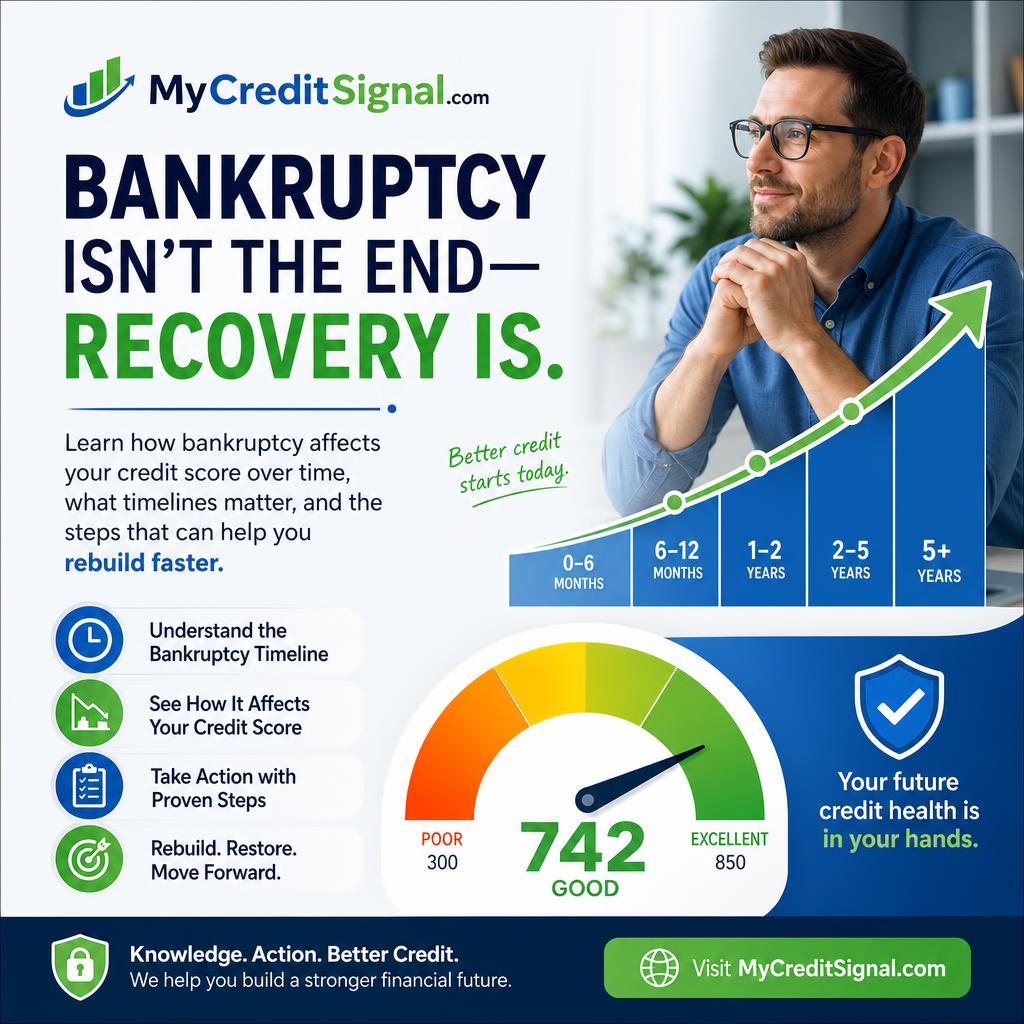
If you have filed bankruptcy, are considering it, or are trying to rebuild after it, the big question is usually not just whether your score drops. It is how long the damage lasts and what actually helps the score recover. That is the real search intent behind bankruptcy credit score questions, and it matters because bankruptcy can stay on your credit report for years while lenders keep pricing risk based on what they see.
This guide is for readers who want a practical long-term view. You will see how Chapter 7 and Chapter 13 usually affect your file over time, which score factors matter most after discharge, what timelines are real, and what actions can move you forward without guessing. If you want a recovery plan instead of fear-based advice, this is for you.
Contents
- 1 Who this is for and who may need a different playbook
- 2 Why bankruptcy can affect your credit for years
- 3 Chapter 7 versus Chapter 13 in long-term credit impact
- 4 The numbers and timelines that actually matter
- 5 What tends to help your score first versus later
- 6 A step by step plan for rebuilding after bankruptcy
- 6.1 Map your current credit picture
- 6.2 Build a payment system that removes missed due dates
- 6.3 Lower utilization if you already have revolving credit
- 6.4 Add new credit only with a clear purpose
- 6.5 Protect cash flow before you chase a higher score
- 6.6 Track progress in 90 day blocks
- 6.7 Focus on consistency for at least the next year
- 7 Mistakes that can keep your score down longer
- 8 What many articles miss about long-term bankruptcy impact
- 9 FAQ
- 10 Helpful tools and related resources
- 11 The bottom line
Key Takeaway
Bankruptcy can hurt your credit sharply at first and remain on your reports for up to 7 to 10 years, but your score can still improve much sooner if you rebuild payment history, keep balances low, and add positive credit behavior consistently.
Who this is for and who may need a different playbook
This article is most useful for three groups. First, people who recently had a bankruptcy discharged and want to understand what happens next. Second, people deciding between Chapter 7 and Chapter 13 who want to think beyond the immediate filing. Third, people whose score is still lower than expected years later and want to know why.
It is especially relevant if you are planning for a future car loan, credit card approval, or apartment application and want to know how lenders may view the bankruptcy item over time. The three major credit bureaus report bankruptcy information under Fair Credit Reporting Act rules, and duration depends on the chapter and timing, not on how quickly you feel financially recovered. You can review the broader credit reporting framework through the FTC credit reporting guidance.
This may be less useful if your main problem is ongoing missed payments after bankruptcy. In that case, the bankruptcy itself is not the only drag on your score. Payment history, amounts owed, and recent inquiries can keep suppressing results even after the bankruptcy begins to age, as explained in MyFICO guidance on negative information and score factors. If your issue is a fresh score drop, this companion article on why your credit score dropped can help you isolate the cause.
Why bankruptcy can affect your credit for years
Bankruptcy is not just another late payment. It signals to lenders that a court process was used to address serious debt distress. Because of that, scoring models tend to treat it as a severe negative event, especially in the beginning. Experian notes that bankruptcy generally causes a large negative initial impact, but the exact drop and the speed of recovery vary by person and by scoring model. That last part matters. Two people can file the same chapter and see different results depending on their starting score, current open accounts, debt levels, and what happens after discharge.
Here is the plain-English version of what changes. Before bankruptcy, your report may contain maxed-out cards, collections, charge-offs, and repeated late payments. After bankruptcy, some of that debt picture can improve because balances and obligations may change, but the bankruptcy public record itself becomes a major negative item. Over time, the older bankruptcy becomes less dominant than it was in the first months, especially if new positive account history is added. That does not mean it stops mattering quickly. It means the file can gradually become more balanced.
Think of bankruptcy as a long timeline item inside a much larger score formula. It is important, but it is not your whole file forever. Payment history, amounts owed, credit mix, length of history, and new credit activity still matter after bankruptcy. If you want a fast score lever to work on while rebuilding, study how credit utilization works because lower revolving balances can sometimes help sooner than waiting for age alone to do the job.
Chapter 7 versus Chapter 13 in long-term credit impact
The reporting timeline is one of the clearest differences. According to the CFPB, bankruptcy information can stay on your credit report for up to 10 years, with Chapter 7 typically reported for 10 years. Certain Chapter 13 bankruptcies may remain for about 7 years after completion, which often means a shorter reporting life than Chapter 7 depending on the case timeline. You can verify that directly in the CFPB bankruptcy reporting guidance and in MyFICO’s overview of how long negative information remains.
That does not automatically mean Chapter 13 is always better for your score. The long-term effect depends on what your report looks like before filing, whether you complete the plan, and how you manage credit afterward. A shorter reporting period helps, but a shorter period alone does not rebuild a score. Positive data has to fill the gap.
A useful decision framework is this. If you are comparing the two from a credit-score angle only, ask three questions: how long will the item appear, what will my open accounts and debt profile look like after filing, and how realistic is my ability to maintain flawless payments afterward? The stronger your post-bankruptcy habits, the more your future behavior can offset the aging negative item.
The numbers and timelines that actually matter
Most consumers focus on one number: the score. But with bankruptcy, the timeline is just as important as the score range itself. Standard FICO scores generally run from 300 to 850. That means there is a wide band for recovery even after a major setback. A score does not need to jump from the low end to the high end overnight to create better loan options later. Progress inside the same range can still matter.
The most important timelines from the current guidance are straightforward:
- Up to 10 years: Chapter 7 commonly remains on a credit report that long.
- About 7 years after completion: certain Chapter 13 cases may be removed in that timeframe.
- First months after filing or discharge: usually the period of the sharpest score damage and most limited approvals.
- Later years: the bankruptcy is still visible, but older negative items generally carry less relative weight than brand-new negatives.
There is also an important scoring context. Bankruptcy is long-lasting, but other negative items and some categories such as medical debt have been de-emphasized or are part of ongoing reporting reforms in 2024 and 2025. That does not erase bankruptcy. It simply means your overall file can evolve in a more favorable direction as some negatives age and as positive information builds.
Here is a practical example. Suppose two consumers both have a bankruptcy on file. One keeps every card at a zero or low balance, opens one starter account responsibly, and makes every payment on time for 24 months. The other applies for several new accounts, misses one payment, and runs cards near the limit. Even though both share the same bankruptcy item, their score trajectories can separate meaningfully because the bankruptcy is only one part of the file.
If you are unsure how a new card, balance payoff, or application could affect your next move, use the credit score simulator before acting.
What tends to help your score first versus later
One mistake people make is treating all rebuilding steps as equally urgent. They are not. Right after bankruptcy, the highest-value actions are the ones that stop new damage and create clean, recent positive history. Much later, account age and consistency start doing more of the heavy lifting.
What to do first
- Make every payment on time, starting now.
- Keep revolving balances low if you have open cards.
- Avoid unnecessary hard inquiries.
- Create a simple budget so you do not fall behind again.
What to do later
- Let accounts age instead of constantly opening and closing them.
- Broaden credit mix carefully only when cash flow is stable.
- Review whether any old habits, like carrying balances, are still hurting utilization.
If you are debating whether closing an old card will clean up your finances, read how closing a credit card can affect your score first. After bankruptcy, protecting available credit and account age can be more valuable than many people realize.
A step by step plan for rebuilding after bankruptcy
Map your current credit picture
List every open account, monthly due date, minimum payment, and current balance. Then separate them into two buckets: accounts that are helping because they can build positive history, and accounts that are risky because they could trigger new late payments. This gives you a realistic starting point instead of working from memory.
Build a payment system that removes missed due dates
Your first weekly action should be setting autopay for at least the minimum on every active account you keep. If you do not trust autopay alone, add calendar reminders three business days before each due date. Since payment history remains one of the biggest score factors, this is the highest-priority move.
Lower utilization if you already have revolving credit
If you have a card with a balance, focus on reducing the reported amount before the statement closes. Even modest changes can help because lower amounts owed can improve the way your file looks. Use your next paycheck to target the highest-utilization card first, not necessarily the largest balance. If you need a structured starting point, review the credit rebuilding checklist.
Add new credit only with a clear purpose
Do not apply for multiple products in a short period just to see what sticks. One carefully chosen rebuilding account can be enough to restart positive reporting. The goal is not to borrow more. The goal is to create a clean line of on-time payments.
Protect cash flow before you chase a higher score
A score recovery plan fails if your budget is too tight to sustain it. This week, calculate your fixed monthly obligations and compare them to take-home pay. If adding any new account makes your budget fragile, wait. A stable financial base beats a rushed application every time.
Track progress in 90 day blocks
Do not judge your recovery every few days. Use a simple 90-day review. Ask: Did I make every payment on time? Did my balances stay low? Did I avoid unnecessary applications? Did my score trend improve, even gradually? Bankruptcy recovery is slow enough that short-term overreacting can lead to bad decisions.
Focus on consistency for at least the next year
The long-term fix is boring by design. On-time payments, low balances, and fewer mistakes are what eventually make the bankruptcy less dominant relative to fresh positive history. There is no shortcut around that pattern.
Mistakes that can keep your score down longer
Applying for too much new credit too fast
Behavior: submitting several applications in a short window after discharge. Consequence: more hard inquiries, more chances of denial, and a riskier-looking file. Fix: choose one rebuilding product or one financing goal at a time and wait to see how it reports before adding anything else.
Ignoring utilization because the bankruptcy feels like the only issue
Behavior: running existing cards close to the limit because the bankruptcy already feels like enough damage. Consequence: your score can stay lower than necessary because amounts owed still matter. Fix: keep balances controlled and pay attention to statement timing, not just due dates.
Closing accounts that are helping more than they hurt
Behavior: shutting down a card to simplify life without checking the score tradeoff. Consequence: you may reduce available credit and raise utilization, which can slow recovery. Fix: estimate the effect before closing anything and keep useful no-fee accounts open if they fit your budget.
Expecting every lender to react the same way
Behavior: assuming one approval or denial means all lenders will see your risk the same way. Consequence: frustration and unnecessary applications. Fix: remember that lender standards differ and scoring models differ, so pace applications and compare offers carefully.
What many articles miss about long-term bankruptcy impact
Many articles stop at the reporting timeline, but reporting duration is not the same as lending impact. A bankruptcy can still matter before it ages off your report, but the practical effect often changes over time. Early on, it may block approvals or lead to expensive terms. Later, some lenders may be more interested in the pattern since discharge than in the existence of the bankruptcy alone.
Another missed point is that bankruptcy can sometimes simplify a chaotic file. That does not make it positive, but it can create a cleaner starting point for rebuilding compared with a report still collecting fresh delinquencies every month. If your pre-bankruptcy file had repeated late payments, charge-offs, and maxed-out cards, a disciplined post-bankruptcy period may look stronger over time than a continuing spiral would have.
And one more nuance: recovery is not linear. Your score may rise, flatten, and even dip temporarily if you open a new account, carry a higher balance one month, or trigger a new inquiry. That does not mean the rebuilding process failed. It means the model is still reacting to normal file changes.
FAQ
How long does bankruptcy stay on my credit report?
Chapter 7 typically remains for up to 10 years, while certain Chapter 13 bankruptcies may be removed about 7 years after completion, according to CFPB and MyFICO guidance.
Will my credit score ever recover after bankruptcy?
Yes, it can recover over time. The exact pace varies by your profile and the scoring model, but on-time payments, low balances, and careful credit use can help the score improve well before the bankruptcy ages off the report.
Do FICO and VantageScore treat bankruptcy the same way?
Not exactly. Both view bankruptcy as a serious negative event, but the score impact can differ by model, lender, and the rest of your credit file.
If you want to turn this into an action plan, start with these resources:
- Use the credit score simulator to think through possible next moves before you apply, close an account, or pay down a balance.
- Work through the credit rebuilding checklist for a practical rebuild sequence after bankruptcy.
- Review this guide to credit utilization if you want one of the fastest ongoing levers for score improvement.
- Read why a credit score drops if your score is moving in ways that do not make sense.
- For source material, see the Experian overview of bankruptcy impact and the CFPB explanation of reporting timelines.
Get weekly credit tips, tool updates, and practical guides – free.
The bottom line
Bankruptcy is a major credit event, but it is not a permanent score sentence. The long-term impact comes down to two timelines happening at once: the reporting clock, which can last up to 7 or 10 years depending on chapter, and your rebuilding clock, which starts as soon as you create clean payment history and lower-risk behavior.
If you do one thing this week, make it this: set up a simple rebuild system with automatic minimum payments, a utilization target you can actually maintain, and one clear rule about avoiding unnecessary applications. Then use a tool like the simulator or checklist to test your next move before you make it. The goal is not perfect credit overnight. The goal is steady progress that gives lenders a better story than the bankruptcy alone.



Leave a Reply
You must be logged in to post a comment.