
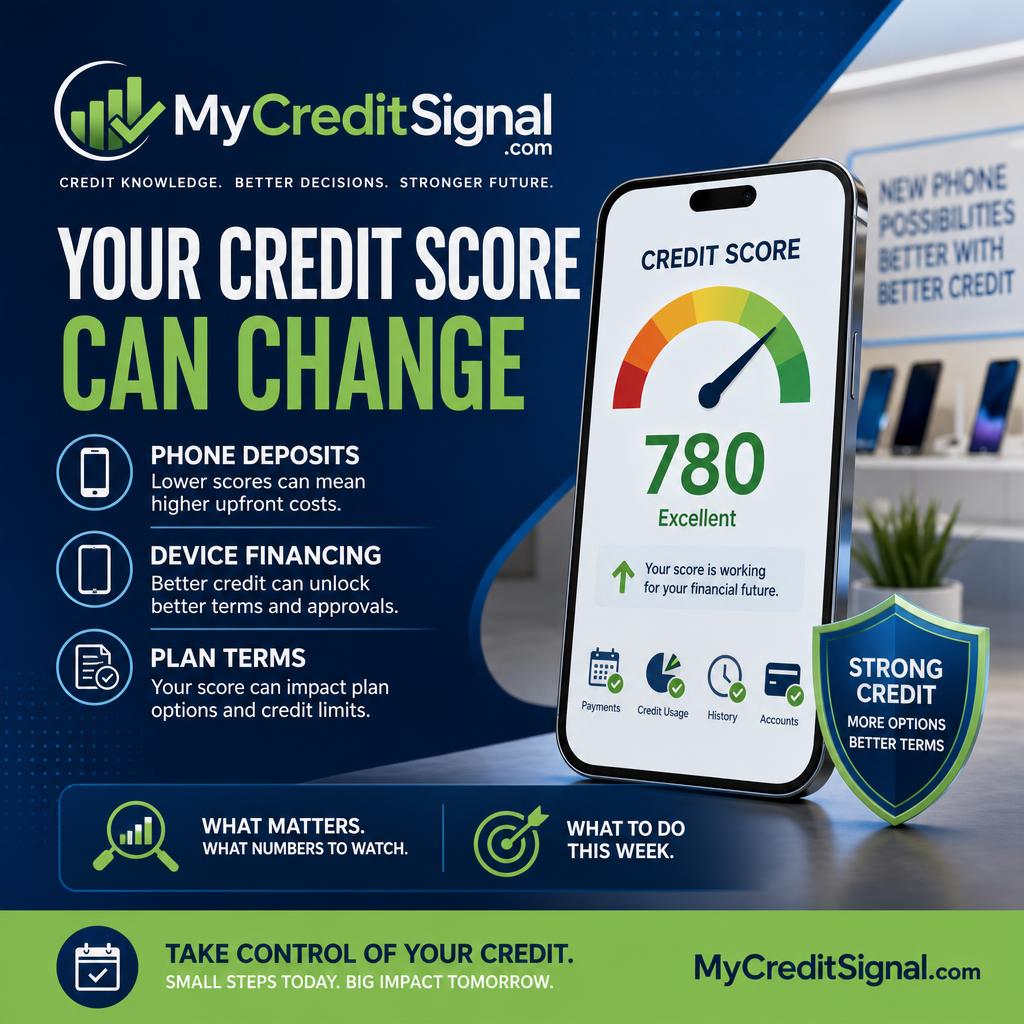
You walk into a carrier store expecting to pay for a new phone over time, then the rep says you need a deposit or different financing terms. That surprise often has less to do with the phone itself and more to do with the credit profile behind your application.
If you have ever wondered how a credit score cell phone application connects to your monthly cost, this guide is for you. You will see where credit matters, which numbers actually affect device financing and deposits, and what steps can improve your position before you apply. The goal is simple: help you avoid overpaying for a phone plan because of a credit decision you did not expect.
Contents
- 1 Who should pay attention to this
- 2 Where your credit score shows up in a phone plan decision
- 3 Why phone bills can matter to your score too
- 4 The score numbers and thresholds that matter most
- 5 A quick decision framework before you apply
- 6 A realistic cost example
- 7 What to do this week if you want better phone terms
- 7.1 Check your current scores without adding a hard inquiry
- 7.2 Review your last two reported card balances
- 7.3 Make every bill payment on time for the next 30 days
- 7.4 Ask the carrier what they check before you submit
- 7.5 Compare paying more upfront versus improving your score first
- 7.6 Consider alternative positive data if your file is thin
- 7.7 Pull your free credit reports and verify the basics
- 8 Mistakes that make your phone plan more expensive
- 9 What many articles miss about wireless credit checks
- 10 When this advice may not apply
- 11 FAQ
- 12 Helpful tools and related resources
- 13 The bottom line
Key Takeaway
Your credit score usually will not stop you from getting basic wireless service, but it can change your deposit, device financing options, credit limit, and total upfront cost.
Who should pay attention to this
This topic matters most if you are doing any of the following:
- Applying for a postpaid wireless plan for the first time
- Trying to finance a device instead of paying full price upfront
- Rebuilding credit and worried about deposits
- Comparing carriers after a recent score drop
- Helping a young adult or family member open a line with limited credit history
It is especially relevant if your budget is tight. A carrier asking for even a $100 or $200 deposit can change whether you can afford the switch this month. And if you are counting on installment billing for a device, the lender or carrier may use score ranges and tradeline data to decide what terms to offer, according to TransUnion’s 2024 telecommunications consumer report.
Who may need a different approach? If you only buy unlocked phones outright and use prepaid service, credit may matter far less. In that case, your issue is more about cash flow than score optimization. If you are new to scoring models, read Credit Score Range Explained for Beginners first so the score bands and lender differences make more sense.
Where your credit score shows up in a phone plan decision
Most people assume a cell phone plan is just a monthly bill. In reality, there are often two separate decisions happening:
- Service approval: whether you can open a line under certain billing terms
- Device financing approval: whether you can spread the phone cost over time and on what terms
Your credit score is not a direct yes-or-no gate for basic wireless service in every case. But it can influence whether you face a higher upfront deposit or less favorable financing terms for devices and premium plans, based on telecom industry reporting and consumer guidance from the CFPB and TransUnion.
That means a stronger score may help you qualify for:
- Lower or no deposit
- Higher device financing limits
- Better installment terms
- More flexibility on postpaid plans
A weaker score or thinner file may lead to:
- An upfront deposit before service starts
- A requirement to choose a cheaper phone
- Shorter financing windows or different offer structures
- A need to use prepaid service temporarily
Results can vary by credit profile, bureau, and scoring model. The FTC notes that lenders may use different scores, and consumers often see differences depending on whether the lender relies on FICO, VantageScore, and which bureau gets pulled.
If you are actively trying to strengthen your profile before applying, a tool like the credit score simulator can help you model how balance changes or on-time payments may affect your broader credit picture.
Why phone bills can matter to your score too
The relationship goes both ways. Your score can affect phone plan costs, and some payment behavior tied to telecom accounts can affect your credit profile. The CFPB explains that payment history is the single most influential factor in most FICO and VantageScore models. That is the big reason missed bills, when they are reported in a way that reaches your credit file, can hurt.
At the same time, not every on-time wireless payment automatically boosts your score. Traditional scoring models rely on the information actually appearing in your credit reports. Some lenders and scoring systems are increasingly using non-traditional or alternative data, including on-time payments reported through credit-building products, according to the Federal Reserve overview of credit-building products. That means reported positive payment patterns may help in some cases, but it is not guaranteed with every carrier or every score model.
A practical rule: assume that late payments create more risk than on-time wireless payments create benefit unless you know your payment history is being reported through an approved credit-building channel.
The score numbers and thresholds that matter most
Wireless carriers do not publish one universal score cutoff, so avoid articles that claim a single magic number. What matters is how your application lands inside the lender or carrier’s internal risk bands.
Here are the grounded numbers worth knowing:
- 300-850: a common VantageScore range used by many lenders
- 0-850: a common FICO range consumers may see
- $0-$200: a typical deposit range reported in some lower credit tiers
- 6 to 12 months: a common device financing term window referenced in consumer guidance, though actual terms vary by carrier and product
There is another threshold people overlook: score variation across bureaus. Credit scores come from Equifax, Experian, and TransUnion, and lenders can pull any one bureau or more than one. In some pricing decisions, a middle score among the three may be used. So if you have one stronger score and two weaker ones, the application result may not reflect the highest number you saw in an app.
This is one reason it helps to understand score ranges in context and not obsess over a single score snapshot. If your balances recently jumped, review your utilization strategy too. Our guide on closing old credit cards explains why available credit can affect your score in ways that spill into other approvals, including wireless financing.
A quick decision framework before you apply
Use this simple framework:
- Need service now, not a premium phone: prioritize the lowest upfront cost and compare prepaid versus postpaid
- Need a new phone and affordable monthly payments: check your score range first and reduce balances before applying if possible
- Score recently dropped: wait through one reporting cycle if you just paid balances down
- Thin credit file: ask whether a deposit option or starter financing tier is available instead of assuming denial
What to do first versus later matters here. First, reduce factors that are hurting approvals right now, such as high card balances or recent missed payments. Later, work on broader credit-building habits like diversified accounts and longer payment history. If you want a second angle on credit mix and how lenders may read your file depth, try the credit mix analyzer.
A realistic cost example
Imagine two shoppers want the same phone and postpaid plan.
Shopper A has a stronger recent payment record and lower revolving balances. The carrier approves standard device financing with no deposit.
Shopper B has a lower score band after several high-balance months. The carrier asks for a $200 deposit or offers a more limited financing path.
Even if their monthly service price looks similar, Shopper B may need much more cash on day one. If that deposit is nonrefundable or tied up for months, it affects the real cost of switching. This is why improving your score before applying can create a savings opportunity even when the advertised plan price is identical.
The same logic applies if you are opening multiple lines. A household adding three devices could multiply the impact of stricter credit treatment, especially if the carrier limits the amount financed at once.
What to do this week if you want better phone terms
Check your current scores without adding a hard inquiry
Looking at your own score usually uses a soft pull and does not hurt your credit. Review the score range you see, note which bureau it comes from, and do not assume every carrier will use that same version. The FTC and CFPB both explain that consumers can see different scores depending on model and bureau.
Review your last two reported card balances
If your balances are temporarily high, your score may be lower than it needs to be. Paying balances down before your next statement closes can help utilization and may improve your profile by the time you apply. If you need a same-silo read on fast score levers, see ways to improve your credit score fast.
Make every bill payment on time for the next 30 days
Payment history is the most influential factor in most FICO and VantageScore models. Set autopay or calendar reminders for credit cards, loans, and your existing wireless bill. This step is basic, but it matters more than most people think.
Ask the carrier what they check before you submit
You can often ask whether the application involves a soft pull, hard pull, deposit review, or device financing review. Not every rep will know the full underwriting logic, but asking can help you avoid an unnecessary application when you are on the edge of a better tier.
Compare paying more upfront versus improving your score first
If you need a phone immediately for work or family reasons, paying upfront may be the better move than taking less favorable financing. If the need is optional, waiting one billing cycle after paying down balances may put you in a stronger position.
Consider alternative positive data if your file is thin
The Federal Reserve notes growing use of credit-building products and alternative tradelines. If your issue is not bad credit but limited history, adding eligible reported payment data over time may help future risk assessments. This is not an instant fix, but it can matter for later applications.
Pull your free credit reports and verify the basics
Use your reports to confirm that your accounts, balances, and payment status are being reflected as expected. The CFPB says ongoing monitoring can help you catch issues that may affect lending and telecom financing decisions. Focus on understanding what is on your file before you apply.
Mistakes that make your phone plan more expensive
Applying right after maxing out a card
Behavior: submitting a device financing application during a high-utilization month. Consequence: your score may be temporarily lower, which can increase the chance of a deposit or weaker terms. Fix: pay balances down and wait for the next reporting cycle when possible.
Assuming your app score is the score the carrier sees
Behavior: relying on one score from one bureau and expecting the same result everywhere. Consequence: surprise when the carrier uses a different bureau, FICO version, or VantageScore model. Fix: treat your visible score as a range indicator, not a guarantee.
Ignoring a small deposit because the monthly price looks fine
Behavior: focusing only on the advertised monthly plan cost. Consequence: underestimating the true upfront cash needed to switch or add lines. Fix: compare total day-one cost, including deposits, taxes, accessories, and any down payment.
Closing older cards before applying
Behavior: shutting down an old account to simplify finances right before carrier review. Consequence: reduced available credit and possible score pressure, depending on your profile. Fix: understand the score tradeoff first by reading why closing old credit cards can hurt your credit score.
What many articles miss about wireless credit checks
Most articles say only that “good credit helps.” That is true but incomplete. Here are the nuances that actually matter.
There is also a timing issue. If you just made a large payment yesterday, the score impact may not show until the creditor reports the new balance. So if your plan purchase is flexible, waiting can be a smart move.
Another point many people miss: for family plans, the primary account holder’s profile may drive more of the decision than the users on each line. If one person in the household has the strongest credit and stable income, structuring the account carefully can make the financing side easier.
When this advice may not apply
If you are paying cash for an unlocked phone and using prepaid service, your score may have little impact on the transaction. In that case, focus on total cost, coverage quality, and budgeting for replacement cycles instead of chasing a short-term score bump for telecom reasons alone.
If your only concern is a score difference between two apps, remember that 50 to 70 percent of borrowers may see different scores when lenders pull different bureaus or models, according to the FTC context provided in consumer score guidance. A difference does not automatically mean something is wrong. It may just reflect a different scoring formula.
And if your profile is in the middle of rebuilding, not every point change will produce a noticeably better wireless offer. Sometimes the best move is less glamorous: one more month of on-time payments, lower balances, and no unnecessary applications.
FAQ
Does checking my own credit score hurt my chances for a phone plan?
Usually no. Checking your own score typically uses a soft pull, which does not affect your credit score.
Do carriers use FICO or VantageScore?
Either can be used, and some carriers or lenders may rely on bureau data or other score variants. That is why your result can differ from what you expected.
Will paying my phone bill on time improve my score right away?
Not always. On-time payments only help if that payment data is reported in a way that affects your credit file or is used through an alternative reporting product. Late payments create the bigger risk.
If you want to take action instead of guessing, start with these resources:
- Credit score simulator to test how balance payoff or on-time payments could change your profile
- Credit mix analyzer to see whether your file depth may be affecting lender confidence
- Credit Score Range Explained for Beginners if you need a clearer read on score bands and why they vary
- Improve your credit score fast for practical next steps before you apply
Authoritative references used in this article include the CFPB guide to understanding credit scores, the FTC consumer advice on credit scores, and VantageScore 4.0 information.
Get weekly credit tips, tool updates, and practical guides – free.
The bottom line
Your credit score can affect a cell phone plan in ways that are easy to miss until you are already applying. The biggest impact is often not whether you can get service at all, but how much cash you need upfront and how flexible your device financing will be.
If you want the best odds of lower deposits and better phone terms, start with the basics this week: check your score, lower high balances, protect your payment history, and compare options before you submit an application. Then use the tools above to decide whether you should apply now or wait for a stronger score snapshot.



Leave a Reply
You must be logged in to post a comment.