
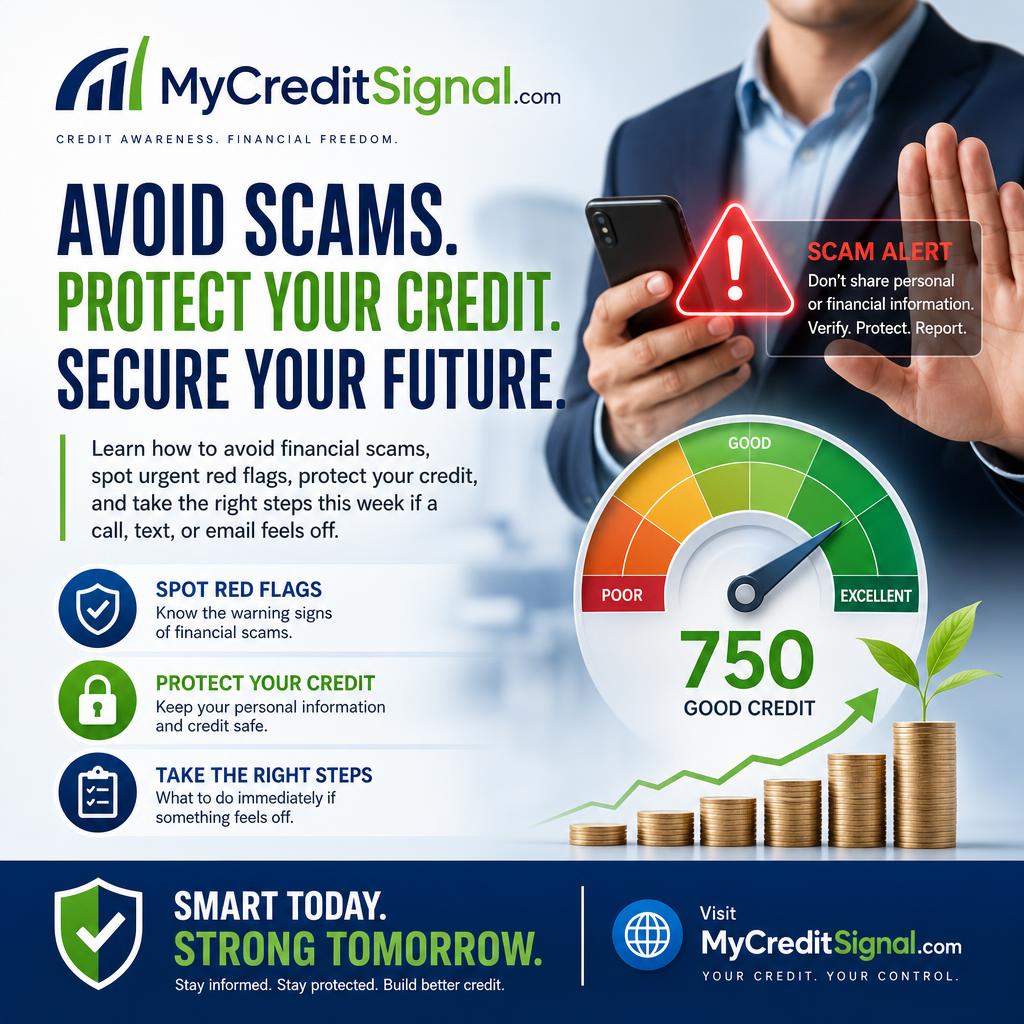
A text says your bank account is locked. An email says your tax refund is on hold. A caller claims to be from a government agency and wants you to verify your Social Security number right now. These are the moments when people lose money fast and, in some cases, end up dealing with damaged credit afterward.
This guide is for people who want to avoid financial scams before they turn into account takeovers, fraudulent charges, or identity theft. You will learn how common scams work, which warning signs matter most, what numbers should get your attention, and the exact steps to take this week to reduce your risk.
Contents
- 1 Who needs this guide most
- 2 The scam patterns showing up most often right now
- 3 How scammers get past smart people
- 4 The numbers and thresholds that matter
- 5 A step by step plan to avoid financial scams this week
- 5.1 Audit the ways scammers can reach you
- 5.2 Turn on two factor authentication for priority accounts
- 5.3 Create your own verification routine
- 5.4 Reduce what one stolen password can do
- 5.5 Set transaction alerts with a low threshold
- 5.6 Watch your credit routinely, not randomly
- 5.7 Prepare a family script before the next scam arrives
- 6 What to do first versus later
- 7 Mistakes that make scams more expensive
- 8 What many articles miss about scam prevention
- 9 FAQ
- 10 Helpful tools and related resources
- 11 The bottom line
Key Takeaway
The fastest way to avoid financial scams is to slow down, verify through official channels, and add layers of protection to your accounts before a scammer ever reaches you.
Who needs this guide most
This article is especially useful if you do any of the following:
- Manage bills and banking mostly on your phone
- Get payment alerts, tax notices, or account messages by text or email
- Use peer-to-peer payment apps
- Share financial tasks with a spouse, parent, or adult child
- Are trying to protect your credit while building savings
You should care even more if your income is tight. Scams often work because they create pressure around money you supposedly owe, money you might lose, or money you could receive quickly. That pressure can lead people to send funds, reveal personal data, or click links without checking them first.
This guide may be less relevant if you are looking for legal help after a large fraud loss or if your business accounts were targeted. In those cases, you may need bank-specific fraud procedures, tax professionals, or law enforcement support in addition to basic consumer steps.
The scam patterns showing up most often right now
The broad pattern is simple: criminals contact people through digital channels, impersonate a trusted source, create urgency, and try to get either personal information or a payment. The FTC says the most common current scams target personal data and payments through phishing, fake texts, and social engineering. The Federal Reserve and FDIC have also highlighted the continued rise of scams involving misrepresentation and account-targeting tactics. For current federal guidance, see the FTC scam update and the Federal Reserve fraud and scams page.
Three patterns matter most for everyday consumers:
Impostor scams
These messages pretend to come from a bank, the IRS, a delivery company, a retailer, or a government office. The CFPB has warned that scammers increasingly impersonate agencies and often ask for upfront fees or taxes while pushing you to act immediately.
Phishing and smishing
Phishing usually arrives by email. Smishing is the text-message version. Both push you toward a fake login page, a malware link, or a number to call.
Tax-season scams
The IRS warns that unexpected calls, emails, texts, or letters claiming you owe taxes or need to verify personal data are almost always scams unless you verify through official IRS channels. The IRS continues to flag refund scams and W-2 related schemes during tax season. Start with the official IRS tax scams page if anything tax-related feels off.
Because fraud can lead to new accounts, missed payments, or maxed-out balances in your name, it helps to understand how your overall credit picture works. If you need a refresher on score basics, read Good Credit Score Range and Why It Matters.
How scammers get past smart people
Most scams do not succeed because the victim is careless. They succeed because the setup is believable and timed well. A few examples:
- You are expecting a package, so a fake delivery text seems normal.
- It is tax season, so an IRS-related message feels plausible.
- You recently changed a password, so a fake security alert catches your attention.
- You are worried about bills, so a threat about account suspension triggers panic.
A useful decision framework is the 3C test: Channel, Claim, Cost.
- Channel: Did the message come through a channel you normally use with that institution?
- Claim: Is the message making an unusual claim like arrest, immediate lockout, refund release, or surprise payment?
- Cost: Are they asking for money, passwords, codes, or sensitive personal data right away?
If two or more of those three feel off, stop and verify independently. Do not reply, do not click, and do not call the number in the message.
If you want a practical habit for monitoring risk around your credit profile, review the tools section on My Credit Signal and the site’s broader resources. A good starting point is the credit score simulator, which can help you understand how account changes may affect your score over time, even though it does not prevent fraud by itself.
The numbers and thresholds that matter
You do not need dozens of statistics to stay safe, but a few numbers create urgency in the right way.
First: the scale is huge. The Federal Reserve reported about $12.5 billion in fraud losses tied to 2024 data. That means scams are not edge cases. They are mainstream consumer risks.
Second: exposure is common. TransUnion found 49% of adults were targeted by email, online, phone, or text scams. In other words, the goal is not to avoid ever being contacted. The goal is to respond correctly when it happens.
Third: people are seeing fraud often. Research cited by the Federal Reserve indicates 57% of Americans encountered some form of financial fraud in 2025.
Fourth: speed matters. While the research context does not give a precise universal deadline for every type of scam, the practical rule is to act the same day if you clicked a bad link, shared a one-time code, sent money, or gave out account details. Waiting until the weekend or your next day off can give a scammer time to change passwords, move money, or apply for credit.
Here is a realistic example. Suppose a scammer convinces you to share your debit card details and drains $600 before you notice. Then they try your email password reset using the same phone number from a fake bank text. If they access one financial account plus your email, the damage can spread from one fraudulent transaction to multiple linked accounts quickly. That is why the priority is containment first, cleanup second.
A step by step plan to avoid financial scams this week
Audit the ways scammers can reach you
List your banking, tax, shopping, and payment accounts. Then note which channels each one uses to contact you: app notification, text, email, phone, or mail. This gives you a baseline. If your bank never texts links, a text with a login link becomes easier to spot. Do this for your top five financial accounts first if you are short on time.
Turn on two factor authentication for priority accounts
Start with your main email, primary bank login, payment apps, and any tax software account. Your email account comes first because password resets for other accounts often route there. If you only do one security task this week, do this one.
Create your own verification routine
Never use the phone number or link from a suspicious message. Instead, open your bank app directly, type the institution’s official web address yourself, or call the number on the back of your card. For tax concerns, verify only through official IRS channels. The IRS states that unexpected messages demanding payment or personal verification are almost always scams unless independently confirmed through official routes.
Reduce what one stolen password can do
Use unique passwords for email, banking, and payment apps. If one login gets exposed in a phishing attack, unique passwords limit the damage. Focus on your biggest risk accounts first rather than trying to change every login in one night.
Set transaction alerts with a low threshold
If your bank allows custom alerts, use a low amount that will catch unauthorized activity early. Some people choose every transaction, while others pick a threshold that fits their normal spending. The exact setting will depend on your bank, but the practical idea is the same: you want fast visibility, not a surprise two weeks later.
Watch your credit routinely, not randomly
Fraud can show up as a new inquiry, a new account, or a sudden balance increase. Build a habit of checking for changes on a regular schedule. You can also learn how alerts fit into a broader prevention plan in this guide to credit monitoring alerts. Monitoring helps you spot suspicious activity faster, which matters when scams turn into identity theft.
Prepare a family script before the next scam arrives
Decide now what everyone in your household will do if they get a threatening text, a tax notice by email, or a call about a blocked account. A simple script works: “I do not verify personal information from incoming calls or texts. I will contact the company directly.” This is especially useful for older relatives and teenagers with payment apps.
What to do first versus later
When people try to improve scam protection, they often do ten low-impact tasks and skip the three that matter most. Here is a better order.
Do first
- Secure your primary email login
- Turn on two factor authentication for bank and payment apps
- Set transaction alerts
- Commit to independent verification for any urgent request
Do next
- Update reused passwords
- Review account recovery options and old phone numbers
- Teach household members the same verification routine
- Check your credit regularly for unfamiliar activity
Do later if you have time
- Organize a password manager
- Separate shopping and banking email addresses
- Review old accounts you no longer use
This order matters because the first group reduces the chance that one scam message turns into multiple compromised accounts.
Mistakes that make scams more expensive
Trusting urgency instead of process
Behavior: You react to a message because it says your account will be frozen in 30 minutes or you owe taxes immediately. Consequence: Panic overrides judgment, and you hand over payment or personal data. Fix: Pause and verify through the official app, website, or number you already have.
Using the contact details inside the suspicious message
Behavior: You call the phone number in the text or click the link in the email to “confirm” it is real. Consequence: You connect directly to the scammer’s fake support path. Fix: Start fresh from a trusted source, such as the back of your debit card, your saved app, or an official government page.
Assuming small losses are the whole problem
Behavior: You notice a minor unauthorized charge and treat it like a one-off annoyance. Consequence: The small charge may be a test before larger fraud or an account takeover attempt. Fix: Report it promptly, review recent logins, change affected passwords, and monitor linked accounts and credit activity.
Thinking credit monitoring replaces account security
Behavior: You rely on alerts alone and skip authentication upgrades or verification habits. Consequence: You may learn about fraud sooner, but you do not reduce the chance of it happening. Fix: Pair monitoring with strong logins, app-based verification when available, and routine account alerts.
What many articles miss about scam prevention
Most scam prevention advice stops at “do not click suspicious links.” That is true, but incomplete.
First nuance: some real messages are urgent too. A fraud alert from your actual bank may need quick action. The difference is that legitimate institutions give you ways to verify through established channels. Urgency alone does not prove a scam. Unverifiable urgency is the problem.
Second nuance: avoiding scams is partly a credit habit. If someone opens accounts or runs up balances in your name, your credit profile can be affected indirectly through new activity, utilization changes, or missed bills you did not know existed. Understanding score ranges and how lenders view risk can help you spot why prevention matters; see Good Credit Score Range and Why It Matters for the broader context.
Third nuance: tax scams deserve special handling. The IRS notes that legitimate notices are usually sent by mail first and can be verified through official channels. So if you get an email, text, or random call claiming you owe money right now, treat that as a red flag until proven otherwise.
FAQ
What are the biggest red flags that a message is a scam?
Look for pressure, threats, surprise refunds, requests for one-time codes, unusual payment methods, or links you did not expect. The combination of urgency and a demand for money or personal information is especially risky.
How can I verify an IRS message safely?
Do not reply to the message or use its links. Go directly to the official IRS website or use other official IRS contact methods. The IRS says unexpected demands by call, email, or text are almost always scams unless verified independently.
How often should I monitor my credit for fraud signs?
Regularly enough that unfamiliar activity does not sit unnoticed for long. A routine schedule works better than checking only when you feel nervous. Combine credit monitoring with account alerts and stronger login security.
If you want to turn this advice into a routine, start with a few practical resources:
- Use the credit score simulator to understand how account changes may affect your credit profile over time.
- Read credit monitoring alerts for a practical overview of how alerts fit into fraud detection.
- Review Good Credit Score Range and Why It Matters if you want to connect fraud prevention with the bigger picture of credit health.
For official scam guidance, keep these authoritative pages bookmarked: the FTC scam prevention tips, the Federal Reserve consumer fraud page, and the FDIC identity theft information page.
Get weekly credit tips, tool updates, and practical guides – free.
The bottom line
To avoid financial scams, you do not need to predict every new trick. You need a repeatable system: slow down, verify independently, secure the accounts that matter most, and monitor for suspicious changes. That approach works whether the scam arrives by text, phone, email, or social media.
Your next step is simple. Today, secure your main email account, turn on alerts for your primary bank account, and decide that no urgent message gets your information until you verify it through an official channel. That one routine can protect both your cash and your credit.


Leave a Reply
You must be logged in to post a comment.