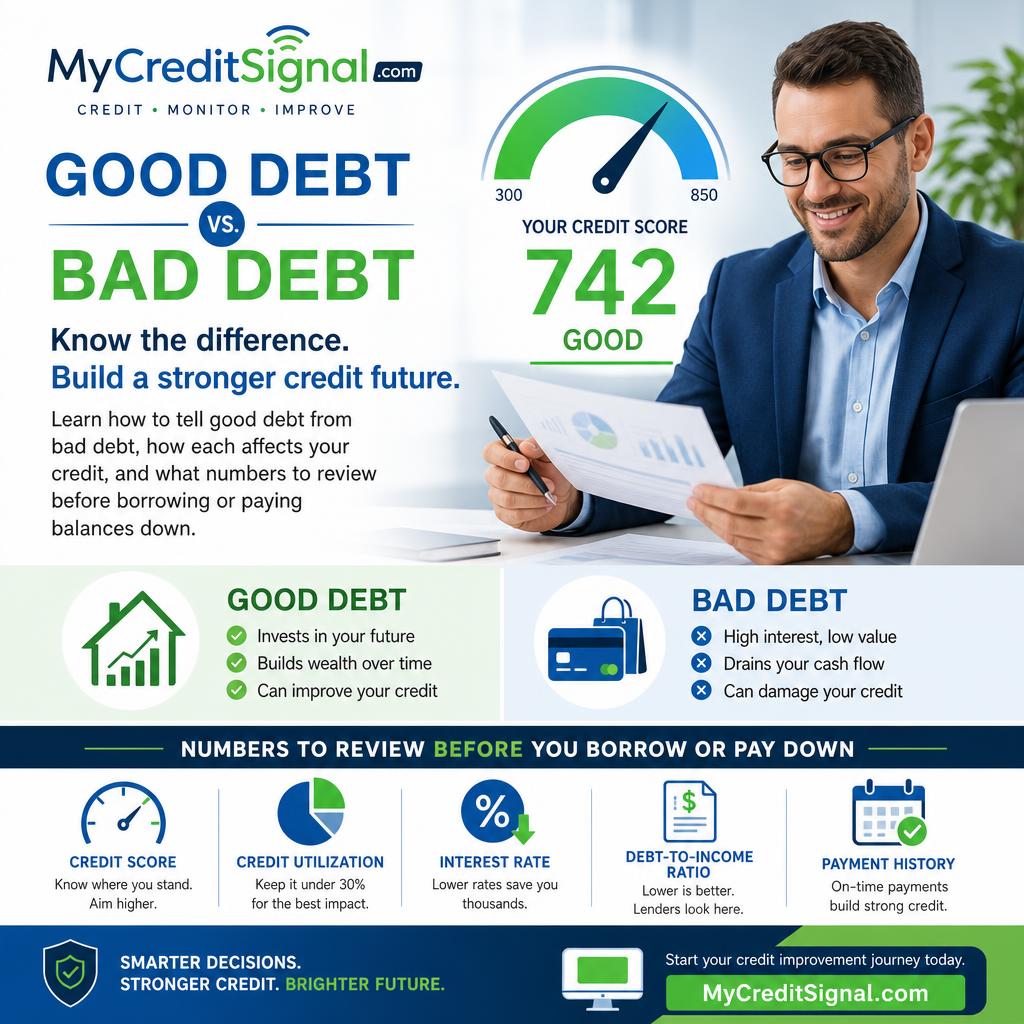
One person uses a loan to finish a degree, lands a better-paying job, and keeps payments current. Another runs up store cards, buy-now-pay-later balances, and a high-rate personal loan for things that lose value fast. Both have debt, but the long-term impact on cash flow and credit can be very different.
If you have ever searched good debt vs bad debt, you are probably trying to answer a practical question: should I borrow for this, pay it off now, or avoid it completely? This guide is for people weighing student loans, auto loans, credit cards, medical bills, and personal loans who want a clearer way to decide. By the end, you will know how to judge debt by purpose, cost, and credit impact, plus what to do this week if your current mix is working against you.
Contents
- 1 Who should care about good debt and bad debt
- 2 What makes debt good or bad in real life
- 3 How different debt types tend to affect credit
- 4 The numbers and thresholds that matter before you borrow
- 5 A simple decision framework you can use in 10 minutes
- 6 Step-by-step plan to separate good debt from bad debt this week
- 6.1 List every debt with four columns
- 6.2 Calculate your monthly debt pressure
- 6.3 Target the debts with the worst credit impact first
- 6.4 Run any new borrowing through a side-by-side comparison
- 6.5 Protect payment history at all costs
- 6.6 Decide what to do now versus later
- 6.7 Review one debt that might be misleading you
- 7 Mistakes that turn manageable debt into bad debt
- 8 What most articles miss about good debt vs bad debt
- 9 What to do first versus later if you have both kinds of debt
- 10 FAQ
- 11 Helpful tools and related resources
- 12 The bottom line
Key Takeaway
Debt is not good or bad by label alone; the deciding factors are whether it helps build income or assets, whether the payments fit your budget, and whether you can manage it in a way that protects your credit.
Who should care about good debt and bad debt
This topic matters most if you are in one of these situations:
- You are deciding whether to borrow for school, a car, a move, or a major purchase.
- You already have debt and need to choose what to pay down first.
- You are trying to improve your credit score while keeping monthly payments manageable.
- You want to compare a loan offer against the real value of what you are buying.
- You are rebuilding after overspending and want a framework that is more useful than simply saying all debt is bad.
It may be less useful if your immediate issue is hardship, collections pressure, or a payment crisis. In that case, the first priority is stabilizing cash flow, understanding your rights with collectors through the FTC debt collection guidance, and making a survival budget before debating whether a debt is technically good or bad.
What makes debt good or bad in real life
In plain English, good debt is borrowing that has a realistic chance to improve your income, net worth, or financial flexibility over time, as long as the terms are affordable. Think of a mortgage on a home you can afford, or student debt tied to a program with a strong payoff and a repayment plan you can handle.
Bad debt is borrowing for purchases that do not increase income or assets, or debt taken on in a way that strains your budget so badly that late payments, high balances, and extra fees become likely. A luxury purchase on a high-interest credit card can be bad debt even if the amount is not huge, because the financing cost and repayment risk are out of proportion to the value you receive.
The Consumer Financial Protection Bureau explains that your credit score is a number created from the information in your credit reports by scoring models such as FICO and VantageScore. It also emphasizes that keeping a good score usually comes down to on-time payments, reasonable credit utilization, and an appropriate mix of credit types over time. You can review that foundation at the CFPB credit score explainer and the CFPB guide to getting and keeping a good credit score.
That leads to an important point: a mortgage is not automatically good debt, and a credit card is not automatically bad debt. Either one can help or hurt depending on three filters:
- Purpose: Does this borrowing help you build income, mobility, or an asset?
- Cost: What will you repay in total, not just monthly?
- Behavior risk: Can you reliably make the payments on time without falling behind somewhere else?
If you want a broader repayment framework, see debt payoff strategies that match your budget and balances. If you are evaluating affordability before taking on more, the debt-to-income calculator can give you a cleaner view of how much room you really have.
How different debt types tend to affect credit
Credit scoring models look at your overall credit behavior, not whether the debt sounds respectable. Still, different debt types often show up in different ways.
Credit cards
Credit cards can help credit if you pay on time and keep utilization reasonable. They can hurt quickly when balances rise because revolving utilization is highly visible month to month. If you have a $5,000 limit and a $4,000 balance, that is 80% utilization. If you pay it down to $1,500, that falls to 30%. Same account, very different signal.
Student loans
Student loans are often considered good debt when they support income growth and the payment fits the budget. But they can still damage credit if you miss payments or borrow far more than your expected earnings can support. The FDIC has consumer guidance reminding borrowers to understand the long-term cost of education debt and to budget for repayment before borrowing.
Mortgages and auto loans
Installment loans such as mortgages and auto loans do not affect utilization the same way credit cards do. Their credit impact is usually driven more by payment history and whether the loan amount was sensible for your finances. A modest car loan used to get to work can be manageable; an oversized payment can crowd out every other goal.
Medical debt
Medical debt often feels different because it is not usually planned. The CFPB has studied how medical debt sent to collections can disproportionately harm credit scores. That is one reason medical bills deserve early attention even when they were unavoidable.
The numbers and thresholds that matter before you borrow
You do not need a perfect model to make a smarter borrowing decision. A few simple numbers can separate manageable debt from the kind that slowly takes over your budget.
1. Your credit score range
Common published FICO ranges put 670 to 739 in the good range, 740 to 799 in very good, and 800 to 850 in exceptional. VantageScore 4.0 uses a 300 to 850 scale. The average FICO score is often referenced around 715. These are useful reference points, but your actual loan offer depends on the lender, the model used, and your full credit profile.
2. Debt-to-income ratio
Debt-to-income ratio, or DTI, compares monthly debt payments with gross monthly income. Formula: monthly debt payments ÷ gross monthly income.
Example: if your gross income is $4,500 per month and your required debt payments are $1,350, your DTI is 30%. That number does not tell you whether debt is morally good or bad. It tells you whether your current obligations may be getting heavy. You can run your own numbers with the debt-to-income calculator or review a borrowing-focused checklist at this DTI borrowing power guide.
3. Utilization on revolving debt
For credit cards, divide your balance by your credit limit. A $900 balance on a $3,000 limit is 30%. A $2,400 balance on the same limit is 80%. If your goal is protecting or improving your score while paying debt down, this number often deserves attention before lower-impact moves.
4. Total repayment cost
Never judge debt only by the monthly payment. Compare what you borrow with what you will repay in total. If two loan options both feel affordable month to month, the one with less total cost usually gives you more room later. The loan comparison calculator can help you compare side by side.
5. Timeline to payoff
A debt that lingers for 5 years, 10 years, or longer affects your flexibility differently than a balance you can clear in 6 to 18 months. A smaller balance with a punishing rate and no clear payoff date is often more dangerous than a larger, structured loan with a stable plan.
A simple decision framework you can use in 10 minutes
When you are unsure whether a debt is worth taking on, use this three-part test:
- Build: Will this debt help build income, skills, transportation reliability, or an asset?
- Budget: Can the payment fit without relying on overtime, new credit cards, or cutting essentials?
- Behavior: Does this debt create a realistic path to on-time payments, or does it raise the chance of carrying balances and paying late?
If the answer is yes to all three, the debt may be productive. If the answer is no to two or more, it is probably risky even if the purchase sounds important.
Example: suppose you are considering a $2,000 laptop for freelance work. If that laptop allows you to earn additional income, the debt could be productive. But if you put it on a card that is already near the limit and only make minimum payments, the financing method may turn a smart purchase into bad debt. Same item, different outcome.
Step-by-step plan to separate good debt from bad debt this week
List every debt with four columns
Write down the balance, required monthly payment, interest rate if you know it, and what the debt was used for. Add one more column labeled builds income or assets? This instantly shows which debts are helping your long-term position and which are just draining cash flow.
Calculate your monthly debt pressure
Add up all required monthly debt payments and divide by your gross monthly income to estimate DTI. Then look at your actual take-home pay and ask a tougher question: after rent, food, transportation, and insurance, do these debt payments still fit? A debt can look fine on paper and still be too tight in real life.
Target the debts with the worst credit impact first
If you have high credit card balances, especially on cards near their limits, prioritize bringing those down. This can help both your budget and your score faster than focusing only on installment debt. If you need a repayment structure, compare methods in this snowball vs avalanche breakdown.
Run any new borrowing through a side-by-side comparison
Before you accept a loan, compare at least two options. Check total repayment, monthly payment, and how long the balance will remain in your life. Use the loan comparison calculator to avoid choosing based on monthly payment alone.
Protect payment history at all costs
The CFPB and FTC both stress the importance of paying on time. Set automatic minimum payments, calendar reminders, or separate bill-pay alerts today. A supposedly good debt becomes damaging fast if you start paying late.
Decide what to do now versus later
Do now: stop adding to high-rate revolving debt, lower utilization where you can, and make sure all accounts are current. Do later: once cash flow is steadier, consider accelerating lower-rate installment debt or refinancing if better terms become available.
Review one debt that might be misleading you
Pick the debt you most often justify to yourself. Ask whether it really supports income, stability, or asset-building, or whether it was simply easy to finance. That one honest review can prevent the next expensive borrowing decision.
Mistakes that turn manageable debt into bad debt
Calling every student or auto loan good debt automatically
Behavior: Assuming a debt is good because it is tied to school or transportation. Consequence: You may borrow more than your future income or current budget can support. Fix: Evaluate the payment, total cost, and likely payoff from the purchase before signing.
Focusing only on interest rate and ignoring utilization
Behavior: Paying extra toward a lower-stress installment loan while credit cards stay near their limits. Consequence: Your score may remain pressured and your budget stays vulnerable to high-rate revolving debt. Fix: Balance payoff strategy with credit impact by lowering card utilization early.
Choosing a loan because the monthly payment looks small
Behavior: Stretching a purchase over a longer term without checking total repayment. Consequence: You stay in debt longer and may pay much more overall. Fix: Compare total cost and timeline, not just the monthly number.
Using new debt to feel better about old debt
Behavior: Consolidating or refinancing without changing the spending habits that created the problem. Consequence: Balances can return, leaving you with old behavior and new obligations. Fix: Pair any new loan with a written spending cap and a payoff schedule.
What most articles miss about good debt vs bad debt
Many articles stop at labels. Real life is messier. Here are a few edge cases worth knowing.
Another commonly missed issue is timing. If your score is already under pressure from missed payments or high balances, the best move is usually not debating philosophy. It is reducing the behaviors that keep hurting your profile. The FTC notes that credit health is strongly tied to payment history and timely obligations. In other words, even good debt stops helping when repayment breaks down.
Also remember that scoring results vary by credit profile and model. FICO and VantageScore both use report data, but lenders may use different versions and weigh your full application differently. A strategy that helps one borrower quickly may move more slowly for another.
What to do first versus later if you have both kinds of debt
If you are juggling student loans, auto loans, and high credit card balances, sequence matters.
First
- Bring all accounts current.
- Prevent new late payments with autopay or reminders.
- Reduce high revolving balances where possible.
- Pause new discretionary borrowing.
Next
- Choose a payoff method for expensive balances.
- Review whether any loan terms can be improved.
- Build a small cash buffer so you do not reuse cards for every surprise expense.
Later
- Accelerate lower-rate installment debt if it supports your bigger goals.
- Reassess whether a future loan would truly be productive or just convenient.
If you need help maintaining momentum once the plan is set, this guide to debt payoff motivation that actually lasts can help you stay consistent without burning out.
FAQ
Is all debt bad for your credit score?
No. Credit scores are based on report data and scoring models, not moral labels. On-time payments, reasonable utilization, and manageable balances can support stronger scores over time.
Does carrying student loan debt help or hurt my credit?
It can do either. Student loans may support credit mix and payment history when managed well, but missed payments or unaffordable balances can hurt your score and budget.
What is the fastest way to improve credit while managing debt?
For many people, the quickest wins are making every payment on time and lowering high credit card utilization. Results vary by profile and scoring model, but those two moves are consistently important.
- Use the debt-to-income calculator to see whether your monthly debt load is still workable.
- Compare borrowing options with the loan comparison calculator before taking on a new payment.
- Read debt payoff strategies if your main issue is sequencing balances efficiently.
- Review the DTI checklist for borrowing power before applying for another loan.
- Browse practical debt articles on the same-silo payoff comparison guide if you are deciding how to attack current balances.
Get weekly credit tips, tool updates, and practical guides – free.
The bottom line
The best way to think about good debt vs bad debt is not as a moral judgment but as a financial filter. Productive debt can help you build income, mobility, or assets when the terms are affordable and payments stay on time. Unproductive debt usually costs more than the value it creates and raises the risk of late payments, high utilization, and financial stress.
Your next step is simple: list your debts, calculate your monthly debt pressure, and identify the one balance that is hurting both your budget and your credit the most. Then use that answer to decide what to pay down first and what future borrowing to avoid.


Leave a Reply
You must be logged in to post a comment.