
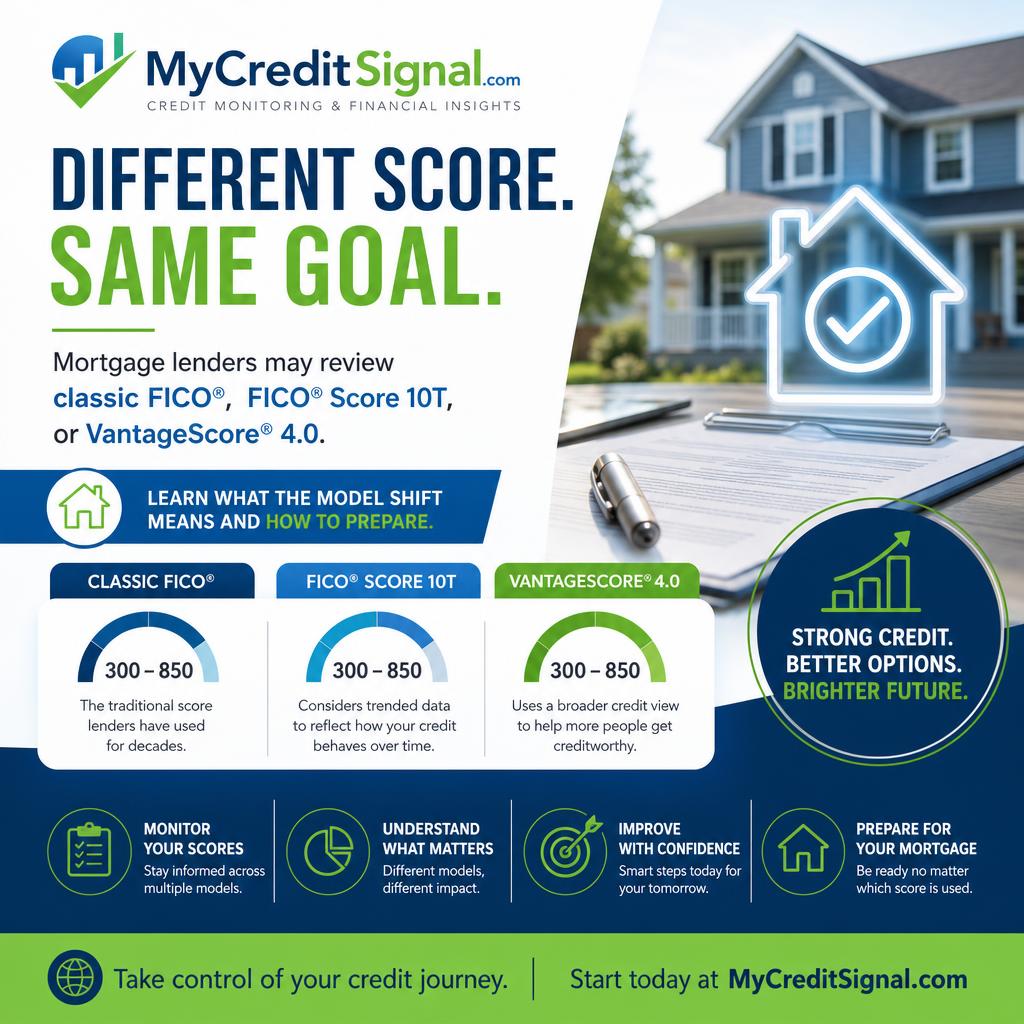
A mortgage applicant can check a credit score online and still be looking at a number that the lender will not use. In 2026, conventional mortgage underwriting is moving toward a broader set of models, including classic FICO scores, FICO Score 10T, and VantageScore 4.0. The practical answer is that the lender and loan program determine which score matters, so the best preparation is to build a stable credit profile rather than chase one displayed number.
This guide is for prospective homebuyers who want to understand the scoring transition before applying. It explains the models in plain English, shows what lenders may review, and gives you a concrete plan for the week ahead.
Contents
- 1 Who needs to understand mortgage scoring changes?
- 2 Which credit score do mortgage lenders use in 2026?
- 3 How do FICO Score 10T and VantageScore 4.0 differ?
- 4 What numbers and timing matter before a mortgage?
- 5 What should you do first and what can wait?
- 6 A five-step mortgage scoring preparation plan
- 7 What mistakes can make the transition harder?
- 8 What do most explanations miss?
- 9 Frequently asked questions
- 10 Helpful tools and related resources
- 11 The practical answer for homebuyers
Key Takeaway
Mortgage lenders may use multiple score models, so focus first on on-time payments, manageable balances, and consistent credit behavior across your reports.
- Conventional mortgage underwriting may include classic FICO, FICO Score 10T, or VantageScore 4.0, depending on lender and program.
- FICO Score 10T evaluates trended credit behavior, while VantageScore 4.0 is designed to use modern data and include more borrowers with shorter histories.
- A score shown to consumers may differ from the score used for underwriting.
- Review your credit position early, then ask a lender which models and loan guidelines apply to your application.
Who needs to understand mortgage scoring changes?
Anyone preparing for a conventional mortgage should understand the change, especially if you plan to apply during the transition to newer models. This includes first-time buyers, homeowners considering a refinance, and borrowers whose credit history is relatively short or whose balances change substantially from month to month.
The subject may be especially important if your score varies noticeably between sources. Different models can interpret the same underlying credit data differently. A lender may also receive information from more than one credit bureau and apply program-specific underwriting rules.
Borrowers with a thin file, recent credit activity, or a pattern of paying balances down shortly before applying should avoid assuming that one consumer score predicts the final mortgage decision. The right approach is to ask questions early and leave time to improve habits.
Which credit score do mortgage lenders use in 2026?
Mortgage lenders may use classic FICO scores, FICO Score 10T, VantageScore 4.0, or more than one model depending on the agency guidance, lender implementation, and loan program. The FHFA and Freddie Mac described a 2024–2026 transition that allows VantageScore 4.0 and FICO Score 10T alongside classic FICO for conventional mortgages.
That does not mean every lender uses every model for every applicant. A lender may have a specific delivery process, implementation timeline, or internal policy. The question to ask is not simply, “What is my credit score?” Ask, “Which score model and version will you use for this loan program, and when will it be pulled?”
Experian’s mortgage guidance also emphasizes that lenders can choose among FICO scores and VantageScore 4.0 according to the agency and loan program. This is why a free educational score is useful for monitoring direction, but it should not be treated as a guaranteed underwriting result.
For a deeper overview, read Mortgage Credit Scoring Models Explained before speaking with a lender.
How do FICO Score 10T and VantageScore 4.0 differ?
FICO Score 10T is a newer FICO model that uses trended data, meaning it evaluates how your credit usage changes over time. VantageScore 4.0 is a model developed by the three major credit bureaus that uses modern data and is designed to be more inclusive of people with shorter or thinner credit histories.
The important difference is not that one model is always better for every borrower. Each model applies its own risk assessment to the available data. A borrower who routinely carries high balances and pays them down later may be evaluated differently from someone who keeps balances low every month, even if both have similar current balances.
FICO markets Score 10T as more predictive than VantageScore 4.0 in mortgage origination and cites potential improvements in approval and pricing accuracy. Those are model-level claims, not a promise that an individual borrower will receive a higher score or a lower mortgage rate.
VantageScore 4.0 may also bring more consumers into consideration. TransUnion describes the model as expanding the lending universe by approximately 34 million consumers. That does not guarantee approval; it means the model is designed to evaluate more people who may have limited traditional scoring histories.
These figures describe industry and model context, not personal approval thresholds. There is no single score cutoff that applies to every lender, borrower, or mortgage product.
Our guide to FICO Score 10T versus VantageScore 4.0 explains the comparison in more detail.
What numbers and timing matter before a mortgage?
The most useful number is not a universal score target. It is the amount of reported revolving debt compared with your available revolving limits, combined with your payment record and recent application activity.
Credit utilization is the percentage of your revolving credit limits represented by reported balances. The basic formula is: total revolving balances divided by total revolving limits, multiplied by 100. For example, a borrower with $2,000 in reported balances and $10,000 in total limits has 20% utilization. A borrower with $8,000 in balances and the same limits has 80% utilization.
That formula is a planning tool, not a guaranteed mortgage rule. Models and lenders can weigh the information differently, and individual results vary by credit profile and scoring model. Still, checking utilization before an application can reveal a practical opportunity: paying down a balance before the issuer reports may change the data available to a scoring model.
Timing matters because lenders generally review credit information during the application process and may review it again before closing. Avoid making large, unexplained changes to your credit profile while a mortgage is in progress. Ask your loan officer before opening an account, closing an account, financing a purchase, or moving significant debt.
The Federal Reserve’s G.19 release continues to track revolving and nonrevolving consumer credit and broader borrowing trends. It provides economic context, but it does not create an individual mortgage approval threshold.
What should you do first and what can wait?
Do the actions that protect your current profile first. Payment reliability and accurate knowledge of your balances deserve attention before shopping for another credit product or trying to optimize a score model.
- First: list every open credit account, its limit, current balance, minimum payment, and due date.
- First: turn on payment reminders or automatic minimum payments, then pay more manually when cash flow permits.
- First: calculate utilization using the formula above and identify the account with the highest balance relative to its limit.
- Next: avoid new applications unless the lender says they are necessary. New accounts can change the information lenders review.
- Next: ask your prospective lender which mortgage program and score models apply before making major credit decisions.
- Later: compare optional credit-building products only after you have a sustainable payment routine and understand the fees.
If you want a simple way to organize your current credit information, use the free resources available through the My Credit Signal tools hub. The purpose is to help you make decisions from your own numbers instead of reacting to a score notification.
A five-step mortgage scoring preparation plan
Build a lender question list
Before requesting a preapproval, write down the loan type, score model and version, bureau data used, timing of the credit pull, and whether the lender expects another review before closing. Clear questions reduce surprises.
Map balances and reporting dates
Record each revolving balance and limit. If an issuer provides a statement closing date or reporting schedule, note it. This helps you understand when a payment may affect the balance supplied to a scoring model.
Protect every due date
Schedule at least the minimum payment before each due date. A payment plan that works during a busy month is more valuable than an aggressive plan that leaves one account unpaid.
Pause unnecessary credit changes
Do not open or close accounts, move balances, or finance major purchases simply to pursue a different score. Discuss the change with your mortgage professional first and consider how it may affect debt and available credit.
Track progress without score chasing
Review balances, payments, and new inquiries on a regular schedule. Scores can differ by model, so evaluate whether your underlying habits are improving rather than expecting every displayed score to move together.
Recheck before submitting an application
Review your budget, debt payments, and available cash before the lender pulls credit. If something changed, explain it promptly instead of waiting for the lender to discover it during underwriting.
What mistakes can make the transition harder?
Chasing a displayed score
Behavior: Treating one free score as the exact mortgage score. Consequence: The lender’s model may produce a different result, creating confusion late in the process. Fix: Monitor the trend, then ask the lender which model applies.
Making a large purchase before closing
Behavior: Financing furniture, a vehicle, or another major expense after preapproval. Consequence: New debt can affect the information reviewed by the lender and change your monthly obligations. Fix: Delay discretionary financing until the mortgage professional confirms it is safe.
Assuming a newer model guarantees a higher score
Behavior: Expecting FICO Score 10T or VantageScore 4.0 to automatically improve every borrower’s result. Consequence: You may make risky changes based on a promise no model can provide. Fix: Keep balances manageable and payments consistent across models.
Ignoring loan-program differences
Behavior: Applying general conventional-loan information to every mortgage. Consequence: A specialized program may use different requirements. Fix: Confirm the program and underwriting rules directly with the lender.
What do most explanations miss?
Score-model expansion does not eliminate the rest of underwriting. Lenders still evaluate income, assets, debts, employment information, loan-to-value considerations, and the documentation required by the applicable program. A strong score cannot substitute for an affordable overall application.
Rental payments may be relevant to some modern scoring approaches or lender processes, but consumers should not assume that rent is included automatically. Ask how rental data is collected, whether it is available for the specific model, and whether the lender’s process accepts it.
Score differences are also not necessarily a problem. A VantageScore 4.0 number and a FICO number can differ because they are separate models with different calculations. The difference becomes useful information only when connected to the model, bureau data, and loan program being used.
For official context, review the Freddie Mac guidance on the mortgage scoring transition, FICO’s explanation of FICO Score 10T and VantageScore 4.0, and Experian’s guide to the credit scores mortgage lenders use.
Frequently asked questions
Can I access VantageScore 4.0 for free?
Experian announced free access to VantageScore 4.0 for mortgage consumers through its Score Choice Bundle in 2025. Availability and eligibility can depend on the provider, so confirm the current terms before relying on access.
Will a new scoring model automatically lower my score?
No. A newer model does not automatically lower every borrower’s score. The outcome depends on your credit behavior, the data available, the scoring model, and the lender’s implementation.
Do multiple mortgage scores hurt my approval odds?
Multiple models do not automatically hurt approval odds. They can produce different assessments, but the lender and loan program determine how those assessments are used.
Are rental payments included in every modern score?
No. Rental-payment treatment depends on the scoring model, data provider, and lender process. Ask whether rental information is accepted and how it will be used for your application.
Start with the free credit and budgeting tools to organize balances and build a repeatable review routine. Then use VantageScore 4.0 Mortgage Changes for Borrowers and Mortgage Credit Scoring Models Explained to compare the mortgage-model transition from a consumer perspective.
If you want a plan tailored to your exact situation, the optional personalized Credit Signal Action Plan is a one-time $15 plan with a custom PDF and tools. The free tools remain available if you prefer to create your own plan.
Get weekly credit tips, tool updates, and practical guides – free.
The practical answer for homebuyers
There is no single mortgage score that every lender uses. During the 2024–2026 transition, conventional mortgage underwriting may include classic FICO, FICO Score 10T, and VantageScore 4.0, with the lender and loan program determining the details.
Your best next step is to identify the program, ask which models apply, protect your payment history, and manage revolving balances consistently. That preparation remains useful even when the score model changes because it strengthens the underlying credit information lenders review.



Want to understand your credit report?
Get plain-English explanations with our free AI Credit Analyzer →
Leave a Reply
You must be logged in to post a comment.