
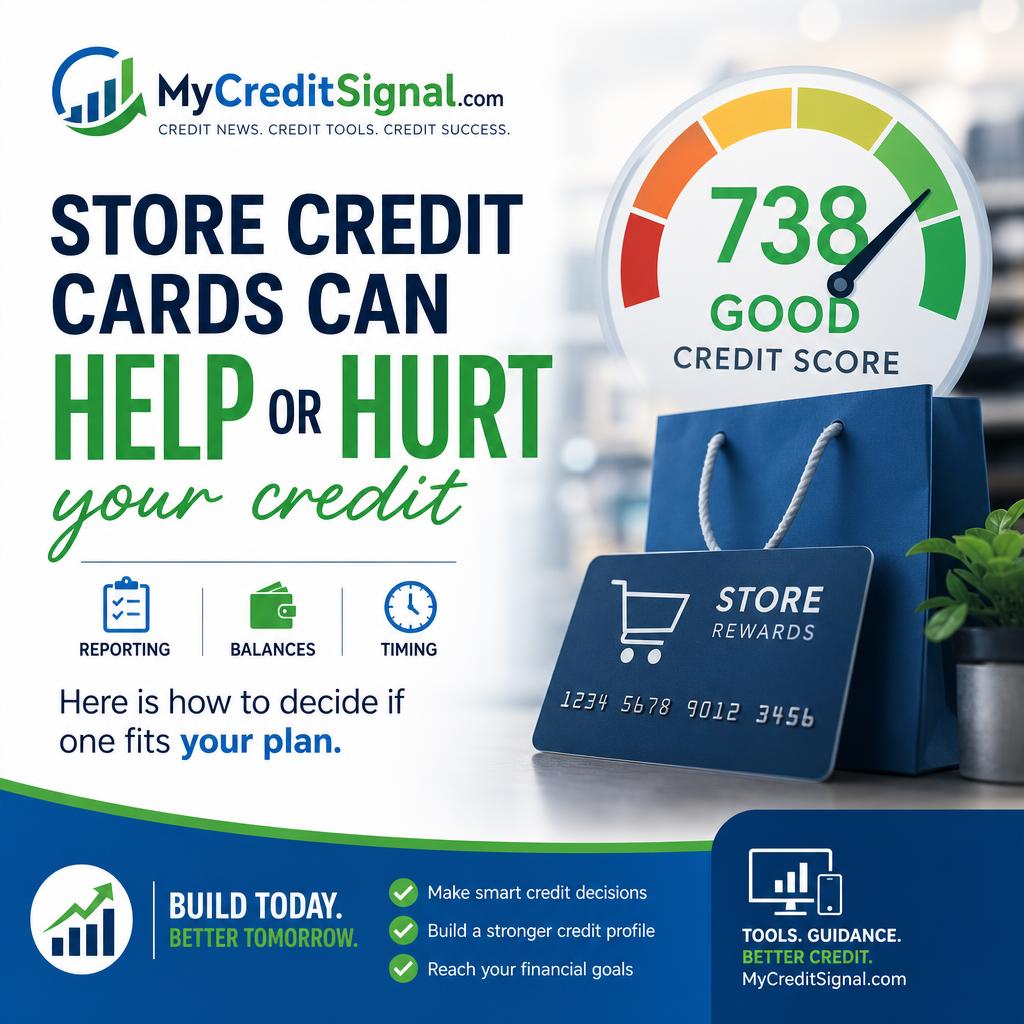
You are checking out at a clothing store, the cashier offers 20% off if you open a card today, and suddenly the decision feels bigger than a one-time discount. That is because store credit cards can affect your credit in multiple directions at once. They may add available credit and help payment history, but they can also trigger a hard inquiry, shorten your average account age, and make high utilization easier to rack up fast.
This guide is for anyone wondering whether store credit cards are good or bad for credit. You will learn how they work, which numbers matter most, when they can help, when they can backfire, and what to do this week if you are considering one.
Contents
- 1 Who should care about store credit cards
- 2 How store credit cards actually affect your score
- 3 The store card decision test before you apply
- 4 The numbers and thresholds that matter most
- 5 When a store credit card can help
- 6 When it is more likely to hurt
- 7 A step by step plan to use one without hurting your credit
- 7.1 Check whether the issuer reports the account
- 7.2 Run the utilization math before the purchase
- 7.3 Decide your payoff deadline before checkout
- 7.4 Set autopay for at least the minimum
- 7.5 Keep the first statement balance low
- 7.6 Avoid multiple new applications this week
- 7.7 Review the card after 90 days
- 8 Mistakes that turn a store card into a credit problem
- 9 What most articles miss about store cards
- 10 What to do first versus later
- 11 FAQ
- 12 Helpful tools and related resources
- 13 Conclusion
Key Takeaway
Store credit cards can help your credit only if the issuer reports the account and you keep balances low, pay on time, and avoid opening one for a discount you cannot afford.
Who should care about store credit cards
Store credit cards matter most for four groups of people.
- Credit builders who want another tradeline and may not qualify for the best general-purpose cards yet.
- Frequent shoppers at one retailer who can use a discount or promotional financing without carrying a balance long term.
- People with high utilization who are tempted to open a new line for breathing room, but could make things worse if spending rises with the limit.
- Anyone applying for major credit soon such as a mortgage or auto loan, because even a small hard inquiry and a new account can be bad timing.
This article may be less useful if you already have strong rewards cards, rarely shop with one retailer, or are using new credit as a way to patch an unstable budget. In that case, the problem may be cash flow, not card choice.
If hard pulls are your main concern, read these hard inquiry facts that can protect your score for a deeper look at timing and application strategy.
How store credit cards actually affect your score
A store card is a credit account, so it can influence the same major scoring factors that general-purpose cards do. The exact impact depends on the scoring model used and your overall profile, but the mechanics are straightforward.
Payment history: If the issuer reports the account to the credit bureaus and you pay on time, the account can strengthen your payment history over time. If you miss payments, it can hurt for the same reason.
Utilization: Your score is influenced by how much of your available revolving credit you use. A new store card can lower your overall utilization if you keep spending flat. But if you fill up the new limit, utilization can still stay high or even rise.
New credit activity: Applying usually creates a hard inquiry. The CFPB notes that hard inquiries from store-card applications can impact your score, though the effect is generally small and short term if the rest of your credit behavior is solid. If you want a fuller explanation of why a score dips after applications, see why credit score drops are often traceable.
Age of accounts: A new account can reduce your average age of credit, which may temporarily drag on your score.
Reporting matters: Experian notes that whether a store card helps your score depends first on whether the issuer reports to the national credit bureaus and second on how you manage the account. If it is not reported, it cannot do much to build your score in the usual way.
That last point is the one many shoppers miss. A store card is not automatically a credit-building tool. It only becomes one when it is reported and managed well. For a broader lens on how account types fit into scoring, try the credit mix analyzer.
The store card decision test before you apply
Here is a simple framework to use in under three minutes at the register. If you answer no to two or more of these, skip the application.
- Will the card be reported? If you cannot confirm reporting to the major bureaus, treat the offer as a shopping perk, not a credit strategy.
- Can you pay the purchase off fast? Promotional financing can be useful, but only if you have a clear payoff plan before the promo ends.
- Will you keep utilization low? A small credit limit can spike utilization quickly if you charge a big purchase.
- Are you avoiding new applications before a larger loan? If a mortgage or auto loan is on your near-term calendar, extra applications may not be worth it.
- Do you shop there often enough? One discount is rarely a good reason to open a line you do not need.
The numbers and thresholds that matter most
You do not need dozens of ratios to make a smart decision. Focus on these.
1. Your utilization percentage
The formula is simple: card balance divided by card limit, and also total revolving balances divided by total revolving limits. Lower is generally better.
Example: say you already have one card with a $1,000 limit and a $400 balance. Your utilization is 40%. If you open a store card with a $500 limit and charge $300 right away, your total balance becomes $700 against $1,500 in total limits. Your overall utilization becomes about 46.7%, which is worse, not better.
Now flip it. If you open that same $500 card but only charge $25 and your original balance stays at $400, your total becomes $425 against $1,500, or about 28.3%. That could be an improvement.
This is why the card itself is not the answer. The balance behavior is.
If you want to test your own numbers before applying, use the credit utilization calculator.
2. The inquiry timing
One hard inquiry usually is not a disaster. Broader credit-score literature often discusses shopping windows of roughly two weeks to 45 days for certain loan types like mortgages and auto loans, though store cards are not typically treated the same way as rate shopping. The practical lesson is still useful: avoid stacking applications close together unless there is a real reason.
3. The promotional financing deadline
Promotional financing can be a plus, but only if the purchase fits your payoff timeline. Since offer terms vary widely by retailer, do the math before signing. If you buy a $600 item and want it gone in 6 months, that means about $100 per month. If you cannot comfortably make that payment, the offer may not save you money.
4. The long-term rate risk
Experian notes that store cards often carry higher APRs than general-purpose cards. Research context here does not give one universal number because rates vary, but the risk is consistent: carrying a balance can erase a sign-up discount quickly.
When a store credit card can help
There are real cases where a store card can be useful.
- You are building thin credit and the issuer reports the account to the major bureaus.
- You make one planned purchase and already have the cash to pay it off quickly.
- You need a small utilization boost by adding available credit, but you will not increase spending with the new line.
- You shop regularly at that retailer and the benefits are meaningful enough to justify keeping the account open.
In those situations, the card may help by adding positive payment history and increasing available credit. FICO and VantageScore models both look at factors like payment history and utilization, though results vary by model and by credit profile. Two people can open the same store card and see different score movements.
When it is more likely to hurt
Store credit cards are more likely to be a bad move when the purchase is emotional, the discount is doing all the convincing, or your budget is already strained.
- You are carrying balances on other cards already. Another card may invite more spending instead of lowering utilization.
- You have a major loan application coming soon. A new inquiry and a new account are often bad timing.
- You are relying on a promo to afford something you cannot otherwise pay for. That is a budget warning sign.
- The issuer does not clearly report the account. Then you are taking on risk without much scoring upside.
- You tend to forget due dates. A single missed payment can cost far more than the checkout discount saved.
Another overlooked issue is credit limit size. Store cards can come with modest starting limits, which means a normal furniture, electronics, or seasonal shopping purchase can push utilization very high on that single account even if your overall profile is decent.
A step by step plan to use one without hurting your credit
Check whether the issuer reports the account
Before applying, ask customer service or review issuer disclosures to confirm the account is reported to the major credit bureaus. If you cannot verify reporting, do not treat the card as a credit-building strategy.
Run the utilization math before the purchase
Add up your current card balances and limits. Then estimate what your balances and total limits would look like after opening the store card. If the purchase would still leave you with high utilization, wait and pay down existing balances first.
Decide your payoff deadline before checkout
Set a payoff schedule in dollars, not intentions. If the purchase is $300 and you want it cleared in 3 months, that is $100 per month. If the number does not fit your budget, skip the card and the purchase.
Set autopay for at least the minimum
This protects your payment history. Then schedule a second manual payment if needed to bring the balance down faster before the statement closes.
Keep the first statement balance low
If your limit is small, even one shopping trip can produce a high reported utilization ratio. Pay part of the balance before the statement date so the reported amount stays modest.
Avoid multiple new applications this week
If you open a store card, hit pause on other credit applications. One inquiry may be manageable; several in a short stretch create noise you do not need.
Review the card after 90 days
Ask two questions: did the card save money, and did it fit your credit plan? If it only led to extra spending, stop using it. If it works well, keep it simple and occasional.
If you want five concrete actions for this week, here they are: verify reporting, calculate utilization, create a payoff amount, enable autopay, and delay any other application until you have seen how the new account settles into your profile.
Mistakes that turn a store card into a credit problem
Opening the card for the discount and carrying the balance
Behavior: You take 10% or 20% off today, then revolve the remaining balance for months. Consequence: The interest cost can outweigh the one-time savings, especially since store cards often have higher APRs than general-purpose cards. Fix: Only open the card if the purchase already fits your payoff plan without stretching your budget.
Assuming a new card automatically lowers utilization
Behavior: You open a new account and immediately use a large share of the limit. Consequence: Utilization can stay high or even rise, hurting the score benefit you expected. Fix: Keep the balance small relative to the limit and pay before the statement closes when possible.
Applying right before a bigger loan
Behavior: You open a store card shortly before shopping for a car loan or mortgage. Consequence: The inquiry and new account can complicate your profile at the wrong time. Fix: Delay optional applications until after the major financing is complete.
Never checking whether the account appears where you expect
Behavior: You assume the card is helping your score but never confirm that it is showing up on your credit reports or credit monitoring tools. Consequence: You may not get the building effect you expected. Fix: Track the account through your normal monitoring routine and look for the tradeline after the first reporting cycle.
What most articles miss about store cards
Most articles stop at a simple yes or no answer. Real life is messier. Here are the nuances that matter.
Store card versus BNPL is not a clean substitute. BNPL products tied to stores have historically not been reported to the major bureaus in the same way as revolving credit cards. That means they may not influence FICO or VantageScore the same way store cards do. If your goal is credit building, do not assume the two products behave alike.
Limit increases can change the picture later. Broader Federal Reserve research on automated credit decisions and limit increases highlights how access to credit can shift over time. A higher limit could lower utilization if spending stays flat, but it can also enable more debt if behavior expands with the limit.
Sometimes the better move is waiting. If your utilization is already elevated or you have recent negative marks, your first task may be cleaning up cash flow and paying balances down, not adding a new retail account. A store card cannot outwork unstable habits.
That is also why store cards are not the first answer for everyone trying to build credit. If your issue is recent score volatility, review the common causes of credit score drops before adding new variables.
What to do first versus later
If you are undecided, use this order.
Do first: confirm reporting, calculate utilization, and check whether you have a major loan application coming up.
Do next: review the promotional financing deadline and set a payoff amount that fits your monthly budget.
Do later: decide whether the account deserves a place in your long-term wallet after 2 to 3 billing cycles. Keep it only if it adds value without increasing spending.
FAQ
Do store credit cards affect my credit score like regular credit cards?
Often yes. If the issuer reports the account, store cards can affect payment history, utilization, inquiries, and account age much like other revolving cards. The exact score impact varies by profile and scoring model.
Can opening a store card improve my score?
It can, but only if the account is reported and you manage it well. Paying on time and keeping balances low are the parts that matter most.
Should I avoid a store card if my utilization is already high?
Usually be careful. A new limit can help only if spending stays controlled. If the new card leads to more charges, high utilization may continue or worsen.
If you want to make this decision with less guesswork, start with the credit utilization calculator to estimate how a new card and balance would affect your ratios. Then use the credit mix analyzer to see whether another revolving account actually fits your broader profile.
For reading that supports the same decision, review hard inquiry facts that can protect your score and common causes of sudden credit score drops.
Authoritative sources used in this analysis include the CFPB issue spotlight on retail credit cards, Experian guidance on whether retail cards affect your score, and Experian guidance on whether store cards can build credit.
Get weekly credit tips, tool updates, and practical guides – free.
Conclusion
Store credit cards are not automatically good or bad for your credit. They are leverage. Used carefully, they can add payment history and available credit. Used casually, they can increase balances, add inquiries, and create more debt than the discount was worth.
Your best next step is simple: run the utilization math, verify reporting, and decide whether the card fits your budget before you apply. If the numbers only work when everything goes perfectly, skip it. If the plan is solid even without the store pitch, then the card may be worth considering.

Leave a Reply
You must be logged in to post a comment.