Contents
A quick self-assessment
You open your credit card app and see a $6,200 balance at 24.99% APR. Your minimum payment is $186, but only a small slice goes toward principal each month. A balance transfer offer with 0% APR for 15 months sounds like a lifeline, but only if it actually lowers your total cost instead of delaying the problem.
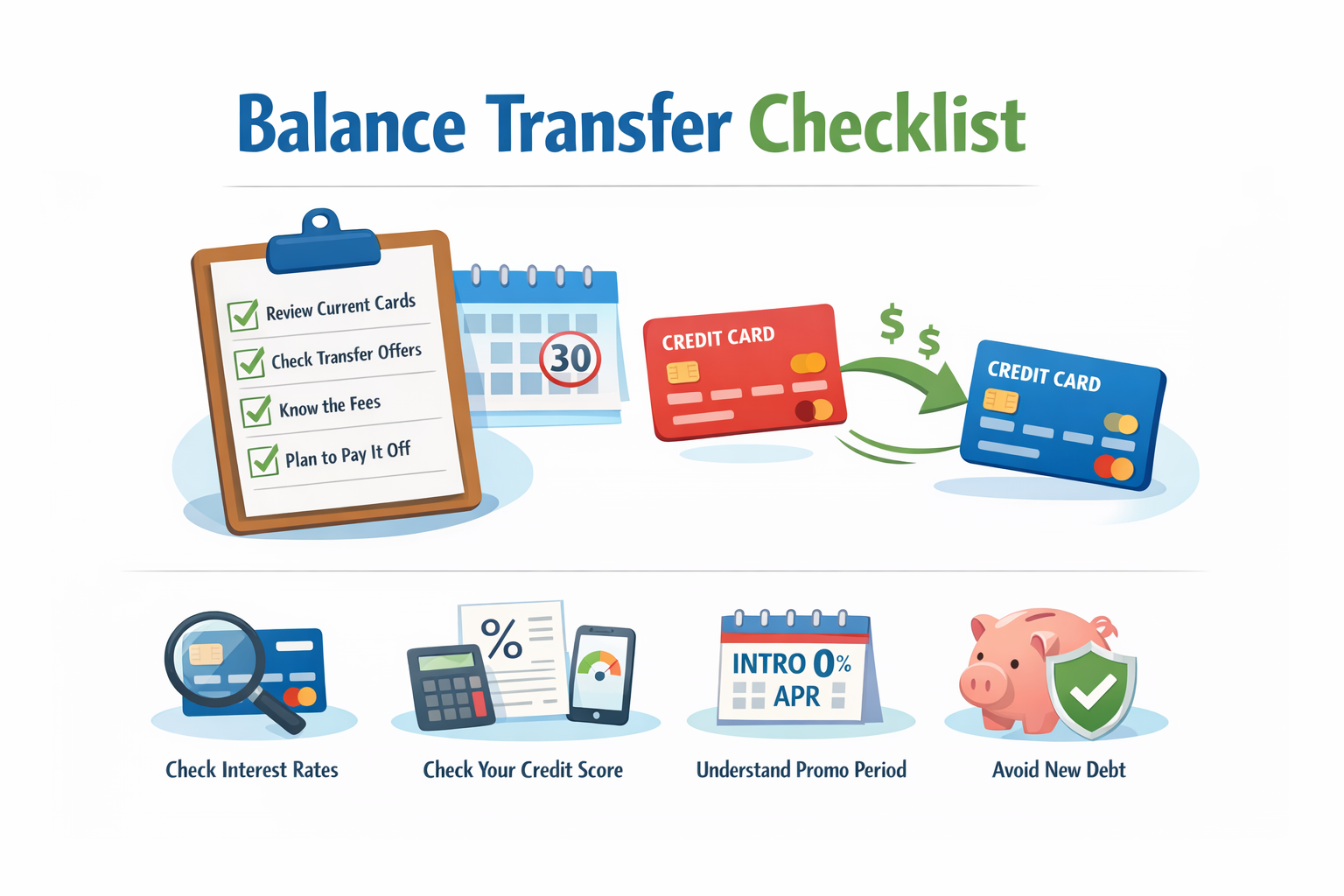
Before you transfer anything, take 10 minutes to assess three numbers: your current balance, your current APR, and the transfer fee. Most balance transfer cards charge 3% to 5% upfront. On a $6,200 transfer, that means paying $186 to $310 immediately. That can still be a smart move if you avoid $1,000 or more in interest, but it is not automatically a win.
Ask yourself two practical questions. First, can you realistically pay off the transferred balance before the promotional period ends? Second, will you stop adding new purchases to the old card or the new one? If the answer to either is no, a balance transfer may give you breathing room without giving you progress.
Understanding the landscape
A balance transfer moves debt from one credit card, usually with a high APR, to another card with a lower promotional APR, often 0% for 12 to 21 months. The goal is simple: reduce interest so more of each payment hits principal. If you are paying 22% to 29% APR now, this can create meaningful savings in a short window.
Here is what many people miss: the promo rate is temporary, and the transfer fee matters. Suppose you transfer $5,000 with a 3% fee onto a card offering 0% for 18 months. Your fee is $150. If you pay off the full $5,000 in 18 months, you may save hundreds compared with staying on a 24% APR card. But if you still owe $2,500 when the intro period ends and the APR jumps to 21.99%, the math changes fast.
There is also a credit score angle. Opening a new card can create a hard inquiry and reduce the average age of your accounts. At the same time, if the transfer lowers your utilization from 78% to 42%, your score may improve. Balance transfers are not magic. They are a tool that works best when paired with a payoff plan, spending control, and clear deadlines.
The approach that works best for different borrowers
Not every borrower should use a balance transfer the same way. If you have a solid credit profile and qualify for a long 0% offer, your best strategy is usually aggressive payoff. That means dividing the transferred balance plus fee by the promo months and setting automatic payments. For example, a $4,120 total balance over 16 months requires about $258 per month. That is a real target, not a vague intention.
If your credit is fair and your approved limit is lower than expected, a partial transfer may still help. Imagine you have $9,000 across two cards but get approved for a $4,000 transfer limit. Move the highest-APR balance first, not the smallest one. A card charging 29.99% costs you much more than one charging 17.99%, so the order matters.
If cash flow is tight, the best use of a balance transfer may be stabilization, not speed. Lowering your monthly interest gives you room to stop falling behind. In that case, pair the transfer with a lean budget and a backup plan such as a hardship review. Readers comparing options can browse more debt and credit education on Our Blog and explore calculators at Free Tools.
Step-by-step walkthrough
Step 1: List every balance and APR. Write down each card, its balance, minimum payment, and APR. If you have $2,800 at 27.24%, $1,900 at 21.99%, and $1,100 at 18.49%, you now know where interest is doing the most damage. This simple list tells you what to transfer first if your new limit is smaller than your total debt.
Step 2: Calculate the real savings after fees. A 0% offer sounds great, but the fee changes the equation. Use the Balance Transfer Savings Calculator to compare your current interest cost with the transfer fee and promo period. If your fee is $240 but your projected interest savings are $1,050, the move is probably worthwhile.
Step 3: Build a payoff deadline before you apply. Do not wait until the card arrives to decide your payment plan. Divide the total transferred amount by the number of promo months, then round up. If you transfer $6,180 including fees and have 15 months, aim for at least $415 per month so you finish early and leave no balance exposed to the post-promo APR.
Step 4: Protect your budget. A balance transfer fails when the old card gets run up again. Open your monthly budget and find the category that caused the debt to grow in the first place, whether that was groceries, takeout, travel, or irregular bills. The Zero-Based Budget Builder can help you assign every dollar before the month starts.
Step 5: Set autopay for more than the minimum. Minimum payments keep the account current, but they will not guarantee payoff before the promo ends. Set autopay for your target amount, not just the minimum due. If your target is $372, schedule $372. Then add a calendar reminder 45 days before the promo expiration date.
Step 6: Stop new charges from sneaking in. Some balance transfer cards charge interest on new purchases right away unless the card also has a 0% purchase APR. Read the terms. If there is any doubt, use the new card only for the transfer and nothing else. Put recurring subscriptions and daily spending on a separate card that you pay in full each month.
Step 7: Track progress monthly. Check your balance after each statement closes. Your payoff pace should be visible. If your balance is not dropping by roughly one-fifteenth each month on a 15-month plan, adjust immediately. The https://mycreditsignal.com/tools/debt-payoff-milestone-tracker/ is useful for keeping the finish line visible and measurable.
Mistakes that set people back
Paying attention to the promo rate but ignoring the fee. A 5% fee on a $7,000 transfer is $350. That may still be cheaper than paying 26% APR for a year, but you need actual numbers, not assumptions. Always compare total cost, not just headline APR.
Keeping the old spending habits. One of the most common mistakes is treating the old card like it is available again the moment the balance moves. That creates a double-debt problem: the transferred balance on the new card plus fresh charges on the old one. If you cannot trust yourself with open credit, freeze the card, remove it from saved wallets, and keep it out of reach.
Missing the payoff window by a few months. This is expensive because even a small leftover balance can start accruing interest at 20% or more. For example, leaving $1,800 unpaid after a 0% period ends can cost roughly $30 to $35 in interest in the first month alone, depending on the APR. Build in a cushion by aiming to finish one month early.
Applying without checking your cash flow. A balance transfer is not a substitute for a workable monthly plan. If your budget is already short by $250 every month, moving the debt will not solve the root issue. You need either lower expenses, more income, or a different debt strategy.
Using the new card for rewards chasing. A 2% cash back bonus is not worth paying 21.99% interest on new purchases. Keep the purpose narrow. This card is for debt reduction, not for points, miles, or convenience spending.
Measuring your progress
The first metric to track is your monthly principal reduction. If you started with $5,150 after fees and your plan is 14 months, you should reduce the balance by about $368 per month. If you only reduce it by $240, you are behind and need to increase payments, cut spending, or add income before the promo clock runs out.
The second metric is utilization. Say your total credit limits are $10,000 and your balances total $7,000 before the transfer. If a new card adds a $6,000 limit and you transfer $5,000, your overall utilization can drop from 70% to around 43.75%, assuming no new spending. That may help your credit profile over time, especially if you keep statement balances low.
The third metric is interest avoided. Compare what you would have paid on the original APR with what you paid in transfer fees and any residual interest. This is where the move proves its value. If you avoided $920 in interest by paying a $150 fee, that is a net savings of $770. That money can go to your emergency fund, another debt, or a future financial buffer.
- Pull your latest card statements and list every APR, balance, and minimum payment in one place.
- Run the numbers with the balance transfer savings calculator before applying for anything.
- Set a target payment that pays the balance off at least 30 days before the promo ends.
- Remove your old card from online stores and mobile wallets to prevent backsliding.
- Review your budget and cut one recurring expense worth at least $25 to $50 per month to support the payoff plan.
Resources and tools
You do not need to guess whether a balance transfer will help. Start with the Balance Transfer Savings Calculator to compare fees, promo periods, and projected savings. This is the fastest way to see whether a transfer saves $100 or $1,000.
Next, tighten your monthly plan with the Zero-Based Budget Builder. A transfer works best when every dollar has a job and your target payment is already built into your monthly spending plan. If your budget is inconsistent, the payoff timeline will be too.
Finally, use the Debt Payoff Milestone Tracker to monitor progress and stay motivated. Seeing your balance move from $5,000 to $3,800 to $2,400 to $0 is powerful. Small visible wins make it easier to stay disciplined for 12 to 18 months.
Join thousands of readers getting actionable tips to raise their credit score, eliminate debt, and build lasting financial confidence.
Final thoughts
A balance transfer can be one of the smartest debt payoff moves available, but only when the math, timeline, and behavior all line up. The best-case scenario is clear: you pay a 3% to 5% fee once, avoid hundreds in interest, and eliminate the balance before the promotional APR expires. The worst-case scenario is also clear: you pay the fee, keep spending, miss the deadline, and end up with the same debt problem wearing a different label.
Keep the strategy simple. Run the savings calculation, set a payoff amount, automate payments, and stop new charges from piling up. If you want a practical next step, use the tools above to test your numbers and build a plan you can actually follow. A balance transfer is not about buying time. It is about using time wisely.
Leave a Reply
You must be logged in to post a comment.