Your car battery dies on Tuesday. Rent is due on Friday. Your checking account has $86 left after groceries. That is the exact moment an emergency fund stops being a nice idea and becomes a survival tool. If you are trying to create an emergency fund budget on a low income, this guide is for you. You do not need a perfect salary, a clean slate, or huge monthly leftovers to get started. You need a realistic target, a simple system, and a few weekly moves that protect your cash flow. By the end, you will know how much to save first, how fast to save it, and what to do when your budget already feels tight.
Contents
- 1 When a starter emergency fund makes the biggest difference
- 2 The core idea behind an emergency fund budget
- 3 The dollar targets that actually make sense on low income
- 4 What to do first versus later
- 5 A step by step plan to build your fund on a tight budget
- 5.1 1. Pick one starter goal and one deadline
- 5.2 2. Open or designate a separate savings spot
- 5.3 3. Save from each paycheck, not from leftovers
- 5.4 4. Cut three low-value expenses this week
- 5.5 5. Create one small income boost
- 5.6 6. Use windfalls strategically
- 5.7 7. Define what counts as an emergency
- 5.8 8. Refill immediately after using it
- 5.9 9. Track progress weekly
- 5.10 Five actions you can take this week
- 6 Mistakes that slow down emergency savings
- 7 What most advice misses about tight budgets
- 8 FAQ
- 9 Helpful tools and related resources
- 10 The bottom line
When a starter emergency fund makes the biggest difference
This advice is for people who have regular bills, limited wiggle room, and want to stop every small crisis from turning into new debt. It fits workers paid weekly, every two weeks, or on inconsistent schedules, especially if money tends to run out before the next paycheck.
A starter emergency fund is most useful if you:
- Have less than $500 in savings
- Often use a credit card for surprise costs
- Need a buffer for gas, medicine, car repairs, co-pays, or a missed shift
- Are paying down debt but keep getting thrown off by small emergencies
This approach may need adjusting if you are facing eviction, utility shutoff, active collections pressure, or income loss right now. In those cases, immediate stabilization matters first: housing, food, transportation to work, and minimum debt payments. If your income is extremely unpredictable, your first goal may be building a one-paycheck buffer rather than aiming for a traditional three to six months of expenses.
The core idea behind an emergency fund budget
An emergency fund budget is simply a spending plan that gives a job to your future cash before you accidentally spend it. Instead of saving whatever is left at the end of the month, you decide in advance how much goes to emergency savings every week or every paycheck.
That shift matters because most tight budgets do not produce random leftovers. Savings usually happens only when it is built into the plan.
Think of your emergency fund in layers:
- Layer 1: $250 to $500 for minor surprises
- Layer 2: $1,000 for more serious but common emergencies
- Layer 3: one month of essential expenses
- Layer 4: three to six months of essentials for a deeper safety net
If your budget is tight, Layer 1 is not too small to matter. A $400 cushion can keep a tire replacement, urgent prescription, or school expense from becoming high-interest debt. That is real progress.
To map out what you can set aside from each paycheck, use the paycheck budget allocator. If you want a concrete target based on your expenses, the emergency fund calculator can help you choose a savings goal that matches your situation.
The dollar targets that actually make sense on low income
Many articles jump straight to three to six months of expenses. That is a solid long-term goal, but it can feel impossible when your current gap is only $40 a week. A better approach is to break the total into milestones with specific deadlines.
Here is a practical framework:
- Start with $300 if your budget is very tight and you are just trying to stop relying on overdrafts or credit for every surprise.
- Aim for $500 if you drive to work, have kids, or have out-of-pocket medical costs that pop up a few times a year.
- Build toward $1,000 once the first target is done and your cash flow is more stable.
Now break that into weekly numbers:
- $300 in 12 weeks = $25 per week
- $500 in 20 weeks = $25 per week
- $500 in 10 weeks = $50 per week
- $1,000 in 40 weeks = $25 per week
- $1,000 in 26 weeks = about $39 per week
If you are paid every two weeks, $25 a week is about $50 per paycheck. If you are paid twice a month, you can target $54 per check to reach roughly $650 in six months. Specific numbers turn a vague goal into a trackable plan.
A useful decision framework is this: save enough to cover your most likely emergency, not your worst possible one. For many households, the most likely hit is between $150 and $600. Think car battery, doctor visit, missed hours, urgent pet expense, or replacing a broken phone screen you need for work.
A simple example
Say you take home $1,900 a month.
- Rent and utilities: $950
- Groceries: $320
- Transportation: $180
- Phone and internet: $110
- Insurance: $140
- Minimum debt payments: $120
- Other essentials: $40
That leaves $40 per month on paper, which is not enough to build savings quickly. But if you cut takeout by $40, switch one subscription off for $18, and bring in $25 a week through one extra shift or side task, you can free up about $158 a month. That is enough to save a little under $40 a week and reach $500 in around 13 weeks.
What to do first versus later
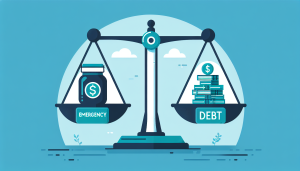
If you are balancing debt and savings, the order matters. You do not want to throw every extra dollar at debt only to swipe the card again when life happens. But you also do not want large savings earning little interest while high-rate debt grows fast.
For many people, this order works well:
- First: stay current on essential bills and minimum debt payments
- Second: build a starter emergency fund of $300 to $1,000
- Third: increase debt payoff once the starter fund is in place
- Later: expand savings toward one month of essentials and beyond
If you are unsure whether to push harder on debt or cash savings right now, compare both paths with the emergency savings vs debt priority tool. You can also use the debt free date calculator to see how changing your payment strategy affects your payoff timeline.
The exception is if you have no savings at all and your life has regular disruptions. In that case, even a $250 cushion can protect your debt plan by reducing new borrowing.
A step by step plan to build your fund on a tight budget
1. Pick one starter goal and one deadline
Do not start with a huge number. Choose $300, $500, or $1,000 and attach a date to it. A goal without a deadline stays abstract. A clear target like save $500 in 16 weeks means you need about $31 a week.
2. Open or designate a separate savings spot
If your emergency money sits in checking, it will get absorbed by normal spending. Use a separate savings account if possible. If not, create a dedicated sub-account or even a cash envelope only for true emergencies. The key is separation, not perfection.
3. Save from each paycheck, not from leftovers
Treat savings like a bill. If payday is Friday, move the money Friday. Even $15 or $20 counts. Consistency matters more than large deposits. Someone saving $25 a week builds $1,300 in a year before interest.
4. Cut three low-value expenses this week
Look for cuts that free cash without breaking your life. Examples:
- Pause one streaming service for 60 days and save $12 to $20 a month
- Reduce takeout by one meal a week and save $40 to $80 a month
- Switch to store brands on 10 grocery items and save $20 to $35 a month
- Lower impulse convenience spending at gas stations or delivery apps and save $15 to $30 a week
You do not need a full budget overhaul. You need enough room to create momentum.
5. Create one small income boost
On a tight budget, expense cuts alone may not be enough. Try one temporary income move for 8 to 12 weeks:
- One extra shift per week
- Selling unused items worth $100 to $300 total
- Pet sitting, delivery, tutoring, or weekend gig work
- Picking up overtime only until the starter fund is complete
If you bring in an extra $60 a week for two months and save all of it, that is about $480.
6. Use windfalls strategically
Tax refunds, birthday cash, rebates, and small bonuses can speed things up fast. A simple split works well: 50 percent to your emergency fund, 30 percent to debt, 20 percent to current needs or planned spending. If your savings is still under $500, you may choose to send a bigger share there.
7. Define what counts as an emergency
This step prevents backsliding. Good examples include urgent medical costs, essential car repairs, replacing broken work equipment, a sudden travel need for family emergency, or covering basics after a short-term income drop. Not emergencies: holiday shopping, concert tickets, routine maintenance you could plan for, or sales that feel urgent.
8. Refill immediately after using it
Your emergency fund will eventually be used. That is not failure. Once the emergency passes, shift back into refill mode. If you spend $220 on a car repair, your next goal is to replace that $220 before making nonessential upgrades elsewhere.
9. Track progress weekly
Check the balance once a week, not ten times a day. Weekly review is enough to confirm whether your transfer happened and whether you need to adjust next week. Too much tracking can make small fluctuations feel discouraging.
Five actions you can take this week
- Choose a starter goal of $300, $500, or $1,000
- Set an automatic transfer of at least $15 to $50 per paycheck
- Cancel or pause one expense for the next 30 days
- Sell one unused item and move the money to savings the same day
- Write your emergency rules in one note on your phone
- Use the emergency fund calculator to set a realistic target
Mistakes that slow down emergency savings
Saving only when money is left over
Behavior: You wait until the end of the month to see what remains.
Consequence: Tight budgets usually leave nothing, so savings never becomes consistent.
Fix: Move the money on payday first, even if the amount is small.
Making the first goal too large
Behavior: You aim for $5,000 immediately because that sounds responsible.
Consequence: The number feels so far away that you stop after a few weeks.
Fix: Use milestones. Reach $300, then $500, then $1,000.
Using the fund for non-emergencies
Behavior: You tap savings for birthdays, sales, or things you forgot to plan for.
Consequence: The balance never stabilizes, and real emergencies still push you into debt.
Fix: Set a written rule for what qualifies and keep separate sinking funds for predictable expenses later.
Ignoring small leaks in the budget
Behavior: You focus only on big cuts and miss the $8, $14, and $22 charges adding up.
Consequence: You feel stuck even though $100 or more per month may be leaving quietly.
Fix: Review the last 30 days of transactions and circle recurring low-value spending first.
What most advice misses about tight budgets
The hardest part of building emergency savings is not math. It is volatility. Hours change. Kids get sick. Prices jump. A plan that looks good on paper can fail if it has no flexibility.
That is why a percentage-only rule does not always work. Telling everyone to save 20 percent sounds neat, but someone with $150 left after essentials may need a flat-dollar target instead. On a low income, saving $20 consistently can beat saving 10 percent inconsistently.
Another overlooked issue is the difference between emergencies and irregular expenses. Back-to-school shopping, annual memberships, and oil changes are not emergencies if you know they are coming. Once your starter emergency fund is built, your next improvement may be adding sinking funds for those predictable costs. That keeps your emergency savings from doing every job.
This advice also may not fit if your highest risk is income interruption rather than surprise bills. For example, gig workers or seasonal workers may need to focus first on a one-paycheck buffer. If one missed week of work would disrupt rent or groceries, that is the target that matters most.
Finally, if your debt has very high interest and you already have $1,000 or more set aside, it may make sense to shift more aggressively toward payoff. The right answer depends on the size of your current buffer, the stability of your income, and how often emergencies actually happen in your household.
FAQ
How much should I have in an emergency fund if I live paycheck to paycheck?
Start with $300 to $500. That amount is often enough to handle smaller emergencies without adding new debt, and it is more realistic than aiming for several months of expenses right away.
Should I save money or pay off debt first?
Usually both, but in stages. Stay current on bills and minimum payments, build a small emergency cushion, then increase debt payoff. This can prevent new borrowing when unexpected costs pop up.
Where should I keep my emergency fund?
Keep it separate from your checking account but easy to access. The best place is a dedicated savings account or another clearly labeled account you will not spend from casually.
If you want help choosing a target, start with the emergency fund calculator. To organize each paycheck so savings fits your bills, try the paycheck budget allocator. If you are balancing savings against debt payoff, compare your options with the emergency savings vs debt priority tool. And if your larger goal is reducing monthly obligations over time, the debt free date calculator can show how faster payoff changes your timeline.
Get weekly credit tips, tool updates, and practical guides – free.
The bottom line
An emergency fund budget is not about finding huge amounts of extra money. It is about protecting your next paycheck from the next surprise. If your budget is tight, start smaller than you think, save on a schedule, and define emergencies clearly. A $25 weekly habit can become a $300, $500, or even $1,000 buffer faster than it seems. Pick your first target today, set the transfer, and let consistency do the heavy lifting.
Leave a Reply
You must be logged in to post a comment.