Contents
A quick self-assessment
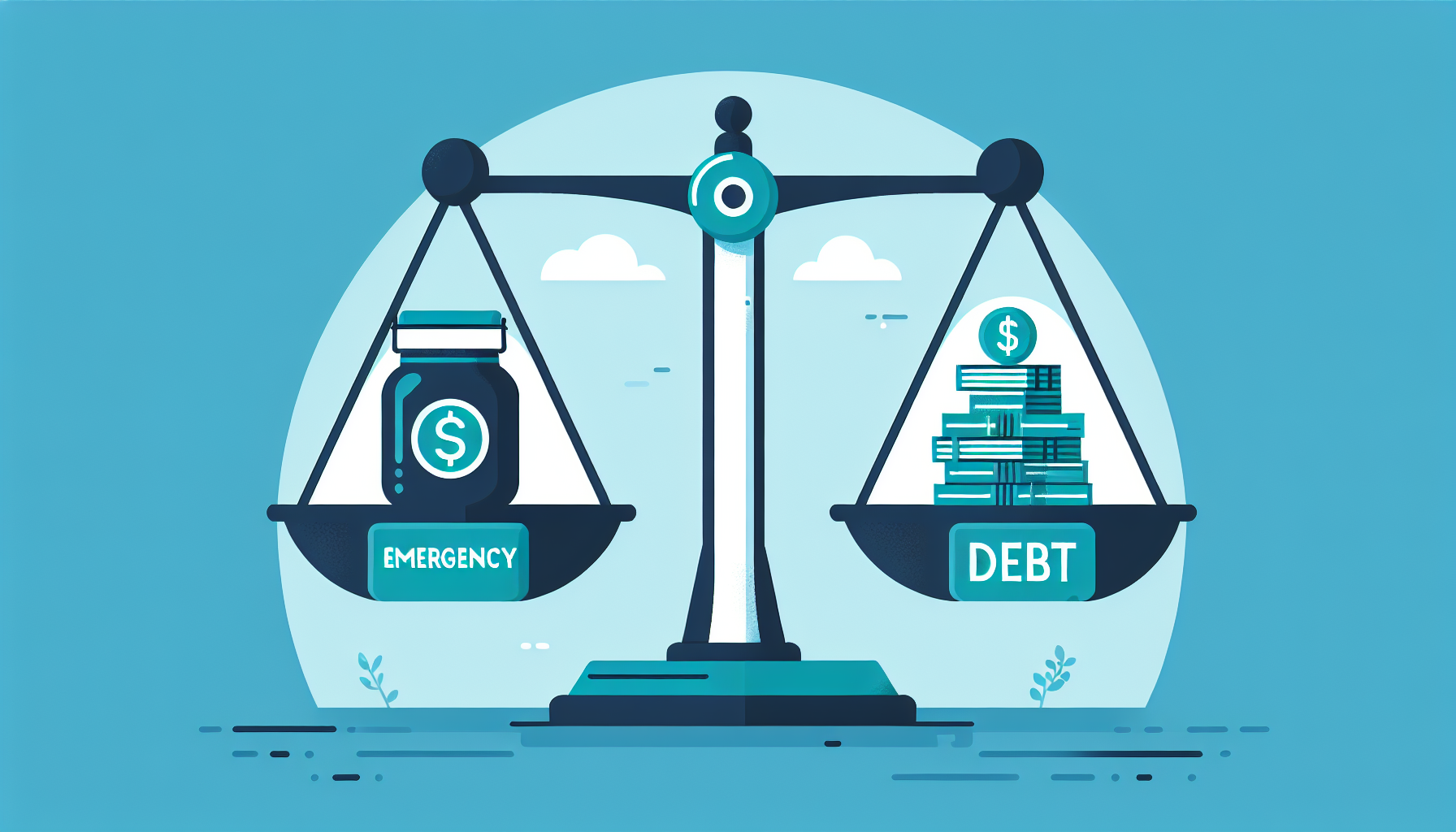
You get hit with a $780 car repair two days before your credit card payment is due. Your checking account has $112 left, your card balance is $4,600 at 24.99% APR, and you have no emergency savings. That one surprise bill can trigger a chain reaction: a missed payment, a new balance, more interest, and a deeper hole next month. This is exactly why the emergency fund versus debt payoff decision matters so much.
Many people assume there is one universal answer. There is not. A household with $8,000 in savings and a stable salaried job should make a different choice than someone with gig income, two maxed-out cards, and no cash cushion. The right move depends on your interest rates, your monthly cash flow, how predictable your income is, and how often unexpected expenses show up.
Start by asking yourself four questions. First, do you have at least $500 to $1,000 in cash for true emergencies? Second, are you carrying high-interest debt above 20% APR? Third, is your income steady, or does it swing by hundreds of dollars month to month? Fourth, have you used credit cards for emergencies in the last 6 months? Your answers will tell you whether saving first, paying debt first, or doing both at the same time makes the most sense.
If you want a fast diagnostic, look at your last 90 days of bank and card activity. Count how many surprise expenses showed up, how much interest you paid, and whether you had to put basics like groceries, gas, or copays on a credit card. Those numbers matter more than generic advice. A plan should fit your real life, not a perfect spreadsheet.
Understanding the landscape
At first glance, debt payoff seems like the obvious winner. If a credit card charges 22% APR, every extra dollar you send to the balance saves expensive interest. On a $5,000 balance at 22% APR, making only minimum payments can stretch payoff into years and cost well over $1,000 in interest. From a math perspective, attacking that debt aggressively is powerful.
But math is only half the picture. Without emergency savings, even a small setback can push you right back onto the card you were trying to pay off. A $350 tire replacement or a $600 urgent care bill can erase weeks of progress. That is why many people pay down debt, feel good for a month, then watch the balance climb again after a single emergency.
An emergency fund changes the pattern. It gives you a buffer so you do not have to borrow every time life gets expensive. For most households, a starter emergency fund of $500 to $1,500 is enough to absorb the most common shocks: a deductible, a repair, a travel emergency, or a temporary income dip. It is not meant to cover 6 months of living expenses right away. It is meant to stop the debt cycle from getting worse.
There is also a psychological benefit. Seeing even $750 in a savings account can reduce panic and improve decision-making. People with a cash cushion are often more consistent with debt payoff because they are not constantly afraid that one bad week will undo everything. Stability makes follow-through easier.
The approach that works best for your situation
There is no single formula, but there are clear patterns. If you have zero emergency savings and high-interest debt, the best move for most people is a hybrid approach: build a small starter fund first, then split your extra money between debt payoff and savings until you reach a stronger cushion. This keeps you from relying on cards while still reducing interest.
If your job is stable, your monthly income is predictable, and your essential expenses are low relative to income, you may only need a starter fund of $500 to $1,000 before going hard on debt. For example, if your rent, transportation, and food are consistent and you have family support in an emergency, a smaller cash reserve may be enough. In that case, every extra dollar after the starter fund should attack balances above 18% APR.
If your income is irregular, your household has children, or your car and housing costs are unpredictable, you likely need a larger first target. Think $1,500 to $2,500 before shifting heavily into debt payoff. A freelancer whose income swings from $2,800 one month to $4,700 the next needs more flexibility than a salaried worker with paid sick time and fixed paydays.
If your debt interest rate is low, the balance tips more toward savings. A 4% auto loan or a 5% federal student loan is not as urgent as a 26% credit card. In that case, building a stronger emergency fund may create more real-world protection than rushing to prepay low-rate debt. The higher the APR, the stronger the case for faster payoff after you have a basic cushion.
One more category matters: people already missing payments. If you are behind on bills, protecting your payment history should come before trying to build a large savings pile. Catch up on minimums, stop new late fees, and stabilize your monthly obligations first. A late payment can hurt your credit far more than keeping an extra $200 in savings while accounts fall behind.
Step-by-step walkthrough
Step 1 is to define your minimum survival number. Add up one month of essential expenses only: housing, utilities, groceries, insurance, transportation, prescriptions, and minimum debt payments. Do not include dining out, subscriptions, or extra debt payments. If that total is $2,350, you now know what one month of bare-bones life costs.
Step 2 is to set a starter emergency fund target. For many readers, $1,000 is a strong first milestone. If your car is older, your income is variable, or you support dependents, choose $1,500 or more. Put this money in a separate savings account so it is available but not mixed into daily spending.
Step 3 is to stop the leak in your monthly budget. Review the last 30 days and cut enough expenses to free at least $100 to $300 per month. That could mean canceling two subscriptions worth $38, reducing takeout by $120, switching insurance to save $45, and trimming impulse spending by $60. Small cuts add up quickly when they are automatic.
Step 4 is to protect every minimum payment. This is non-negotiable. Missing a payment can trigger late fees, penalty APRs, and credit damage. Set up autopay for at least the minimum due, then make extra payments manually when cash flow allows.
Step 5 is to choose your split. A practical option is 70/30 while building your starter fund and paying debt at the same time. For example, if you free up $400 per month, send $280 to debt and $120 to savings until your emergency fund hits the target. After that, shift to 90/10 or even 100/0 toward high-interest debt until the expensive balances are gone.
Step 6 is to target debt strategically. If motivation is your main problem, paying off the smallest balance first can create momentum. If total interest cost is the priority, attack the highest APR first. Either approach works better when you can stick with it for at least 6 to 12 months.
Step 7 is to raise your emergency fund after the worst debt is under control. Once your credit card balances are significantly reduced or paid off, work toward 1 month of essential expenses, then 3 months over time. If your minimum survival number is $2,350, your long-term emergency fund goals might be $2,350 first, then $7,050 later.
Mistakes that set people back
Trying to save 6 months of expenses before paying high-interest debt
This sounds responsible, but it can be very expensive when your credit card APR is 20% to 29%. If you spend 18 months building a large cash reserve while carrying a $6,000 card balance at 24.99%, interest keeps compounding in the background. A better move is usually to build a starter fund first, then attack the high-interest debt hard.
The fix is to separate short-term protection from long-term security. Save enough to avoid new borrowing, then redirect aggressively toward expensive balances. You can expand your emergency fund later once the interest drag is gone.
Throwing every spare dollar at debt with no cash buffer
This is the opposite problem. It looks disciplined on paper, but it often fails in real life. One moderate emergency can put you right back on the card, sometimes at a higher balance than before because of fees and interest.
The fix is simple: keep a starter reserve even if it feels small. A $750 to $1,000 buffer will not solve every problem, but it can prevent new debt from replacing the old debt you just paid down.
Ignoring irregular expenses
Many budgets fail because they only account for monthly bills. Car registration, annual memberships, school costs, holiday spending, and quarterly insurance payments are predictable even if they are not monthly. When they arrive, they feel like emergencies even though they are not.
The fix is to create sinking funds for known non-monthly costs. If car maintenance averages $600 per year, set aside $50 per month. If holiday spending is usually $900, save $75 per month starting early instead of using credit in December.
Keeping savings in the same account as spending money
When emergency savings sits in checking, it is easy to spend it on convenience purchases. A few $40 restaurant orders and a weekend trip can quietly drain what was supposed to be your safety net.
The fix is to keep emergency money separate and label it clearly. A dedicated savings account named “Emergency Only” creates friction and helps you preserve the money for actual surprises.
Measuring your progress
You do not need a complicated dashboard, but you do need a few numbers. Track your emergency fund balance, total high-interest debt, minimum monthly debt payments, and the amount of interest you paid this month. If your savings rises from $300 to $900 while your card debt falls from $4,800 to $3,900, that is meaningful progress even if you are not debt-free yet.
Another useful metric is your debt-to-income ratio. Lenders care about how much of your gross monthly income goes toward debt payments because it affects borrowing risk. If your minimum debt payments total $850 and your gross monthly income is $4,000, your DTI is 21.25%. Lower is generally better, and reducing that number can improve your flexibility for future goals.
Watch your reliance on credit for emergencies too. A strong sign that your plan is working is that surprise costs are handled with cash instead of plastic. If you go 90 days without adding new debt for unplanned expenses, you are building real financial resilience, not just moving numbers around.
Set milestone dates. For example: reach $1,000 in emergency savings by June 30, pay off Card A by August 15, reduce total revolving debt by 20% in 6 months, and build one month of essential expenses within 12 months. Specific targets make it easier to adjust when life changes.
Resources and tools
Using the right tools can make this decision much less stressful. If you are unsure whether to direct your next extra $200 toward savings or debt, start with the Emergency Fund vs Debt Payoff Priority Tool. It helps you compare your situation based on risk, debt cost, and cash flow instead of relying on guesswork.
To tighten up your monthly plan, the Zero-Based Budget Builder can help you assign every dollar a job. That is especially useful when you are trying to fund savings and debt payoff at the same time. If you want to see how debt payments affect borrowing readiness, check the Debt-to-Income Calculator.
For more practical guidance, explore the full tools page to find calculators and planners that fit your next step. You can also browse the latest strategies on the blog if you want more examples on budgeting, payoff methods, and credit-building habits.
Join thousands of readers getting actionable tips to raise their credit score, eliminate debt, and build lasting financial confidence.
Final thoughts
The best answer to emergency fund versus debt payoff is usually not all-or-nothing. For most people, the winning sequence is: protect minimum payments, build a starter emergency fund, then attack high-interest debt aggressively while continuing to save in smaller amounts. That approach lowers the chance that one surprise bill will undo your progress.
If you need a simple rule, use this one: save $500 to $1,500 first, depending on how unstable your income and expenses are, then focus on debt with the highest interest rate. Once expensive balances are under control, grow your emergency fund toward one month of essential expenses and eventually 3 months or more. Progress does not have to be perfect to be powerful.
The key is to choose a plan you can follow for the next 90 days, not just the next 9 days. Run your numbers, automate the basics, and make your next extra dollar intentional. A small cushion plus a focused payoff plan can change your finances faster than chasing the “perfect” answer.
Leave a Reply
You must be logged in to post a comment.