
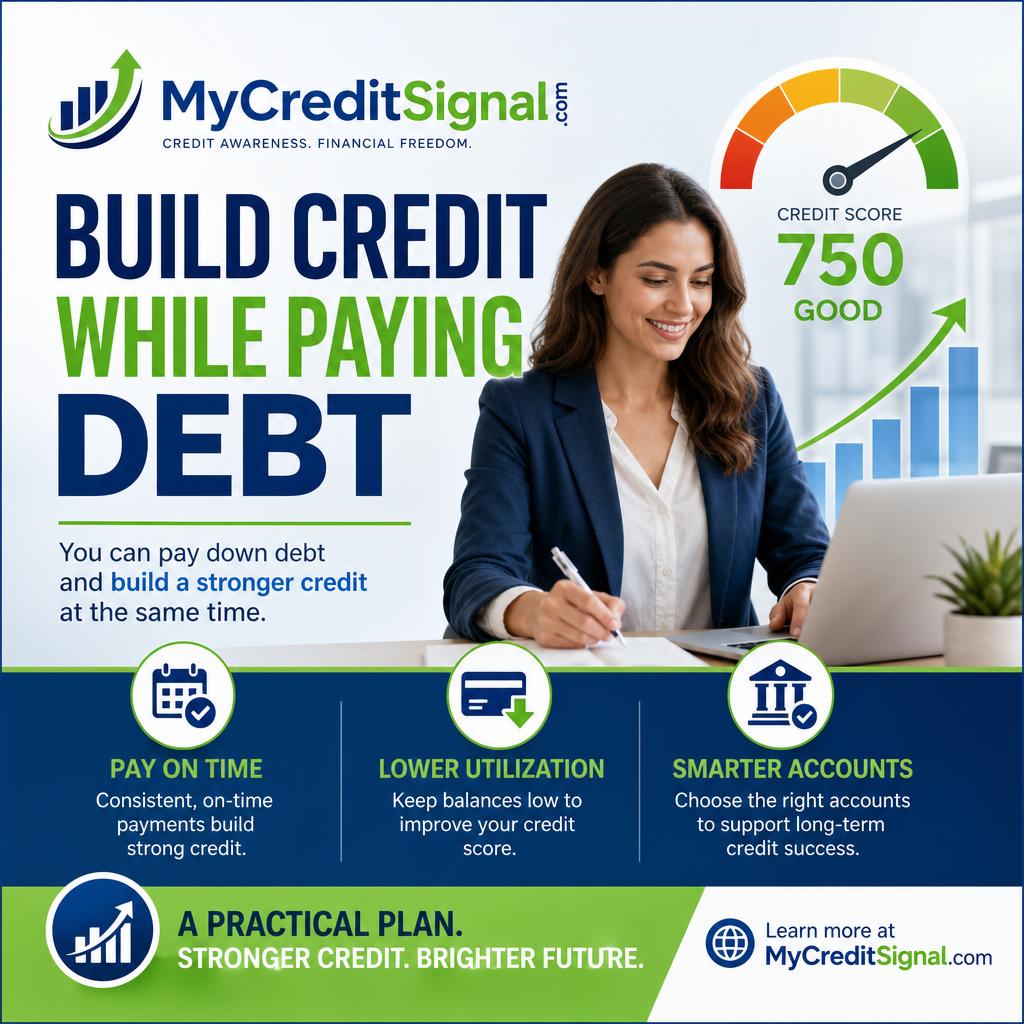
If you are sending every extra dollar to debt and still hoping your credit score improves, you are not thinking about money the wrong way. You are just dealing with two systems at once. One system rewards lower balances. The other rewards steady payment history, open accounts, and healthy utilization. That is why someone can aggressively pay debt and still feel disappointed by slow score movement.
This guide is for people who want to build credit while paying debt without opening random accounts or stretching a tight budget. You will learn what to prioritize first, which numbers matter most, and how to use a dual strategy that improves cash flow and credit profile over time. Results can vary by credit profile and scoring model, but the habits below are the ones most likely to matter.
Contents
- 1 Who this strategy is for and who should pause
- 2 Why paying debt and building credit are not the same job
- 3 The numbers that matter most right now
- 4 A simple decision framework for what to do first
- 5 A realistic example with numbers
- 6 Your step by step plan for the next 30 days
- 6.1 List every debt and separate revolving from installment
- 6.2 Automate at least the minimum on every reported account
- 6.3 Target the card with the worst utilization, not just the highest balance
- 6.4 Stop adding new card balances during the reset period
- 6.5 Use one builder product only if it fits your budget
- 6.6 Check whether rent reporting is available
- 6.7 Track progress with one payoff and one credit metric
- 7 Mistakes that slow both payoff and score gains
- 8 What most articles miss and when this advice changes
- 9 FAQ
- 10 Helpful tools and related resources
- 11 Conclusion
Key Takeaway
You can build credit while paying off debt by protecting on-time payments first, then lowering revolving balances to better utilization levels instead of chasing every debt equally.
Who this strategy is for and who should pause
This approach fits you if you have active debt, at least one account that reports to the credit bureaus, and enough income to cover minimum payments consistently. It is especially useful if your score is being held back by a mix of high credit card balances, thin payment history, or both.
It is a strong fit for:
- People carrying credit card balances but trying to avoid new damage
- Borrowers with installment debt who want better score habits while paying it down
- Renters or newer borrowers deciding whether to add a credit-building product
- Anyone trying to reach more favorable lending territory, often around the 700 range used by many lenders as a rough good-credit benchmark
This may not be the best first move if you cannot cover minimum payments, are facing immediate collection pressure, or have no room in your budget for stabilization. In that case, cash-flow triage comes before score optimization. If your budget is very tight, read Build Credit Low Income the Smart Way for options that put less strain on your monthly finances.
Why paying debt and building credit are not the same job
The confusion starts here: paying debt is a cash-flow goal, while building credit is a reporting goal. They overlap, but they are not identical.
According to the CFPB, timely payments are the most reliable way to build a positive payment history, and payment history is the biggest driver of most credit scores. The CFPB also explains that payment history and credit utilization are among the most influential factors in many scoring models. That means the highest-impact moves are usually:
- Never missing a due date
- Reducing revolving card balances relative to limits
- Keeping reported accounts active and in good standing
Here is the key distinction. If you throw all spare cash at a personal loan with a fixed monthly payment, you may reduce total debt and interest, but you may not improve your score as quickly as lowering maxed-out credit cards. That is because credit cards directly affect utilization, and utilization can change as soon as lower balances are reported.
On the other hand, paying down installment debt still matters. It improves debt burden, protects payment history, and may support your profile over time. It is just often not the fastest lever for score gains.
If you want a deeper look at how balances affect scores, use the credit score simulator and review the practical guidance in this credit utilization guide. Those two resources make it easier to see why $500 paid toward the right account can matter more than $500 spread across the wrong ones.
The numbers that matter most right now
You do not need to track twenty metrics. You need a short list.
1. Payment history
This is the foundation. A perfect payment streak is more valuable than squeezing out a slightly faster payoff while risking a late payment. The CFPB is clear that on-time payments are the most dependable path to building credit.
2. Revolving utilization
Utilization is your current card balance divided by your credit limit. Example: a $900 balance on a $3,000 limit card equals 30% utilization. The CFPB points to 30% as a useful threshold in many models. In practice, lower is often better, especially on individual cards.
Formula: balance ÷ limit = utilization
Example:
- Card A: $1,200 balance on $2,000 limit = 60%
- Card B: $300 balance on $3,000 limit = 10%
- Total: $1,500 on $5,000 = 30%
That total looks decent, but Card A at 60% can still hurt. Individual-card utilization matters too.
3. Reporting accounts
Not every payment builds credit. The CFPB notes that only payments reported to the nationwide credit reporting companies help. If you are considering a secured card, credit-builder loan, or rent-reporting service, confirm that the account actually reports. The CFPB has also found that credit-builder products can help establish or expand payment history when reporting occurs, but results vary by product and lender practices.
4. Timeline expectations
Some changes can show up after the next reporting cycle, especially utilization reductions. Broader score improvement usually takes longer because payment history compounds over time. Do not assume that paying one debt in full will automatically produce an immediate jump. The CFPB notes that score effects depend on the type of account, how it is reported, and your broader profile.
5. Credit report coverage
Your credit history is held by three major nationwide bureaus. The CFPB explains how the Fair Credit Reporting Act governs how long information can stay on your report and how reporting works. Reviewing all three reports helps you see which accounts are active, which balances are being reported, and whether your plan is targeting the accounts that actually move the needle.
A simple decision framework for what to do first
If you feel stuck between debt payoff and credit building, use this order:
- First: protect every minimum payment and due date
- Second: lower the highest-utilization credit card balances
- Third: add a credit-building product only if you can manage it without missing payments elsewhere
- Later: optimize credit mix and longer-term profile details
This framework works because it aligns with the two biggest score drivers named by the CFPB: payment history and utilization. It also respects a basic debt-payoff truth: if the plan is too tight to sustain, it will fail.
For debt sequencing ideas, compare your options with debt payoff strategies that fit different balance types. If you are also trying to improve account variety without overborrowing, Build a Better Credit Mix Without Overdoing It can help you avoid unnecessary new debt.
A realistic example with numbers
Suppose Maya has:
- Credit Card 1: $2,400 balance on a $3,000 limit
- Credit Card 2: $400 balance on a $2,000 limit
- Auto loan: fixed monthly payment, current and on time
- $450 per month available for debt payoff
Her total card utilization is $2,800 ÷ $5,000 = 56%. That is well above the 30% level often cited as supportive in many scoring models. Card 1 alone is at 80%, which is worse.
If Maya sends the full $450 extra payment to the auto loan, she lowers total debt but leaves her revolving utilization almost unchanged. If instead she sends the $450 to Card 1 while keeping every minimum paid, her balance drops to $1,950. Now:
- Card 1 utilization becomes 65%
- Total utilization becomes $2,350 ÷ $5,000 = 47%
That is still not ideal, but it is a stronger scoring move than reducing installment debt first. Two more months of the same pattern could bring total utilization much closer to 30%, assuming no new charges.
Once her utilization is healthier, Maya can shift more aggressively into payoff mode. This is the heart of the dual strategy: spend early dollars where they protect score factors most, then keep advancing the payoff plan.
Your step by step plan for the next 30 days
List every debt and separate revolving from installment
Write down each balance, minimum payment, interest rate, credit limit, and due date. Put credit cards in one column and installment debts like auto loans or personal loans in another. This single page shows which balances affect utilization and which mostly affect payment history and overall debt load.
Automate at least the minimum on every reported account
Your first job is to avoid a missed payment. Set auto-pay for the minimum if your checking balance can support it, then add calendar reminders a few days before each due date. This week, verify which accounts actually report to the bureaus. If an account does not report, paying it is still important for your finances, but it will not build score history by itself.
Target the card with the worst utilization, not just the highest balance
Look for the card closest to maxed out. Paying a card from 85% down to 55% often does more for your profile than spreading the same amount across four cards. Aim to move your overall utilization toward 30% first, then lower if possible.
Stop adding new card balances during the reset period
A balance payoff plan fails when new spending replaces the amount you paid down. For the next 30 days, keep card spending limited to one small recurring charge only if you can pay it off quickly, or pause usage altogether. Use debit or cash for variable spending categories so your utilization trend actually improves.
Use one builder product only if it fits your budget
If you have thin credit and no open revolving account, a secured card or credit-builder loan can help establish payment history when the lender reports. The CFPB notes these products can help, but results vary by product and reporting practices. Do not open one if doing so would make your debt payments harder to manage.
Check whether rent reporting is available
Rent reporting can help some consumers. Experian has reported that on-time payments submitted through RentBureau can positively affect some credit profiles, and recent studies found score improvements for many users. Ask your landlord or property manager whether payments are reported, and confirm which bureau receives the data.
Track progress with one payoff and one credit metric
Pick two numbers only: total revolving utilization and total debt paid down. Update them each payday. If you want a simple way to stay consistent, use the debt payoff milestone tracker. If your profile is thin, pair that with a 90 day credit building goal plan so you know what improvement should look like.
Those are your concrete actions for this week:
- Pull together balances, limits, and due dates
- Set or verify automatic minimum payments
- Choose one high-utilization card for extra payments
- Pause new credit card spending for 30 days
- Confirm whether any new account or rent payment will actually be reported
- Track utilization after each statement closes
Mistakes that slow both payoff and score gains
Sending every extra dollar to the wrong debt first
Behavior: Focusing only on the loan with the highest payment or the balance that feels emotionally annoying. Consequence: You may reduce debt but leave credit card utilization high, which can limit score improvement. Fix: Keep minimums current everywhere, then direct extra cash to the most overused revolving account first.
Closing a credit card right after paying it down
Behavior: Paying off a card and immediately shutting it down to avoid temptation. Consequence: You can reduce available credit and raise utilization ratios on remaining cards. Fix: If fees are not an issue and the account is manageable, consider keeping it open with a very small planned charge and full payoff.
Using bills that do not report as your main credit-building plan
Behavior: Assuming every utility, phone, or subscription payment automatically helps your score. Consequence: You may stay disciplined but see little score benefit. Fix: Confirm reporting before counting on any payment as a credit-building move. The CFPB specifically warns that many common bills may not help unless reported.
Opening too many new accounts while already overloaded
Behavior: Adding several builder products at once because you want faster gains. Consequence: More due dates, more complexity, and a higher chance of a late payment. Fix: Add only one manageable reporting account if you truly need it and can support it without stress.
What most articles miss and when this advice changes
Many articles act like credit building and debt payoff can be optimized with one neat formula. Real life is messier.
First, cash flow beats theory. If you are one missed paycheck away from falling behind, your plan should be conservative. A perfect utilization target does not matter if it causes a late payment next month.
Second, all debt is not scored the same way. Revolving debt usually deserves earlier attention for score improvement. Installment debt may still be the right emotional or financial target if the payment is straining your monthly budget.
Third, not all score gains are worth paying for. Some rent-reporting or credit-building services may help, but only if the data is actually reported and the fee does not crowd out your minimum payments or emergency buffer.
A final nuance: you may not need a new account at all. If you already have open cards and the problem is high utilization, the fastest move is usually balance reduction, not account shopping.
FAQ
How long does it take to build credit while paying debt?
Utilization improvements can show after the next reporting cycle, while stronger payment history usually takes longer to compound. Exact timing varies by credit profile, lender reporting schedule, and scoring model.
Should I use a secured card or a credit-builder loan if I already have debt?
Only if your current budget can easily absorb one more payment. If you already have reporting accounts and high card balances, lowering utilization may help more right now than opening a new product.
Do rent payments really help my credit score?
They can if they are reported. Experian says reported on-time rent payments through RentBureau can positively affect some profiles, but the impact depends on the bureau, the scoring model, and the rest of your file.
If you want to turn this into a working plan instead of a good intention, start with tools that show tradeoffs clearly:
- Credit score simulator to estimate how utilization and payment changes may affect your profile
- Debt payoff milestone tracker to keep your plan visible and measurable
- Credit utilization guide for a deeper explanation of card ratios and reporting timing
- Debt payoff strategies to decide how to sequence balances once utilization improves
- Build Credit Low Income the Smart Way if you need lower-cost ways to keep building without overloading your budget
For outside guidance, the most useful starting points are the CFPB pages on how to build credit and how credit reporting works under the FCRA, plus the Federal Reserve’s consumer credit release for broader trends.
Get weekly credit tips, tool updates, and practical guides – free.
Conclusion
The best way to build credit while paying debt is usually not to split every dollar evenly. It is to protect payment history first, attack the most damaging revolving balances second, and add new credit-building tools only when they truly fit your budget. That approach helps your score and your payoff timeline work together instead of competing.
Your next step is simple: calculate your current utilization, choose one card to target, and lock in automatic minimum payments today. Once those pieces are in place, progress gets much easier to measure and much harder to derail.


Leave a Reply
You must be logged in to post a comment.