
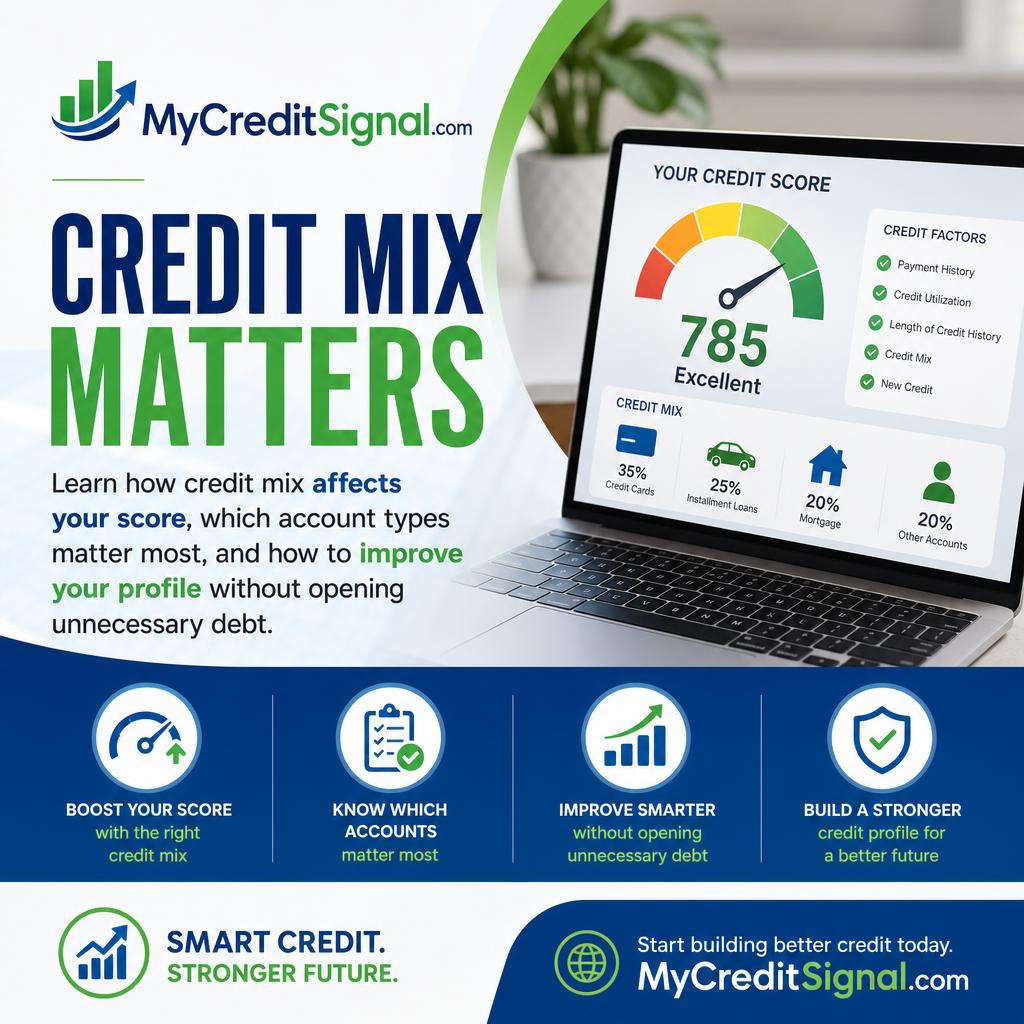
If you already pay on time and keep balances under control, you might wonder whether your next score boost will come from improving your credit mix. That question matters most for people with thin files, newer credit histories, or only one type of account showing on their reports. This guide is for readers who want a smarter credit-building strategy, not more debt for the sake of it. You will learn what credit mix actually means, when it is worth improving, how much attention it deserves compared with bigger score drivers, and what steps to take first so you do not hurt your progress chasing a small scoring factor.
Contents
- 1 Who should care about credit mix right now
- 2 Credit mix in plain English
- 3 The score math that matters more than the hype
- 4 What a strong mix usually looks like
- 5 The numbers and timelines to use when planning
- 6 A step by step plan to build credit mix the smart way
- 7 Mistakes that can make your score worse
- 8 What most articles miss about credit mix
- 9 FAQ
- 10 Helpful tools and related resources
- 11 The bottom line
Key Takeaway
Credit mix can help, but because it is only a small part of your score, the best strategy is to strengthen it gradually through accounts you actually need while prioritizing on-time payments and low utilization.
Who should care about credit mix right now
Credit mix matters most if your file is very simple. That usually means one of these situations:
- You only have credit cards and no installment loan history.
- You only have student loans or an auto loan and no revolving credit.
- You are rebuilding and your active accounts are limited.
- You are starting from zero and want to build a fuller profile over time.
It can also matter if you are close to applying for a major loan and your profile is otherwise strong. In that case, an underdeveloped mix may be one small reason your score is not as strong as it could be.
Who may need a different approach? If you currently carry expensive balances, miss payments, or use most of your card limits, credit mix is not your first problem. Payment history and amounts owed are much more important than account variety. The Consumer Financial Protection Bureau and major scoring education sources consistently place those factors ahead of mix in importance. If your card balances are high, start with utilization. If you are new to credit entirely, start with one manageable account and consistency.
If that sounds like you, review a practical credit utilization guide first, because lowering balances can often move the needle faster than adding a new account type.
Credit mix in plain English
Credit mix means the different kinds of credit accounts in your profile. The two main buckets are:
- Revolving credit: accounts you can borrow from, repay, and use again, like credit cards.
- Installment credit: loans with a set balance and set payment schedule, like auto loans, student loans, personal loans, or mortgages.
Scoring models look at whether you have experience managing more than one type. The logic is simple: a person who has successfully handled both revolving and installment accounts may present a more complete borrowing track record than someone with only one type.
But here is the part many articles skip: credit mix is a supporting factor, not a main factor. FICO says credit mix is about 10% of the score, while payment history is 35% and amounts owed are 30%. Experian explains the same overall idea: having a mix can help, but it usually does less for you than paying on time and keeping utilization low. The CFPB also notes that lenders use multiple scoring models, including FICO and VantageScore, which may weigh factors somewhat differently even though they rely on similar bureau data.
That means two things are true at once. First, a better mix can help your profile. Second, opening extra accounts just to chase mix can backfire if it causes hard inquiries, fees, interest, or shortens your average age of accounts.
If you want a quick way to assess where you stand, use the credit mix analyzer to see whether your profile is one-dimensional or reasonably balanced already.
The score math that matters more than the hype
Here is the practical ranking to keep in mind.
First priority: payment history. At about 35% of a FICO Score, this is the biggest piece. One missed payment can do more damage than a perfect mix can offset.
Second priority: amounts owed, especially revolving utilization. At about 30%, this is another major factor. If you use too much of your available credit, the score impact can be much larger than any benefit from account variety.
Third priority: everything else, including credit mix, length of credit history, and new credit activity. These matter, but usually after the first two are under control.
A useful decision framework is this:
- If you have missed payments in the past 12 months, fix that before worrying about mix.
- If your credit card balances are high relative to limits, lower them before adding accounts.
- If your profile is clean and stable but thin, then improving mix may make sense.
Think of credit mix as the final 10% work, not the first 90% work.
Example: say you have one credit card with a $1,000 limit and a $650 balance. Even if you add a small installment account, your high revolving balance is still likely the more urgent issue. Paying that balance down changes the risk picture faster than adding another tradeline. After the balance is lower and you have several months of clean payments, then a second account type could be a reasonable next step.
If you want to test how different moves may affect your profile, the credit score simulator can help you compare a utilization reduction versus adding a new account.
What a strong mix usually looks like
A strong credit mix does not mean collecting a pile of accounts. It usually means having at least some experience with both major categories over time, with all accounts managed responsibly.
For many people, a balanced setup could look like one or two revolving accounts plus one installment account they already needed anyway. That installment account might be a student loan, an auto loan, a mortgage, or a small credit-builder product used strategically. It does not need to be every loan type at once.
Do secured cards count? Yes, secured cards generally contribute as revolving credit because they function like credit cards for scoring purposes. They are often one of the safest ways for a beginner or rebuilder to establish revolving history without taking on large debt. If you are comparing secured cards with other starter tools, you may also want to read How a Credit Builder App Can Help Scores and Credit Builder Loans Worth It or Not.
What about store cards? They are still revolving accounts, but they do not create a new category of credit. A store card can expand revolving history, yet it will not solve a lack of installment credit by itself. For the tradeoffs, see Store Credit Cards and Your Credit Score.
The numbers and timelines to use when planning
Because credit mix is about 10% of a FICO Score, expect modest gains, not a dramatic jump. MyFICO educational material indicates that if you already have solid payment history and low utilization, adding a different account type may only produce incremental benefit. Experian also notes that the impact of a single new tradeline over 12 months can be modest on average.
That is why timing matters.
- Short term: opening a new account can temporarily pressure your score because of a hard inquiry and a younger average age of accounts.
- Medium term: if the account reports positively and fits your budget, it may help diversify your file.
- Long term: the value comes from a sustained history of on-time payments across different account types.
A practical rule is to avoid opening accounts for mix right before a major application. If you plan to apply for a mortgage, auto loan, or other important financing soon, stability often matters more than experimentation.
Here is a simple planning formula:
Ask whether the account improves both your credit profile and your cash flow plan. If the answer is not yes on both, wait.
For example, a small credit-builder loan with a manageable payment might make sense if you have no installment history and can comfortably fit the payment into your monthly budget. A random personal loan at a high interest rate just to create mix usually does not.
A step by step plan to build credit mix the smart way
Audit your current accounts
List every active account and place each one into two columns: revolving or installment. If every account falls into one column, your mix is thin. Do this before applying for anything. You might already have more variety than you think if student loans, auto loans, or older active accounts are still reporting.
Fix the high impact issues first this week
Before chasing mix, make all current accounts current and cut revolving balances if they are high. Since payment history is about 35% of a FICO Score and amounts owed about 30%, these actions usually offer more upside than diversification alone. Set autopay for at least the minimum due and make one extra payment this week if you can.
Choose the missing account type only if it serves a real purpose
If you only have installment loans, a starter or secured card may be the cleaner move. If you only have credit cards and no installment history, consider whether a small credit-builder loan fits your budget and goals. The CFPB guidance supports adding credit types strategically when needed, not opening multiple new accounts purely for mix benefits.
Open one account, not several
Do not stack applications. One new account gives you a way to build history without piling on hard inquiries and reducing the average age of your accounts all at once. If you are rebuilding from scratch, one revolving account plus one manageable installment account over time is often enough to create a healthier profile.
Keep the new account easy to manage
If it is a card, use it lightly and pay on time. If it is an installment product, choose a payment you can make even in a bad month. The whole point of improving mix is to add positive data. A new account that creates late payments destroys the benefit.
Track results over months, not days
Credit mix is not an overnight lever. Give the new account time to report and build a pattern of positive use. Score changes vary by profile and model, so compare trends rather than expecting one exact outcome. Reviewing your plan monthly works better than checking daily for tiny changes.
Decide what comes first versus later
First: on-time payments, lower card balances, and one stable starter account if needed. Later: improving mix with a second account type after your basics are under control. If you are new to credit entirely, read How Long to Build Credit From Zero for a realistic timeline before adding complexity.
Five concrete actions you can take this week:
- Pull together a list of your active revolving and installment accounts.
- Set autopay on every open account for at least the minimum payment.
- Make one extra card payment to reduce your balance.
- Use the credit mix analyzer to identify whether you truly have a gap.
- Compare one possible new account type with your monthly budget before applying.
Mistakes that can make your score worse
Opening accounts only for the label
Behavior: applying for several products just to say you have different kinds of credit. Consequence: multiple inquiries, younger average account age, extra payments, and possibly more debt than you can handle. Fix: add one account type at a time only when it matches a real borrowing need and a realistic budget.
Ignoring utilization while chasing mix
Behavior: keeping high credit card balances while focusing on adding an installment loan. Consequence: the high balance can hurt your score more than the new account helps because amounts owed carries much more weight than mix. Fix: lower revolving balances first, then revisit whether mix still needs attention.
Taking on costly debt for a small scoring benefit
Behavior: borrowing at high rates or paying unnecessary fees for a product you do not need. Consequence: you may spend real money for only modest score gains, and any payment trouble can erase the benefit. Fix: choose low-cost tools, secured products, or credit-builder options only if the payment is comfortably affordable.
Making a change right before a major loan application
Behavior: opening a new tradeline weeks before applying for a mortgage or auto loan. Consequence: short-term score pressure or extra underwriting questions at the worst possible time. Fix: prioritize stability before major applications and avoid unnecessary changes close to decision time.
What most articles miss about credit mix
Most articles talk about credit mix as if there is one perfect recipe. There is not. The right mix depends on your starting point, your borrowing needs, and your tolerance for complexity.
If you already have excellent payment history and low utilization, you may see only modest gains from adding another type of account. MyFICO educational materials make this clear by placing mix at about 10% of the score. That means a thin but well-managed file can still be strong, while a diverse but poorly managed file can still struggle.
Another nuance: lenders use multiple models. FICO and VantageScore share the same broad data sources but can weight factors differently. So results can vary by profile and scoring model. A move that helps one person a little may do almost nothing for another.
FAQ
Is it worth opening a new account just to improve credit mix?
Usually only if the account also serves a real purpose and fits your budget. Credit mix is a smaller factor than payment history and utilization, so opening costly or unnecessary debt just for mix is often not worth it.
Do secured credit cards help with credit mix?
Yes. Secured cards generally count as revolving credit. They can help if you need revolving history, but they do not replace the role of installment credit if that is the missing category in your profile.
How long does it take for a better credit mix to matter?
There is no fixed timeline. A new account must report and then build positive payment history over time. Any benefit is usually gradual, and short-term score movement can vary by credit profile and scoring model.
If you want to turn this into a concrete plan, start with the credit mix analyzer to see whether you actually have a gap. Then test possible next moves with the credit score simulator. If your balances are the bigger issue, revisit the credit utilization guide. If you are deciding between starter products, these related reads can help: Credit Builder Loans Worth It or Not and Store Credit Cards and Your Credit Score.
Get weekly credit tips, tool updates, and practical guides – free.
The bottom line
A stronger credit mix can help your score, but it is rarely the first lever to pull. Because mix makes up about 10% of a FICO Score, the smarter move is to earn that benefit gradually through accounts you genuinely need and can manage well. Pay on time, keep revolving balances in check, and then fill in the missing credit type only if it improves your overall profile.
Your next best step is simple: map your current accounts into revolving and installment categories, fix any payment or utilization issues first, and use the available tools to decide whether adding one carefully chosen account makes sense. That approach builds a stronger score without creating debt you never needed.


Leave a Reply
You must be logged in to post a comment.