
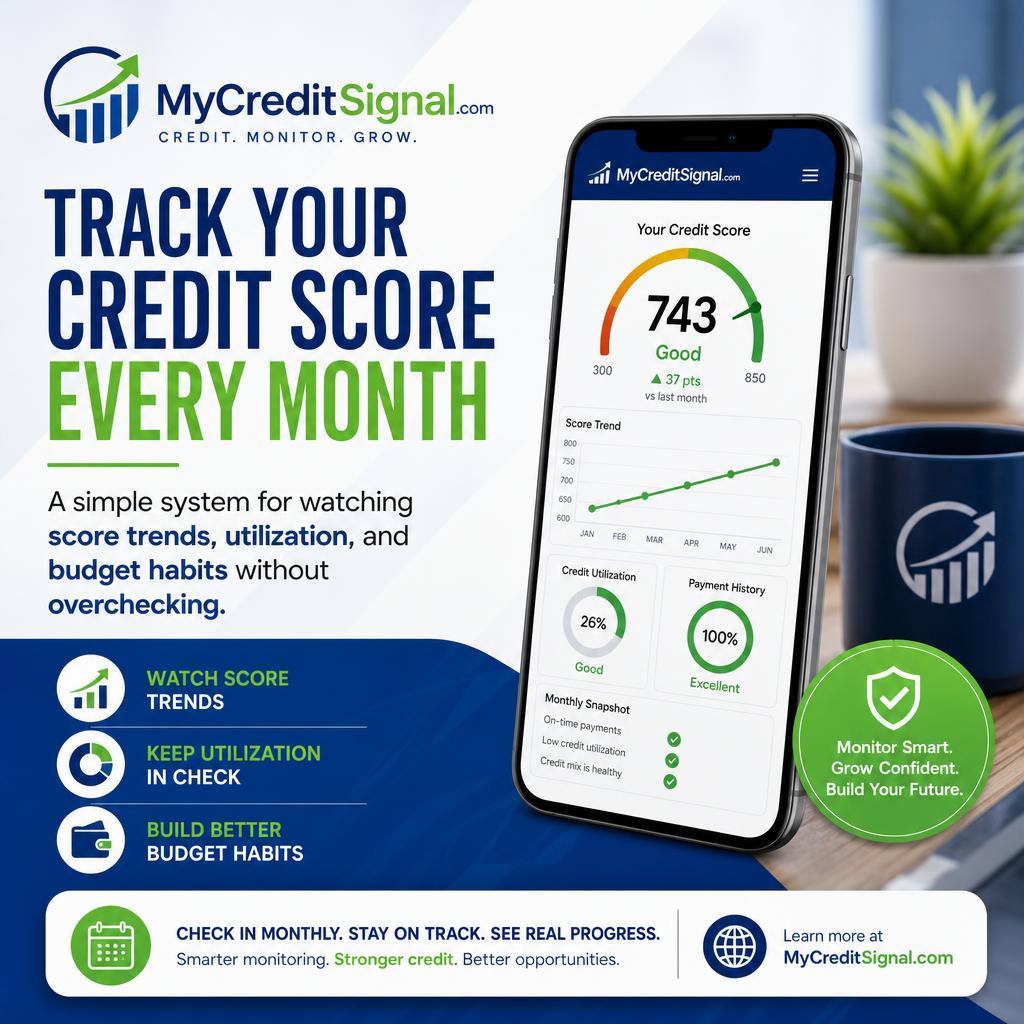
Imagine paying down a card by $600, waiting for your score to jump, then seeing almost no change the next week. That is where a lot of people get frustrated. They are taking real action, but they are not tracking the right things in the right order. If you want to track credit score monthly, this guide is for you. It is built for people who want a repeatable system, not daily score anxiety. By the end, you will know what to check each month, which numbers matter most, how to compare score movement with your budget, and what to do when your score does not move as fast as you hoped.
Contents
- 1 Who should use a monthly credit tracking system
- 2 Your monthly score check is only part of the picture
- 3 The numbers that matter more than daily score swings
- 4 A simple monthly tracking framework that actually works
- 5 Your step by step monthly plan
- 5.1 Pick one monthly check date
- 5.2 Pull your current score from the same source first
- 5.3 Check your report activity, not just the score
- 5.4 Calculate utilization with real numbers
- 5.5 Match score movement to your budget activity
- 5.6 Write one short monthly score note
- 5.7 Choose one action for the next 30 days
- 6 What to do first versus later
- 7 Mistakes that make monthly tracking less useful
- 8 What many monthly tracking guides leave out
- 9 FAQ
- 10 Helpful tools and related resources
- 11 Conclusion
Key Takeaway
The smartest way to track credit score monthly is to watch trend lines, utilization, payment timing, and report updates together instead of obsessing over one score on one day.
Who should use a monthly credit tracking system
A monthly system makes the most sense if you are actively trying to improve your credit over the next 6 to 12 months, preparing for a loan, paying down revolving debt, rebuilding after missed payments, or simply trying to understand why your score moves up and down.
It is especially useful for:
- People paying down credit cards and wanting to see whether lower balances are helping
- Anyone planning to apply for a car loan, apartment lease, or mortgage in the next year
- People whose scores vary between bureaus and want a cleaner way to compare trends
- Anyone using a budget to free up cash for debt payoff and wanting to connect money decisions to score results
This may not be the right approach if you are checking several dashboards every day and getting stressed by tiny swings. A monthly cadence is meant to reduce noise. If you need a deeper foundation on score bands first, read this beginner guide to credit score ranges so you know what movement actually matters for your situation.
Your monthly score check is only part of the picture
A credit score is a three-digit summary of what is in your credit reports. A credit report is the detailed file itself. That distinction matters because your score can move only after the underlying data changes. According to the CFPB, checking your own credit file or score is generally a soft inquiry, which means it typically does not hurt your score. You can review more on that at the CFPB credit score explainer and the CFPB guidance on checking your own report.
There is another reason to zoom out. Lenders do not all use the same model. The Federal Reserve education resource explains that FICO and VantageScore are both dominant formulas, and the score you see from a bank or app may use a different model or bureau than the one a lender checks. That means monthly tracking should focus less on one exact number and more on whether your overall direction is improving. See the Federal Reserve overview here: How a FICO Credit Score Is Determined.
A practical monthly review has four parts:
- Score trend: Is your score generally rising, flat, or falling?
- Report updates: Did balances, payment status, or new accounts change?
- Budget behavior: Did your spending and payments support lower balances?
- Next move: What one or two actions will improve next month more than last month?
If you want a projection before you make changes, the credit score simulator can help you test possible scenarios without guessing.
The numbers that matter more than daily score swings
If you want to track credit score monthly, you need a small dashboard of numbers. Most people watch too much and understand too little. Start with these.
1. Your score range and trend
Commonly used FICO scores range from 300 to 850. That sounds basic, but it keeps you grounded. A 7-point shift may feel dramatic in an app notification, yet it may be less important than a consistent 20- to 30-point improvement over several months. Track your score on the same day each month and note the source and bureau if shown.
2. Payment history status
Payment history is the biggest factor in many FICO scoring models at about 35 percent. That means one missed payment can matter more than several smaller optimization tricks. Your monthly review should always start with one question: did every required payment clear on time?
3. Revolving utilization
Amounts owed relative to limits account for about 30 percent in the FICO framework. For credit cards, that usually means your utilization ratio. The formula is simple:
Total credit card balances ÷ total credit limits = utilization
Example: if you have $2,400 in balances across cards with a combined limit of $8,000, your utilization is 30 percent. If you pay balances down to $1,200 and limits stay the same, utilization falls to 15 percent. That drop can matter because lower utilization generally helps your score.
If your balances jumped suddenly, read these utilization spike warning signs to figure out whether statement timing, spending, or a balance transfer caused the change.
4. Bureau differences
The CFPB notes that the three major bureaus, Equifax, Experian, and TransUnion, can show different data and different scores. So if one score is flat while another rises, that does not automatically mean something is wrong. It may simply mean one bureau received updated account information first.
5. Monthly debt paydown in dollars
This is the number many people skip, even though it connects budget decisions to credit progress. Write down how much revolving debt you reduced this month in actual dollars. If your score is flat but your card balances fell by $500, that is still real progress. The score may catch up after the next reporting cycle.
A simple monthly tracking framework that actually works
Use this decision framework each month: Protect, reduce, verify, then optimize.
- Protect: Make sure every payment is on time. No exceptions.
- Reduce: Bring down revolving balances where you can.
- Verify: Check whether your reports and score sources updated.
- Optimize: Fine-tune timing, autopay, and payoff targets after the basics are covered.
This order matters. For example, paying off $300 of a card is useful, but not if you accidentally miss another bill while doing it. Similarly, checking five score apps is not helpful if you never compare the score movement with what actually happened in your budget.
If you are trying to choose a realistic improvement target, this guide to setting credit score goals can help you match your timeline to the actions that matter most.
Your step by step monthly plan
Pick one monthly check date
Choose one date every month, such as the 3rd or the first Saturday. Consistency matters more than frequency. Checking on a random schedule makes it harder to compare trends. Put a recurring reminder on your phone and calendar today.
Pull your current score from the same source first
Start with the same app, bank dashboard, or credit monitoring source every month so you are comparing like with like. Record the score, bureau if shown, and model if shown. Remember that results can vary by credit profile, bureau data, and scoring model, so trend direction matters more than any single score snapshot.
Check your report activity, not just the score
Use your monthly review to see whether balances, payment status, or new accounts changed. The FTC says consumers can get free online access to credit reports through AnnualCreditReport.com, and the current guidance has emphasized free weekly access, which is useful for verifying what is reporting month to month. See the FTC overview here: Free credit reports.
Calculate utilization with real numbers
Write down total card balances and total card limits. Then divide balances by limits. Do the same for any single card carrying a high balance. Example: Card A balance $900 on a $1,000 limit equals 90 percent utilization on that card even if your overall utilization is lower. That can still pressure your score. This week, pull your latest statements and calculate both total and per-card utilization.
Match score movement to your budget activity
Look at what actually happened in the last 30 days. Did you reduce balances by $200, $500, or $1,000? Did you carry a larger statement balance because of travel, car repairs, or seasonal spending? The CFPB describes credit monitoring as watching score changes and key factors, then comparing them with your own financial activity month by month. That is exactly what turns score watching into decision making.
Write one short monthly score note
Keep it simple: score, utilization, total debt change, and one explanation. Example: “Score up 12 points. Utilization down from 42 percent to 31 percent. Paid $650 toward cards. No missed payments.” This creates a useful record and stops you from relying on memory.
Choose one action for the next 30 days
Do not chase ten fixes at once. Choose the highest-impact move. That may be setting autopay for every minimum payment, paying an extra $250 toward the highest-utilization card, pausing a large discretionary purchase, or moving a payment date so your balance reports lower. If you are mapping credit progress to a timeline like an auto loan or apartment move, use the financial goal timeline planner to line up your next steps.
That seven-step cycle gives you at least five concrete actions you can take this week: set a check date, record your score source, review your report, calculate utilization, compare with your budget, write a monthly note, and choose one action for the next month.
What to do first versus later
When people track monthly progress, they often ask what deserves attention now and what can wait. Use this order.
Do first
- Protect on-time payments
- Lower very high card balances
- Review whether new balances reported higher than expected
- Make sure you know which bureau or model your score source uses
Do later
- Worrying about tiny week-to-week score swings
- Comparing one bureau score against another without looking at data differences
- Trying advanced tactics before you have stable payment habits and a working budget
Example: say your score is 642 this month, your total card debt is $4,800, and your limits total $10,000. Your utilization is 48 percent. In that case, your first job is not to refresh your score more often. It is to get utilization down. If you pay $900 over two months and drop balances to $3,900, utilization falls to 39 percent. If you keep paying and reach $2,900, utilization falls to 29 percent. That kind of measurable change is much more important than minor app fluctuations.
Mistakes that make monthly tracking less useful
Checking too many score sources at once
Behavior: Comparing several apps, banks, and bureau dashboards every few days. Consequence: You see different numbers, panic, and lose track of which score moved and why. Fix: Use one primary source for your monthly check, then use reports and secondary sources only for context.
Watching the score but ignoring utilization math
Behavior: You celebrate paying down debt but never calculate balance-to-limit ratios. Consequence: You miss why your score is still under pressure, especially if one card remains near its limit. Fix: Track both total utilization and per-card utilization every month.
Assuming no score jump means no progress
Behavior: You paid debt down, but because your score did not rise immediately, you think the effort failed. Consequence: You may stop good habits right before the next reporting cycle helps you. Fix: Track debt reduction in dollars and wait for reporting updates before judging the result.
Treating every score difference as a problem
Behavior: You assume all bureau scores should match exactly. Consequence: Normal differences create unnecessary stress. Fix: Remember the CFPB guidance: scores can differ because bureau files and scoring formulas differ.
What many monthly tracking guides leave out
First, credit monitoring is helpful, but it is not complete protection against identity theft. The CFPB notes that monitoring can alert you to changes, yet it is not a guarantee. That means alerts are useful, but they should not replace good account security habits.
Second, some advice applies differently depending on your profile. If you have very thin credit, low account age, or a recent major derogatory event, your score may respond more slowly than someone whose only issue is high utilization. Monthly tracking still helps, but the timeline can vary.
Third, if you recently opened a new card or completed a balance transfer, the short-term picture may look messy before it looks better. A new inquiry or younger average age can offset some utilization gains for a while. If that is your situation, this balance transfer credit score guide can help you interpret the tradeoffs.
FAQ
Does checking my own credit score hurt my score?
No. Checking your own score or report is generally treated as a soft inquiry and typically does not affect your score, according to the CFPB.
Why are my scores different between Equifax, Experian, and TransUnion?
The bureaus may have different data on file, and the score shown may use a different model. That is why comparing trends is usually more useful than comparing exact numbers.
How often should I track credit score monthly if I am improving my credit?
For most people, once a month is enough for structured tracking. If you are verifying recent payments posted correctly, you can check your reports more often without harming your score, but you still do not need to obsess over daily score changes.
If you want to make your monthly review easier, start with these:
- Credit score simulator to test how payoff choices might affect your trajectory
- Financial goal timeline planner to connect your score goals to an application date or payoff target
- Credit score range explained for beginners if you want a quick refresher on what different score bands mean
- Utilization spike warning signs if your score recently dipped after card balances rose
Get weekly credit tips, tool updates, and practical guides – free.
Conclusion
If you want to track credit score monthly, the best move is to stop treating your score like a mystery and start treating it like a monthly review process. Check the same source, verify report updates, calculate utilization, compare your score trend with your budget behavior, and choose one high-impact action for the next 30 days.
You do not need perfect data or daily refreshes. You need a repeatable system. Pick your monthly check date today, calculate your current utilization, and record your first score note. That is how progress becomes visible.



Leave a Reply
You must be logged in to post a comment.