
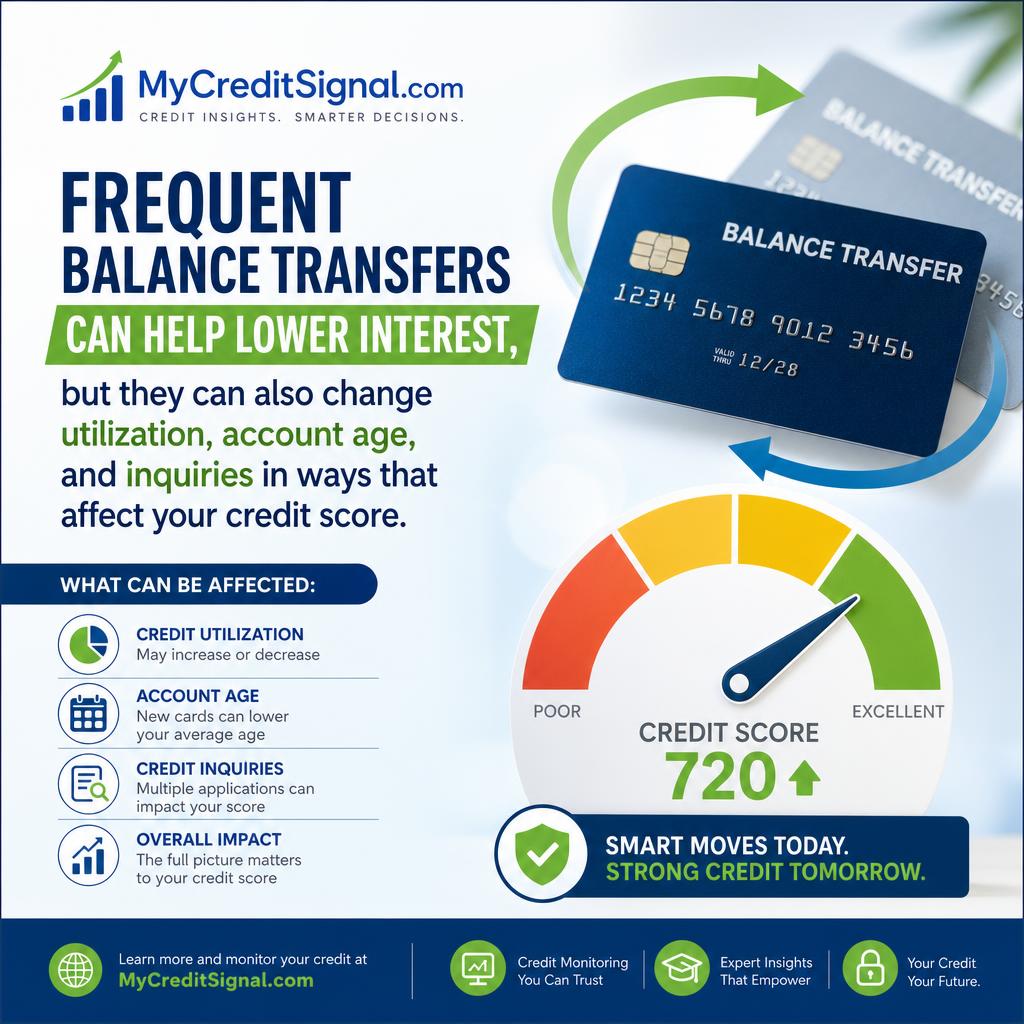
If you have moved a credit card balance more than once, you have probably asked a fair question: will frequent balance transfers hurt your score even if they save you money? That is the real issue behind most searches for balance transfers credit score. A transfer can lower your interest costs and sometimes improve utilization, but repeated transfers can also add new hard inquiries, shorten your average account age over time, and create a pattern of high revolving debt that scoring models may not love. This article is for people juggling card debt, promotional APR offers, and payoff plans who want a practical way to decide when a transfer helps, when it backfires, and what to do next.
Contents
- 1 Who should pay attention to frequent balance transfers
- 2 What repeated balance transfers actually do to your credit file
- 3 The numbers that matter before you transfer again
- 4 A simple decision framework before another transfer
- 5 How frequent is too frequent
- 6 A step by step plan for using balance transfers without hurting your score more than necessary
- 6.1 List every card balance, limit, APR, and promo end date
- 6.2 Calculate total utilization and per card utilization
- 6.3 Estimate the real cost of the next transfer
- 6.4 Set a fixed monthly payoff target before applying
- 6.5 Stop using the cards you just cleared
- 6.6 Automate more than the minimum payment
- 6.7 Review your profile before any major loan application
- 7 What to do first versus later
- 8 Mistakes that make frequent transfers backfire
- 9 What most articles miss about repeated transfers
- 10 FAQ
- 11 Helpful tools and related resources
- 12 The bottom line on balance transfers and your score
Key Takeaway
Balance transfers do not automatically hurt your credit score, but doing them too often can create a stack of inquiries, new accounts, transfer fees, and lingering debt that limits the benefit.
Who should pay attention to frequent balance transfers
This topic matters most if you carry revolving debt and get tempted by 0% intro APR mailers, bank app offers, or prequalified card promotions. It is especially relevant if you have transferred a balance in the past year and are considering doing it again before the current promo period ends.
You should care about this if:
- You carry balances across more than one card.
- You are using transfers as part of a debt payoff strategy.
- You expect to apply for a mortgage, auto loan, or another major credit product soon.
- You have opened several cards recently and are worried about hard inquiries.
- You want to lower utilization without accidentally creating new problems.
A different approach may be better if your debt is small enough to pay off within a few months, if the transfer fee would wipe out most of the savings, or if your score is already under pressure from missed payments. In that case, a new promotional card may not fix the real issue. If you need a refresher on how inquiries fit into the bigger score picture, read 5 Hard Inquiry Facts That Can Protect Your Score.
What repeated balance transfers actually do to your credit file
A balance transfer is not a separate credit product on its own. In most cases, you apply for a new card or use an existing card with a transfer offer, then move debt from one revolving account to another. Your score reacts to the pieces around that move, not just the transfer label.
Here is what can change:
- A hard inquiry may appear. If you open a new card to get the offer, the issuer usually pulls your credit.
- A new account may appear. That can lower your average age of accounts, which is one reason frequent transfers can matter over time.
- Your utilization can shift. Paying down one maxed-out card and moving the debt to a card with higher available credit can help if total utilization improves and the destination card is not overloaded.
- Your total debt does not disappear. A transfer moves debt. It does not pay it off.
- Your fee costs can rise. Many transfer offers charge a fee based on the amount transferred, so repeating the strategy can get expensive.
That account-age piece is easy to underestimate. Older accounts help stabilize your profile, which is why keeping seasoned accounts open can matter. For more on that factor, see Age of Credit History and Your Credit Score.
If you want to estimate how a new card and lower balances might affect your score directionally, try the credit score simulator before you apply.
The numbers that matter before you transfer again
The smart way to evaluate a transfer is to look at four numbers: your transfer fee, your promo APR window, your monthly payoff amount, and your current utilization. You do not need a perfect forecast. You do need a realistic one.
1. Transfer fee
Most balance transfer offers charge a fee expressed as a percentage of the amount transferred. If you move $4,000 at a 3% fee, that costs $120. If the fee is 5%, the same transfer costs $200. Those numbers matter because every repeat transfer adds more cost to debt you already have.
2. Promo period length
A 0% offer only helps if your payoff timeline fits inside the promotional period, or at least cuts enough interest to justify the fee. For example, if you move $4,000 and can pay $335 per month, you will pay off roughly $4,020 in 12 months including a $120 fee. If your budget only supports $175 per month, you would still owe about $2,020 after 12 months before any standard APR kicks in. In that situation, the transfer buys time, but it does not solve the payoff problem.
3. Utilization after the move
Your score often responds more to utilization than to the transfer itself. If you transfer $3,000 from a card with a $3,500 limit to a new card with a $10,000 limit, the original card drops near zero and the new card lands at 30%. Depending on your other balances, your total utilization may improve. If instead you move $5,000 onto a new card with a $5,500 limit, that destination card starts above 90% utilization, which can limit the scoring benefit.
4. Inquiry timing
One inquiry is usually manageable. Several new applications in a short span can create more drag, especially if your file is thin or you already opened other credit recently. Results vary by credit profile and scoring model, so there is no universal point drop to promise.
A simple decision framework before another transfer
Use this quick filter before you submit any application.
- Transfer now if the fee is reasonable, you have a clear payoff date, your utilization will improve, and you do not expect a major loan application soon.
- Wait if your current promo offer still gives you enough time and opening a new account would only save a small amount.
- Skip it if you are using transfers to avoid changing spending habits, if the new card will start nearly maxed out, or if you cannot estimate how much you can pay each month.
If your goal is to compare transfer costs against interest savings, use the balance transfer savings calculator. A calculator can help you separate a genuinely good offer from one that just sounds good.
How frequent is too frequent
There is no official rule that says two transfers are fine and three are harmful. What matters is the pattern on your report. If you open multiple cards within a short period, repeatedly carry high revolving balances, and transfer because the last promo period ended without meaningful principal reduction, that pattern can weaken your file even if every payment is on time.
Think of repeated transfers in three buckets:
- One strategic transfer: Often the least risky. You lower interest, attack the balance, and avoid more applications.
- Occasional transfer with a real payoff plan: Potentially workable if your balances are falling and you are not piling up inquiries.
- Serial transfer behavior: Riskier. This is when balances keep moving but not shrinking enough, fees keep stacking, and new credit becomes the main strategy.
If that last bucket sounds familiar, your next move should probably be budget and payoff planning first, then transfer shopping second. You may also like Savings and Credit Building at the Same Time because repeated transfers often happen when there is no cash buffer for emergencies.
A step by step plan for using balance transfers without hurting your score more than necessary
List every card balance, limit, APR, and promo end date
Write down the current balance, credit limit, standard APR, minimum payment, and any promotional APR expiration date for each card. You cannot judge whether another transfer helps until you know exactly which balance is most expensive and when your current deal ends.
Calculate total utilization and per card utilization
Divide each card balance by its limit, then divide all revolving balances by all revolving limits. Both views matter. A transfer can improve total utilization while still leaving one card extremely high, which may blunt the score benefit.
Estimate the real cost of the next transfer
Multiply the balance you plan to move by the transfer fee percentage. Then compare that fee to the interest you would pay if you stayed put. If the fee is $150 and the interest saved over the promo period is only slightly higher, the benefit may be too small to justify a new account and inquiry.
Set a fixed monthly payoff target before applying
Do not apply first and figure it out later. If you transfer $6,000 and want it gone in 15 months, your rough target is $400 per month before considering any fee. If your budget cannot support that, decide now whether you are solving a rate problem or just delaying a debt problem.
Stop using the cards you just cleared
This is one of the biggest make-or-break habits. A balance transfer only works if the old card stays low or at zero. If you run it back up, you can end up with debt on two cards instead of one and utilization can worsen fast.
Automate more than the minimum payment
Set automatic payments for at least the amount needed to finish within the promotional period. Minimum payments protect payment history, but they usually do not erase the balance before the standard APR returns.
Review your profile before any major loan application
If you plan to apply for a mortgage, refinance, or auto loan soon, pause and review whether another inquiry or new card is worth it. Sometimes preserving stability matters more than squeezing out one more promo offer.
What to do first versus later
If you feel stuck, prioritize in this order.
- Do first: map balances, calculate utilization, check promo deadlines, and set a payment amount you can actually sustain.
- Do next: compare fee cost versus interest savings and test the scenario with tools.
- Do later: apply for a new transfer card only after you know the move improves both cash flow and payoff odds.
That order matters because many people reverse it. They apply based on the intro APR headline, then discover the limit is too low, the fee is higher than expected, or the payment plan was never realistic.
Mistakes that make frequent transfers backfire
Moving debt without lowering spending
Behavior: You transfer a balance, free up the original card, and start using that card again for everyday purchases. Consequence: Your total revolving debt can grow, utilization can climb again, and the transfer does not create lasting score improvement. Fix: Freeze the old card for new spending or remove it from your wallet and autopay accounts until the transferred balance is under control.
Ignoring the transfer fee
Behavior: You focus on the 0% APR and overlook the fee attached to every move. Consequence: Repeated fees chip away at your savings and can make a series of transfers more expensive than expected. Fix: Always calculate the fee in dollars first and compare it to the interest you would avoid.
Opening too many cards too fast
Behavior: You chase multiple offers in a short window to keep extending promo periods. Consequence: You may add several hard inquiries, reduce average account age, and create a riskier-looking credit pattern. Fix: Slow down and use one well-planned transfer rather than several reactive ones.
Waiting until the promo is almost over
Behavior: You ignore the promotional deadline until the final month. Consequence: You may rush into another transfer without comparing terms or adjusting your budget. Fix: Put a reminder 60 to 90 days before the promo ends so you can choose from a position of control.
What most articles miss about repeated transfers
Most articles frame balance transfers as a math problem only. The missing piece is behavior. If transfers are helping you create a lower-interest runway for aggressive payoff, they can be useful. If transfers are replacing a sustainable repayment system, they become a loop.
Another nuance: even when a transfer helps your utilization, your score may not move much right away if other factors are holding it back. Payment history, total debt, account age, and recent applications all interact. Results can vary by credit profile and scoring model.
One more thing many readers miss: older accounts can be worth protecting. Closing an old card after a transfer might seem tidy, but it can reduce available credit and potentially affect your age mix over time. That does not mean never close a card. It means weigh the tradeoff before you do it.
FAQ
Do balance transfers always lower your credit score?
No. A transfer can help if it lowers utilization and supports faster payoff. But opening new accounts too often can add hard inquiries and reduce average account age, so the effect is mixed.
How long should I wait before doing another balance transfer?
There is no universal timeline. The better question is whether your balances are shrinking, whether another inquiry makes sense, and whether the fee plus new account is worth the savings.
Is it better to transfer a balance or just pay it down?
If you can pay the balance off quickly, paying it down directly may be simpler. A transfer is more useful when the interest savings clearly outweigh the fee and you have a firm payoff plan.
If you want to turn this into a concrete plan, start with the balance transfer savings calculator to compare fee cost against interest savings. Then use the credit score simulator to think through how a new account and lower utilization could affect your credit profile.
For related reading, check 5 Hard Inquiry Facts That Can Protect Your Score if you are worried about the application side, and Age of Credit History and Your Credit Score if you are deciding whether opening another card is worth the impact on account age.
Authoritative sources can also help you verify terms before applying. Review general balance transfer and card pricing disclosures from the Consumer Financial Protection Bureau, learn how credit scores weigh revolving debt and utilization from myFICO, and compare card agreement details through the CFPB credit card agreement database.
Get weekly credit tips, tool updates, and practical guides – free.
The bottom line on balance transfers and your score
Frequent balance transfers are not automatically bad, but they are rarely neutral. Every new transfer should earn its place by lowering costs, improving your payoff path, and avoiding unnecessary score drag from extra inquiries, new accounts, and repeated high utilization.
If you do one thing this week, calculate the fee, your monthly payoff target, and your utilization after the move before you apply. That simple check can tell you whether another transfer is a smart reset or just another delay.



Leave a Reply
You must be logged in to post a comment.