
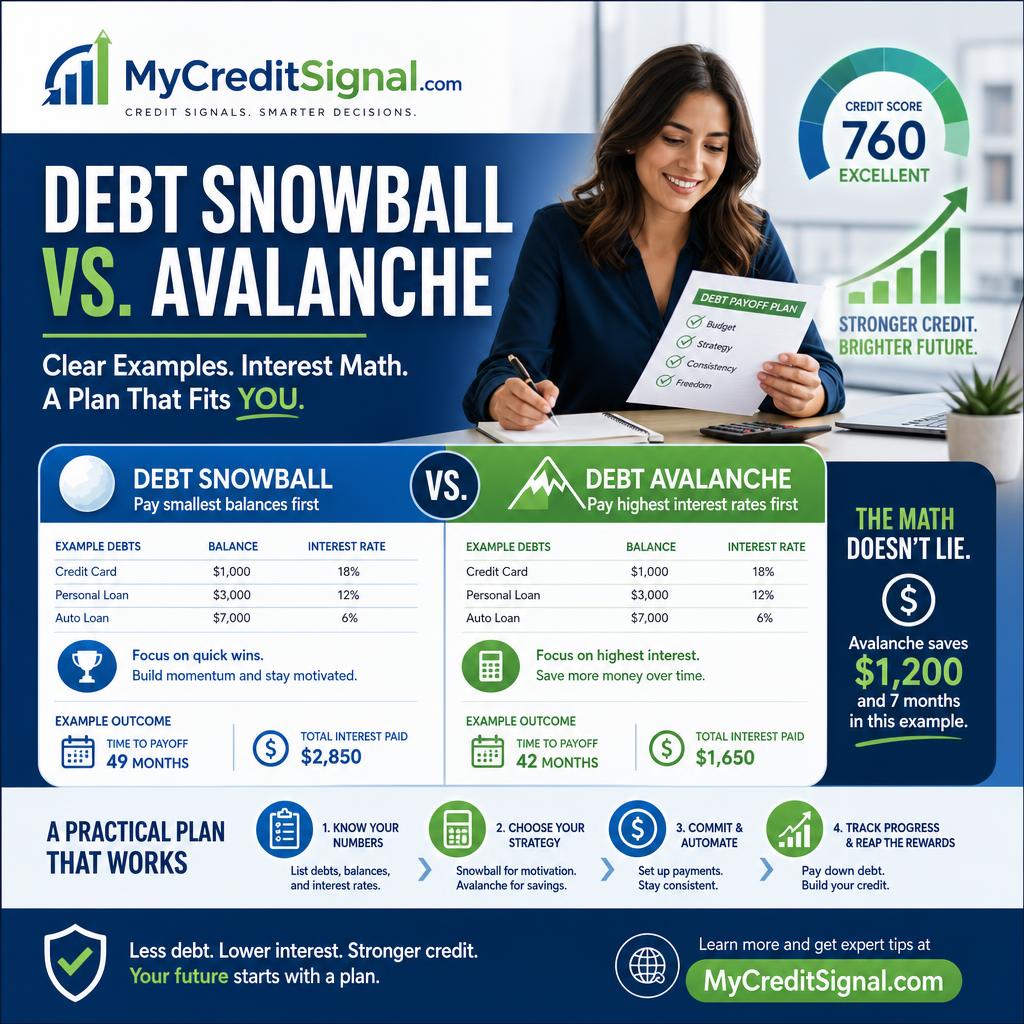
If you have three or four debts staring at you every month, the hardest part is often not making a payment. It is deciding where your extra money should go. Put it toward the smallest balance and you may get a fast win. Put it toward the highest APR and you may cut more interest. That is the real debate in debt snowball vs avalanche.
This guide is for people who can pay more than the minimum but want a smarter order. You will see how each method works, which numbers matter most when credit card APRs are high, and how to pick a payoff plan you can actually stick with. If you want a deeper payoff roadmap after this comparison, read Pay Off Credit Card Debt Faster A Practical 6 Week Plan or compare your options with the snowball vs avalanche comparison tool.
Contents
- 1 Who should care about debt snowball vs avalanche
- 2 How each payoff method actually works
- 3 The numbers that change the answer
- 4 Snowball vs avalanche in a high APR environment
- 5 How to choose the right method for your situation
- 6 What to do first this week and what can wait
- 7 A step by step payoff plan
- 7.1 Write down every debt in one list
- 7.2 Pick one fixed extra payment amount
- 7.3 Rank your debts based on your method
- 7.4 Automate minimums and manually target the extra payment
- 7.5 Cut one recurring expense and redirect it
- 7.6 Track milestones, not just balances
- 7.7 Review the plan after one billing cycle
- 8 Mistakes to avoid
- 9 What most articles miss about this decision
- 10 FAQ
- 11 Helpful tools and related resources
- 12 Conclusion
Key Takeaway
The avalanche method usually saves more money on interest, but the snowball method can be the better choice if quick wins are what keep you consistent month after month.
Who should care about debt snowball vs avalanche
This comparison matters most if you have multiple revolving balances, especially credit cards, and at least a little room in your budget to send extra money each month. The choice becomes more important when your rates are high. Federal Reserve data has shown average card APRs around 21.0% in early 2026, with general consumer card ranges around 18.0% to 23.0%. At those rates, interest is not a side detail. It can reshape your payoff timeline.
You should care about this article if:
- You have at least two debts with different balances or APRs.
- You can pay minimums on all accounts and add extra to one target debt.
- You want a repeatable plan rather than guessing each month.
- You are deciding between motivation first and math first.
This article may be less useful if you are already behind on minimum payments, facing collections, or dealing with urgent cash flow instability. In those cases, the first priority is stabilizing your budget and staying current where possible. It also may not be the right framework if nearly all your debt has the same interest rate, because then the difference between the two methods can shrink.
How each payoff method actually works
Debt snowball
Debt snowball means you pay the minimum on every debt, then put all extra money toward the smallest balance first. Once that smallest balance is gone, you roll that payment into the next-smallest balance. The payment grows like a snowball rolling downhill.
Major banks like Chase and Capital One describe this method as useful for creating momentum because you get quicker psychological wins when accounts disappear. Chase notes that snowball focuses on smallest balances first, even though it may not be the fastest route to minimize interest. Capital One also presents it as a structured payoff approach that can help people stay engaged with the plan.
Debt avalanche
Debt avalanche also has you pay minimums on all debts, but your extra money goes to the highest interest rate first. After that debt is paid off, you move to the next-highest APR. Chase states that avalanche typically results in lower total interest paid over the payoff horizon because you attack the costliest balance first.
If you want to explore this math-heavy approach further, see how the debt avalanche method can save interest. If you are still deciding between broader payoff systems, this guide to debt payoff strategies can help put both methods in context.
A simple decision framework
Use this quick rule:
- Choose avalanche if your top goal is paying less total interest.
- Choose snowball if your top goal is seeing faster account closures to stay motivated.
- Choose a hybrid if one balance is tiny and one APR is extremely high. You may clear the tiny one first, then switch to avalanche.
Wells Fargo and Chase both emphasize that the best method depends on your goals and habits, not just the spreadsheet. That is the part many people skip.
The numbers that change the answer
In a low-rate world, the difference between snowball and avalanche might feel small. With credit card APRs commonly around 20% or more, the payoff order matters more. The higher the APR gap between your debts, the more valuable avalanche becomes.
Here is a realistic example using only a simple payment pattern:
- Card A: $900 balance at 22.0% APR
- Card B: $2,400 balance at 19.0% APR
- Card C: $4,000 balance at 21.0% APR
- Total extra debt payment available each month after minimums: $300
Under snowball, you would target Card A first because it has the smallest balance. Under avalanche, you would also target Card A first because it has the highest APR. In that case, both methods start the same. But imagine Card A were $900 at 18.0% instead. Then snowball would still hit Card A first, while avalanche would likely target Card C at 21.0% first.
The more months you carry a high-rate balance, the more interest piles up. That is why Chase says avalanche typically leads to lower total interest costs. The basic formula behind the decision is straightforward: when balances are similar, APR should drive the order. When balances are wildly different, behavior may matter more if quick wins are the only thing that keeps you going.
Another number that matters is your monthly extra payment. If you are only adding a small amount beyond minimums, the emotional value of closing one small account can be powerful. If you have a larger extra payment amount, avalanche can produce more visible savings because you are attacking expensive interest faster.
The CFPB offers a reducing debt worksheet that can support either strategy by helping you list balances, rates, and monthly payments in one place. The FTC also provides general advice on getting out of debt without endorsing one single repayment order for everyone.
Snowball vs avalanche in a high APR environment
High APRs are the reason this debate is still so relevant. Federal Reserve data has shown general card APRs in the 18.0% to 23.0% range in recent years, and many private-label or high-rate cards can sit above 20%. When rates are that high, a balance can linger much longer than borrowers expect if they only pay minimums.
That does not automatically mean avalanche is always the best choice. One common misconception is that avalanche wins regardless of personal factors. Chase and CFPB materials both point to real tradeoffs. If you start avalanche, get discouraged, and stop sending extra payments after two months, the math advantage disappears fast. A slightly less efficient method you follow for a year is better than the ideal method you quit.
Experian reported that 26% of consumers in its 2025 debt analysis used the snowball method. That does not prove snowball is superior. It does show that many people prefer a strategy that feels achievable in real life.
How to choose the right method for your situation
Before you commit, answer these four questions:
- Do I need motivation now? If you are overwhelmed and close to giving up, snowball may keep you moving.
- How big is the APR gap? If one card is 23.0% and another is 18.0%, avalanche has more value.
- How many debts do I have? With many small balances, snowball can simplify your monthly life faster.
- Am I consistent? If you already budget well and rarely miss a plan, avalanche may fit you better.
A practical checklist looks like this:
- Pick snowball if you need early wins, have several small balances, or want fewer monthly bills as soon as possible.
- Pick avalanche if your rates vary a lot, you are disciplined, and your main goal is minimizing interest.
- Pick hybrid if you want one quick elimination first, then you can switch to highest APR for the rest.
And yes, you can switch methods mid-plan. There is generally no penalty for changing your payoff order as long as you keep making at least the required minimum payments on each account.
What to do first this week and what can wait
The first priority is not choosing a fancy method. It is getting your full debt picture onto one page. After that, decide where your next extra dollar goes. Later, you can optimize categories in your budget, automate payments, and track milestones more closely.
Do first:
- List each debt with balance, APR, and minimum payment.
- Find one realistic monthly extra payment amount.
- Choose snowball or avalanche and write the target order.
- Set automatic minimum payments if possible.
Do later:
- Refine your budget categories.
- Look for spending cuts that are repeatable, not extreme.
- Track your payoff milestones and recheck your order every month or two.
If you need structure for the execution side, the debt payoff milestone tracker can help you monitor progress without overcomplicating it.
A step by step payoff plan
Write down every debt in one list
Create a simple table with creditor name, current balance, APR, and minimum payment. Do not rely on memory. The CFPB worksheet is a solid model for this. Your first action this week is to build that list and total the minimums.
Pick one fixed extra payment amount
Choose a number you can repeat monthly, even if it is modest. Consistency matters more than picking an ambitious number you cannot sustain. Your second action is to decide on that amount today and add it to your calendar or budget app.
Rank your debts based on your method
If you choose snowball, rank debts from smallest balance to largest. If you choose avalanche, rank them from highest APR to lowest. Your third action is to make the ranking visible, whether on paper, in a spreadsheet, or in a payoff tool.
Automate minimums and manually target the extra payment
Minimum payments protect you from falling behind while you focus your extra money on one debt. Your fourth action this week is to verify due dates and automate what you can. Manual mistakes can undo progress.
Cut one recurring expense and redirect it
Do not search for ten cuts. Find one reliable source of extra cash. That could be a subscription, delivery habit, or weekly spending category. Your fifth action is to redirect that money straight to the target debt, not leave it in checking where it gets absorbed.
Track milestones, not just balances
Measure progress in visible chunks such as first account paid off, first $500 reduction, or first month with no new charges. Milestones keep motivation up whether you use snowball or avalanche. If you want extra structure, use the comparison tool first and then record your checkpoints in the tracker.
Review the plan after one billing cycle
At the end of the month, ask two questions: Did I follow the plan, and do I still believe I can follow it next month? If yes, continue. If no, simplify. Switching from avalanche to snowball or from snowball to avalanche is better than abandoning payoff altogether.
Mistakes to avoid
Choosing based only on emotion or only on math
Behavior: Picking snowball because it sounds easier or picking avalanche because it sounds smartest, without considering your actual habits. Consequence: You may choose a method that looks good on paper but fails in month two or three. Fix: Match the strategy to your behavior. If you need visible wins, use snowball. If you are disciplined and rate gaps are large, use avalanche.
Ignoring APR differences that are costing real money
Behavior: Treating all cards the same when one is far more expensive. Consequence: You carry a 21.0% to 23.0% balance longer than necessary and give up more money to interest. Fix: Highlight the highest APR debt in your list. If the rate gap is meaningful, strongly consider avalanche or a hybrid.
Continuing to add new charges while paying down old ones
Behavior: Sending extra payments to one card while still using other cards for nonessential spending. Consequence: Progress slows or reverses, and your payoff timeline stretches. Fix: Freeze discretionary card use during the payoff period when possible and use your budget to control new spending.
Forgetting to review the plan after life changes
Behavior: Sticking with the same monthly amount after a job change, rent increase, or surprise expense. Consequence: You miss payments or get frustrated with a plan that no longer fits. Fix: Recheck balances, APRs, and cash flow every month or two and adjust the extra payment before the plan breaks.
What most articles miss about this decision
Many comparisons stop at this line: avalanche saves money, snowball builds motivation. That is true, but incomplete.
What gets missed is that your payoff order should follow three factors at once: cost, behavior, and complexity. Cost is the APR. Behavior is whether you actually continue the plan. Complexity is how many accounts you are juggling and how badly you need to simplify monthly administration.
There are also cases where neither pure method is perfect:
- If one debt is tiny enough to disappear this month, clearing it first may reduce mental load even if its APR is not the highest.
- If one APR is much higher than the rest, avalanche becomes more compelling.
- If two debts have nearly identical APRs, targeting the smaller one may give you a mini snowball with almost no mathematical sacrifice.
- If you have uneven income, a flexible hybrid may outperform both because it keeps the plan realistic.
Another thing most articles miss is that the strategy choice does not directly create your credit outcome by itself. Paying down revolving balances can help your credit profile over time, but results can vary based on your full credit profile and scoring model. The bigger immediate win is usually lower interest cost, lower balances, and fewer monthly obligations.
FAQ
Which method usually saves more on interest
Debt avalanche usually saves more on total interest because it targets the highest APR first. Chase specifically notes that avalanche typically results in lower interest paid over the payoff period.
Should I start with the smallest debt or the highest interest rate
Start with the smallest debt if quick wins will keep you engaged. Start with the highest interest rate if your main goal is paying less overall. If you are stuck, use a hybrid and reassess after one debt is gone.
Can I switch from snowball to avalanche later
Yes. You can change your payoff order at any time as long as you continue making required minimum payments on every account. Many people start with motivation and switch to math once they build momentum.
If you want to turn this comparison into action, start with the snowball vs avalanche comparison tool to map your payoff order. Then use the debt payoff milestone tracker to stay consistent over the next few billing cycles.
For more payoff guidance, read Pay Off Credit Card Debt Faster A Practical 6 Week Plan, Debt Avalanche Method Save Interest, and Mastering Debt Payoff Strategies.
Authoritative sources used in this guide include Chase on debt snowball vs avalanche, the CFPB reducing debt worksheet, and the FTC guide on getting out of debt.
Get weekly credit tips, tool updates, and practical guides – free.
Conclusion
In the debt snowball vs avalanche debate, there is no single best method for every borrower. Avalanche usually wins on interest savings. Snowball often wins on momentum. The right choice is the one that fits both your numbers and your behavior.
Your next step is simple: list your debts, choose your order, and send your next extra payment with intention instead of guesswork. If you want help deciding, run both scenarios in the comparison tool and pick the plan you can follow for the next 90 days.



Want to understand your credit report?
Get plain-English explanations with our free AI Credit Analyzer →
Leave a Reply
You must be logged in to post a comment.