
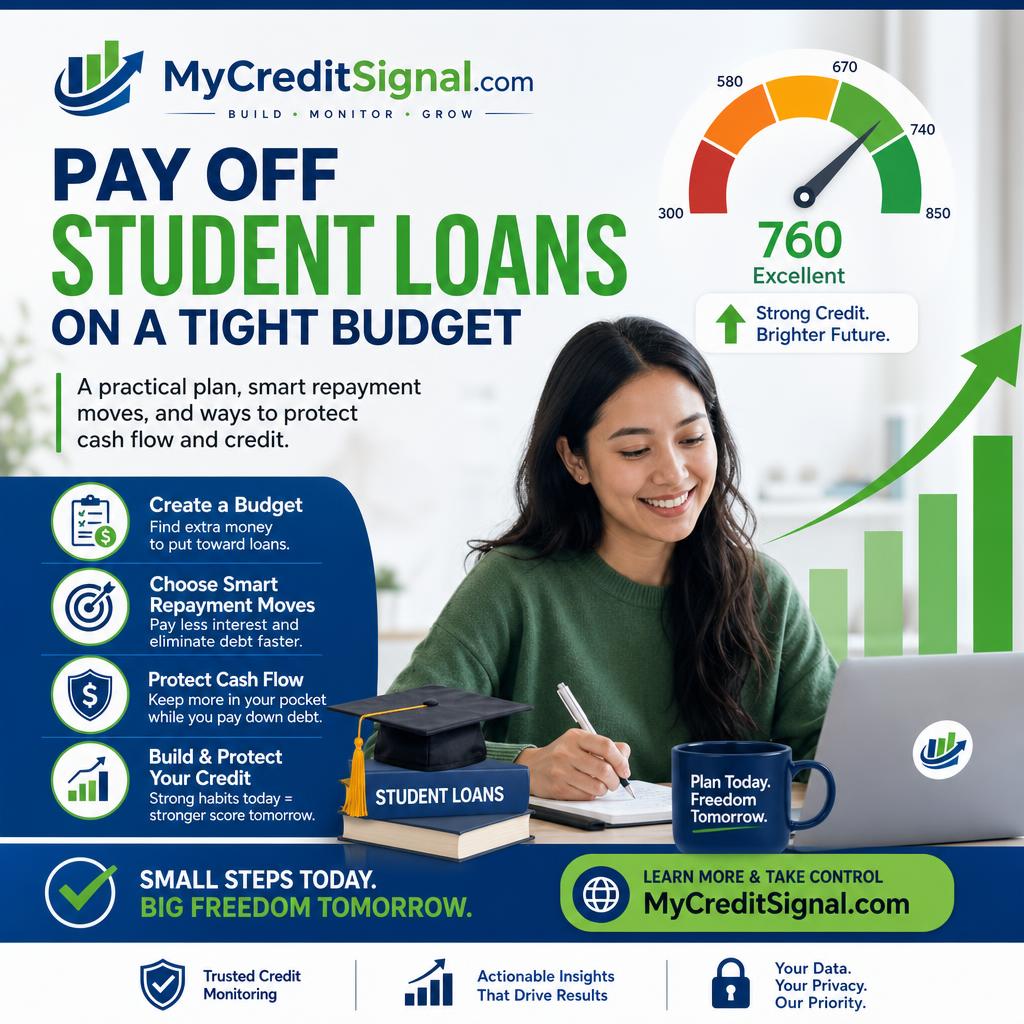
If your student loan bill is back, interest is accruing again, and your budget already feels stretched, the question is not whether you care about debt. It is how to keep paying without falling behind on rent, groceries, or other bills. That is the real problem for borrowers trying to pay off student loans on a tight budget.
This guide is for people who want a practical plan, not guilt. You will learn how to lower the pressure on your monthly cash flow, decide when to pay extra, and use the current federal repayment rules without assuming every loan works the same way. If you need a simple system, start here.
Contents
- 1 Who this is for and who needs a different playbook
- 2 Why student loan payoff works differently after the pause
- 3 The core rule for a tight budget is lower required then pay extra
- 4 The numbers and thresholds that matter most
- 5 What to do first versus what can wait
- 6 A step by step plan you can use this week
- 6.1 List every loan and separate federal from private
- 6.2 Check whether your required payment can be lowered
- 6.3 Create a survival budget before adding extra payments
- 6.4 Choose one fixed extra amount you can repeat
- 6.5 Pick your trigger for bigger payments
- 6.6 Track interest paid for tax season
- 6.7 Review the plan every 90 days
- 7 Mistakes that make tight budget repayment harder
- 8 What most articles miss about paying off student loans
- 9 FAQ
- 10 Helpful tools and related resources
- 11 Conclusion
Key Takeaway
The fastest safe way to pay off student loans on a tight budget is to first secure an affordable required payment, then direct every small extra dollar with intention instead of guessing each month.
Who this is for and who needs a different playbook
This article is for you if you have federal or private student loans, your income is tight, and you are trying to balance debt payoff with everyday bills. It is especially useful if your payment restarted recently, your required amount changed, or you are not sure whether you should aim for minimum payments or faster payoff.
It is also a fit if you are trying to protect your credit while paying down debt. Timely student loan payments can support credit health, while missed payments and other negative events can hurt, although the exact scoring effect varies by credit model and overall profile according to guidance from FICO.
This may not be the right approach if:
- You are already in a formal forgiveness track like PSLF and your lowest qualifying payment matters more than early payoff.
- You have extremely high-interest private loans and need to focus on lender-specific hardship options first.
- Your budget is negative before debt payments, meaning you need a survival budget before a payoff strategy.
If your cash flow is unstable month to month, pair this article with budgeting with irregular income so your loan plan works even when paychecks change.
Why student loan payoff works differently after the pause
The old payment-pause environment is over for most borrowers. Federal student loan payments resumed, and interest began accruing again for most borrowers in 2024 to 2025, with continued rule changes affecting repayment options through 2026 according to the U.S. Department of Education. That changes the math.
When interest is accruing again, every month you delay can increase the total cost of repayment. But that does not automatically mean you should throw every spare dollar at loans right now. On a tight budget, the order matters:
- First, make sure your required payment is affordable.
- Second, prevent late payments on all debts.
- Third, build enough cash stability that one surprise expense does not force you to skip the loan payment.
- Then, and only then, start accelerating payoff.
For federal borrowers, that usually means checking whether an income-driven repayment plan can lower the required bill. The CFPB explains that income-driven repayment plans base monthly payments on income and family size and can be as low as $0 for eligible borrowers at very low income levels. Learn the federal options at StudentAid.gov.
For private loans, the logic is different. Most private lenders do not offer federal-style IDR plans. The CFPB notes that private borrowers typically need to ask about lender-specific relief, such as forbearance or modified payment schedules. That means your first move is often a phone call, not an online federal application.
The core rule for a tight budget is lower required then pay extra
Many borrowers make one of two mistakes. They either chase the lowest payment forever and never make progress, or they force an aggressive payoff amount that wrecks the rest of the budget. The better approach is a two-layer system.
Layer one is your required payment strategy
This is the minimum you are obligated to pay under your current plan. For federal loans, you may be able to reduce that number through income-driven repayment. For private loans, you may need to negotiate a temporary alternative with the lender.
Layer two is your optional extra payment strategy
This is where payoff speed happens. Once your required payment is manageable, you choose a fixed extra amount you can sustain. That might be $25, $50, or one irregular-income windfall here and there. Small numbers still count when they happen consistently.
A useful decision framework is this:
- Do essentials fit after the required student loan payment? If no, reduce the required payment if possible.
- Do you have room for a repeatable extra amount every month? If yes, automate it.
- Is your income unpredictable? If yes, make extra payments only from pre-decided surplus buckets like overtime, bonuses, or tax refunds.
If you want a simple place to map those numbers, use the student loan repayment planner and pair it with the paycheck budget allocator so the payment fits inside your actual pay cycle.
The numbers and thresholds that matter most
You do not need dozens of formulas to pay off student loans. You need a handful of numbers that change your decision.
1. Your required monthly payment
This is the number that determines whether your budget survives. If your federal payment is too high, an IDR option may reduce it based on income and family size. Some eligible borrowers can qualify for a payment as low as $0, according to the CFPB.
2. Your extra payment amount
This is your payoff accelerator. On a tight budget, do not choose a heroic number. Choose a durable one. An extra $40 every month beats an extra $200 once followed by two missed payments elsewhere.
3. Your tax deduction opportunity
The IRS allows a student loan interest deduction of up to $2,500, with MAGI-based phase-outs and income limits. If you paid enough interest and qualify, this can reduce after-tax repayment cost. Review the details in IRS Publication 970. This should not be the reason you keep debt, but it is worth tracking at tax time.
4. Your forgiveness timeline if applicable
If you are working toward PSLF, the key number is 120 qualifying monthly payments while working full-time for a qualifying employer. If you are on an IDR-related forgiveness path, timelines can run much longer depending on the plan, and program availability has seen changes and legal challenges. In that case, paying extra may not always be the best move.
5. Your debt-to-income pressure
Even if student loans are manageable month to month, they still affect your overall cash flow and borrowing power. If you are also trying to qualify for a mortgage or other financing, review this DTI checklist for borrowing power so you can see how your student loans fit into the bigger picture.
Here is a realistic example. Say your federal required payment is $145, but an IDR plan lowers it to $60. That frees up $85 a month. Instead of spending the full $85 elsewhere, you might put $35 into a small emergency buffer and send $50 back as an extra loan payment. The required bill becomes safer, but your payoff does not stall.
What to do first versus what can wait
On a tight budget, timing matters as much as tactics. Here is the simplest order of operations.
- Do first: confirm your loan type, servicer, current payment, next due date, and whether interest is accruing.
- Do first: check whether your federal payment can be reduced through IDR or whether your private lender offers hardship options.
- Do first: build a line in your budget specifically for student loans instead of hoping there is money left.
- Do next: automate the minimum payment to avoid late fees and credit damage.
- Do later: increase extra payments once your budget is steady for at least one to two billing cycles.
- Do later: use windfalls to make targeted principal reductions if that does not undercut essentials.
For a broader payoff framework, this debt payoff strategies guide can help you decide how student loans fit alongside credit cards, personal loans, and other balances.
A step by step plan you can use this week
List every loan and separate federal from private
Write down the servicer, balance, required payment, and due date for each loan. Federal and private loans play by different rules. If you mix them together, you can miss an IDR option on one side or a lender hardship option on the other.
Check whether your required payment can be lowered
If you have federal loans, review repayment choices at StudentAid.gov repayment and compare IDR eligibility. If your income is low enough, your payment could be reduced substantially, even to $0 in some cases. If you have private loans, contact the lender and ask specifically about temporary modified repayment or forbearance options.
Create a survival budget before adding extra payments
Cover housing, utilities, food, transportation, insurance, and minimum debt payments first. Then see what remains. If you need help assigning each paycheck a job, use the paycheck budget allocator. This is where many borrowers realize the issue is not discipline. It is that the required payment was never matched to the real budget.
Choose one fixed extra amount you can repeat
Start with a number small enough that you will actually keep doing it. That might be $20 per paycheck or $50 per month. Put that number in writing. If you cannot commit to a monthly extra, define a rule such as sending 50 percent of overtime or side-income money to the loan.
Pick your trigger for bigger payments
Use windfalls intentionally. Tax refunds, reimbursements, bonuses, and cash gifts can shorten repayment if you decide ahead of time what share goes to loans. This is better than making emotional one-off payments and then regretting the cash squeeze later.
Track interest paid for tax season
Save your 1098-E if you receive one. Lenders generally send Form 1098-E if you paid $600 or more in student loan interest during the year. The student loan interest deduction can be worth up to $2,500 if you qualify under MAGI limits. That does not erase the debt, but it can trim the after-tax cost.
Review the plan every 90 days
Recheck your income, family size, and payment status quarterly. This matters because federal repayment options have seen ongoing updates and legal changes through 2025 and 2026. A plan that made sense six months ago may no longer be your best fit.
Five concrete actions you can take this week:
- Log in to your servicer account and verify your next due date.
- Separate your loans into federal and private categories.
- Price your true essentials for one month on paper.
- Apply for or review IDR if your federal payment is too high.
- Set one automatic extra payment you can sustain.
Mistakes that make tight budget repayment harder
Paying extra before fixing an unaffordable required payment
Behavior: sending aggressive extra payments while the required bill is still too high. Consequence: you may run short on essentials and end up missing another payment later. Fix: lower the required payment first if you qualify, then add extra only after the budget balances.
Treating private loans like federal loans
Behavior: assuming all student loans have IDR or forgiveness-style options. Consequence: you waste time chasing programs that do not apply while missing lender-specific relief. Fix: verify loan type first and call private lenders directly for hardship or modified payment options.
Using every spare dollar for loans and keeping no buffer
Behavior: throwing all extra cash at debt with no room for car repairs, medicine, or other basics. Consequence: one surprise expense can force you to use expensive credit or skip payments. Fix: keep a small buffer alongside your payoff plan, even if progress is slower at first.
Ignoring the tax side of repayment
Behavior: not tracking interest paid or forgetting the 1098-E. Consequence: you may miss a deduction that lowers your after-tax repayment cost. Fix: save your tax forms and review eligibility under IRS Publication 970.
What most articles miss about paying off student loans
Most articles assume faster payoff is always better. That is not always true.
Another missed point is that legal and regulatory changes matter more with student loans than with many other debts. The SAVE plan replaced REPAYE in 2023, but it also faced freezes and legal challenges, and the Department of Education has continued to adjust repayment options under evolving law, according to ED and NASFAA summaries. So any long-range plan should be reviewed regularly, not set once and forgotten.
Finally, credit impact is more nuanced than many people think. Timely payments generally help credit health over time, while missed payments can hurt. But the exact impact depends on the scoring model and your broader credit profile. That means consistent on-time payments usually matter more than making flashy extra payments you cannot maintain.
FAQ
What is the best way to pay off student loans on a tight budget?
Start by lowering the required payment if you qualify, especially on federal loans through IDR. Then automate the minimum and add a small repeatable extra payment. Consistency beats overcommitting.
Are private student loans eligible for income driven repayment?
Usually no. The CFPB notes that most private student loans do not offer federal-style IDR plans. You need to ask the lender about hardship relief, temporary forbearance, or modified repayment options.
How does student loan interest affect taxes?
If you qualify, the IRS allows a student loan interest deduction of up to $2,500, subject to MAGI-based limits and phase-outs. Keep your 1098-E and review Publication 970 at tax time.
- Use the student loan repayment planner to map monthly payments and payoff timing.
- Use the paycheck budget allocator to fit loan payments into your real cash flow.
- Read the debt payoff strategies guide if you are balancing student loans with other debts.
- Review budgeting with irregular income if your pay varies month to month.
Get weekly credit tips, tool updates, and practical guides – free.
Conclusion
To pay off student loans on a tight budget, do not start with sacrifice. Start with structure. Make the required payment affordable, protect your essentials, and then send extra money on purpose. That approach lowers the odds of missed payments and gives you a payoff plan you can actually stick to.
Your next step is simple: verify your loan type today, review your current payment options, and run the numbers in a repayment planner. When the payment fits your budget, progress gets much easier to sustain.



Want to understand your credit report?
Get plain-English explanations with our free AI Credit Analyzer →
Leave a Reply
You must be logged in to post a comment.