
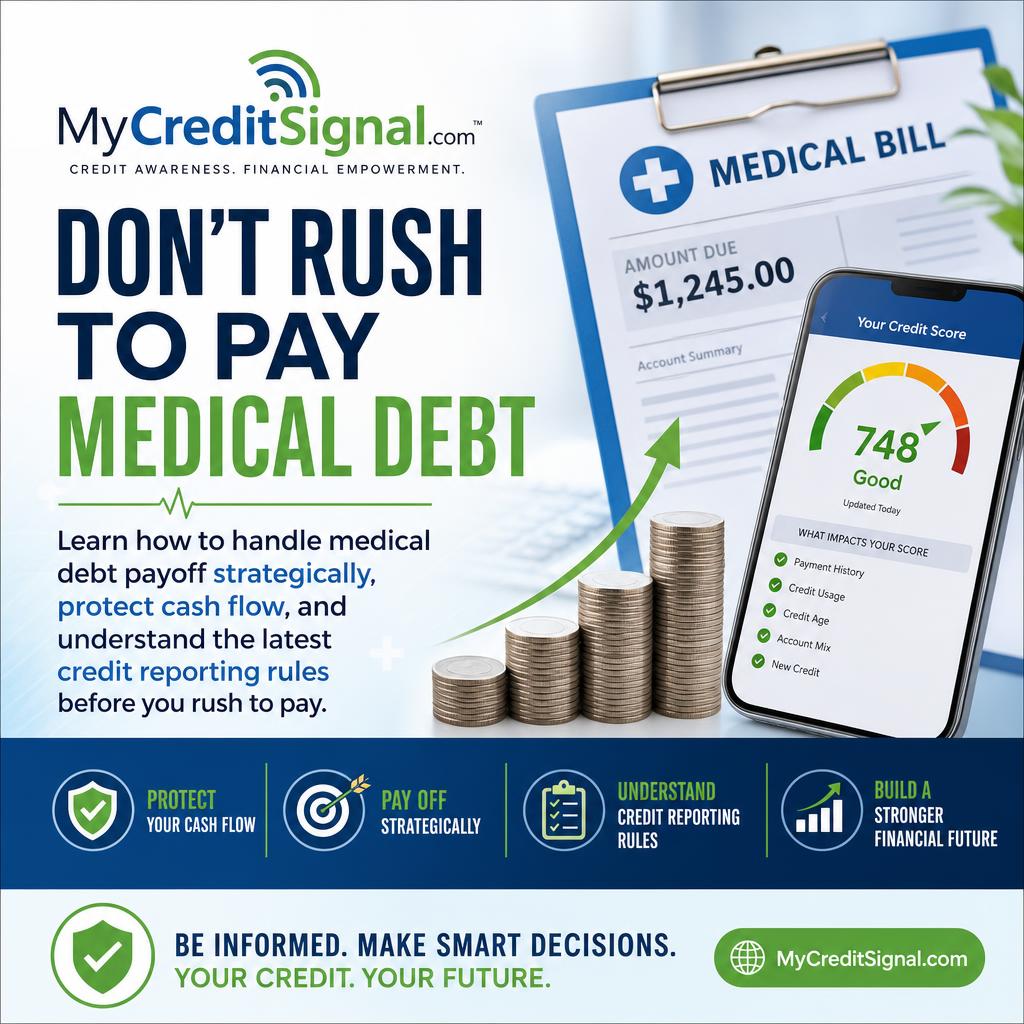
A $1,200 hospital bill can feel like an emergency long after the medical issue is over. If you throw every spare dollar at it too fast, you can miss rent, skip other debts, or drain the cash cushion that keeps one setback from becoming three. If you ignore it, collections pressure and stress can grow. This guide is for people who need a practical medical debt payoff plan that protects both credit and day-to-day finances. You will learn what medical debt rules look like now, which numbers matter most, and how to decide what to pay first, what to negotiate, and what to delay without making your situation worse.
Medical debt is not handled exactly like credit card debt. Reporting rules have changed, federal protections have expanded, and the smartest move is often a sequence, not a panic payment.
Contents
- 1 Who this medical debt payoff guide is for
- 2 Why medical debt needs a different game plan
- 3 The thresholds that matter before you send a payment
- 4 A quick first-versus-later checklist
- 5 A realistic example of medical debt payoff math
- 6 Your step-by-step medical debt payoff plan
- 6.1 List every medical balance by amount, status, and deadline
- 6.2 Protect your baseline budget before making extra payments
- 6.3 Check whether surprise-billing protections may apply
- 6.4 Ask the provider for in-house payment options before using outside credit
- 6.5 Prioritize accounts based on pressure, not panic
- 6.6 Set a monthly target you can keep for at least 6 months
- 6.7 Prepare for settlement talks only if your budget supports a lump sum
- 6.8 Build a tiny buffer while you pay
- 7 Five actions to take this week
- 8 Mistakes that make medical debt harder to fix
- 9 What most articles miss about medical debt
- 10 When this advice does not apply cleanly
- 11 FAQ
- 12 Helpful tools and related resources
- 13 Conclusion
Key Takeaway
The best medical debt payoff plan is usually the one that protects cash flow first, uses current medical debt rules to your advantage, and targets the balances most likely to hurt your finances next.
Who this medical debt payoff guide is for
This article is most useful if you fall into one of these groups:
- You have one or more medical bills and cannot pay them in full this month.
- You are worried that paying the bill too aggressively will force you to use credit cards for groceries, utilities, or rent.
- You have already been contacted by a collector and want to respond strategically.
- You are trying to balance medical debt payoff with other debts that charge high interest.
- You want to understand how recent credit reporting changes affect the urgency of payment.
This is probably not the right framework if you have enough savings to pay the bill in full without disrupting your emergency fund or if you are dealing with a legal, insurance-coverage, or employer-benefit issue that needs specialized advice first. It is also not a fit if your top problem is a credit report error or dispute, because that is a separate topic from payoff strategy.
If your broader debt picture is messy, it may help to zoom out and map every balance before focusing on just one bill. Our guide on how to calculate total debt and build a payoff plan can help you organize the full picture first.
Why medical debt needs a different game plan
Medical debt payoff is not just about paying as fast as possible. It is about timing, protections, and tradeoffs.
First, many medical debts are treated differently by credit reporting systems than other debts. According to Experian, major credit bureaus removed medical collections with an initial reported balance under $500 from consumer credit reports, and many medical debts may be excluded from reporting if resolved within 12 months. That means a $350 medical collection does not carry the same credit consequences as a $350 credit card collection.
Second, federal policy has kept moving in a more consumer-protective direction. The CFPB finalized rule changes in 2025 aimed at curbing the use and reporting of medical debt in credit decisions, according to a summary linked from the consumer protection framework in the research context. That does not mean medical bills are harmless. It means you should avoid making old assumptions, such as treating every medical bill like an immediate credit-score emergency.
Third, you may have rights before and during collections activity. The FTC debt collection guidance explains that collectors face limits on abusive conduct and consumers have rights around verification. The CMS No Surprises Act toolkit also outlines protections against certain surprise bills in emergency and out-of-network situations.
That combination changes the order of operations. In plain English: do not assume your first move is to empty savings or skip other core bills to erase medical debt immediately.
The thresholds that matter before you send a payment
If you want a practical decision framework, focus on four thresholds.
1. The under $500 reporting threshold
Medical collections under $500 were removed from U.S. credit reports by the major bureaus in 2023. That does not make the bill optional. You can still face collection efforts, account stress, and possible lender-specific impacts outside a classic score model. But it does change urgency. A $275 bill may deserve a payment plan, not a financial fire drill.
2. The 12-month window
Experian notes that many medical debts may be kept off credit reports if resolved within one year. The key word is many, not all. You should still act early, but this policy can give you breathing room to set up terms without wrecking your budget in one month.
3. Your monthly cash-flow gap
Here is the formula to use this week: essential monthly bills minus reliable monthly income = cash-flow gap or surplus. Essential bills include housing, utilities, food, transportation, insurance, minimum debt payments, and basic child or medical needs. If you have only a $75 surplus per month after essentials, agreeing to a $200 medical payment plan is not a plan. It is a future late payment.
4. The cost of replacement debt
If paying a medical bill forces you to carry credit card debt at a higher rate, you may be solving the less expensive problem first. Some medical financing products advertise low rates, and the research context notes a typical cited range of 0% to 5% for some consumer medical credit lines depending on issuer terms, but terms vary and penalties matter. Always compare that with the rate on any credit card balance you would create instead.
A quick first-versus-later checklist
When you cannot do everything at once, use this short order-of-operations test.
- Do first: protect housing, utilities, food, transportation, insurance, and minimum payments on interest-bearing debts.
- Do next: identify whether the medical bill falls under No Surprises Act protections or qualifies for provider hardship or no-interest payment options.
- Do after that: prioritize larger balances, accounts already in collections, or accounts that could disrupt care access with that provider.
- Do later: small balances under $500 that can be handled through a short payment plan without sacrificing essentials.
If you need a broader payoff structure for all debts, not just medical bills, see debt payoff strategies that fit your finances. If a recent missed payment is already affecting your borrowing options, this guide on recovering from late payments can help you limit additional damage while you work through the bill.
A realistic example of medical debt payoff math
Say you have:
- $1,800 in medical bills
- $400 on a second medical bill
- $1,200 in checking after rent is paid
- $900 in emergency savings
- $250 monthly cash surplus after essentials and minimum debt payments
A panic response would be to wipe out the $1,800 bill using savings and checking. That leaves you thin on cash and vulnerable to the next car repair or prescription cost.
A more strategic approach might look like this:
- Keep the $900 emergency fund intact.
- Use $200 from checking to start goodwill and show engagement.
- Ask the provider for an interest-free payment plan on the $1,800 balance at $100 to $125 per month.
- Target the $400 bill for faster payoff if it is already closer to collections contact.
- Leave at least $125 to $150 of monthly surplus uncommitted so one irregular expense does not break the plan.
In that example, payoff is slower, but the plan is stronger. The goal is not to look aggressive on paper. The goal is to actually finish.
Your step-by-step medical debt payoff plan
List every medical balance by amount, status, and deadline
Create one page with provider name, balance, due date, whether the account is still with the provider or a collector, and whether the amount is under or over $500. Also note whether the service involved emergency care or out-of-network billing. This single sheet becomes your decision map.
Protect your baseline budget before making extra payments
Calculate your true monthly surplus after essentials. Do not count overtime that is inconsistent or money you hope to make. If your surplus is $90, a $150 agreement is too high. A medical debt payoff plan that causes overdrafts or credit card reliance will usually cost you more later.
Check whether surprise-billing protections may apply
The No Surprises Act provides protections in many emergency and certain out-of-network situations. Use the CMS consumer toolkit to understand whether the bill may fall under those rules. Even if the protection does not erase the full amount, it may change what you owe or how the bill should be handled.
Ask the provider for in-house payment options before using outside credit
Provider payment plans are often simpler and may avoid interest that a new credit line could charge later. If you are offered financing, review the APR, fees, end date for promotional terms, and penalties. A headline rate of 0% is useful only if the full agreement fits your budget and does not reset to a worse cost later.
Prioritize accounts based on pressure, not panic
Pay first where the consequences are nearest: balances already in collections contact, accounts that may affect ongoing care with the provider, and larger balances that need formal arrangements. Lower on the list are smaller balances under $500 if paying them first would leave you short on necessities.
Set a monthly target you can keep for at least 6 months
Consistency matters more than an impressive first payment. If you can truly afford $125 per month, set that as your medical debt payoff amount. Then divide it among the accounts you chose to prioritize. You can estimate your timeline with the debt-free date calculator so you know when the balance could realistically be gone.
Prepare for settlement talks only if your budget supports a lump sum
If an account is in collections and you have a limited lump sum available, use a framework before making offers. Your total settlement budget should never include money needed for rent, utilities, groceries, prescriptions, or your minimum debt payments. The collection settlement budget planner can help you test what is truly affordable before you negotiate.
Build a tiny buffer while you pay
Even a modest cash cushion matters. The Federal Reserve’s 2025 Economic Well-Being report points to ongoing financial strain from medical expenses. That is a reminder that payoff and resilience need to happen together. If paying $125 monthly would reduce you to zero cushion, paying $90 may be the more durable move.
Five actions to take this week
- Write down every medical bill with amount, status, and due date.
- Separate balances under $500 from balances above that threshold.
- Calculate your actual monthly surplus after essentials and minimum payments.
- Call at least one provider this week to ask about hardship terms or a no-interest payment plan.
- Use one calculator or planner to estimate a finish date before you agree to any monthly amount.
- Read the FTC debt collection FAQ if a collector has already contacted you.
Mistakes that make medical debt harder to fix
Using your entire emergency fund to get rid of the bill fast
Behavior: Draining savings to pay medical debt in one shot. Consequence: The next surprise expense may push you onto a credit card or cause missed payments elsewhere. Fix: Keep a basic reserve and use a payment plan if wiping out the bill would leave you exposed.
Treating a small medical balance like a bigger emergency than rent or utilities
Behavior: Paying a medical bill before essential living costs. Consequence: You may solve one problem while creating late fees, service interruptions, or much more expensive debt. Fix: Protect the core budget first, then work the medical balance into a realistic monthly plan.
Agreeing to a monthly payment you cannot sustain
Behavior: Saying yes on the phone to an amount that looks good but does not fit your numbers. Consequence: The plan breaks, you fall behind again, and stress increases. Fix: Base every offer on your documented monthly surplus, not pressure in the moment.
Using medical financing without reading the fine print
Behavior: Focusing only on a low intro rate. Consequence: Fees, penalties, or later-rate changes can erase the apparent benefit. Fix: Compare the full terms with your provider’s in-house plan and your other debt costs before signing anything.
What most articles miss about medical debt
Many articles frame this as a simple yes-or-no question: should you pay the bill immediately or not? Real life is messier. Three details often get skipped.
Your credit score is not the only risk
Medical debt reporting changes matter, but your day-to-day stability matters more. If paying a $600 bill causes two $35 overdraft fees and a credit card balance you revolve for months, the total damage can exceed the original issue.
Provider access can matter
Sometimes the practical reason to address a bill is not credit. It is preserving a relationship with a doctor, clinic, or hospital system you still need. That can make a payment arrangement worth prioritizing even when the credit impact is limited.
Collections timing does not mean you should do nothing
Some readers hear about the under-$500 removal or the one-year reporting window and conclude they should ignore every medical bill until later. That is too simplistic. Reporting rules can evolve, not all billing situations are identical, and collections pressure can still create real stress and logistical problems.
When this advice does not apply cleanly
There are a few cases where a standard medical debt payoff framework needs adjusting.
- You can pay in full easily: If the bill is accurate and paying it will not damage your savings or other goals, simplicity may beat optimization.
- You are facing multiple high-interest debts: A low-pressure medical bill may need to rank behind expensive revolving debt, especially if the medical account still allows a no-interest plan.
- You expect a near-term lump sum: If a tax refund, HSA reimbursement, or other reliable funds are coming soon, a short bridge strategy may work better than locking into an oversized monthly plan.
If your whole debt load needs restructuring, not just your medical bills, compare medical payoff choices inside your broader plan rather than in isolation. That is why many readers benefit from reading how to choose a debt payoff strategy that fits after they map their medical balances.
FAQ
Does paying a medical collection always raise my credit score right away?
No. Experian notes that paid medical collections can be treated differently by scoring models, and results vary. Paying may still be the right money move, but the score benefit may not be immediate.
Can medical debt still matter if it is under $500?
Yes. Major bureaus removed medical collections under $500 from consumer credit reports, but the bill can still lead to collection activity, provider account issues, and budget strain if ignored.
Should I use a credit card to pay medical debt?
Usually only if the alternative is worse and you have a clear payoff plan. Moving a medical bill onto a higher-cost balance can turn a manageable problem into a more expensive one.
- Debt-free date calculator to estimate how long your plan will take.
- Collection settlement budget planner to test lump-sum offers safely.
- Debt payoff strategies guide for fitting medical balances into a full debt plan.
- Late payment recovery guide if the bill already contributed to missed payments elsewhere.
Get weekly credit tips, tool updates, and practical guides – free.
Conclusion
The smartest medical debt payoff plan is usually not the fastest one. It is the one that keeps your essentials covered, uses current reporting rules and federal protections wisely, and gives you a monthly number you can actually sustain. Medical debt can be serious, but it does not always deserve top priority over every other bill in your life.
Your next step is simple: list the balances, identify which ones create the most immediate risk, and set one affordable monthly target today. A calm plan beats a panicked payment every time.



Want to understand your credit report?
Get plain-English explanations with our free AI Credit Analyzer →
Leave a Reply
You must be logged in to post a comment.