
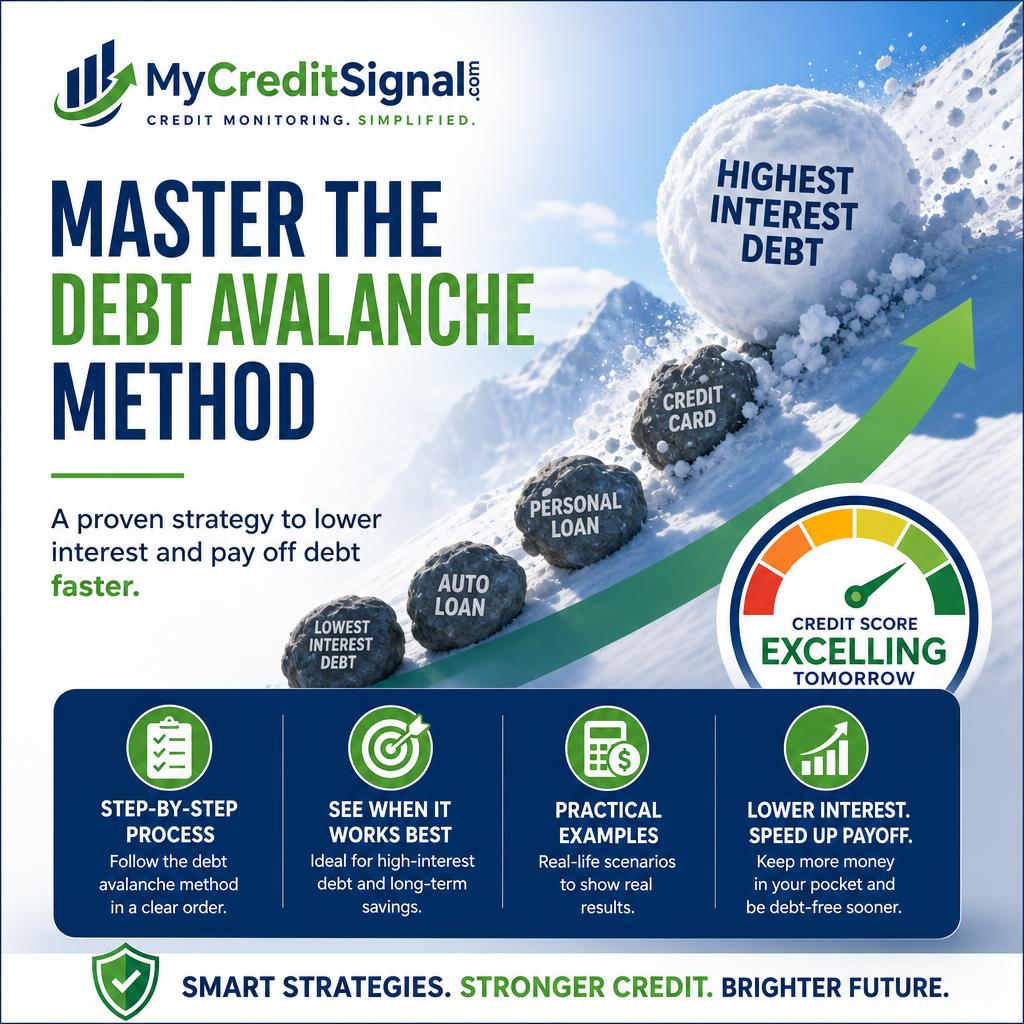
If you have three or four debts competing for your extra money, the wrong payoff order can quietly cost you more month after month. That is the problem the debt avalanche method is built to solve. Instead of guessing which balance to attack, you focus your extra payment on the highest APR debt while keeping minimum payments on the rest. This guide is for people who want a practical system, not a slogan. By the end, you will know the exact debt avalanche method steps to organize your debts, choose your first target, estimate where your extra dollars should go, and avoid common payoff mistakes.
Contents
- 1 Who should use a debt avalanche payoff plan
- 2 How the debt avalanche actually works in plain English
- 3 The numbers that matter before you start
- 4 A fast decision framework for what to do first versus later
- 5 Debt avalanche method steps you can follow this week
- 5.1 List every debt on one sheet
- 5.2 Rank debts from highest APR to lowest
- 5.3 Set a fixed extra payment amount
- 5.4 Automate minimums on every non-target debt
- 5.5 Attack the highest APR debt with every extra dollar
- 5.6 Roll freed-up payments to the next debt immediately
- 5.7 Review utilization and APR changes every month
- 6 Mistakes that make the avalanche less effective
- 7 What most articles miss about avalanche planning
- 8 When a different strategy may be smarter
- 9 FAQ about debt avalanche method steps
- 10 Helpful tools and related resources
- 11 Put the method to work now
Key Takeaway
The debt avalanche method works best when you consistently direct every extra dollar to the highest-interest debt first, then roll that payment into the next debt to reduce total interest over time.
Who should use a debt avalanche payoff plan
This method fits best if your debt list includes at least one account with a meaningfully higher APR than the others. Think credit cards, store cards, or high-rate personal loans sitting next to lower-rate auto or student debt. According to Forbes Advisor, the debt avalanche prioritizes the debt with the highest interest rate first while you continue minimum payments on every other account.
You are a strong candidate if:
- You want to minimize total interest paid, not just get the fastest emotional win.
- You can stay consistent even if the first debt takes a while to disappear.
- You have enough cash flow to pay at least minimums on all debts plus some extra on one target debt.
- You want a payoff system that also makes room for credit score improvement when high-utilization credit cards are involved.
This method may be a weaker fit if you need quick motivation from knocking out a very small balance first. In that case, a comparison tool can help you weigh tradeoffs. My Credit Signal has a snowball vs avalanche comparison tool that can help you see which structure matches your cash flow and habits better. You may also want to read Mastering Debt Payoff Strategies if you are still deciding between approaches.
How the debt avalanche actually works in plain English
Debt avalanche is simple: list every debt, sort them by APR from highest to lowest, pay minimums on all of them, and send every extra dollar to the highest-rate debt until it is gone. Then you take the payment that used to go to that debt and add it to the next-highest APR debt. Forbes Advisor describes the process in four steps: list debts, rank by interest rate, budget for extra payments, and apply freed-up payments to the next debt.
Why does this matter? Because interest is not spread evenly across your debts. A balance at a much higher APR drains more money over time than one at a lower APR. Fidelity notes that avalanche is generally more effective for reducing overall debt when high-interest loans are present, though the right choice still depends on personal circumstances.
There is also a credit angle here. Experian explains that paying down high-utilization revolving debt, such as credit cards, can influence utilization and score over time. That means the debt with the highest APR and the debt doing the most score damage are often the same account, but not always. When they are different, you may need a hybrid approach, which we will cover later.
If you want a deeper primer before building your list, see Mastering the Debt Avalanche Method Save Interest for a broader walkthrough of the strategy.
The numbers that matter before you start
You do not need advanced math to use debt avalanche, but you do need the right numbers in one place. Gather these for each debt:
- Current balance
- APR
- Minimum monthly payment
- Due date
- Whether the debt is revolving or installment
APR is the ranking number. Balance matters too, but it does not decide the order in a pure avalanche. If Card A has a smaller balance but Card B has the higher APR, Card B comes first.
Here is a simple example:
- Credit card A: $4,000 at 29% APR, minimum $120
- Credit card B: $2,000 at 18% APR, minimum $60
- Personal loan: $6,000 at 11% APR, minimum $180
- Auto loan: $9,000 at 7% APR, minimum $240
Assume you can put $250 extra toward debt each month after covering all minimums. Under avalanche, the full extra $250 goes to credit card A first because 29% is the highest APR. Once that card is paid off, you roll its old minimum payment of $120 plus the extra $250 onto the next target. That means card B would receive its own minimum plus a much larger attack payment. This is the compounding power of rollover.
A second threshold to watch is credit utilization on revolving accounts. Experian notes that keeping utilization below about 30% is associated with more favorable credit scores. If one of your credit cards is maxed out or close to it, paying that card down can support both payoff math and score recovery over time. Results still vary by credit profile and scoring model, but the threshold is a useful planning marker.
If you want to organize these numbers quickly, use the debt avalanche planner. It gives you one place to rank balances and estimate where your extra payment should go first.
A fast decision framework for what to do first versus later
Use this short framework before you send your next extra payment:
- First: Make every minimum payment on time. Payment history matters more than payoff speed if you are trying to protect credit.
- Next: Identify the highest APR debt. That is your standard avalanche target.
- Check one exception: If another credit card is driving extremely high utilization, compare whether a short-term push to lower that utilization makes sense.
- Later: Lower-rate installment debts usually stay lower on the list unless there is a special reason, such as a looming rate reset or cash flow issue.
This prevents a common problem: scattering extra money across multiple balances. That feels productive, but it often slows momentum because no single expensive balance drops fast enough.
Debt avalanche method steps you can follow this week
List every debt on one sheet
Write down every account with its balance, APR, minimum payment, and due date. Do not rely on memory. Pull the exact APR from your statements or online account pages. If you have promotional financing, note when that rate ends. Concrete action for this week: build your list in one sitting and include even the debts you dislike looking at.
Rank debts from highest APR to lowest
Now ignore balance size for a moment and sort by interest rate. Your highest APR debt becomes target number one. If two debts have the same APR, target the smaller balance first only as a tiebreaker to create a quicker rollover. Concrete action: reorder your list today and mark one account as your active target.
Set a fixed extra payment amount
Choose a number you can repeat monthly, not just once. Even a modest extra payment matters when it is consistent. Review your last 30 days of spending and identify one or two categories you can trim without causing backlash next month. Concrete action: move that amount into your budget as a recurring debt line item before the next billing cycle.
Automate minimums on every non-target debt
The avalanche only works if every account stays current. Late fees and penalty APRs can wipe out the gains from smart sequencing. Concrete action: set autopay for the minimum on every debt except the target, then manually send the extra payment to the target after each paycheck or once per month.
Attack the highest APR debt with every extra dollar
Send your fixed extra amount to the target debt each month. If you get a refund, bonus, side income payment, or lower-than-expected bill, add some or all of it to that same debt instead of splitting it across several accounts. Concrete action: decide in advance what percentage of windfalls will go to debt so you do not negotiate with yourself later.
Roll freed-up payments to the next debt immediately
Once the first target is paid off, do not absorb that payment back into everyday spending. Add the old minimum payment from the paid-off debt to the extra amount you were already sending. This creates a larger attack payment on the next debt. Concrete action: update your payoff plan the same week a debt reaches zero so the rollover starts with no delay.
Review utilization and APR changes every month
Credit cards can change rates, and your utilization can shift if you keep using an account while paying it down. Concrete action: once a month, log balances, check whether any card is still above about 30% utilization, and confirm your target debt still deserves first place.
If you prefer tracking progress visually, pair this with a debt payoff spreadsheet so you can see balances, target order, and your projected debt-free timeline in one place.
Mistakes that make the avalanche less effective
Paying extra on the wrong debt because the balance looks scary
Behavior: You throw extra money at the biggest balance instead of the highest APR debt. Consequence: You may stay in expensive revolving debt longer and pay more interest overall. Fix: Rank by APR first, then use balance size only as a tiebreaker when rates are equal.
Spreading extra payments across multiple accounts
Behavior: You split an extra payment among several debts each month. Consequence: None of the balances falls fast enough to create a meaningful rollover, so progress feels slow. Fix: Keep minimums on all debts and direct the full extra amount to one target debt at a time.
Ignoring cash flow and choosing an extra payment you cannot sustain
Behavior: You commit to a large extra payment that only works in a perfect month. Consequence: You may miss the target in tighter months, lose momentum, or rely on cards again. Fix: Start with a repeatable number, then increase it only after two or three months of consistency.
Keeping a target card active while paying it down
Behavior: You continue charging regular spending to the card you are trying to eliminate. Consequence: The balance does not fall as planned, utilization stays high, and you may underestimate how long payoff will take. Fix: Pause new spending on the target card whenever possible and use debit or a budgeted checking account category instead.
What most articles miss about avalanche planning
Many articles frame avalanche as a pure math decision. That is incomplete. The best payoff plan is the one you can keep going through normal life interruptions.
Another nuance is credit scoring. Paying off high-interest debt does not always produce an immediate score jump. Experian notes that effects depend on utilization, payment history, and timing of account updates. If your highest APR debt is an installment loan and your highest utilization is sitting on a different credit card, a short hybrid phase may be reasonable: lower the most overused revolving account to a more manageable utilization range, then return to strict avalanche order.
This is also where realistic planning matters. If your first target debt will take a long time, build milestone checkpoints instead of waiting for one big payoff moment. For ideas on keeping motivation up without spending more, read Debt Payoff Milestones Without Spending More.
When a different strategy may be smarter
Debt avalanche is powerful, but not universal. Consider another path if any of these apply:
- You are missing minimum payments now. Stabilizing your budget and due dates comes before optimization.
- You need fast behavioral wins to stay committed. A snowball or hybrid method may help you finish what you start.
- You are dealing with complex nonconsumer debt, such as tax obligations, where formal repayment options may change the best order.
- You are already in talks with a nonprofit credit counselor about a debt management plan. In that case, compare your projected avalanche timeline with the terms you are offered.
If you are unsure how aggressive your timeline should be, a separate planning article like Set a Debt Free Date You Can Reach can help you choose a target that fits your cash flow instead of sabotaging it.
FAQ about debt avalanche method steps
What is the main difference between debt avalanche and debt snowball?
Avalanche ranks debts by highest APR first, while snowball ranks by smallest balance first. Avalanche is usually better for reducing total interest when rates vary, while snowball may feel more motivating for some people.
Will paying high-interest debt first improve my credit score?
It can help over time, especially if the debt is a high-utilization credit card, but results vary. Payment history, utilization, account type, and the timing of lender updates all affect score changes.
How much extra money should I put toward the target debt each month?
Use a fixed amount you can sustain every month after covering all minimums. Consistency matters more than setting an ambitious number that only works occasionally.
- Use the debt avalanche planner to rank your debts and choose your first target.
- Compare motivation versus interest savings with the snowball vs avalanche comparison tool.
- Read Mastering the Debt Avalanche Method Save Interest for a broader strategy overview.
- Review Mastering Debt Payoff Strategies if you want to compare avalanche with other payoff frameworks.
Get weekly credit tips, tool updates, and practical guides – free.
Put the method to work now
The debt avalanche method is not complicated, but it does reward precision. List every debt, rank by APR, lock in a repeatable extra payment, and keep rolling freed-up payments forward. That is how you cut interest and speed up payoff without constantly rethinking your plan.
Your next step is simple: build your debt list today and run it through the debt avalanche planner. Once your target debt is clear, automate the minimums, send the extra payment, and let the system do its job month after month.



Want to understand your credit report?
Get plain-English explanations with our free AI Credit Analyzer →
Leave a Reply
You must be logged in to post a comment.