
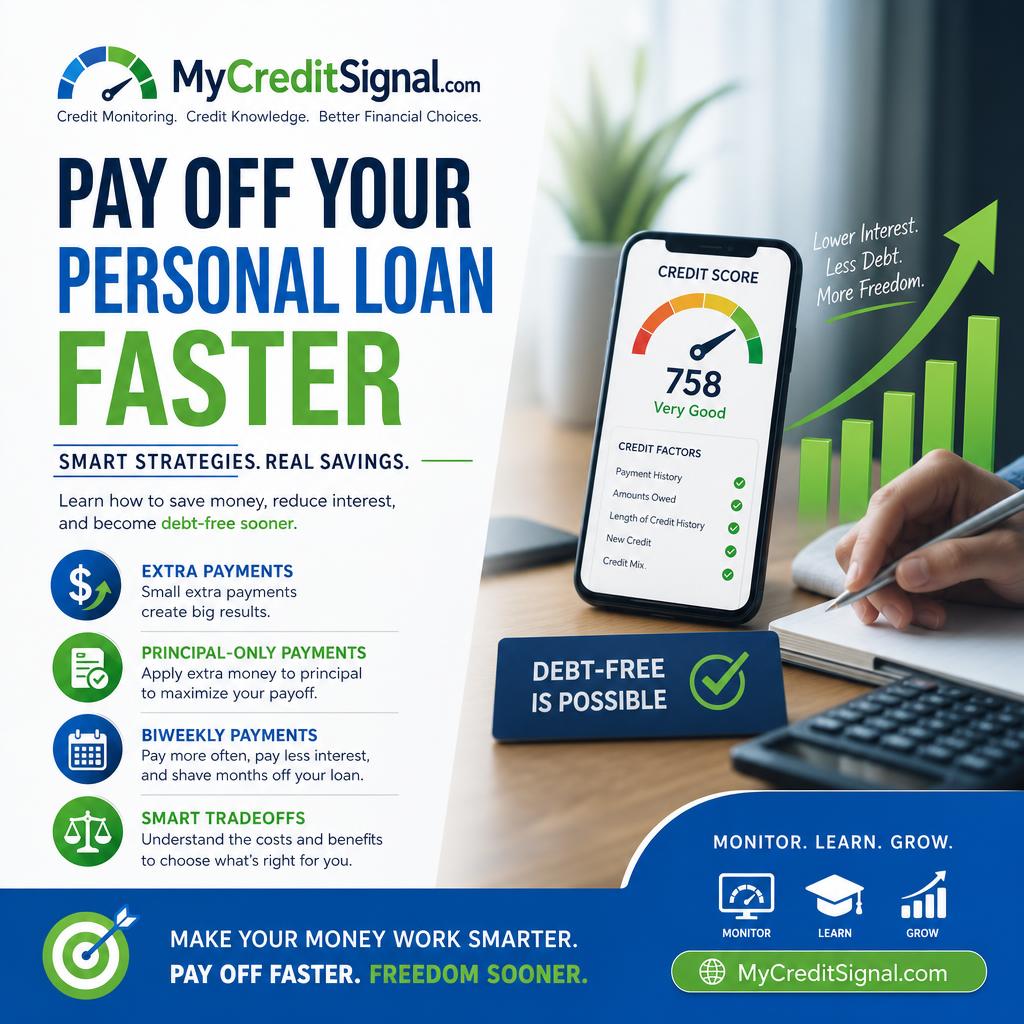
If your personal loan payment feels manageable but painfully slow, you are not imagining it. A fixed installment loan can look simple on paper while still costing a lot in interest over time. The good news is that many borrowers can pay off a personal loan faster by adding extra payments, switching timing, and making sure every extra dollar hits principal instead of being treated as an early next payment.
This guide is for borrowers who want a cleaner payoff plan without wrecking cash flow. You will learn how extra payments really work, which numbers matter most, how to avoid lender processing mistakes, and when paying early may not be the smartest next move.
Contents
- 1 Who should use this strategy
- 2 What extra payments actually do to a personal loan
- 3 The loan details that matter more than motivation
- 4 A quick numbers example before you send more money
- 5 Biweekly payments versus monthly extra payments
- 6 What to do first this week and what can wait
- 7 A step by step plan to pay off your personal loan faster
- 7.1 Read the loan agreement and statement line by line
- 7.2 Ask for principal-only payment instructions in writing
- 7.3 Pick one repeatable extra amount
- 7.4 Decide on monthly or biweekly timing
- 7.5 Check the first extra payment after it posts
- 7.6 Redirect windfalls with a split rule
- 7.7 Review your ranking against other debts every 90 days
- 8 Mistakes that can cancel out your payoff gains
- 9 What many payoff articles leave out
- 10 FAQ
- 11 Helpful tools and related resources
- 12 Conclusion
Key Takeaway
The fastest safe way to pay off a personal loan is to send targeted extra payments to principal, confirm your lender applies them correctly, and use a payoff schedule you can repeat every month.
Who should use this strategy
This approach makes the most sense if you have a personal loan with a fixed payment, no urgent past-due bills, and room in your budget for steady extra payments. It is especially useful if your rate is meaningfully higher than what you earn on savings, or if you want to reduce required debt before a future goal like moving, changing jobs, or qualifying for another loan.
It can also fit well if you are already using a broader payoff strategy. If you are still deciding whether to attack one debt or organize everything together, read Calculate Total Debt and Build a Payoff Plan first so your extra payments go to the right place.
This may not be your best first move if:
- You do not yet have a basic emergency cushion.
- Your lender charges a prepayment penalty or early payoff fee that cuts into savings.
- You carry other debts with a higher interest rate, where each extra dollar would save more.
- Your cash flow is unstable enough that aggressive overpayments could push you back into credit card debt.
What extra payments actually do to a personal loan
On an installment loan, interest is charged based on the balance you still owe. When you reduce principal earlier than scheduled, future interest has less balance to work from. That is why extra payments can shorten the term and reduce total interest, as long as the lender applies the extra amount to principal rather than treating it as money for a future due date. The Consumer Financial Protection Bureau specifically warns that some lenders may spread extra payments differently unless you give clear instructions. CFPB source.
In plain English, this means there are two separate questions:
- Are you paying extra? That creates the opportunity to save interest.
- Is the lender applying it to principal? That determines whether you actually get the benefit now.
That distinction is easy to miss. A borrower may send an extra $100 and assume the loan will end sooner. But if the servicer advances the due date instead, the balance may not fall as efficiently as expected. That is why documentation matters.
If you have multiple debts, extra payments also need to be prioritized correctly. CFPB consumer advisory guidance supports directing extra money to the highest interest rate debt first when your goal is interest savings. So if your personal loan is at 9% and your credit card is much higher, the personal loan may not be the best place for your first extra dollar.
For readers comparing payoff sequences, the debt avalanche logic in this debt avalanche guide can help you decide whether your personal loan should be first, second, or later in line.
The loan details that matter more than motivation
Most payoff articles overfocus on discipline and underfocus on mechanics. For a personal loan, the most important variables are boring but powerful:
- Current balance because extra payments matter more when there is still time left for interest savings to compound.
- APR because a higher rate increases the value of paying early.
- Remaining term because extra payments sent early usually save more than the same dollars sent near the end.
- Prepayment rules because fees can shrink the benefit.
- Posting instructions because lender systems may not default to principal-only treatment.
There is also a credit angle. FICO explains that paying off an installment loan early can affect your score in the short term, but scores can recover as you continue making on-time payments on other accounts and reduce overall debt. Payment history remains a major factor, and myFICO notes that payment history makes up 35% of a FICO score. myFICO source.
That means the right question is not, “Will this help my score instantly?” The better question is, “Will this improve my overall debt position without causing a cash flow problem?” Credit score effects can vary by profile and scoring model, so do not judge the strategy only by a possible short-term score move.
A quick numbers example before you send more money
Suppose you have a $15,000 personal loan at 9% APR over 5 years. The exact savings from an extra payment depends on the amortization schedule and lender rules, so you should run your own numbers. But the structure is straightforward: when you add recurring principal payments, you reduce the balance sooner, which cuts future interest and can shave months or even years off the term. Consumer guidance summarized in the research context notes a common accelerated payoff horizon of 1 to 3 years in modest-balance scenarios, depending on balance and payment plan.
Use this simple decision framework:
- First: Confirm there is no prepayment penalty.
- Second: Compare your personal loan APR with your other debts.
- Third: Decide between a fixed extra monthly amount or a biweekly rhythm.
- Fourth: Verify principal application after the first extra payment posts.
If you want to compare options side by side, use the loan comparison calculator to see which payoff approach lines up best with your balance, term, and budget.
Biweekly payments versus monthly extra payments
Many lenders allow biweekly or accelerated payment schedules. According to CFPB consumer advisory materials, that kind of timing can shave months off a loan and reduce interest compared with standard monthly payments. The reason is simple: money reaches the balance earlier and more often.
There are two common ways to do this:
- Biweekly half-payments: You pay half the monthly amount every two weeks. Over a full year, that usually results in more total payment cycles than a standard monthly schedule.
- Monthly payment plus fixed extra: You keep the required payment and add a set principal-only amount such as $25, $50, or $100.
Which is better? Usually the one you can repeat without fail. A biweekly schedule can be great if you are paid every two weeks and want automation. A fixed monthly extra may be better if your income is uneven and you want one manual decision each month.
If you want to test the timing difference, the biweekly payment savings tool can help you estimate whether smaller, more frequent payments outperform your current schedule.
And if you are building a bigger payoff system beyond one loan, these debt payoff strategies can help you fit personal-loan acceleration into a broader plan.
What to do first this week and what can wait
Not every task deserves the same urgency. Here is the practical order:
Do first
- Pull your latest statement and find your payoff balance, APR, and next due date.
- Check for a prepayment penalty, fee language, or special payment instructions.
- Call or message the lender and ask exactly how to label an extra payment so it goes to principal.
- Choose one amount you can sustain every month, even in a tighter month.
Do next
- Set up automatic extra payments only after you confirm the lender’s process.
- Decide whether your personal loan beats your other debts on interest savings priority.
- Create a simple tracking sheet with date sent, amount, and posted balance.
Do later
- Increase the extra amount after a raise, refund, or expense cut.
- Re-evaluate whether refinancing makes sense if your rate is still high.
This order matters because sending money before understanding the lender workflow is how borrowers lose efficiency.
A step by step plan to pay off your personal loan faster
Read the loan agreement and statement line by line
Look for any mention of prepayment penalties, payoff quotes, or how additional amounts are applied. If the language is vague, contact the lender before sending extra money. Your goal this week is not speed. It is clarity.
Ask for principal-only payment instructions in writing
CFPB guidance makes this step important because some lenders may apply extra money toward future payments unless told otherwise. Ask the lender to explain the exact online option, memo field, or phone instruction needed for principal reduction. Save the message or take notes with the date, time, and representative name.
Pick one repeatable extra amount
Choose a number that fits your real budget, not your best-case budget. An extra $25 every month that always happens is better than promising $200 and skipping every third month. If you want a quick source for that money, redirect one canceled subscription, one weekly takeout purchase, or one side-income deposit.
Decide on monthly or biweekly timing
If you are paid biweekly, test a biweekly plan. If your income arrives monthly or irregularly, a fixed monthly extra may be cleaner. Use one method for at least two or three billing cycles so you can see whether it works operationally.
Check the first extra payment after it posts
Do not assume it worked. Review the transaction history and confirm the extra amount reduced principal rather than simply moving your next due date. If the posting looks wrong, contact the lender immediately and document the issue.
Redirect windfalls with a split rule
When you get extra money, avoid sending all of it automatically to debt if that leaves you short later. Split windfalls between payoff and cash stability. If you expect a refund, this tax refund debt payoff guide shows how to reduce debt without hurting monthly flexibility.
Review your ranking against other debts every 90 days
Rates, balances, and cash flow change. Re-check whether the personal loan still deserves your extra payment dollars. If another balance now costs more, shift your acceleration strategy there.
These steps give you at least five concrete actions you can take this week: read the contract, contact the lender, choose an extra amount, set a schedule, and verify posting. Most borrowers can do all five in under an hour.
Mistakes that can cancel out your payoff gains
Sending extra money without principal instructions
Behavior: You pay more than the minimum and assume the lender will treat it as principal reduction. Consequence: The lender may credit it toward future payments instead, reducing your immediate interest benefit. Fix: Use the lender’s exact principal-only process and verify the first posting against your balance.
Draining savings to wipe out the loan faster
Behavior: You throw every spare dollar at the loan and leave yourself with no cushion. Consequence: A car repair or medical bill pushes you back onto a credit card, often at a higher rate. Fix: Keep enough cash to avoid new debt while making steady extra payments. If you struggle with this tradeoff, this guide on avoiding new debt during payoff is worth reading.
Focusing only on this loan when another debt costs more
Behavior: You aggressively pay down a moderate-rate personal loan while a higher-rate balance sits untouched. Consequence: You lose potential interest savings overall. Fix: Compare APRs and direct extra payments to the highest-cost debt first unless another goal, such as lowering a required monthly payment, matters more right now.
Expecting an instant credit score boost
Behavior: You pay off the loan early mainly to force a quick score increase. Consequence: You may see little change or even a short-term dip depending on your profile and loan mix. Fix: Treat early payoff as a debt-cost and cash-flow decision first, with credit benefits developing over time as you maintain strong payment habits elsewhere.
What many payoff articles leave out
Two things are commonly skipped.
First, personal loan interest is generally not tax-deductible in normal consumer use. IRS Topic No. 505 makes clear that personal loan interest is not typically deductible unless the loan qualifies under specific business or investment purposes. That means your return on early payoff is usually straightforward: you are saving interest expense, not giving up a major tax break. IRS source.
Second, reporting and scoring treatment can evolve. General regulatory and reporting updates between 2024 and 2026 may affect how installment loan payments are reported and evaluated. That is another reason not to obsess over a single score movement after payoff. Your bigger win is lower debt and simpler monthly obligations.
FAQ
If I make extra payments, how do I get them applied to principal?
Ask your lender for the exact process before sending money. CFPB guidance notes that some lenders may otherwise apply the amount toward future payments or handle it differently unless you specify principal.
Will paying off a personal loan early hurt my credit score?
It can affect your score in the short term, but the impact varies by credit profile and scoring model. myFICO notes that scores can recover as you keep other accounts current and reduce overall debt.
Are biweekly payments really worth it?
They can be, especially if your lender supports them and your pay schedule matches. More frequent payments can reduce interest and shorten payoff time, but the real value depends on consistent execution and correct application.
If you want to turn this article into an actual payoff system, start with these resources:
- Loan comparison calculator to compare payoff options before changing your schedule.
- Biweekly payment savings tool to test whether faster payment timing shortens your term.
- Debt avalanche method guide to decide whether this loan should be your first payoff target.
- Debt payoff strategies resource if you want a broader system for multiple balances.
Get weekly credit tips, tool updates, and practical guides – free.
Conclusion
If you want to pay off a personal loan faster, the best move is usually not a dramatic one-time payment. It is a repeatable system: verify the lender rules, send consistent extra amounts, make sure they reduce principal, and keep enough cash on hand so you do not create new debt while trying to eliminate old debt.
Start with one small action today: check your lender’s principal-only payment process. Once that is clear, run your numbers with the right tool, choose a realistic extra amount, and let the payoff timeline start shrinking.



Want to understand your credit report?
Get plain-English explanations with our free AI Credit Analyzer →
Leave a Reply
You must be logged in to post a comment.