
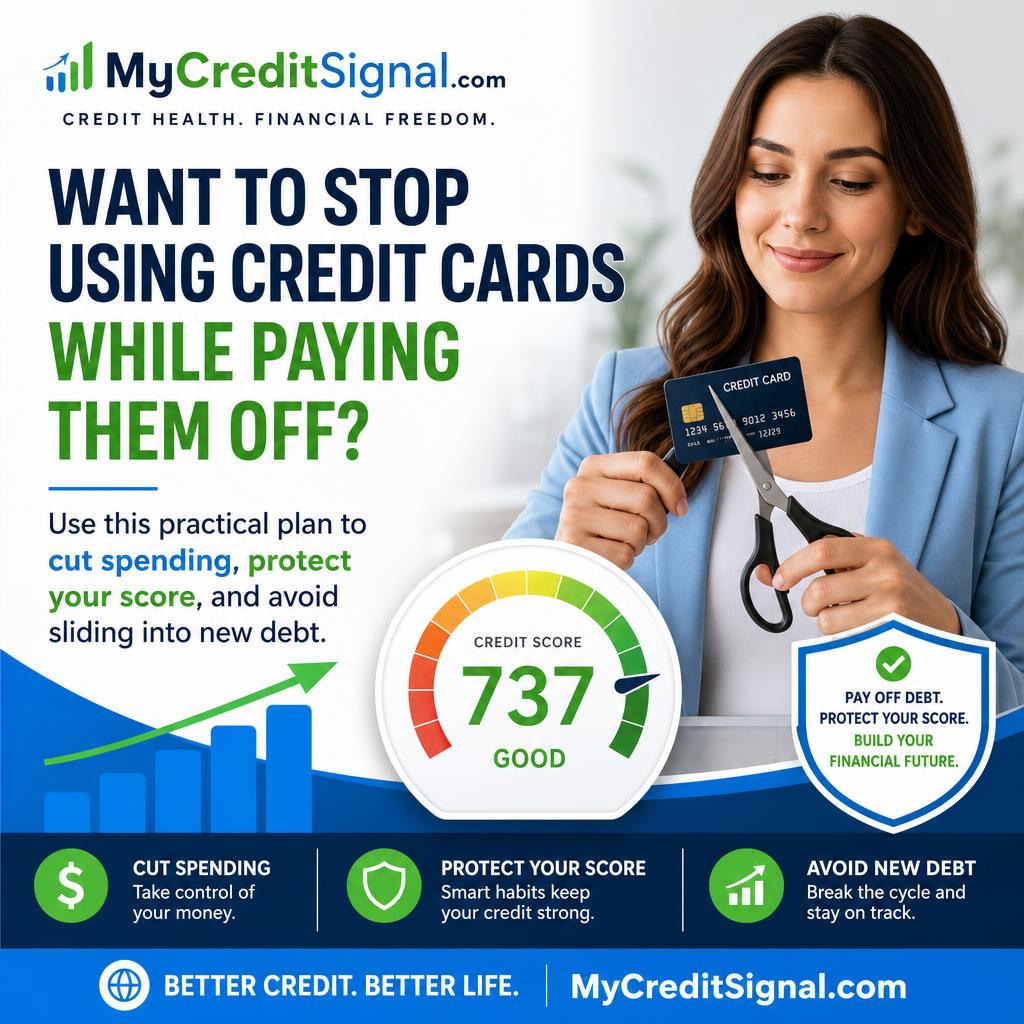
If your cards are supposed to be in payoff mode but you keep reaching for them at the grocery store, for car repairs, or during a tight week before payday, you are not dealing with a math problem alone. You are dealing with a behavior system that still makes credit cards your easiest option. That is why many people make payments for months and feel like nothing changes.
This guide is for people who want to stop using credit cards while paying them off without wrecking cash flow or making avoidable credit score mistakes. You will learn what to change first, which numbers matter most, and how to replace card spending with a plan that is harder to break than good intentions alone.
Contents
- 1 Who should use this approach
- 2 Why stopping card use is harder than just paying more
- 3 The mechanics that matter while you pay them off
- 4 The numbers and thresholds worth watching
- 5 A step by step plan to stop using credit cards this week
- 5.1 Remove cards from your default payment flow
- 5.2 Choose your replacement spending method
- 5.3 Automate every minimum payment
- 5.4 Create a mini buffer before you go aggressive
- 5.5 Pick one payoff target and measure net progress
- 5.6 Set written rules for exceptions
- 5.7 Review statement dates, not just due dates
- 6 Mistakes that quietly keep the cycle going
- 7 What most articles miss
- 8 When this advice does not apply as written
- 9 FAQ
- 10 Helpful tools and related resources
- 11 Conclusion
Key Takeaway
You do not need to close every card or disappear from credit to stop using credit cards; you need a spending replacement plan, a payoff sequence, and enough cash buffer to avoid charging new purchases.
Who should use this approach
This article fits you if your goal is to stop adding new card debt while you pay down existing balances. It is especially useful if you:
- Pay more than the minimum but keep reusing the same cards
- Want to protect your credit score while changing your habits
- Use cards for convenience, rewards, or to smooth over cash shortages
- Need a practical transition from card spending to debit or cash spending
This is probably not the best stand-alone approach if you have no room in your budget for basics like rent, utilities, food, or transportation. In that case, the first problem is cash flow. You may need to pause aggressive payoff and decide whether extra dollars should go to savings first or debt first. A good framework for that tradeoff is in Saving vs Paying Debt a Simple Decision Guide.
Why stopping card use is harder than just paying more
Many borrowers assume the solution is simple: send bigger payments and stop swiping. In real life, those are two separate behaviors. One reduces old debt. The other prevents new debt. If you do only the first one, your balances can stall.
That is why “I pay my card in full now” and “my score will immediately improve” are not the same thing. The CFPB explains that paying in full each month generally avoids interest, but it does not guarantee an instant score improvement because reported balances depend on timing and other factors. If your issuer reports a high balance before your payment posts, your utilization can still look elevated for that cycle. See the CFPB guidance here: Will paying off my credit card balance every month improve my credit score?.
There is also a habit problem. Credit cards account for about 35% of all payments by number in 2024, according to the Federal Reserve. That means card use is deeply built into how people shop, tap, subscribe, and pay online. If you do not replace that system, you will keep “accidentally” using credit.
And if you are not careful, you can create a second issue while trying to solve the first one: hurting your utilization by closing cards too fast. The FDIC also emphasizes understanding how credit card terms, limits, and utilization affect overall credit health. That matters if you are trying to reduce card use without increasing score pressure.
If you need help mapping the payoff side of the equation, start with the numbers in the credit card payoff calculator and compare them with your current budget reality.
The mechanics that matter while you pay them off
Here is the plain-English version of how to stop using credit cards without making your situation messier:
- Keep making every payment on time. A habit reset is not useful if it creates late payments.
- Reduce new charges faster than you reduce old balances. If a card balance drops by $150 but you add $120 in new spending, progress is weak.
- Protect available credit when possible. Lower utilization generally helps scores more than maxing out cards and then closing them.
- Move spending to money you already have. Debit, checking, or a planned cash envelope works better than “I will just be careful.”
- Build a small shock absorber. Even a modest cash buffer can prevent one surprise bill from sending you back to revolving debt.
A quick decision framework: first stop the leak, then lower the interest cost, then speed up payoff. In other words:
- First: stop routine new charges
- Next: automate minimums on every card
- Then: direct extra money to one target balance
- Later: decide whether any card should be closed or kept open
If your minimum payments are eating up cash and you are unsure how much they are costing you over time, use the minimum payment trap calculator and read what minimum payments really cost before deciding how aggressive your next move should be.
The numbers and thresholds worth watching
You do not need 20 metrics. You need a short scoreboard.
1. Your utilization range
A commonly cited guideline is to keep credit utilization below 30% of your total available credit. That is not a magic cutoff and score results vary by credit profile and scoring model, but it is a useful guardrail.
Example: if your total credit limit is $10,000, then 30% utilization means about $3,000 in reported balances. If you currently owe $5,500, you are at 55% utilization. If you pay down to $2,900 and avoid new spending before the statement date, you may present a much healthier picture than someone who pays $300 but keeps charging $250 back.
2. The gap between new charges and payoff
Track this every month: payments made minus new purchases charged. If you paid $500 but charged $350, your net debt reduction was only $150. That is the real progress number.
3. Your minimum-payment coverage
You need enough money in checking to cover every minimum automatically. Missing this breaks the whole plan. From there, direct extra cash to one card at a time. If you need a more detailed sequence, this 6 week credit card payoff plan can help you organize the next month and a half.
4. The no-card streak
Give yourself a measurable behavior target: 7 days, then 14, then 30. This sounds small, but it matters because the problem is behavioral. A visible streak often changes spending faster than a vague rule.
5. The emergency spending threshold
Set one dollar amount that determines when you can use a card. For example, you might say, “If the expense is under $100, it must come from checking, not credit.” Or, “Only same-day medical or car breakdown costs can go on a card.” Specific rules reduce rationalizing.
A step by step plan to stop using credit cards this week
Remove cards from your default payment flow
Delete saved card numbers from shopping apps, delivery services, browser autofill, and retail accounts. Take cards out of mobile wallets. Move the physical cards out of your everyday wallet. If you want friction, put one card in a sealed envelope at home for true emergencies and leave the others inaccessible. This is one of the fastest actions you can take this week because it changes behavior before willpower has a chance to fail.
Choose your replacement spending method
Pick one primary replacement now: debit card, cash for selected categories, or a weekly checking transfer. Do not say, “I will just spend less.” Replace card spending with a working tool. If groceries are your weak point, load your grocery budget into checking every Friday. If takeout is the problem, use a fixed weekly amount in cash or a separate debit-only spending account.
Automate every minimum payment
Set automatic payments for at least the minimum on every card. This protects your payment history while you work on the behavior side. Then review due dates and align them with your pay schedule if your issuers allow it. A clean setup matters because stopping card use should not create missed payments or late fees.
Create a mini buffer before you go aggressive
If every small surprise sends you back to credit, put a small cash barrier in place first. That could mean a one-paycheck cushion for variable bills or a starter emergency amount that covers common annoyances like prescriptions, copays, gas, or a minor car issue. The exact amount depends on your expenses, but the principle is simple: no buffer means higher relapse risk.
Pick one payoff target and measure net progress
List each card, balance, minimum payment, and whether it is still being used. Then choose one target card for extra payments. Every week, record two numbers: how much you paid and how much new spending you added. Your goal is for new spending to fall to zero on non-emergency purchases. A spreadsheet can make this easier. If you want a visual tracker, see Debt Payoff Spreadsheet to Track Progress.
Set written rules for exceptions
Do not rely on “emergencies only” unless you define emergency. Write down what counts. For example: urgent car repair needed to get to work, same-day medical expense, or travel disruption. Not included: sale items, convenience spending, gifts, food delivery, or boredom spending. Good rules cut down on in-the-moment negotiations with yourself.
Review statement dates, not just due dates
If your goal includes protecting your credit score, watch when balances are reported. Paying before the statement closes can lower the reported balance for that cycle. Again, results vary by scoring model and profile, but timing matters more than many people realize. This is one reason paying in full does not always equal an instant score jump.
Those seven steps are enough to act on this week. If you want to go further, pair them with a simple anti-relapse plan like the one in How to Avoid New Debt During Debt Payoff.
Mistakes that quietly keep the cycle going
Paying extra while still using the card for everyday spending
Behavior: You send an extra $200 to a card, then put groceries, gas, and subscriptions right back on it. Consequence: Your real debt reduction is much smaller than you think, and interest can keep building on carried balances. Fix: Separate payoff from spending completely. Use debit or cash for routine purchases and track net debt reduction, not just payment size.
Closing a paid down card too soon
Behavior: You pay off a card and immediately close it because you do not trust yourself to keep it open. Consequence: You may reduce available credit, which can raise utilization if other balances remain. Fix: First remove access and keep the account open if fees are not a problem, especially while other balances still exist. Decide on closure later when your utilization is lower and your habits are steadier.
Using rewards as a reason to keep spending
Behavior: You tell yourself the points or cash back justify using the card. Consequence: A few dollars in rewards can cost far more if the balance revolves and triggers interest. Fix: Pause rewards thinking until you are back to using credit only if you can pay in full without fail.
Trying to quit credit cards without fixing subscriptions
Behavior: Streaming, software, memberships, and autopays stay attached to your cards. Consequence: You keep generating new charges even when you think you stopped. Fix: Audit recurring charges this week and move or cancel them one by one.
What most articles miss
Most advice stops at “cut up the cards.” That misses three real-world complications.
Your credit score may not move in a straight line
Even when you do the right things, score changes can lag because of reporting cycles, balance timing, and the specific scoring model used. The CFPB is clear that paying in full helps avoid interest but does not guarantee immediate score improvement. That does not mean your plan is failing.
Issuers may respond to behavior over time
Recent Federal Reserve research notes discuss how banks may adjust limits based on spending and repayment behavior. You should not make decisions based on fear, but it does mean your available credit is not static forever. That is another reason to reduce reliance on cards now and improve cash flow directly rather than assuming your limits will always stay the same.
Some people should not stop all card activity forever
There is a difference between stopping card use during payoff and never using credit again. Some borrowers eventually return to limited, controlled use and pay in full every month. In payments research, people who do that are often described as transactors. The key is sequencing: first get out of revolving behavior, then decide whether any card still fits your system.
When this advice does not apply as written
There are a few cases where you may need a modified plan.
- You have irregular income. You may need larger checking cushions and weekly budget resets, not monthly rules alone.
- You are in active hardship. If you cannot cover essentials, preserving housing, utilities, food, and transportation comes before aggressive payoff.
- You share cards with a spouse or partner. Behavior rules need to be joint rules, or new charges will keep appearing.
- You rely on a card for business expenses. You need account separation and a reimbursement system, not a vague promise to spend carefully.
If your timeline feels unrealistic, reset it rather than forcing a plan you cannot maintain. A longer, stable payoff path beats a short plan that collapses in month two.
FAQ
Should I stop using all credit cards at once?
For many people, yes for routine spending. But you may keep one card inaccessible at home for true emergencies while removing all cards from daily use. The point is to stop normal swiping, not create chaos if something urgent happens.
Will my credit score drop if I stop using credit cards?
Not necessarily. In many cases, reducing balances and utilization can help. But results vary by credit profile and scoring model, and score changes may not happen immediately because reported balances depend on timing.
Should I keep a paid off card open?
Often, keeping it open can help preserve available credit and utilization, especially if there is no annual fee. The better question is whether you can keep it open without restarting the spending habit.
If you want to turn this into a working payoff system, start with these:
- Credit card payoff calculator to estimate your timeline and see how extra payments change the result
- Minimum payment trap calculator to compare slow-pay outcomes against a faster payoff plan
- Pay off credit card debt faster with a 6 week plan for a short-term execution framework
- Learn what minimum payments cost so you can see why balance carryover drags progress
For outside guidance, these sources are worth bookmarking: the FDIC on managing credit card terms and utilization, the CFPB on paying in full and credit scores, and the Federal Reserve data on balance carrying behavior.
Get weekly credit tips, tool updates, and practical guides – free.
Conclusion
If you want to stop using credit cards while paying them off, do not treat it like a motivation challenge. Treat it like a system change. Remove easy access, replace card spending with a real alternative, automate minimums, define emergencies, and measure net debt reduction instead of just payment size.
Your next step is simple: delete your saved cards today, set up the minimums, and run your balances through the credit card payoff calculator. Once the habit loop is broken, payoff gets much easier to see and much harder to undo.


Want to understand your credit report?
Get plain-English explanations with our free AI Credit Analyzer →
Leave a Reply
You must be logged in to post a comment.