 Skip to content
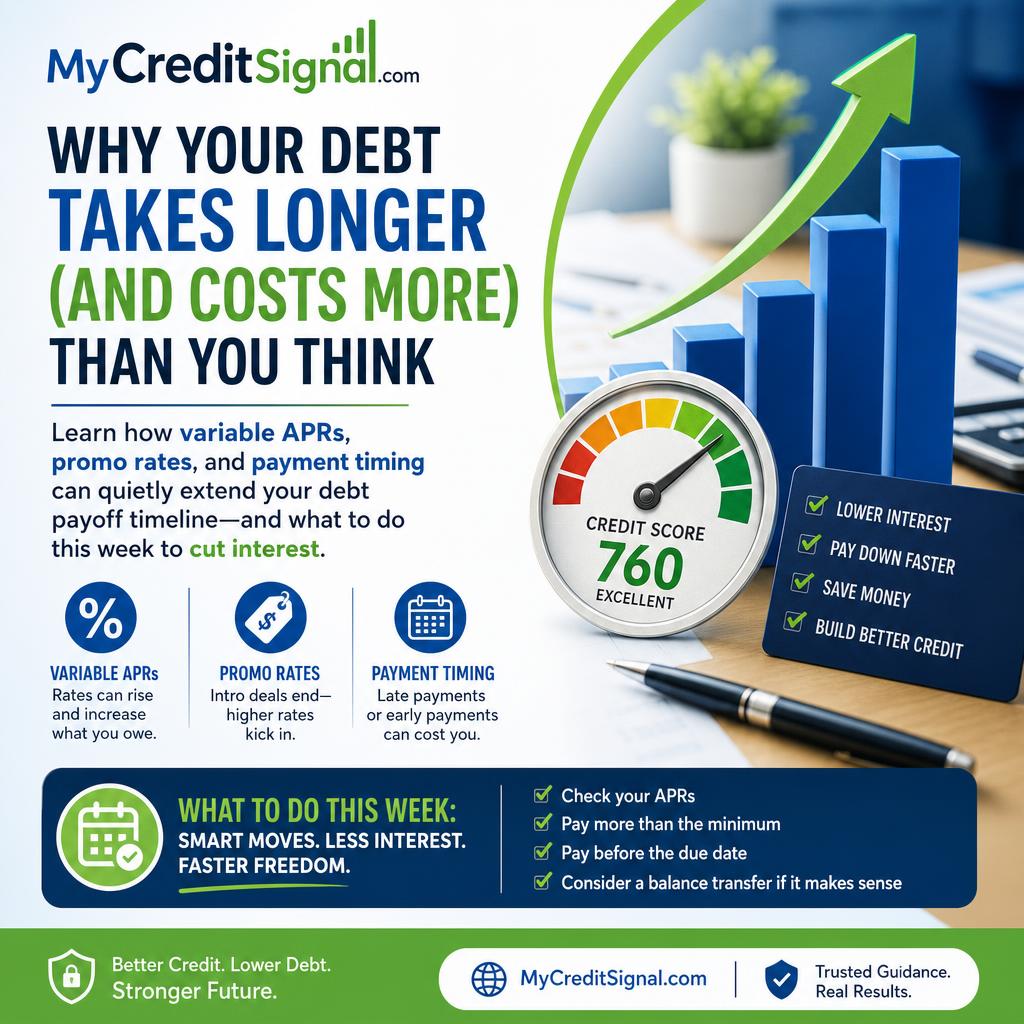
If your debt payoff plan looks good on paper but the balances barely move, interest is usually the reason. A card at a variable APR can cost more after rates rise. A promotional rate can expire right before you hit your target. A minimum payment can keep you current while slowing progress for months or years. This guide is for people paying down credit cards, personal loans, or multiple balances who want a clearer payoff timeline. You will see how interest rates debt payoff math works, which numbers deserve your attention first, and what actions can cut interest starting this week.
The big idea is simple: debt payoff is not only about how much you owe. It is also about how fast interest keeps rebuilding part of that balance. The FDIC notes that many credit cards carry variable rates and that rate changes can increase total interest paid over time if balances are not paid off promptly. That means even a steady payment plan can lose ground when rates change.
Contents
- 1 Who should pay attention to rate drag
- 2 Why variable APRs quietly stretch your payoff date
- 3 How promo APR periods change the math
- 4 The numbers that matter more than your balance alone
- 5 A realistic example of rate drag in action
- 6 What to do first and what can wait
- 7 A step by step plan to reduce interest this week
- 7.1 List every balance with its current APR
- 7.2 Calculate which balance is costing you the most
- 7.3 Increase one payment, not all of them equally
- 7.4 Put promo deadlines on your calendar now
- 7.5 Run two payoff scenarios
- 7.6 Trim one expense and redirect it automatically
- 7.7 Review whether your current strategy still fits your cash flow
- 8 Mistakes that make interest more expensive than it needs to be
- 9 What many payoff articles leave out
- 10 FAQ
- 11 Helpful tools and related resources
- 12 The bottom line on interest rates and debt payoff
Key Takeaway
The fastest way to shrink payoff time is usually to direct extra money to the highest-interest balance, monitor rate changes, and act before promo APRs expire.
Who should pay attention to rate drag
This topic matters most if you are in one of these groups:
- You carry credit card balances from month to month.
- You have a promotional APR that ends within the next 12 months.
- You are making more than the minimum but still feel like progress is slow.
- You are choosing between the snowball and avalanche methods.
- You are deciding whether to refinance or transfer a balance.
It also matters if your income is stable enough to make consistent extra payments. In that case, the right payment order can save a meaningful amount of interest.
This article is less useful if all your revolving balances are already paid in full every month, because interest rates matter far less when no balance carries over. It is also not a full guide to tax debt or specialized hardship programs. If you are juggling IRS balances, timing matters there too because interest and penalties can keep accruing, as the IRS explains in its quarterly interest guidance at irs.gov.
Why variable APRs quietly stretch your payoff date
Many borrowers build a plan around today’s rate and assume the math will stay the same. That is where debt payoff projections go wrong. The FDIC explains that many consumer credit products, especially credit cards, have variable APRs tied to a benchmark. When that benchmark rises, your card APR can rise too. If your payment stays fixed, more of that payment goes to interest and less goes to principal.
Here is the practical version. Imagine you pay $300 a month toward a card. If the rate rises, your $300 does not buy the same amount of progress anymore. The lender is not changing your balance directly. Interest is simply taking a larger slice of each payment before principal gets reduced.
This is why minimum-payment plans are especially vulnerable. If you have not reviewed that risk yet, read how minimum payments cost you more over time. It pairs well with this topic because the real problem is usually not one bad month. It is month after month of slow principal reduction.
The Federal Reserve’s consumer credit data at federalreserve.gov shows ongoing movement in borrowing and repayment across households. That matters because your payoff plan lives in a broader rate environment. Even if your habits improve, a higher-rate environment can still make progress feel slower than expected.
How promo APR periods change the math
A low promotional APR can be genuinely useful, but only if your plan is built around the end date. One of the most common misconceptions is that a lower advertised rate permanently lowers the cost of payoff. It does not. Promotional APRs are temporary. Once the offer ends, the standard APR applies.
That means the right question is not, “Is this promo rate lower?” The right question is, “Can I pay enough during the promo period to make the standard rate less painful later?”
Use a quick decision framework:
- Good fit: You know the end date, have a stable monthly surplus, and can automate payments above the minimum.
- Risky fit: You are already tight on cash flow and are using the promo to postpone hard budget choices.
- Bad fit: You assume the low rate will last long enough without checking the terms or your actual monthly payoff capacity.
If you need help modeling the numbers, the credit card payoff calculator can show how changing the APR or monthly payment affects your debt-free date.
The numbers that matter more than your balance alone
When people say, “I need to pay off debt,” they often look only at the current balance. That is incomplete. To figure out how interest rates debt payoff outcomes really work, track five numbers for each account:
- Current balance
- APR
- Whether the APR is variable or promotional
- Minimum payment
- Promo end date or next repricing risk
Those five numbers tell you which balance is expensive today and which one could become expensive soon.
A simple monthly interest estimate helps. Start by converting APR to a daily or monthly rate. If a card has a 24% APR, the rough monthly rate is about 2%. On a $5,000 balance, that is about $100 in interest for the month before much principal moves. If you pay $150, only about $50 may reduce the balance. If you pay $300, about $200 may reduce principal instead. That is why extra payments can speed things up more than people expect.
If you want the exact daily-rate version, use the APR to daily rate converter. It is especially helpful for credit cards, where daily periodic rates often drive the interest calculation.
Another number that matters is your credit profile. FICO reported an average U.S. score of 717 in 2024, and the scoring landscape is shifting as FHFA has outlined transitions toward newer scoring models including VantageScore 4.0 and FICO 10T at fhfa.gov. That does not mean your score guarantees a certain rate, but it does mean payment behavior and utilization can influence what refinance or transfer options you may qualify for later.
A realistic example of rate drag in action
Suppose you have two cards and $500 a month to put toward debt.
- Card A: $3,000 balance at 29.99% APR
- Card B: $4,000 balance at 18% APR
If you split the payment evenly, you feel balanced, but the math is weaker. Card A is charging interest much faster. The avalanche approach would keep minimum payments on both cards and send the extra money to Card A first. That lowers total interest cost faster because you are attacking the most expensive balance.
This does not mean the avalanche method is always emotionally easier. But if your main goal is reducing interest, it is usually the cleaner option. For a deeper breakdown, see how the debt avalanche method saves interest.
Now add one more wrinkle: Card A is variable. If the rate rises, the cost gap between A and B widens further. Suddenly, “just keep paying steadily” becomes a weaker strategy than actively reviewing rates and reallocating extra payments.
What to do first and what can wait
When everything feels urgent, use this order:
- Do first: review APRs, promo end dates, and minimums for every balance.
- Do first: protect on-time payments on every account.
- Do first: direct extra money to the highest current or soon-to-jump APR.
- Do next: test payoff scenarios with a calculator.
- Do later: compare refinance or transfer options if your credit and cash flow support it.
The point is to stop the most expensive interest leak before optimizing the rest.
A step by step plan to reduce interest this week
List every balance with its current APR
Open your statements and make a plain list of balances, APRs, minimum payments, and whether each rate is variable or promotional. If any promo rate is active, write the exact end month next to it. Do not rely on memory.
Calculate which balance is costing you the most
Estimate the monthly interest on each account. You do not need perfect precision to see the ranking. A fast estimate is balance multiplied by the monthly rate. A high APR on a moderate balance can cost more than a lower APR on a larger balance. This is the first action that often changes payment priorities immediately.
Increase one payment, not all of them equally
Keep minimums on all debts, then move every available extra dollar to the highest-cost account. If you only have an extra $25 or $50 this month, send it where interest is steepest. Small targeted overpayments often outperform evenly spreading extra cash around.
Put promo deadlines on your calendar now
If a promotional APR ends in six months, set reminders at 90, 60, and 30 days before the reset. Your goal is to avoid being surprised by a jump back to the standard rate. This matters more than most people think because the best time to speed up a promo balance is before the rate changes, not after.
Run two payoff scenarios
Use the credit card payoff calculator to compare your current payment with a slightly higher payment. Then compare your current payment order with an avalanche order. Seeing the timeline difference can make it much easier to commit to one plan.
Trim one expense and redirect it automatically
Pick one recurring expense you can cut this week and automate that amount toward debt. The amount does not need to be huge. Consistency matters more than making one dramatic payment and then stopping.
Review whether your current strategy still fits your cash flow
If your budget is too tight to make progress, forcing a perfect payoff method may backfire. In that case, stabilize cash flow first so you do not create new debt while paying off old debt. A plan that survives three rough months is better than a perfect plan you quit after three weeks.
Mistakes that make interest more expensive than it needs to be
Paying only the minimum because it feels safe
Behavior: You pay the minimum every month and assume time will solve the problem. Consequence: More of each payment goes to interest, and balances can linger far longer than expected. Fix: Keep minimums as the floor, not the plan. Add even a modest fixed extra amount to the highest-rate balance.
Ignoring variable rate changes
Behavior: You build a payoff plan once and never revisit the APRs. Consequence: A rate increase quietly slows principal reduction and extends your payoff date. Fix: Review statements monthly or quarterly and adjust payment priorities when rates move.
Treating a promo APR like a long-term solution
Behavior: You relax because the rate is low right now. Consequence: When the promo ends, the balance is still large and the standard APR hits harder. Fix: Build your plan around the expiration date and front-load payments during the low-rate window.
Falling for rate-reduction scams
Behavior: You trust a company that promises it can slash your card rate for a fee. Consequence: You may lose money, waste time, or be pushed into deceptive debt relief offers. Fix: Use scam-free education from sources like the FTC’s credit and debt guidance at consumer.ftc.gov and focus on budgeting, direct payoff planning, and legitimate comparisons.
What many payoff articles leave out
Most articles say higher interest is bad, then stop there. The missing nuance is that not all high-interest debt should be attacked the same way at the same moment.
For example, if one balance is at a moderate rate today but has a promo ending next month, it may deserve attention before a slightly higher fixed-rate balance. Timing matters, not just rank order.
Another thing many articles miss is the connection between interest and score-related options. With scoring models evolving and lenders using different models, your payment history and utilization may affect future rate-shopping differently depending on the creditor and model. Results can vary, so do not build a plan that depends entirely on qualifying for a better offer later.
FAQ
How do variable interest rates affect my debt payoff timeline?
If your APR rises and your monthly payment stays the same, more of each payment goes to interest and less goes to principal. That usually extends your payoff date unless you increase your payment.
Does paying off debt earlier always save money?
Usually yes on high-interest debt, because you reduce future interest charges. The tradeoff is cash flow. If paying extra leaves you unable to handle emergencies, the plan may backfire.
Should I focus on the highest APR or the smallest balance first?
If your goal is minimizing interest, the highest APR usually comes first. If motivation is your biggest problem, a smallest-balance-first approach may help you stay consistent. Choose the method you can actually maintain.
Use these resources to turn the ideas above into a working plan:
- Credit card payoff calculator to estimate timelines and compare payment amounts
- APR to daily rate converter to understand how card interest builds
- Debt avalanche method guide for prioritizing high-rate balances
- Minimum payment cost breakdown to see why small payments slow progress
- Free credit and budgeting tools to keep testing better scenarios as rates or balances change
Get weekly credit tips, tool updates, and practical guides – free.
The bottom line on interest rates and debt payoff
Interest is not a side detail in your payoff plan. It is one of the main forces shaping how long your debt lasts and how much it costs. Variable APRs can rise. Promotional rates end. Minimum payments keep the account current but often do very little to crush the balance. Once you see those moving parts clearly, the next step gets easier.
This week, gather your APRs, flag any promo deadlines, run two payoff scenarios, and send your next extra dollar to the balance doing the most damage. That one shift can make your plan faster, cheaper, and much less frustrating.



Want to understand your credit report?
Get plain-English explanations with our free AI Credit Analyzer →
Leave a Reply
You must be logged in to post a comment.