
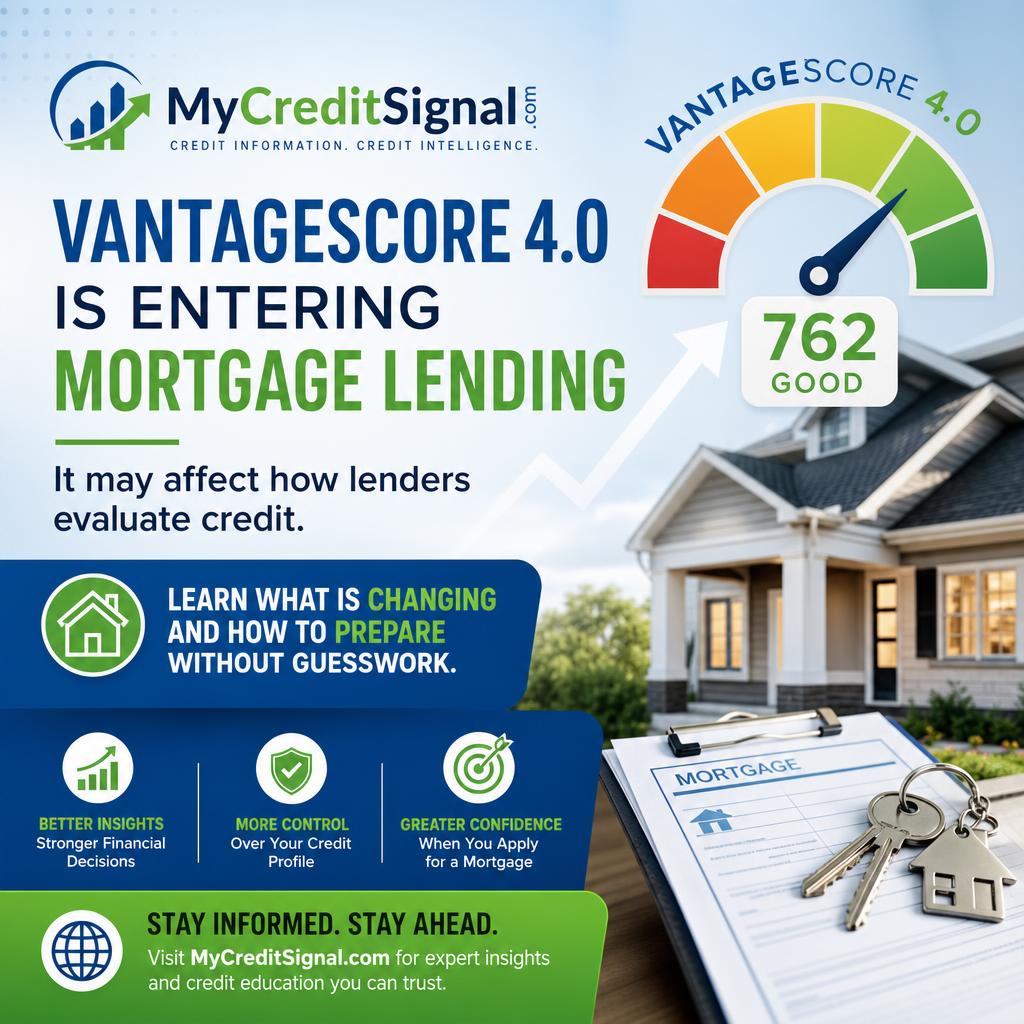
A lender may look at the same credit history and produce a different score than the number you recently saw online. That is because credit scores come from scoring models, and VantageScore 4.0 is one newer model gaining attention as mortgage credit scoring changes. This guide is for consumers preparing for a mortgage, comparing credit information, or trying to understand why scores do not always match. You will learn what VantageScore 4.0 is, what its adoption means, and which credit habits are worth prioritizing now.
VantageScore 4.0 is a newer credit scoring model that estimates credit risk from information in a credit report. It may treat recent credit behavior, rent payments, and other available data differently from older models. The practical response is not to chase one score; it is to build a consistent credit profile that can hold up when different lenders and models evaluate it.
Contents
- 1 Who should pay attention to VantageScore 4.0?
- 2 What is VantageScore 4.0 in plain English?
- 3 How are mortgage lenders adopting VantageScore 4.0?
- 4 What changes when a lender uses a newer model?
- 5 Which credit factors deserve attention first?
- 6 What can you do this week to prepare?
- 7 What mistakes can make the transition more confusing?
- 8 What does VantageScore 4.0 not guarantee?
- 9 Frequently asked questions about VantageScore 4.0
- 10 Free tools and related resources
- 11 Build a stronger profile without chasing a model
Key Takeaway
VantageScore 4.0 is expanding in mortgage discussions, but adoption is phased, so consumers should focus on accurate account information, on-time payments, manageable balances, and a clear understanding of which score a lender uses.
Who should pay attention to VantageScore 4.0?
VantageScore 4.0 matters most to people who expect a lender to evaluate their credit soon or who are confused by different scores from different services. That includes prospective homebuyers, consumers with limited credit histories, renters applying through screening systems, and borrowers rebuilding after missed payments or high balances.
Homebuyers should pay attention because Fannie Mae and Freddie Mac have updated their eligibility framework to allow VantageScore 4.0 and future FICO models as part of the mortgage credit score framework. The Federal Housing Finance Agency, which oversees the enterprises, has also published updates about the transition toward newer models. Read the practical background in VantageScore 4.0 mortgage rules explained.
This topic may be less urgent if you are not applying for credit and only want a general educational score. A score shown by a personal finance app can still help you watch trends, but it may not be the score a particular lender uses. If you are about to submit a mortgage application, ask the lender which scoring model, credit bureau data, and reporting format will be used rather than assuming every displayed score is interchangeable.
What is VantageScore 4.0 in plain English?
VantageScore 4.0 is an algorithm that converts credit-report information into a number intended to predict credit risk. Your credit report is the underlying file of account and payment information; your credit score is a calculation made from that file. A VantageScore and a FICO Score can differ because each model weighs information according to its own design.
One feature of VantageScore 4.0 is its use of newer data treatment, including the potential consideration of rent payments when that information is available through an accepted reporting source. The model may also place more emphasis on recent credit behavior than older models do. These features do not mean that every rent payment automatically appears in every credit file or that every lender uses the model in the same way.
FICO Score 10T is another newer model mentioned in the mortgage transition. It uses trended data, meaning it can assess patterns in account balances and payments over time rather than looking only at a single snapshot. VantageScore 4.0 and FICO Score 10T are separate models, not two names for the same score.
How are mortgage lenders adopting VantageScore 4.0?
Mortgage adoption is moving through a policy and implementation process rather than a single switch date. The GSEs are government-sponsored enterprises, specifically Fannie Mae and Freddie Mac, that buy mortgages from lenders and therefore influence which credit-score models are accepted in conventional mortgage lending.
FHFA and the enterprises have signaled a move toward including VantageScore 4.0 and FICO 10T in the mortgage credit-score framework. Fannie Mae’s credit score models and reports guidance explains the initiative and related eligibility changes. The FHFA credit score policy page provides additional timeline and policy updates.
The key consumer point is that approval by a policy framework does not mean every mortgage lender immediately uses VantageScore 4.0 for every applicant. Lenders still need systems, vendor relationships, underwriting procedures, and instructions for collecting and interpreting scores. Timelines have changed as implementation details have developed.
Experian’s announcement that it would offer VantageScore 4.0 to mortgage clients, including free access in some contexts, is another market-adoption signal. It suggests that access to the model is becoming easier for mortgage participants, but it does not guarantee that your next lender will use it.
What changes when a lender uses a newer model?
The lender may evaluate the same broad credit history through a different lens. Recent payment behavior, balance patterns, account age, types of credit, and available alternative data can be treated differently depending on the model and the information supplied to it.
For example, imagine a consumer has a credit card with a $2,000 limit and a $600 balance when the issuer reports. The balance represents 30% of that card’s limit. That calculation describes the reported balance-to-limit relationship; it does not predict the exact score impact under VantageScore 4.0, FICO, or any lender-specific version. If the consumer pays the balance to $200 before the next reporting date, the reported relationship becomes 10%, but the score response can vary by profile and scoring model.
This is why a single score change should not be treated as a universal verdict. A lender may use one model for a specific product, another lender may use another model, and the score available to consumers may be an educational version. The more useful goal is to improve the underlying habits that multiple models tend to view favorably.
Which credit factors deserve attention first?
Start with information and behaviors that can create broad benefits across scoring models. The order matters because some actions protect your eligibility immediately while others are longer-term improvements.
- First, payment reliability: Make every account payment on time and keep a calendar or automatic payment for at least the minimum due.
- Second, reported balances: Review card balances before the issuer reports them and avoid treating the credit limit as available spending money.
- Third, new applications: Apply only when the account serves a clear purpose, because multiple new applications can complicate a near-term credit review.
- Later, profile depth: Give healthy accounts time to age instead of opening unnecessary accounts to create activity.
- Ongoing, data consistency: Monitor the information that lenders may use and keep your personal records organized.
Consumers with thin credit files need a different priority from consumers with several established accounts. A thin file may benefit from a carefully selected account that reports payments, while someone already carrying several balances may need to stabilize cash flow first. Neither person should open accounts solely because a website suggests that more accounts are always better.
For a broader checklist focused on practical habits after a setback, see this credit rebuilding checklist. It can help you separate urgent payment tasks from slower profile-building decisions.
What can you do this week to prepare?
A useful preparation plan does not require predicting your future score. It requires creating a repeatable record of responsible credit management and learning how your intended lender evaluates applicants.
List every active credit account
Write down each card, loan, limit, balance, due date, and minimum payment. Use your statements and account portals rather than memory. This list gives you a working view of obligations before you make any changes.
Protect the next payment
Set automatic payments for at least the minimum due on each account, then schedule a manual payment if you want to pay more. Check that the linked bank account can cover the withdrawal so an attempted payment does not fail.
Measure reported balances
Calculate each card’s reported balance divided by its credit limit. Use the result to identify which account has the largest balance relationship. If you are preparing for a lender review, ask when each issuer typically reports rather than assuming the due date and reporting date are identical.
Pause unnecessary applications
For the rest of this week, do not apply for a new account unless you can explain the purpose, cost, expected benefit, and timing. A new account can add complexity when you are trying to present a stable credit profile.
Ask the lender precise questions
If a mortgage is your goal, ask which scoring model is currently used, whether the lender follows GSE-specific requirements, what reports are requested, and how recently the scores must be generated. Record the answers in your application notes.
Track trends without score chasing
Choose a regular day to review your credit information and account balances. Note payment status, balance movement, and new inquiries. A trend log is more useful than checking several apps repeatedly after every payment.
What mistakes can make the transition more confusing?
Mistake 1 Buying every score you see
Behavior: Treating each score from an app or lender as a definitive grade. Consequence: You may spend money or change good habits because numbers differ across models. Fix: Identify the score’s model, bureau, date, and intended use before comparing it with another score.
Mistake 2 Assuming adoption is immediate
Behavior: Believing every mortgage lender has already replaced its existing process. Consequence: You may prepare for a model the lender does not currently use. Fix: Ask the lender for its current process and rely on official FHFA or enterprise updates for broader policy changes.
Mistake 3 Opening accounts to manufacture diversity
Behavior: Applying for several products because newer models consider more data. Consequence: New inquiries, new payments, and additional balances can make your finances harder to manage. Fix: Add credit only when it fits your budget and has a clear purpose.
Mistake 4 Ignoring cash flow
Behavior: Focusing on the score while relying on credit for regular bills. Consequence: Balances may rise again even after a one-time payment. Fix: Pair credit actions with a budget that shows which expenses can be paid without borrowing.
What does VantageScore 4.0 not guarantee?
VantageScore 4.0 does not guarantee mortgage approval, a lower interest rate, or a score increase. Lenders review more than a score, including income, debts, assets, loan purpose, property details, and their own underwriting requirements. The model also cannot compensate for an unaffordable payment or an application that does not meet the lender’s rules.
Rent reporting is another area where expectations need care. VantageScore 4.0 may treat rental payment information differently when that information is available through an accepted reporting channel, but not every landlord reports rent and not every lender receives the same data. Ask how the data is reported before paying for a service.
Results also vary by credit profile and scoring model. A consumer with a long history may see a different response from a consumer with only one account. A balance change may matter differently when the rest of the file contains multiple accounts, recent applications, or limited payment history.
Frequently asked questions about VantageScore 4.0
Will my existing credit score change when VantageScore 4.0 is adopted?
Your existing score does not automatically change simply because a newer model becomes available. A lender may calculate a different score from the same credit-report information, and the result can vary by model, bureau data, and credit profile.
When will mortgage lenders use VantageScore 4.0?
Adoption is phased, with FHFA, Fannie Mae, and Freddie Mac publishing policy and implementation updates. There is not one immediate date at which every mortgage lender switches, so ask your lender which model it currently uses.
Can rent payments help under VantageScore 4.0?
Rent payments may be considered when they are supplied through an accepted reporting source, but rent is not automatically included in every credit file. Confirm whether your payment data is reported and whether the lender receives it.
Use the free resources available through My Credit Signal to turn model changes into a practical routine. Start with the best free credit help tools guide to choose a calculator, simulator, report resource, or monitoring step that matches your situation.
If your focus is specifically a future home purchase, compare the discussion in VantageScore 4.0 and mortgage lending explained. It covers the mortgage context without suggesting that every lender is already using the same process.
You can also visit the My Credit Signal home page to find free credit and budgeting resources. The best tool is the one you will use consistently: a payment calendar, balance tracker, budget, or score-monitoring routine.
Build a stronger profile without chasing a model
The mortgage market is moving toward newer scoring models, including VantageScore 4.0 and FICO Score 10T, but the consumer strategy remains grounded in fundamentals. Pay on time, keep balances manageable, avoid unnecessary applications, allow healthy accounts to age, and ask lenders which model they use.
Take one action today: list your accounts, schedule the next payments, or calculate your reported balance relationships. Then review the result weekly and adjust your budget before balances become difficult to control. Consistency gives you a stronger foundation than reacting to every score variation.
Get weekly credit tips, tool updates, and practical guides – free.
VantageScore 4.0 may change how some lenders interpret your credit history, but it does not change the value of steady financial habits. Treat every score as model-specific information, confirm the lender’s requirements, and use free tools to track the actions you can control.



Want to understand your credit report?
Get plain-English explanations with our free AI Credit Analyzer →
Leave a Reply
You must be logged in to post a comment.