
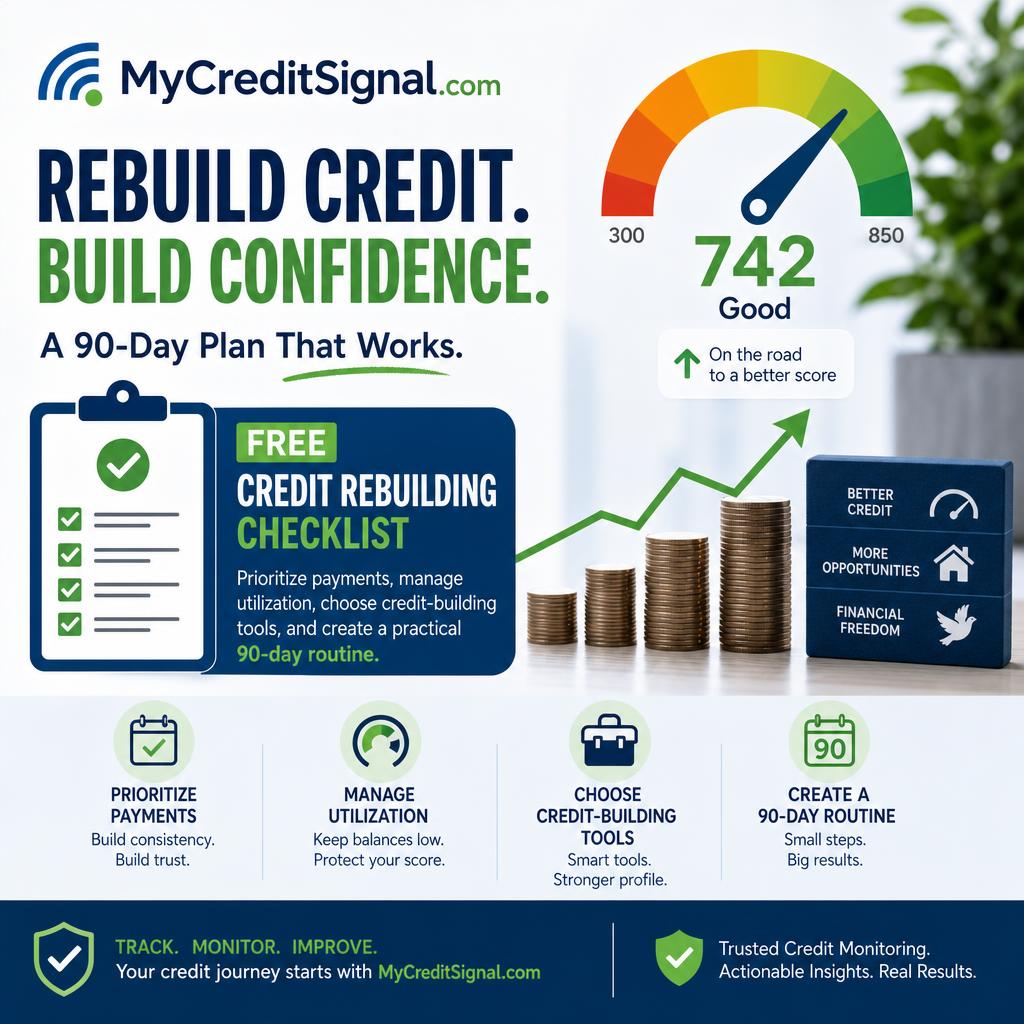
A financial setback can make credit rebuilding feel like a list of problems with no obvious starting point. This free credit rebuilding checklist for 2026 gives you a practical order: protect upcoming payments first, lower revolving balances where possible, add positive activity carefully, and review progress over time. It is designed for someone recovering from missed payments, high balances, reduced income, or a period without active credit.
You will not repair a credit profile overnight. Credit scores are calculated from credit report data, and the CFPB explains that rebuilding requires consistent positive activity across accounts. Use this checklist to decide what to do this week, what to revisit monthly, and when a credit-building product may or may not be appropriate.
Contents
- 1 Who should use this credit rebuilding checklist?
- 2 What does rebuilding credit actually involve?
- 3 Which numbers and timelines matter most?
- 4 What should you do first this week?
- 5 How do you decide what to do now versus later?
- 6 What credit rebuilding mistakes should you avoid?
- 7 What can this checklist miss?
- 8 Credit rebuilding checklist questions
- 9 Free tools and related resources
- 10 Your next step
Key Takeaway
The strongest free rebuilding plan is a repeatable routine that keeps payments on time, controls revolving balances, and avoids unnecessary new applications.
Who should use this credit rebuilding checklist?
This checklist is a good fit if your credit profile has been weakened by missed payments, high card balances, closed accounts, limited recent activity, or a change in income. It can also help if you are starting to build credit and want a cautious system rather than opening several accounts at once.
It is not a substitute for a household cash-flow plan. If you are choosing between a credit card payment and essentials such as housing, utilities, food, or transportation, stabilize the budget and contact creditors about available hardship options first. You can use the hardship program eligibility quiz to think through whether a creditor assistance conversation may be worth pursuing.
This advice also is not a promise of a particular score increase. Results vary by credit profile, the information being reported, and the scoring model used. Lenders may use different versions of FICO or VantageScore, so a change visible in one score may not appear identically in another.
What does rebuilding credit actually involve?
A credit score is a numerical summary of credit risk calculated from information such as payment history, amounts owed, length of credit history, new credit, and credit mix. Rebuilding means gradually adding reliable, positive evidence to that history while reducing behaviors that create additional risk.
Payment history and amounts owed are among the most important score factors. In everyday terms, that means a modest account paid on time can be more useful than several accounts opened impulsively. Credit utilization is the amount owed on revolving accounts compared with their credit limits. The formula is: total revolving balances divided by total revolving limits, multiplied by 100.
For example, if one card has a $1,000 limit and a $700 balance, its utilization is 70%. Paying the balance down to $300 would make the utilization 30%. That calculation is a planning tool, not a guaranteed scoring threshold. Individual scoring models can evaluate utilization differently, and the balance reported by a creditor may not be the balance you see on the day you make a payment.
The CFPB recommends focusing on responsible use and consistent payments rather than quick fixes. The Federal Reserve also identifies secured cards and small-dollar loans as credit-building products that may help consumers establish or rebuild credit when used responsibly.
Which numbers and timelines matter most?
Start with numbers you can control: each account’s due date, minimum payment, current balance, credit limit, and available cash after essential expenses. Do not build a plan around a score target alone.
The CFPB source used for this checklist notes that borrowers may typically need about 15 months to demonstrate positive payment behavior after setbacks, but that figure is an illustrative industry guideline, not a promise. Some profiles may show movement sooner; others may need longer because older negative information, high balances, or limited history continues to affect the calculation.
Use three review points instead of checking constantly:
- This week: prevent the next missed payment and list every revolving balance.
- After 30 days: confirm payments processed and check whether balances are moving in the intended direction.
- After 90 days: compare your habits, balances, and score sources, then choose the next small adjustment.
What should you do first this week?
Use this priority rule: protect payment history first, reduce expensive or highly utilized revolving debt second, and consider new credit-building products only after the first two tasks are stable.
Make a complete account inventory
Write down each open credit account, its due date, minimum payment, balance, limit, annual fee if any, and automatic-payment status. Include accounts you have not used recently. A complete inventory prevents a forgotten due date from creating another setback.
Set up a payment safety net
Schedule at least the required payment by each due date if your cash flow allows it. A reminder several days before the due date gives you time to move money or contact the creditor. Automatic payments can help, but only use them when the linked account has enough money to avoid overdrafts.
Choose one balance to work on
Do not scatter a small extra payment across every account without a reason. Choose the card with the highest utilization, the balance with the highest interest cost, or the account that can be reduced most quickly. The best choice depends on whether your immediate priority is score management, interest savings, or motivation.
Calculate utilization before and after a payment
Add your revolving balances and limits, then use the utilization formula. If your total limits are $4,000 and your balances total $2,000, total utilization is 50%. A payment that lowers balances to $1,200 would bring it to 30%. Keep enough cash for essentials before making an aggressive payment.
Pause unnecessary applications
Apply for new credit only when you have a clear purpose, understand the terms, and can afford the account. Opening multiple accounts can create new inquiries and new payment obligations without rapidly improving a score. Review your eligibility and budget before submitting an application.
Consider one credit-building product if needed
If you have limited active credit, a secured credit card may be worth researching. A secured card requires a cash deposit that serves as collateral, and responsible on-time payments may help establish credit when the issuer reports activity. Compare fees, reporting practices, deposit requirements, and whether you can use the card without carrying a balance.
Track the habit for 90 days
Keep a simple monthly log of payments made, balances, limits, and any applications. Check your score through a free source on the same schedule rather than reacting to every daily change. The free credit rebuilding checklist tool can help turn these tasks into a repeatable routine.
How do you decide what to do now versus later?
Use a three-column decision framework: protect, improve, and consider. Put anything that prevents a new missed payment in the protect column. Put balance reduction and spending controls in improve. Put secured cards, authorized-user arrangements, or other new credit decisions in consider.
Finish the protect column before moving to consider. If your income is unpredictable, preserving a small cash buffer may be more useful than paying a card down to a particular percentage and then needing to use it again. If payments are stable but utilization is high, balance reduction may be the next logical focus. If balances are manageable but you have little active history, research one carefully selected credit-building option.
For a second opinion on score effects, use the credit score simulator. Treat its results as estimates, not guarantees, because the simulator may not reflect every lender’s scoring model or every future account update.
What credit rebuilding mistakes should you avoid?
Paying for an overnight fix
Behavior: Paying a company that promises immediate score results or guaranteed deletions. Consequence: You may lose money while delaying actions that create positive history. Fix: The FTC warns about credit repair scams; compare the service’s promises, costs, and protections before paying. Start with free tools and creditor conversations.
Opening several accounts at once
Behavior: Applying for multiple cards because you expect more available credit to produce a fast improvement. Consequence: New inquiries and payment obligations can add risk, especially when income is tight. Fix: Apply only for an account with a defined purpose and a payment plan.
Using a card after paying it down
Behavior: Making a large payment, then charging the same amount again because the budget has not changed. Consequence: The reported balance can remain high and the debt cycle continues. Fix: Set a weekly spending limit and keep card purchases tied to money already available.
Closing an account without checking the tradeoff
Behavior: Closing an older card immediately because it is unused or has a fee. Consequence: You may lose available credit or change the age and mix of your active accounts. Fix: Compare the fee savings with the possible utilization and account-history effects, and ask the issuer about lower-cost options before closing.
What can this checklist miss?
A checklist cannot solve a payment that is unaffordable today. If you are behind because of unemployment, illness, or another hardship, contact the creditor promptly and ask what assistance options are available. Get any new arrangement’s payment amount, duration, fees, and reporting treatment in writing before agreeing.
It also cannot predict a mortgage, auto, or credit-card approval. Mortgage underwriting is evolving, and newer FICO and VantageScore options have been incorporated into ongoing industry updates. The score you monitor is useful for tracking direction, but the lender’s model, income review, debt obligations, and product requirements still matter.
Be cautious with authorized-user arrangements. They can affect the authorized user’s profile, but the primary account holder controls payment behavior. Only consider this option with someone who pays on time, keeps balances under control, and understands the relationship clearly.
Credit rebuilding checklist questions
What is the fastest way to start rebuilding credit after a setback?
Start by preventing the next missed payment, listing every account, and reducing revolving balances when your budget permits. Consistent positive activity matters more than a quick-fix service, and meaningful progress can take months.
How much should I pay toward a credit card?
Pay at least the required amount by the due date, then direct affordable extra money toward one priority balance. Use the utilization formula to measure progress, but keep enough cash for essential expenses and avoid borrowing the amount back.
Can a secured credit card rebuild credit?
A secured credit card may help when the issuer reports activity and you make payments on time. Compare the deposit, fees, reporting practices, and spending limits, and use it only for purchases you can repay.
Start with the free credit rebuilding checklist to organize your weekly tasks. If you are weighing a payment or balance change, the credit score simulator can provide an estimate. For guidance on paid services and consumer protections, read what credit repair companies can legally do.
Free tools remain available for every reader. If you want a plan tailored to your exact situation, the optional personalized Credit Signal Action Plan is a $15 one-time plan with a custom PDF plus tools; it is not required to use the free resources.
Get weekly credit tips, tool updates, and practical guides – free.
Your next step
Do not try to complete every credit task in one day. Today, list your accounts and protect the next payment. This week, calculate utilization and choose one affordable balance target. Over the next 90 days, repeat the routine and evaluate progress using the same reliable tracking method.
The goal of this credit rebuilding checklist for 2026 is not a perfect score or a dramatic overnight change. It is a stable pattern of on-time payments, manageable balances, deliberate applications, and informed decisions that can strengthen your profile over time.



Leave a Reply
You must be logged in to post a comment.