
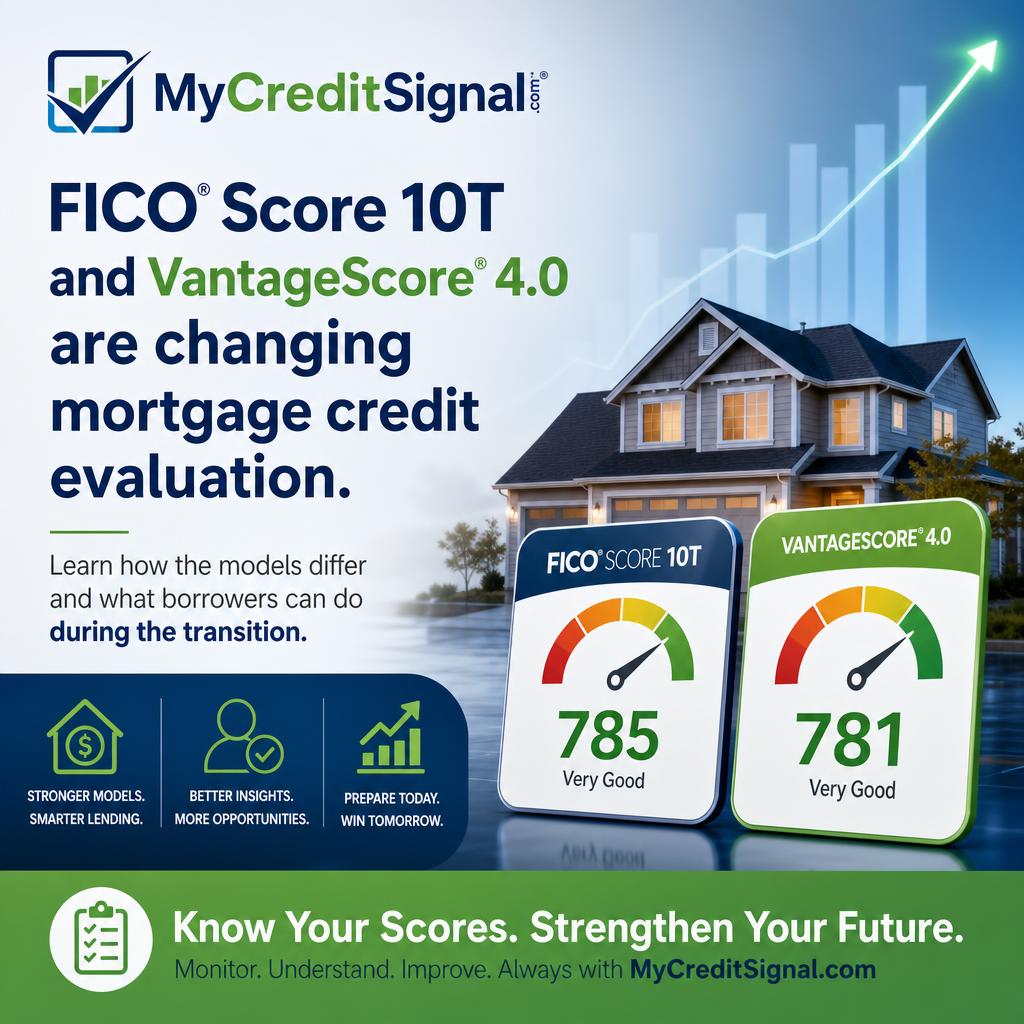
A mortgage applicant may soon be evaluated with more than the classic FICO scores many consumers know. FICO Score 10T and VantageScore 4.0 are newer models entering the mortgage-lending transition, and they can interpret the same credit history differently. This guide explains what each model is, how the planned bi-merge process works, and which credit habits are useful regardless of the score a lender uses.
The practical answer is simple: you cannot choose the scoring model used for your mortgage application, but you can prepare the underlying credit profile that all major models review. Keep payments current, manage balances consistently, avoid unnecessary new accounts before applying, and ask your lender which models and reporting process apply to your loan.
Contents
- 1 Who should pay attention to these mortgage score changes?
- 2 What is the difference between FICO Score 10T and VantageScore 4.0?
- 3 How will bi-merge credit reporting affect mortgage borrowers?
- 4 Which numbers and time periods matter before a mortgage application?
- 5 What should you do this week to prepare?
- 6 What mistakes can make the transition harder?
- 7 What does this advice miss in special situations?
- 8 Frequently asked questions about the new mortgage models
- 9 Helpful tools and related resources
- 10 The practical bottom line
Key Takeaway
FICO Score 10T and VantageScore 4.0 use different algorithms, so the same borrower may see different results; steady credit behavior is the most useful preparation during the transition.
- FICO Score 10T uses trended, longitudinal data to evaluate patterns over time.
- VantageScore 4.0 is a separate model with its own algorithm and scoring treatment.
- FHFA is moving toward bi-merge reporting and expects both scores where available after implementation.
- There is no single new score threshold that guarantees mortgage approval for every lender or borrower.
Who should pay attention to these mortgage score changes?
These changes matter most to people planning to apply for a conventional mortgage, refinance an existing mortgage, compare loan offers, or improve their credit before a future home purchase. They also matter to borrowers whose credit history includes recent balance changes, limited account activity, or a long pattern of paying balances down over time.
Mortgage lenders do not approve applications based on a score alone. They may also consider income, debts, assets, loan characteristics, down payment information, and their own underwriting requirements. A newer model can influence risk evaluation, but it does not replace the broader mortgage review.
If you are not planning to apply for a mortgage, you usually do not need to change your entire credit routine because of this transition. Credit card issuers, landlords, auto lenders, and other businesses may use different scoring models and policies. The model used for one application may not be the model used for another.
What is the difference between FICO Score 10T and VantageScore 4.0?
FICO Score 10T is a FICO model designed to be more predictive for lenders by using trended credit data. Trended data looks at account behavior over time rather than treating a balance as an isolated snapshot. For example, a lender may be able to distinguish between someone who regularly pays a balance down and someone whose balance is steadily increasing, depending on the data available.
VantageScore 4.0 is a separate scoring model developed by VantageScore. It uses similar broad categories of credit information as FICO models, but its algorithm and treatment of data are different. That means two models can review the same reported history and produce different scores without either score being automatically wrong.
The difference is not that one model is universally good and the other is universally bad. Each model is built for a lender’s defined purpose. The important consumer takeaway is that you should focus less on chasing a particular number and more on the behaviors that create a strong, stable credit profile.
Why can the same credit history produce different scores?
Scoring models assign different importance to the information they receive. They may handle balance trends, thin files, recently opened accounts, payment patterns, and available credit differently. The scores can also differ because lenders may receive data from different credit reporting sources or at different times.
This is why a score from a free consumer tool is useful for tracking direction, but it is not a promise about the score used in mortgage underwriting. My Credit Signal’s free tools can help you organize your credit habits and monitor progress without assuming that one displayed score represents every lender’s decision.
How will bi-merge credit reporting affect mortgage borrowers?
Bi-merge credit reporting is an approach in which mortgage lenders may receive two credit scores and two versions of credit history data for a consumer. FHFA has described a transition toward bi-merge reporting for its Enterprises, Fannie Mae and Freddie Mac, while allowing interim use of Classic FICO or VantageScore 4.0 during the transition.
FHFA expects that, after implementation, lenders will deliver mortgage loans with both FICO 10T and VantageScore 4.0 scores where available. This does not mean every consumer will immediately see multiple new scores for every credit activity. It also does not mean every lender outside the affected mortgage process will use both models.
Fannie Mae and Freddie Mac are providing historical data and guidance to support the move to newer models. Fannie Mae and Freddie Mac updated their Selling Guide on April 22, 2026, to recognize VantageScore 4.0 and FICO Score 10T as approved models for mortgage underwriting and securitization. Implementation details can still depend on lender procedures, loan type, and the timing of the transition.
For a deeper explanation of the mortgage process, read Mortgage Credit Scoring Models Explained. The goal is not to predict an exact score from a public calculator; it is to understand which information may be reviewed and prepare before a lender pulls credit.
Which numbers and time periods matter before a mortgage application?
There is no universal score cutoff in the research available for this transition, and a score threshold that works for one lender or loan program may not apply to another. Do not treat a headline number as a guaranteed approval or rate qualification.
One confirmed scale of the transition is its use of multiple models. FHFA announced interim acceptance of multiple credit score models on November 1, 2024. FICO reported positive real-world validation from mortgage lenders participating in FICO Score 10T Early Adopter programs on April 24, 2025. These milestones show that adoption is active, but they do not turn every lender into a single standardized scoring system overnight.
The Federal Reserve has referenced approximately $1.2 trillion in aggregate U.S. credit card balances for 2025. That figure describes total consumer leverage, not an individual borrower’s score. For your own planning, the useful numbers are your statement balances, payment due dates, available credit, account ages, and recent applications.
What should a borrower measure first?
Measure payment reliability first, then balance direction, then new-credit activity. A borrower who pays on time but has balances rising each month may need a different plan from someone with low balances but several recent applications. This order helps you address the behavior with the greatest immediate risk before worrying about small score differences.
For example, suppose a cardholder has a $4,000 credit limit and a $1,600 statement balance. The balance represents 40% of that card’s limit. If the cardholder pays the balance to $800 before the statement is generated, the reported balance would represent 20%, assuming the issuer reports that amount. This example explains how reported balances can change; it does not establish a universal approval threshold or predict a particular score increase.
What should you do this week to prepare?
List every account and reporting date
Write down each credit card, loan, limit, balance, minimum payment, due date, and statement closing date you can find. Separate the date a payment is due from the date a balance may be reported. This gives you a working view of the information models may receive.
Automate at least the minimum payment
Set an automatic minimum payment from an account that is reliably funded, then add a calendar reminder for any extra payment. Payment history is a foundational part of credit evaluation, and automation reduces the chance that a busy week becomes a missed payment.
Track balances by direction, not one snapshot
Record balances when statements close and compare the trend over several cycles. FICO Score 10T is specifically designed to use trended data, so a repeatable pattern of reducing balances is more meaningful than a single last-minute payment for your personal planning.
Pause unnecessary applications before mortgage shopping
Do not open a new card or apply for several accounts simply to test an offer while preparing for a mortgage. New applications and accounts can change the information available to lenders. If you need credit for an essential reason, ask a mortgage professional how the timing could affect your application.
Use a written cash-flow plan for paydown
Choose a safe extra-payment amount after covering housing, utilities, food, transportation, and minimum debt payments. A plan that leaves no cash for routine expenses can force new card spending and undermine the progress it was meant to create.
Ask the lender specific model questions
Before submitting a full application, ask which credit reporting process applies, whether the lender is using an interim model, and how it handles multiple scores where available. The lender can explain its current process more accurately than a general online prediction.
Use the first three steps immediately if your application is soon. Put larger credit changes, such as closing an account or moving debt, in the later decision category unless a qualified professional explains the consequences. Stability is often more useful than a rushed optimization attempt.
What mistakes can make the transition harder?
Chasing a score from one app
Behavior: Treating one consumer score as the exact mortgage score. Consequence: A different model may show a different result, creating false confidence or unnecessary panic. Fix: Use free tools to track the factors you control and ask the lender which model applies.
Making a large payment without protecting cash flow
Behavior: Sending every available dollar to a card before a mortgage application. Consequence: An unexpected bill may lead to new borrowing or a missed payment. Fix: Keep essential expenses funded and use a repeatable payment amount.
Opening accounts to manufacture a quick improvement
Behavior: Applying for multiple cards because a model transition is in the news. Consequence: New inquiries and accounts can change the profile a lender evaluates. Fix: Apply only when the account serves a clear need and the timing fits your mortgage plan.
Assuming bi-merge means automatic approval
Behavior: Believing that receiving two scores gives the borrower two chances to qualify. Consequence: The lender may still apply its own underwriting rules and review the full application. Fix: Treat bi-merge as a reporting and model transition, not an approval promise.
What does this advice miss in special situations?
Credit models depend on the data available to them. A consumer with a thin credit file, recently paid-off accounts, authorized-user activity, or accounts reported at different times may experience more variation between models. The same action can also have different effects depending on the rest of the profile.
Mortgage scoring changes do not replace the need to compare loan estimates, review affordability, or understand the lender’s requirements. A higher score may not make an unaffordable payment safe. Conversely, a borrower should not delay learning about mortgage options solely because every detail of the model transition is not yet familiar.
Regulators are also paying attention to complex technologies used in credit decisions. CFPB supervisory materials from 2025 discuss advanced technologies and complex credit scoring in consumer lending, while Regulation B implements the Equal Credit Opportunity Act and prohibits discrimination in credit evaluation. These developments concern lender responsibilities; they do not create a personal score guarantee or a universal consumer checklist.
Debt collection rules are a separate issue from mortgage scoring. The FTC continues to provide consumer guidance and enforce debt collection rules under the Fair Debt Collection Practices Act. If a collection company contacts you, consult current FTC guidance rather than assuming that a change in mortgage scoring rules changes collection practices.
For practical monitoring habits, see How to Monitor Your Credit Reports in 2026. To compare the newer mortgage model specifically, review VantageScore 4.0 and Mortgage Lending Explained.
Frequently asked questions about the new mortgage models
Will lenders provide both FICO Score 10T and VantageScore 4.0?
FHFA expects lenders to deliver mortgage loans with both scores where available after implementation. During the transition, interim approaches may include Classic FICO or VantageScore 4.0, so the exact process depends on timing and lender requirements.
Will FICO Score 10T replace every older FICO score?
No. The transition is not an immediate replacement of every scoring model used by every lender. Mortgage lenders are moving toward newer models, but different businesses can continue to use different models and policies.
Should I change my credit habits because of VantageScore 4.0?
Focus on habits that support a strong profile under any reasonable model: pay on time, manage balances, avoid unnecessary applications, and review your credit information consistently. Do not make a major financial move solely to chase a score you cannot confirm a lender will use.
Start with the free resources that help you organize your next move:
- Mortgage Credit Scoring Models Explained provides broader context on the mortgage scoring transition.
- VantageScore 4.0 What Consumers Should Know explains what consumers can do while the model enters mortgage lending.
- How to Monitor Your Credit Reports in 2026 offers a practical routine for organizing credit information.
- Visit My Credit Signal to find free credit and budgeting tools for your personal review.
If you want a plan tailored to your exact situation, the optional personalized Credit Signal Action Plan provides a custom PDF and tools for a 90-day plan. The free tools remain available if you prefer to build your own routine.
Get weekly credit tips, tool updates, and practical guides – free.
The practical bottom line
FICO Score 10T and VantageScore 4.0 represent a meaningful shift in mortgage credit evaluation, but consumers do not need to predict every algorithmic detail. The most dependable preparation is a stable record of on-time payments, manageable and thoughtfully monitored balances, limited unnecessary applications, and a clear understanding of your lender’s current process.
This week, list your accounts, automate minimum payments, track balance trends, and schedule a lender conversation before a full application. Those steps improve your decision-making even when scores vary by model, and they help you approach the mortgage transition with information instead of guesswork.



Want to understand your credit report?
Get plain-English explanations with our free AI Credit Analyzer →
Leave a Reply
You must be logged in to post a comment.