
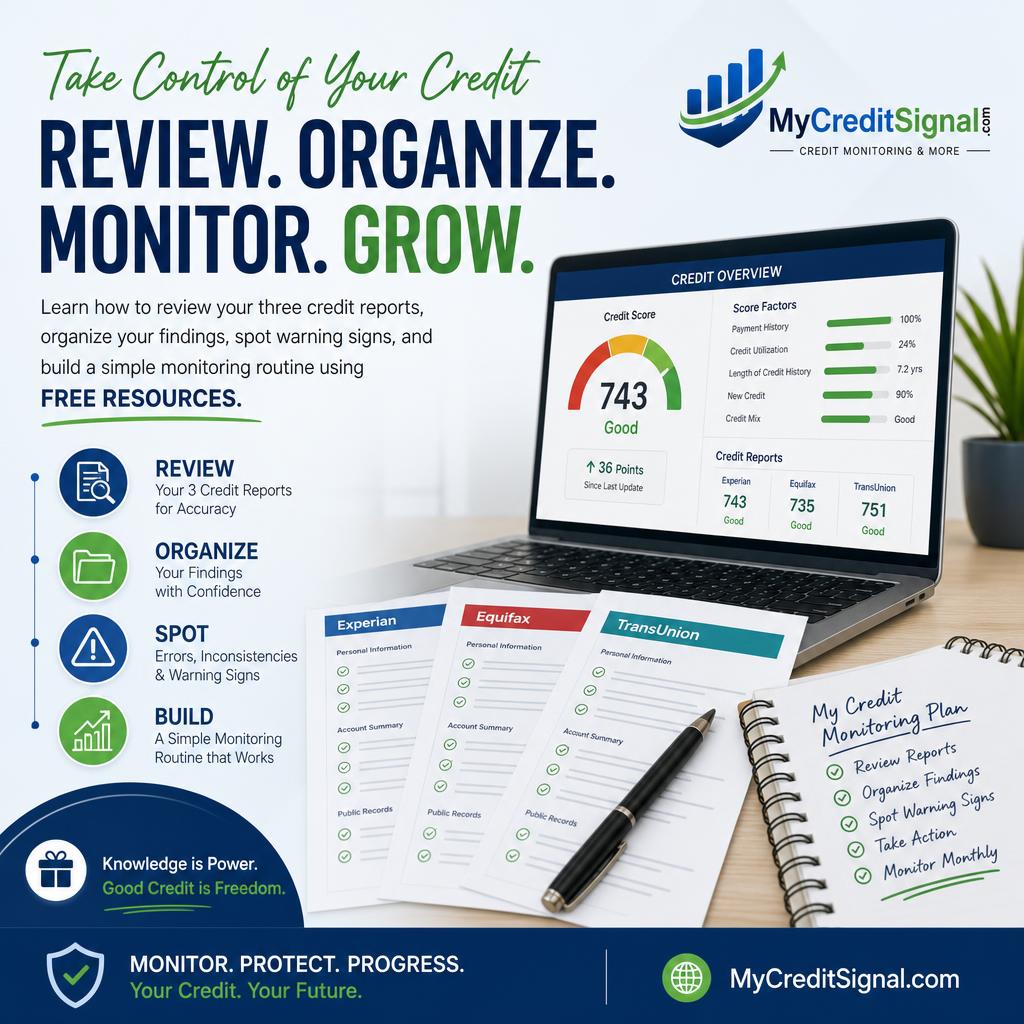
If you are preparing for a loan, apartment application, job screening, or simply trying to understand your financial starting point, review all three of your credit reports instead of relying on a single snapshot. You can obtain a free report from Experian, Equifax, and TransUnion through AnnualCreditReport.com once every 12 months per bureau. This guide shows how to access the reports, compare them, record important details, and create a practical monitoring routine without paying for a subscription.
The goal is not to memorize every line. It is to identify unfamiliar accounts, outdated contact information, unexpected balances, and changes that deserve attention before they affect an important application.
Contents
- 1 Who should review all three credit reports?
- 2 What does a credit report actually show?
- 3 Which report details deserve the closest look?
- 4 How do you get your reports safely?
- 5 A five-step review plan you can complete this week
- 6 What should you do first and what can wait?
- 7 Common monitoring mistakes and their fixes
- 8 When does this approach need extra care?
- 9 Frequently asked questions about credit report monitoring
- 10 Free tools and related resources
- 11 Build a repeatable credit review habit
Key Takeaway
Pull your three reports from the official source, compare the major account details, document what you see, and check your financial activity regularly.
Who should review all three credit reports?
Anyone planning a major financial decision should review all three reports, especially if an application is coming soon or your financial circumstances recently changed. The three bureaus may receive information from different companies, so one report may contain an account or balance that does not appear on another.
This process is especially useful for people who:
- Are preparing to apply for housing, an auto loan, or a credit card.
- Have recently changed addresses, names, employers, or phone numbers.
- Have opened, closed, refinanced, or paid off an account.
- Have shared personal information with a company or service that later experienced a security incident.
- Want a clear baseline before using a credit-building or budgeting strategy.
A paid monitoring service may be unnecessary if your main goal is an occasional full review. However, people with active identity-theft concerns, frequent applications, or a need for continuous alerts may prefer a more comprehensive monitoring approach.
What does a credit report actually show?
A credit report is a record of information supplied by companies that report account activity to credit reporting agencies. It is not the same thing as a credit score. A report contains the underlying account data, while a scoring model uses selected information from a report to calculate a score.
Most reports include identification information, account histories, balances, payment status, credit limits, inquiries, and certain public-record information. Review each section separately. A correct name or previous address does not prove that every account listed belongs to you, and a familiar lender name does not guarantee that the balance or status is current.
Which report details deserve the closest look?
Start with identity and account ownership, then move to balances and payment status. This order helps you distinguish harmless information from details that may affect an application or indicate unauthorized activity.
1. Personal information
Check your name, current address, former addresses, employer information, and other identifying details. Some older information may be legitimate, but unfamiliar identity details should be recorded for follow-up.
2. Open and closed accounts
Confirm that every listed account is familiar. For each account, note the creditor, account type, opening date, current balance, credit limit if applicable, and payment status.
3. Balances and limits
Compare reported balances with your own statements. Credit card utilization is the portion of available revolving credit currently used. For example, a $600 balance on a $2,000 limit represents 30% utilization.
4. Inquiries
Review applications for credit that you recognize. A hard inquiry generally relates to a request for new credit, while other inquiries may be visible only to you or may not affect scoring in the same way.
5. Negative information
Check the account status, dates, and balance of any negative information. Accurate negative information can generally remain on a report for up to seven years, while bankruptcies may follow different timelines depending on the type.
How do you get your reports safely?
Use AnnualCreditReport.com, the official website for obtaining reports from the three major bureaus. Avoid entering sensitive information into websites that promise a free report but require an unwanted trial or recurring membership.
Save each report in a secure location and record the date you accessed it. If you prefer paper records, print the pages that contain account details and store them somewhere private. Do not email full reports casually because they contain sensitive personal information.
A five-step review plan you can complete this week
Choose the right review window
Set aside enough uninterrupted time to examine the reports carefully. If you are applying for credit soon, review them before submitting applications so you have time to understand unfamiliar information.
Download or save all three reports
Access Experian, Equifax, and TransUnion through the official source. Name your files by bureau and date so you can compare them without confusion.
Create one comparison sheet
Make columns for creditor name, account type, opening date, balance, limit, status, and last reported date. Mark each line as familiar, needs review, or urgent. This simple structure prevents you from relying on memory.
Confirm your own records
Compare the reports with recent statements, loan records, and account-closure confirmations. Focus first on accounts you do not recognize, balances that look materially different, and accounts marked open after you expected them to be closed.
Secure your accounts
Change passwords for financial accounts if anything looks unfamiliar, use unique passwords, and turn on available account alerts. Contact the company connected with an unfamiliar account through a trusted statement or official website, not through contact details in a suspicious message.
Set a recurring review reminder
Choose a schedule that matches your situation. A once-a-year full review is a useful baseline, while people preparing for major applications or responding to suspicious activity may need to check more often through available free or paid services.
What should you do first and what can wait?
Use this decision framework: ownership first, accuracy second, optimization third. First, identify accounts or inquiries you do not recognize. Next, compare balances, limits, dates, and statuses with your records. Only after those checks should you focus on score-improvement strategies such as reducing revolving balances or planning new applications.
For example, suppose your report shows a $600 balance on a $2,000 limit. The utilization calculation is $600 divided by $2,000, or 30%. If your records confirm the balance, it is an optimization question. If you do not recognize the account, ownership is the priority and you should contact the relevant company using independently verified contact information.
To model possible score effects after your review, use the free credit score simulator. Treat the result as an estimate because scoring models and individual credit profiles differ.
Common monitoring mistakes and their fixes
Reviewing only one bureau
Behavior: You check one report and assume it represents every report. Consequence: You may miss information that appears with another bureau. Fix: Compare all three reports through the official source.
Confusing a score with a report
Behavior: You watch a score number but never inspect the account data behind it. Consequence: You cannot tell which account detail may be influencing the result. Fix: Review the reports first, then use a simulator for planning.
Ignoring small unfamiliar details
Behavior: You dismiss an unfamiliar address, inquiry, or account because the amount is small. Consequence: A small warning sign can remain unnoticed while activity continues. Fix: Record every unfamiliar item and verify it through a trusted source.
Using an unofficial free-report website
Behavior: You enter personal information into a site that advertises a free report. Consequence: You may enroll in a paid service or expose sensitive data. Fix: Start with AnnualCreditReport.com and read every screen before submitting information.
When does this approach need extra care?
A routine review is useful, but it does not replace immediate action when you suspect identity theft. The Federal Trade Commission directs consumers to IdentityTheft.gov for reporting and recovery guidance. Follow the instructions there and keep the resulting records with your financial documents.
Also, do not assume that every difference between reports is automatically a problem. Companies may report to different bureaus, and reporting dates can vary. Compare the information with your own statements before drawing conclusions.
Frequently asked questions about credit report monitoring
How often can I get a free credit report?
You can generally obtain one free report every 12 months from each bureau through AnnualCreditReport.com. Additional access may be available during certain special circumstances or promotional periods.
Should I review all three credit reports?
Yes, reviewing all three gives you a broader view because companies may report information to different bureaus. Compare account names, balances, limits, dates, and statuses across the reports.
Will checking my own report hurt my credit score?
Requesting your own credit report is a personal review and is not the same as applying for new credit. It is a useful step before making a major financial decision.
Once you have reviewed your reports, keep your next step focused. Use the credit report letter helper if you need help organizing a written request about information you are addressing, and use the credit score simulator to compare possible repayment or utilization scenarios.
For another practical explanation of warning signs that may not belong to you, read Credit Score Errors That Are Not Yours. The free tools remain available for readers who want to understand their credit without committing to a paid service.
Get weekly credit tips, tool updates, and practical guides – free.
Build a repeatable credit review habit
The most useful credit review is one you can repeat. Start with AnnualCreditReport.com, compare all three reports, document what you find, and separate urgent account-ownership questions from later score optimization.
Your next step this week is simple: access the reports, create the comparison sheet, and review the accounts you recognize least. A clear record gives you more control over future applications and helps you act earlier when something does not match your financial records.



Leave a Reply
You must be logged in to post a comment.