
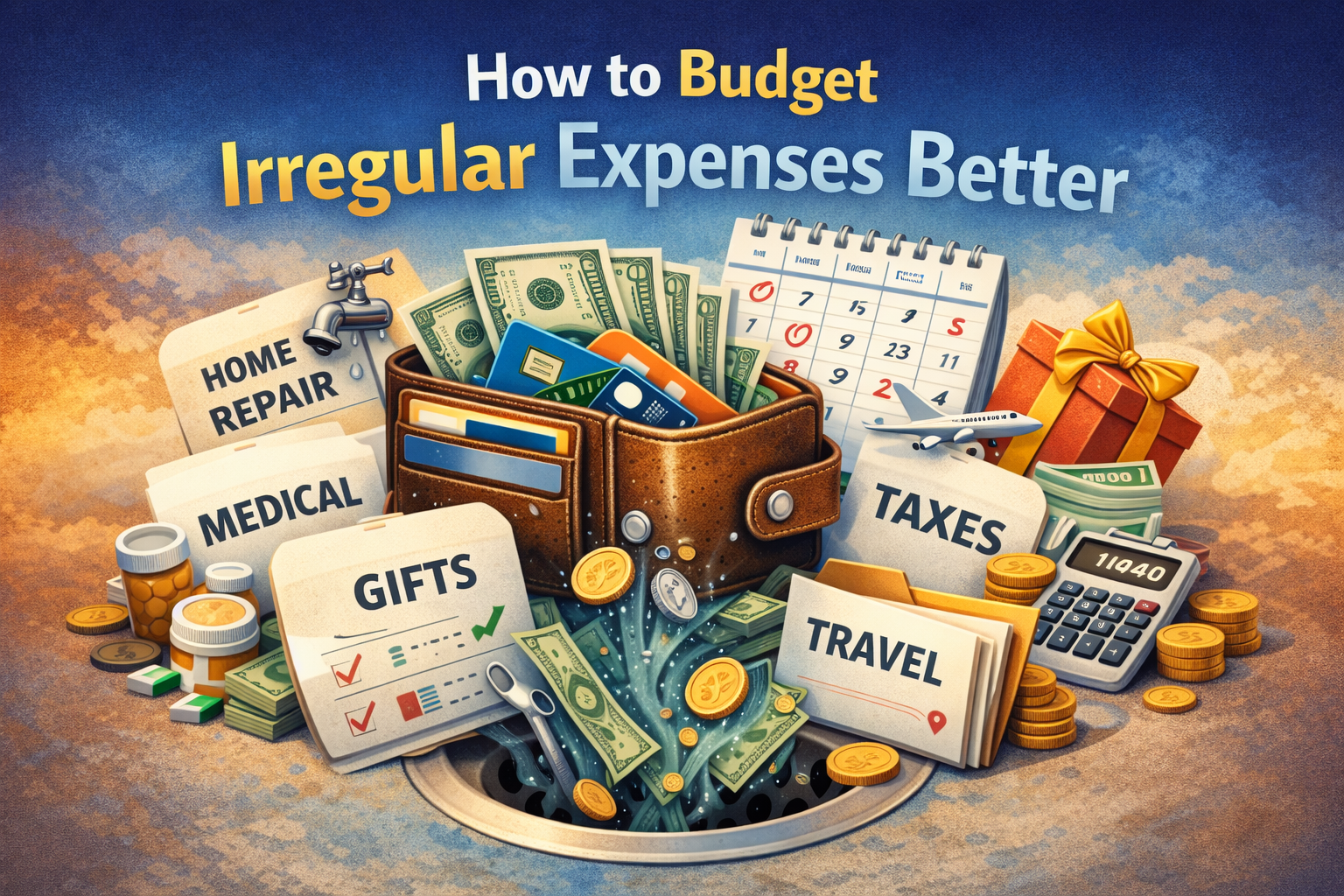
Your budget can look fine on paper and still fall apart the minute a nonmonthly bill shows up. A $600 car insurance premium, a $250 holiday trip, or a $900 repair can wreck a solid month if you only plan for rent, groceries, and utilities. If you are trying to budget irregular expenses, this guide is for people who want fewer money surprises and more control over cash flow. You will learn how to spot these costs early, turn them into manageable monthly targets, and build a system that works even when income or expenses are not perfectly steady.
Contents
- 1 Who needs an irregular expense budget
- 2 Why irregular expenses cause budget failure
- 3 The simple method that makes nonmonthly bills manageable
- 4 The numbers that matter most
- 5 What to fund first and what can wait
- 6 A practical 7 step plan you can start this week
- 6.1 1. Review the last 12 months of spending
- 6.2 2. Build an irregular expense list with estimated due dates
- 6.3 3. Convert each item into a monthly or paycheck amount
- 6.4 4. Open or organize dedicated savings buckets
- 6.5 5. Automate transfers on payday
- 6.6 6. Start with the next three high-impact expenses
- 6.7 7. Check and adjust once a month
- 7 Three mistakes that keep sinking funds from working
- 8 What most advice misses about irregular expenses
- 9 FAQ
- 10 Helpful tools and related resources
- 11 The bottom line
Who needs an irregular expense budget
This strategy is a strong fit for people who have predictable monthly bills but keep getting thrown off by expenses that do not happen every month. That includes annual subscriptions, quarterly insurance premiums, school costs, holiday spending, medical copays, pet care, home maintenance, and car repairs.
It is especially useful for:
- Households that feel like they are always starting over after one surprise bill
- Freelancers or hourly workers who need more stable planning
- Families with children, where seasonal and school-related costs pop up often
- Car owners and homeowners, who face maintenance and repair costs that are uneven but unavoidable
- Anyone trying to grow savings without dipping into it every few months
This approach may not be enough on its own if you are already behind on essentials like rent, utilities, or minimum debt payments. In that case, your first move is stabilizing cash flow and covering necessities before setting aggressive sinking fund targets. If your income changes a lot month to month, pair this article with a guide on budgeting with irregular income so your plan accounts for both uneven pay and uneven bills.
Why irregular expenses cause budget failure
Most people do not really have surprise expenses. They have overlooked expenses. The car registration that arrives every year is not random. Holiday gifts are not random. Back-to-school shopping is not random. The problem is timing. Monthly budgets focus on bills due in the next 30 days, while irregular expenses arrive every 3, 6, or 12 months and hit all at once.
That creates a common trap. You might feel like you have an extra $300 this month because no large bills are due. Then two months later, a $450 vet bill and a $180 annual subscription renew in the same week. If you did not reserve money ahead of time, the choices get expensive fast: use a credit card, skip a bill, pull from your emergency fund, or give up on another financial goal.
The better system is to treat irregular expenses like monthly bills, even when the due date is far away. Instead of reacting to a lump sum later, you break the total into smaller set-asides now. That is the core move that makes this work.
If your budget currently starts with each paycheck, a tool like the paycheck budget allocator can help you assign part of every pay cycle to these nonmonthly costs before the money gets spent elsewhere.
The simple method that makes nonmonthly bills manageable
Budgeting irregular expenses comes down to three steps: identify them, annualize them, and divide them into monthly or per-paycheck targets.
Step 1: Identify every nonmonthly cost
Look back at the past 12 months of bank and card statements. List anything that did not happen monthly but still mattered. Include both required and highly likely expenses. A useful rule is this: if you would probably pay it again within the next 12 months, it belongs on the list.
Step 2: Calculate the annual total
Add up what each item costs over a full year. If your car insurance is $720 every 6 months, the annual cost is $1,440. If holiday spending is usually around $600, use $600. If car repairs vary, use an average based on the last two or three years or start with a realistic placeholder.
Step 3: Divide into a recurring target
Take the annual number and divide by 12 for a monthly target. If you are paid every two weeks, divide by 26 to get a per-paycheck number. This turns a painful lump sum into a routine line item.
Here is the formula in plain English: total yearly irregular expenses divided by 12 equals your monthly sinking fund target.
That is why irregular expense planning is so effective. It replaces panic with math.
The numbers that matter most
There is no perfect universal percentage for irregular expenses, but there are realistic ranges that help. Many households underestimate these costs by several hundred dollars per month because they ignore annual and seasonal spending. Once you track them, the total is often larger than expected.
Here is a sample annual list for one household:
- Car insurance premium: $1,200 per year
- Car maintenance and repairs: $900 per year
- Medical and dental out-of-pocket: $600 per year
- Gifts and holidays: $750 per year
- Home maintenance: $1,200 per year
- Pet care beyond food: $480 per year
- Annual subscriptions and renewals: $300 per year
- Travel for family events: $720 per year
Total annual irregular expenses: $6,150.
Divide $6,150 by 12 and the monthly target is $512.50. If that sounds high, that is the point. Many people are already spending this money. They just are not planning for it in advance.
If you are paid twice per month, set aside about $256 per paycheck. If you are paid biweekly, set aside about $237. If that amount feels impossible right now, do not give up on the system. Prioritize the most urgent categories first and phase in the rest over 60 to 90 days.
A useful threshold: if your irregular expenses total more than 10 percent of your take-home pay across the year, you need a dedicated sinking fund system, not just a general savings bucket. A single savings account can work, but mentally or digitally separating categories makes it easier to avoid spending money meant for insurance on a holiday sale.
Another number that matters is your emergency fund target. Irregular expenses and emergency savings are not the same thing. Tires, annual fees, and school supplies are expected costs. A job loss or urgent medical event is not. If you are not sure whether your emergency savings is on track, use the emergency fund calculator to estimate a realistic cushion for true emergencies.
What to fund first and what can wait
If your irregular expense list is long, do not try to fully fund everything at once. Use a simple decision framework: urgency, certainty, and consequence.
Fund first if the expense is due soon, highly likely, and expensive to miss. Examples include insurance premiums, annual registrations, known school fees, and upcoming medical deductibles.
Fund second if the expense is likely but timing is less exact. Examples include car maintenance, pet care, or household replacements like a microwave or appliance repair.
Fund later if the expense is optional or can be scaled down without causing a financial problem. Examples include holiday extras, elective travel upgrades, or nonessential subscriptions.
This matters because trying to save equally for everything can leave you underprepared for the items with the highest penalties. Missing a $500 insurance bill can create fees or coverage issues. Cutting holiday spending from $700 to $400 is usually easier than scrambling for a premium due next month.
If you are also trying to build basic cash reserves, read how to create an emergency fund budget plan so your irregular expenses do not crowd out core savings.
A practical 7 step plan you can start this week
You do not need a brand-new financial life to make this work. You need a repeatable process. Here is a practical seven-step setup.
1. Review the last 12 months of spending
Go through your statements and highlight anything nonmonthly. Be specific. Instead of writing misc car costs, separate registration, oil changes, tires, and repairs if possible. This step alone can uncover leaks and forgotten renewals.
2. Build an irregular expense list with estimated due dates
Create columns for category, annual amount, next due date, and monthly target. If a bill is every 6 months, note both due dates. If spending is seasonal, assign a likely month. Imperfect dates are fine. Guessing responsibly is better than not planning at all.
3. Convert each item into a monthly or paycheck amount
Use the formula described earlier. If your annual holiday budget is $600, save $50 per month. If your annual car maintenance budget is $900, save $75 per month. If your annual subscriptions total $240, save $20 per month.
4. Open or organize dedicated savings buckets
You can use one savings account with separate tracking categories, or multiple named buckets if your bank allows it. Common buckets are auto, home, medical, annual bills, gifts, and travel. The goal is not complexity. The goal is visibility.
5. Automate transfers on payday
Automation solves the timing problem. If you wait until month-end to save what is left, there usually is not much left. Set transfers for the same day your paycheck lands. Even $25 to $75 per category makes a difference when done consistently.
6. Start with the next three high-impact expenses
Do not spread yourself too thin. Pick the next three irregular expenses most likely to hurt your budget in the next 90 days. Fund those first. Once they are under control, add more categories. This keeps the plan realistic.
7. Check and adjust once a month
Prices change. Deductibles change. Kids grow. Cars age. Review your sinking funds monthly for five minutes. If a category is consistently too low, raise it. If one is overfunded, redirect the excess to another bucket or to your emergency savings.
Five concrete actions you can take this week:
- Pull the last 12 months of bank and card statements
- List at least 10 nonmonthly expenses with rough annual totals
- Choose the next three expenses due within 90 to 180 days
- Set one automatic transfer before your next payday
- Cut or pause one low-value subscription and redirect that amount to a sinking fund
- Use a paycheck-based allocation method so each pay cycle covers part of these costs
Three mistakes that keep sinking funds from working
Mistake 1: Treating irregular expenses like emergencies
The behavior is paying expected costs out of your emergency fund every time they show up. The consequence is that your emergency savings never grows or stays intact for true emergencies. The fix is to separate expected nonmonthly expenses from genuine emergencies and fund them differently.
Mistake 2: Using unrealistic estimates
The behavior is setting aside $25 a month for car repairs when your actual average is closer to $900 a year. The consequence is chronic shortfalls and frustration with the system. The fix is to use past spending or realistic replacement costs, then round up by 10 percent to 15 percent for categories that tend to run high.
Mistake 3: Keeping everything in checking
The behavior is mentally earmarking money for annual bills while leaving it mixed in spendable cash. The consequence is accidental overspending because the balance looks available. The fix is to move irregular expense money to a separate savings bucket or at least track it in a dedicated category outside your daily spending account.
Mistake 4: Funding too many categories at once
The behavior is trying to save for 12 different future expenses immediately. The consequence is tiny balances everywhere and little protection where it matters most. The fix is to focus first on the biggest and nearest costs, then expand gradually.
What most advice misses about irregular expenses
Many articles make irregular expense budgeting sound clean and exact. Real life is not. Some categories will be predictable, like annual memberships. Others will be estimates, like dental work, travel, or appliance replacement. The system still works because budgeting is about improving your odds, not predicting every dollar perfectly.
There are also cases where this advice needs to be adapted.
If your income is highly variable, your savings contribution may need to be percentage-based instead of fixed. For example, you might send 8 percent of each paycheck to irregular expenses, then direct any strong income months toward near-term categories.
If you are paying off high-interest debt above roughly 20 percent APR, there is a tradeoff. You still need to fund known near-term bills, but you may not want to build every sinking fund aggressively while expensive interest compounds. In that situation, focus on unavoidable upcoming costs and a basic emergency cushion, then attack the debt.
If you already have a healthy emergency fund and stable cash flow, you can simplify. You may choose one larger annual expense fund instead of many small buckets, especially if your spending history is consistent. What matters is that the money is reserved before the bill arrives.
Another nuance: some expenses feel irregular but are really periodic essentials. For families, back-to-school spending, summer child care, sports fees, and holiday travel are often recurring enough to count as annual line items. If it happens most years, put it in the plan.
FAQ
How much should I budget for irregular expenses each month
Add your expected annual nonmonthly expenses and divide by 12. Many households land somewhere between 5 percent and 15 percent of take-home pay, but your number depends on your car, home, family size, and insurance structure.
Should irregular expenses go in my emergency fund
No. Expected costs like insurance premiums, registration fees, gifts, and routine repairs should usually have their own sinking funds. Emergency savings should be reserved for true emergencies such as job loss or urgent major events.
What if I cannot afford the full monthly target yet
Start with the most urgent and most certain expenses first. Fund the next three high-impact categories, automate a smaller amount, and increase contributions as your cash flow improves.
If you want to put this into action, start with the paycheck budget allocator to map your income across bills, savings, and irregular expense categories. If your income itself changes from month to month, this guide on budgeting with irregular income can help you build a more stable plan. For a stronger safety net, use the emergency fund calculator and review this article on building an emergency fund budget plan so expected costs and emergencies do not get mixed together.
Get weekly credit tips, tool updates, and practical guides – free.
The bottom line
To budget irregular expenses like a pro, stop treating them like random setbacks. List them, annualize them, divide them into monthly or paycheck targets, and automate the savings before you spend the money elsewhere. That one shift can make your budget feel dramatically more stable within a couple of pay cycles. Start by identifying your next three nonmonthly expenses, set a transfer for your next payday, and build from there.


Want to understand your credit report?
Get plain-English explanations with our free AI Credit Analyzer →
Leave a Reply
You must be logged in to post a comment.