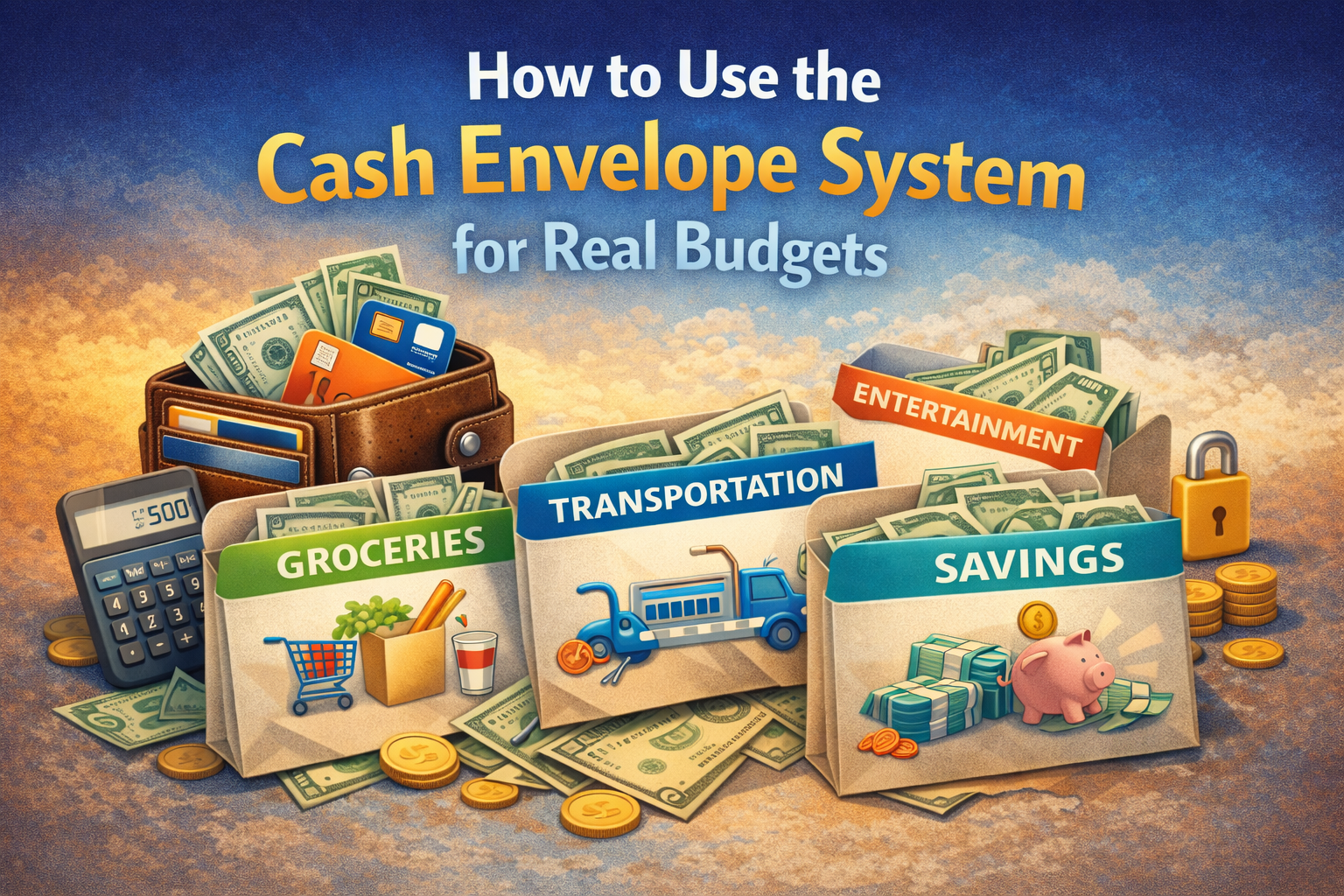
You set a grocery budget of $500, swipe your card a few extra times, and by the 22nd of the month you are already at $642. That is exactly why people still search for the cash envelope system. It creates a hard stop that digital spending often does not. But in 2026, when rent, subscriptions, delivery apps, and tap-to-pay dominate daily life, the old envelope method needs a reality check. This guide is for people who want tighter control over everyday spending, especially if card spending keeps drifting higher than planned. By the end, you will know whether the cash envelope system fits your life, what categories it works best for, and how to test it without making your entire budget harder to manage.
Contents
- 1 Who should try the cash envelope system right now
- 2 What the cash envelope system actually does well in 2026
- 3 The numbers that decide whether this method is worth it
- 4 Where envelopes work best and where they usually fail
- 5 A practical 30 day test plan
- 6 Common mistakes that make people think it stopped working
- 7 What most articles miss about using cash in a digital economy
- 8 What to do first versus what to do later
- 9 FAQ
- 10 Helpful tools and related resources
- 11 The bottom line
Who should try the cash envelope system right now
The cash envelope system works best for people with a specific problem: variable spending that keeps creeping up. If your fixed bills are mostly on autopay but your week-to-week choices on food, takeout, entertainment, or personal spending keep blowing up the plan, cash can help.
It is especially useful for:
- People who overspend in 3 to 5 flexible categories every month
- Households trying to stop small daily purchases from snowballing
- Anyone rebuilding money habits after relying too much on credit cards
- Beginners who need a simple visual way to see what is left
- Couples who want shared spending limits without constant app checking
It may not be the best fit for:
- People whose budget problems come mostly from low income, not overspending
- Anyone with irregular cash access, mobility issues, or no safe place to store cash
- Households where most expenses are online, automated, or card-only
- Frequent travelers who need digital records and fraud protection
If your income changes month to month, build the broader plan first, then decide where cash helps most. A good starting point is this guide to budgeting with irregular income. The envelope method is strongest as a control tool for selected categories, not as a complete financial system for every bill you pay.
What the cash envelope system actually does well in 2026
At its core, the cash envelope system means assigning physical cash to specific spending categories before you spend it. Once an envelope is empty, spending in that category stops until the next refill.
That sounds almost too simple, but the key benefit is behavioral. A debit card makes every purchase feel roughly the same. A grocery run for $84, a coffee stop for $7, and a lunch delivery for $29 all happen with one tap. Cash creates friction. You literally watch the money leave. For many people, that friction is the point.
In 2026, the system still works for categories with three traits:
- The spending is frequent
- The amount changes week to week
- You can realistically pay in cash at least most of the time
That usually includes groceries, restaurants, entertainment, beauty or barber visits, kids activities, household extras, and personal spending.
It is much weaker for rent, utilities, insurance, debt payments, subscriptions, and anything that requires online payment. That is why the smartest version today is often a hybrid budget: bills stay digital, while a few problem categories use cash caps.
If you need a clean way to split income between fixed bills and flexible spending before deciding your envelope amounts, use the paycheck budget allocator. It can help you see whether the issue is actually overspending in flexible categories or simply that too much of your check is already committed before the month starts.
The numbers that decide whether this method is worth it
You do not need a perfect budget to test the envelope system, but you do need a few clear numbers. These matter most:
1. Your monthly overspending amount
Look at the last 60 to 90 days and total how much you exceeded your target in flexible categories. For example:
- Groceries budgeted at $500, actual average $610, over by $110
- Takeout budgeted at $120, actual average $240, over by $120
- Entertainment budgeted at $80, actual average $145, over by $65
Total monthly drift: $295.
If a cash method can cut even 60 percent of that drift, that is about $177 per month or $2,124 per year. That is enough to fund a starter emergency cushion, make extra debt payments, or stop carrying small balances between paychecks.
2. The refill schedule
Monthly envelopes can fail because too much cash is available too early. A better setup is weekly or per-paycheck refills. Example:
- Monthly grocery budget: $600
- Paid every two weeks: $300 per paycheck
- Weekly version: about $150 per week
Shorter refill windows reduce the odds of spending half the month’s money in the first 10 days.
3. ATM and convenience costs
If your bank charges $3 out of network and the ATM owner adds another $3, one cash withdrawal can cost $6. Do that four times a month and you lose $24. If using cash saves you $150, that tradeoff may still be worth it. If it only saves you $20, it is not.
4. Leakage rate
Leakage is what happens when you run out of cash and quietly switch back to a card. If you budget $200 in an envelope but still spend another $140 on your card in that same category, the envelope did not fix the behavior. It only disguised it. Track this for 30 days.
5. Carryover rules
Decide in advance whether leftover cash rolls forward, gets swept to savings, or funds a planned treat. Without a rule, leftover cash often disappears. A simple formula works: leftover amount x 50 percent to savings, 50 percent stays in the category next month.
For readers building a full spending plan, the zero-based budget builder can help you assign every dollar a job first. Then your envelope amounts become intentional limits, not random guesses.
Where envelopes work best and where they usually fail
Most articles treat this as an all-or-nothing choice. That is a mistake. The better question is which categories deserve cash.
Best categories for envelopes
- Groceries: easy to overspend, frequent, and usually cash-friendly
- Dining out: one of the fastest categories to spiral
- Entertainment: movies, events, casual outings, hobbies
- Personal spending: clothes, cosmetics, gaming, impulse purchases
- Kids extras: snacks, small school asks, weekend activities
Poor categories for envelopes
- Rent or mortgage: usually digital and too large to manage in cash
- Utilities: fixed timing and mostly online
- Insurance: recurring, digital, and often autopaid
- Subscriptions: impossible to control with paper envelopes alone
- Online shopping: cash creates friction, but not always enough unless you remove saved cards too
Use this quick decision framework: if the category is variable, emotional, and easy to overspend, cash is worth testing. If it is fixed, automated, and already predictable, keep it digital.
A practical 30 day test plan
Do not switch your whole financial life at once. Run a limited test for one month.
Step 1: Pick only 3 categories
Choose the categories that caused the most overspending in the last 2 months. For most households, that is some combination of groceries, dining out, entertainment, and personal spending.
Step 2: Set a cap using your real averages
Do not slash everything by 50 percent on day one. If your recent average for takeout is $220, set the first envelope at $180 or $190, not $80. The goal is behavior change you can repeat.
Step 3: Refill per paycheck or weekly
If you are paid twice a month and your grocery cap is $560, place $280 in the envelope each payday. This prevents front-loading. For categories that get impulsive fast, weekly works even better.
Step 4: Remove the backup temptation
Leave one card at home for these categories if possible. If you carry multiple cards and all of them can override the envelope limit, the system loses its power.
Step 5: Track every cash purchase for 30 days
Write the amount on the envelope or keep a note on your phone. It does not need to be fancy. What matters is matching the cash left with what you think you spent.
Step 6: Measure card leakage
At the end of each week, check whether you spent anything on a debit or credit card in those same categories. If yes, note the amount. This tells you whether the envelope is controlling spending or just shifting payment methods.
Step 7: Review and adjust, do not abandon
If groceries ran out in 10 days, ask why. Prices rose? Bulk purchase week? Poor category estimate? A good fix might be adding $40 and cutting dining out by $40, not giving up on the system entirely.
Five concrete actions you can take this week:
- Pull your last two bank or card statements and identify your top three overspending categories
- Set one realistic monthly cap for each of those categories
- Withdraw only the first week or first paycheck amount, not the full month
- Delete saved card info from your most tempting food delivery or shopping app
- Choose a rule for leftovers, such as moving half to savings immediately
If part of your goal is to free up cash for emergencies instead of just cutting spending, connect this test to a simple backup plan using an emergency fund budget plan. Saving even $25 to $50 a week from reduced overspending can make the method feel more rewarding.
Common mistakes that make people think it stopped working
Using envelopes for every category
Behavior: You try to manage groceries, gas, rent, utilities, gifts, pets, and subscriptions all with cash.
Consequence: The system becomes annoying, time-consuming, and unrealistic. You quit within a month.
Fix: Use cash only for 2 to 5 flexible categories where friction will actually change behavior.
Making the numbers too strict too fast
Behavior: You cut groceries from $700 to $400 or dining out from $250 to $50 because you want fast results.
Consequence: You blow the budget early, feel like the method failed, and switch back to cards.
Fix: Start 10 percent to 20 percent below your current average, then tighten later if it works.
Ignoring digital leakage
Behavior: You use an envelope but keep ordering online or tapping your card when the cash is gone.
Consequence: Spending does not actually fall, so the budget looks better on paper than in reality.
Fix: Check weekly transactions and treat any card spend in envelope categories as part of the same limit.
No rule for leftover money
Behavior: You end the month with $36 left in entertainment cash and just spend it because it feels extra.
Consequence: You lose one of the biggest benefits of the system, which is visible progress.
Fix: Decide before the month starts where leftovers go. Savings is usually the best default.
What most articles miss about using cash in a digital economy
The cash envelope system is not outdated because people changed. It is harder because commerce changed. Many purchases now happen online, through apps, or through subscriptions hidden in the background. That means a modern version needs extra guardrails.
Here is what many guides leave out:
- Cash does not cancel weak category planning. If your grocery number is unrealistic, an envelope will not fix it.
- Cash can create recordkeeping gaps. If you need detailed transaction history for shared budgets, reimbursement, or tax tracking, digital may be easier.
- Safety matters. Carrying $300 to $500 in cash is not practical for everyone.
- Rewards are a real tradeoff. If you reliably pay cards in full and use modest spending controls already, switching everything to cash may cost you convenience and card rewards without saving much.
- Household coordination matters. A couple can fail with envelopes if one person uses cash and the other keeps swiping.
There are also situations where the advice does not apply well. If your main issue is unstable income, not spending discipline, focus first on bill timing, buffer savings, and minimum baseline expenses. If your budget is already extremely tight, envelopes can still help with control, but they will not solve an income shortfall on their own.
The best use case is narrow and powerful: you have enough income to cover essentials, but a few flexible categories keep stealing money from larger goals.
What to do first versus what to do later
If you are interested but unsure, sequence matters.
Do first
- Identify your 2 to 3 worst categories
- Set limits based on recent averages
- Choose a weekly or per-paycheck refill cycle
- Track leakage from card spending
Do later
- Expand to more categories only if the first month works
- Tighten limits gradually after you see stable results
- Create a routine for rolling leftovers into savings or debt payoff
- Build a broader zero-based budget around the method
This order matters because behavior change usually fails when the setup is too ambitious. Small, visible wins make the system sustainable.
FAQ
Does the cash envelope system help with overspending?
Yes, especially in categories where spending is frequent and impulsive. It works by creating a hard limit and more awareness at the point of purchase.
Can I use the cash envelope system if I mostly shop online?
Partly. It is less effective for online-heavy spending unless you also remove saved cards, reduce app use, and treat digital purchases as part of the same category cap.
How many envelopes should I start with?
Usually three is enough. Starting with too many categories makes the method harder to maintain.
If you want to test the method with less guesswork, start with the paycheck budget allocator to map each check to your core expenses and flexible spending. If you prefer a full plan where every dollar is assigned before the month begins, try the zero-based budget builder. Readers with fluctuating income can also review budgeting with irregular income before setting envelope amounts. And if your bigger goal is to stop overspending so you can build a safety net, this emergency fund budget plan is the next logical step.
Get weekly credit tips, tool updates, and practical guides – free.
The bottom line
The cash envelope system still works in 2026, but not as a one-size-fits-all answer. It works best as a targeted tool for a few categories where convenience keeps leading to overspending. If your problem is groceries, takeout, entertainment, or personal spending, cash can create the friction your card never will. If most of your money challenges come from fixed bills, online spending, or irregular income, use it selectively or pair it with a stronger digital budget.
Your next step is simple: choose three categories, set realistic caps, and test the system for 30 days. If it cuts overspending even modestly, you will know fast, and the savings can start working toward something bigger than another impulse purchase.


Want to understand your credit report?
Get plain-English explanations with our free AI Credit Analyzer →
Leave a Reply
You must be logged in to post a comment.