
If your bankruptcy has been discharged and you are wondering what to do next, the biggest risk is not the old filing itself. It is doing nothing for the next 6 to 12 months. Credit scores respond to current behavior, and after bankruptcy that means replacing old negative history with new on-time payments, modest balances, and carefully chosen accounts. This guide is for people who want a practical plan to rebuild credit after bankruptcy without taking on more debt than they can handle.
You will learn what matters most, which accounts to consider first, what numbers to watch, and how to avoid the common mistakes that slow recovery. The goal is not a miracle score jump. The goal is building a cleaner, stronger profile step by step.
Contents
- 1 Who this guide is for
- 2 Why post-bankruptcy credit recovery works differently
- 3 The numbers and timelines that matter most
- 4 What to do first versus later
- 5 A step-by-step plan to rebuild credit after bankruptcy
- 5.1 Pull all three credit reports and make a rebuild file
- 5.2 Lock down on-time payments on every current bill
- 5.3 Choose one starter product, not several
- 5.4 Use the account lightly and predictably
- 5.5 Keep reported balances low
- 5.6 Wait for consistency before adding another account
- 5.7 Track progress monthly, not emotionally
- 6 Mistakes that can slow your recovery
- 7 What most articles miss
- 8 FAQ
- 9 Helpful tools and related resources
- 10 Conclusion
Key Takeaway
You can rebuild credit after bankruptcy by focusing on on-time payments, one or two low-risk starter accounts, and low balances over the next 12 to 24 months.
Who this guide is for
This article is for people whose bankruptcy has been discharged and who want to qualify for better borrowing terms later, whether that means a safer credit card, a car loan, or eventually a mortgage. It is especially useful if you have little or no open credit right now and need a low-risk way to start reporting positive activity again.
This may not be the right first step if your income is still unstable, you are behind on current essential bills, or you are tempted to use new credit to cover a monthly shortfall. In that case, work on cash flow first. Credit rebuilding works best when your budget can support every payment in full and on time.
If late payments are still showing on active accounts, read how to recover from late payments alongside this guide. Bankruptcy recovery and late-payment recovery often overlap, but your first priority is still making every current payment by the due date.
Why post-bankruptcy credit recovery works differently
After bankruptcy, you are not trying to erase the filing quickly. You are trying to outrank it with newer positive behavior. According to MyFICO, payment history makes up about 35% of a FICO Score, which is why your next 12 months of payment behavior matter so much. A bankruptcy can stay on your credit reports for up to 10 years for Chapter 7 and typically 7 years for Chapter 13, but its impact tends to lessen over time as positive accounts are added and aged, as explained in educational guidance from Experian.
That means the recovery formula is simple even if it is not fast: add fresh positive accounts, keep utilization low, avoid new mistakes, and give the accounts time to age.
A good way to think about it is this:
- First: stabilize income and bill payments.
- Next: open one starter account you can manage easily.
- Then: add a second account only if it helps your profile and your budget.
- Always: keep balances low and avoid payment slips.
If you need help understanding balance management once you open a card, this credit utilization guide can help you decide how much of your limit to use without making your profile look stretched.
The numbers and timelines that matter most
Post-bankruptcy rebuilding gets easier when you stop chasing vague advice and focus on a few measurable targets.
1. Payment history matters more than almost anything else
Because payment history is roughly 35% of a FICO Score, one missed payment can undercut months of progress. Set up autopay for at least the minimum due, then manually pay the full statement balance if your cash flow allows. For most people rebuilding, full and on-time is the safest pattern.
2. The public record lasts longer than the heaviest damage
Chapter 7 may remain on your reports for up to 10 years, while Chapter 13 typically remains for 7 years. That sounds discouraging, but lenders and scoring models also weigh your recent activity. A five-year-old bankruptcy paired with two years of clean, positive payment history looks very different from a recent bankruptcy with no new accounts.
3. Meaningful improvement often takes 1 to 2 years
There is no universal score timeline, and results vary by profile and scoring model. Still, a realistic expectation for noticeable progress is often within 1 to 2 years of disciplined rebuilding. Think in quarters, not weeks.
4. Keep starter-account math simple
Suppose you open a secured card with a $300 deposit and a $300 limit. If you charge $30 of recurring expenses and pay the statement in full, your balance is only 10% of the limit. If you charge $240 and let it report, that is 80% utilization, which can make you look riskier even if you pay on time later.
Use this quick formula: reported balance divided by credit limit equals utilization. On a $500 limit, a $50 balance is 10%. On a $500 limit, a $200 balance is 40%.
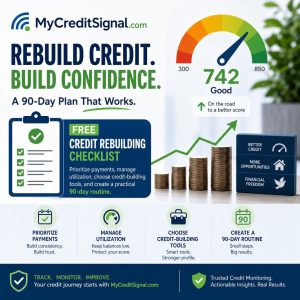
If you want a structured starting point, use the credit rebuilding checklist to map out your first month, then use the credit score simulator to estimate how lower balances and consistent payments could affect your path.
What to do first versus later
Many people rebuild too aggressively because they feel behind. That usually backfires. A better framework is to separate actions into three buckets.
Do first
- Review your credit reports from all three bureaus through the official free report source linked by the CFPB.
- Make sure every current bill is set to pay on time.
- Choose one starter product, usually a secured card or credit-builder loan.
- Create a budget line for the deposit, small charges, and full monthly payoff.
Do second
- Add a second account only after you have handled the first one well for several months.
- Track utilization and reduce reported balances before statement closing dates when possible.
- Check progress monthly, not daily.
Do later
- Apply for unsecured products only when your current accounts show a solid payment pattern.
- Shop for larger borrowing needs after you have built more recent positive history.
- Expand accounts slowly instead of opening several at once.
The core idea is restraint. One well-managed account does more for your rebuild than three new accounts you can barely keep organized.
A step-by-step plan to rebuild credit after bankruptcy
Pull all three credit reports and make a rebuild file
Start by reviewing your reports from Experian, Equifax, and TransUnion using the free access route highlighted by the CFPB. You are looking for what is open, what is closed, and whether you have any active accounts left to rebuild with. Create a simple rebuild file with your account list, due dates, statement dates, and a note on which accounts report monthly.
This week action: download or print all three reports and list every open account in one document.
Lock down on-time payments on every current bill
Because payment history carries so much weight, your first win is consistency. Set autopay for the minimum on any open installment or revolving account. Then schedule a calendar reminder 5 to 7 days before each due date to pay more or pay in full. If cash flow is tight, keep the charge volume small enough that full payoff is still realistic.
This week action: turn on autopay and add due-date reminders for every account you still have.
Choose one starter product, not several
Authoritative consumer guidance commonly points to secured credit cards and credit-builder loans as lower-risk rebuilding tools. A secured card is often best if you can handle a small deposit and want flexible monthly use. A credit-builder loan may fit better if you prefer a fixed payment structure and want installment history.
Use this decision framework: choose a secured card first if you can keep spending extremely small and pay in full every month. Choose a credit-builder loan first if fixed payments suit your habits better and you are less likely to overspend on a card.
This week action: pick one product type and set a maximum affordable monthly payment or deposit before applying.
Use the account lightly and predictably
If you open a secured card, put one or two small recurring bills on it, such as a streaming service or phone bill, then pay the statement balance in full. If the limit is $200, a $10 to $20 recurring charge is enough to show activity without stressing your budget. If you open a credit-builder loan, treat the payment like rent or insurance: automatic and non-negotiable.
This week action: assign one small recurring expense to the new card or automate the new installment payment.
Keep reported balances low
Low utilization supports a stronger profile over time. If your card balance creeps up, make an extra payment before the statement closes so a smaller amount reports. For example, on a $300 limit, paying the balance down to $30 before the statement date means only 10% utilization reports.
This week action: look up your statement closing date and set a reminder 3 days before it.
Wait for consistency before adding another account
You do not need a thick file immediately. You need a stable one. After you show a clean pattern for several months, you can consider a second account if it adds useful diversity or a higher total limit. But avoid stacking applications just because you get offers in the mail.
This week action: write a rule for yourself: no second application until the first account has a consistent on-time track record.
Track progress monthly, not emotionally
Use one day each month to review balances, payments, and whether your utilization stayed under your personal target. Scores can move unevenly, especially after a major event like bankruptcy. Focus on inputs you control: payments made, balances reported, and applications avoided.
This week action: schedule a monthly 20-minute credit review on your calendar.
Mistakes that can slow your recovery
Applying for too many accounts too soon
Behavior: submitting several applications in the first few months after discharge. Consequence: you may add hard inquiries, increase the chance of denials, and create more bills to manage before your habits are stable. Fix: open one starter account first and prove you can manage it before adding anything else.
Using a secured card like a spending tool
Behavior: charging large balances because the limit feels small and manageable. Consequence: high reported utilization can weaken your profile and raise the risk of missing a payment. Fix: keep the card for one or two planned purchases and pay the statement balance in full.
Ignoring statement dates
Behavior: paying only on the due date without knowing what balance reports. Consequence: you may show a high balance to the bureaus even when you pay on time. Fix: learn both your due date and statement closing date, then pay down balances before the statement closes.
Monitoring obsessively but not changing behavior
Behavior: checking your score constantly while continuing inconsistent habits. Consequence: stress goes up but results do not. Fix: review monthly and tie each review to one action, such as lowering a balance or confirming autopay worked.
What most articles miss
Most bankruptcy recovery articles tell you to get a secured card and wait. That is incomplete. The real issue is account fit. A secured card helps only if the deposit is affordable, the spending is controlled, and you can pay in full every month. A credit-builder loan helps only if the payment fits comfortably into your budget and does not create pressure elsewhere.
Another missing point is that rebuilding is partly a budgeting task, not just a credit task. If a $200 deposit means you will carry a utility balance next month, the timing is wrong. If a $25 monthly payment is easy and predictable, the timing may be right.
It is also easy to overlook lender standards outside your score. Some lenders care about time since discharge, income stability, cash reserves, and debt-to-income ratio. So even if your score improves, approval timing can still vary.
FAQ
How long does bankruptcy affect my credit after discharge?
Chapter 7 can remain on credit reports for up to 10 years, and Chapter 13 typically remains for 7 years. But the effect can lessen over time as you add positive, well-managed accounts and avoid new negatives.
What is the fastest way to rebuild credit after bankruptcy?
The fastest sustainable way is usually to make every payment on time, open one low-risk account such as a secured card or credit-builder loan, keep balances low, and avoid unnecessary applications. There is no instant fix, but steady behavior matters.
Should I get a secured card or a credit-builder loan first?
If you can keep card spending tiny and pay in full, a secured card is often a practical first move. If fixed monthly payments are easier for you to manage, a credit-builder loan may be the better first choice.
If you want to turn this article into an action plan, start with the credit rebuilding checklist. It can help you organize due dates, product choices, and monthly review points.
To understand how changes in balances and payment behavior may shape your timeline, try the credit score simulator.
For more context on keeping balances under control once you reopen credit, review our guide to credit utilization. If your profile also includes recent missed payments on surviving accounts, see how to recover from late payments.
For authoritative consumer guidance, the strongest outside references for this topic are the CFPB page on how to rebuild your credit, MyFICO’s guidance on reviving credit after bankruptcy, and Experian’s credit guide.
Get weekly credit tips, tool updates, and practical guides – free.
Conclusion
To rebuild credit after bankruptcy, focus on the few actions that matter most: pay every bill on time, open one manageable starter account, keep balances low, and let time work for you. The bankruptcy entry may stay on your reports for years, but it does not have to define the next version of your credit profile.
Your best next step is simple: pull your reports, choose one rebuilding tool, and set up a system that makes on-time payments automatic. Small, boring consistency is what usually wins here.


Leave a Reply
You must be logged in to post a comment.