
If you are starting from nothing, the biggest question is usually not whether credit matters. It is how long it takes before your efforts actually turn into a score that lenders can use. Maybe you want to qualify for an apartment, get a better auto loan, or stop paying deposits on everything. This guide is for readers with no credit history or an extremely thin file who want a realistic timeline, not hype. You will see what can happen in the first 30 days, the first few months, and after the first six months, plus what actions can help you build momentum faster.
The short version is encouraging. A first score may appear in roughly 4 to 6 months after reporting activity begins, but building good credit usually takes longer because lenders care about more than just the existence of a score. They may look at payment history, low utilization, account age, and how recently you opened new credit. That is why the answer to how long to build credit is part timeline and part strategy.
Contents
- 1 Who should care about this timeline
- 2 What actually creates a score from nothing
- 3 The timeline most people should expect
- 4 The numbers and thresholds that matter most
- 5 A practical plan for the next 6 months
- 5.1 Choose one reporting starter account
- 5.2 Set one recurring charge under your comfort level
- 5.3 Turn on autopay for at least the minimum
- 5.4 Manage the statement balance, not just the due date
- 5.5 Check progress monthly, not daily
- 5.6 Wait before adding a second account
- 5.7 Review your goal before your score
- 6 Mistakes that drag out the process
- 7 What most articles miss about building good credit
- 8 FAQ
- 9 Helpful tools and related resources
- 10 The bottom line
Key Takeaway
You may see a first credit score within 4 to 6 months, but building good credit from zero usually depends on consistent on-time payments, low utilization, and letting your accounts age without mistakes.
Who should care about this timeline
This article is most useful if you are in one of these groups:
- You have never had a credit card, loan, or other account reported to the bureaus.
- You are a young adult trying to build your first score before renting or financing a car.
- You mostly use debit and cash and now need a credit profile for real-world borrowing.
- You have a very thin file and want to know why one month of good behavior is not enough.
This may be the wrong playbook if you already have old accounts, collections, major delinquencies, or a recent score drop. In that case, the issue is not building from zero. It is improving an existing profile. If your main concern is understanding how balances affect score movement, read this guide to credit utilization calculators for a more targeted strategy.
Students can also use this article, but if you want age-specific examples and lower-risk first steps, this college student credit guide goes deeper on what makes sense when your income is limited.
What actually creates a score from nothing
A credit score is built from information reported on your credit file. No reported account usually means no score. Once an account starts reporting, scoring models begin to collect enough data to generate a number. That number is not a finish line. It is just the start.
Two scoring models matter most in this conversation. FICO is still the name most borrowers hear because many lenders use it. VantageScore 4.0 is another model that can score thinner files sooner than older models and places strong emphasis on payment history and new credit, according to VantageScore consumer FAQs. Both commonly use the 300 to 850 scale, but lenders may use different versions depending on the product.
In plain English, your early credit timeline depends on four things:
- Whether an account is actually reporting to the bureaus.
- How quickly the first few payments post and whether they are on time.
- How much of your limit you use if the account is revolving credit like a card.
- How long the account stays open and active without negative marks.
Length of credit history matters, but it is not the only lever. Experian notes that longer history generally helps, while utilization, payment history, new credit, and account mix also affect the score. That means you cannot rush the age factor, but you can control the other ones starting this week.
If you need a fuller beginner roadmap, this step-by-step guide to building credit from scratch pairs well with the timeline in this article.
The timeline most people should expect
Month 0 to 1
You open a starter account, usually a secured credit card, an authorized user line, or a credit-builder product. The Federal Reserve has noted that secured cards and secured small-dollar loans are widely used as credit-building products, based on tradeline-level bureau data through 2024. That does not mean every product works equally well for every person, but it confirms the mainstream nature of these tools.
At this stage, the most important question is simple: will the account report? If it does not report, it may help your cash flow or savings habits, but it will not help your score timeline.
Month 2 to 3
Your account may now be showing on one or more bureaus, but that still may not be enough for every scoring model to generate a score. Keep paying on time and keep balances low if it is a card. Do not assume no score means no progress. Reporting lag is normal.
Month 4 to 6
This is the window where many consumers may start seeing a first score, according to Capital One guidance. Some models may score thin files sooner, and some lenders may still want more history. This is why a first score and a useful borrowing profile are not the same thing.
Month 7 to 12
This is where disciplined behavior starts to matter more than your opening move. One account with twelve months of on-time history and low utilization generally looks stronger than one fresh account with erratic balances and multiple new applications. If you opened a secured card and used it lightly, you may now be in a much better position to qualify for an unsecured card or better pricing, though results vary by lender and model.
After year 1
The score may become more stable because your file is no longer brand new. At this point, account age starts to help more, and your decisions about whether to add another product should be based on a purpose, not impatience. A second card can improve total available credit and help utilization, but opening too much too fast can work against you.
The numbers and thresholds that matter most
When people ask how long to build credit, they often focus only on months. That misses the operational side of the problem. Here are the thresholds that matter while your file is young.
1. Utilization should stay low
A commonly cited target band is 0% to 30%, and many consumers aim even lower, often around 0% to 10%, according to Experian. If your card has a $300 limit, 30% utilization means a balance of $90. If you keep reporting around $20 to $30 instead, you are giving the model a lower-risk picture.
Quick formula: balance ÷ credit limit = utilization.
Example: a $75 reported balance on a $300 limit is 25% utilization. A $15 reported balance on that same card is 5%.
If you want to test scenarios before your statement closes, use the credit score simulator tool to estimate how lower balances could change your profile over time.
2. One late payment can matter more than several perfect swipes
Payment history remains one of the strongest drivers of scoring. VantageScore 4.0 specifically emphasizes payment history and new credit. In practical terms, making six small purchases and paying them on time is useful. Making one payment late can overshadow that progress.
3. New accounts help and hurt at the same time
A new account is necessary when you have no file. But opening several accounts in a short stretch can make you look riskier, especially when your profile is still thin. A simple decision framework works well here:
- Need a score fast: open one reporting starter product and manage it well.
- Need better utilization later: consider a second product only after several months of clean history.
- Need a mortgage soon: prioritize stability over stacking fresh accounts.
4. Account age cannot be compressed
You can optimize balances and never miss a payment, but you still cannot turn a three-month-old file into a two-year-old one. This is one reason some borrowers get frustrated. They are doing the right things, but the profile still needs time to mature.
A practical plan for the next 6 months
Choose one reporting starter account
Pick a product designed for limited history, such as a secured credit card or another verified credit-building product. The Federal Reserve and CFPB both recognize these products as common ways to establish history, though outcomes vary by person and product. Your job this week is to confirm the account reports and fits your cash flow.
Set one recurring charge under your comfort level
Use a small bill you already pay, such as a streaming service, transit pass, or one tank of gas. The goal is not to spend more. The goal is to create regular activity without tempting yourself into carrying a high balance. If your limit is $200, keeping the reported balance at $20 to $40 is much safer than letting it climb near $150.
Turn on autopay for at least the minimum
This is one of the highest-value actions you can take this week. Minimum autopay reduces the chance of a damaging late payment. Then add a calendar reminder to pay the full statement balance manually if you can. That gives you both protection and control.
Manage the statement balance, not just the due date
Many beginners pay by the due date and assume utilization will stay low. But if a high balance reports on the statement closing date, your score can still look worse. Make a mid-cycle payment if needed so the reported balance stays in a lower range. This is where understanding utilization becomes powerful. For deeper examples, read this explanation of utilization thresholds.
Check progress monthly, not daily
Credit building is slow enough that daily checking usually creates stress, not insight. Review your account once a month. Confirm the account reported, the payment posted on time, and the balance stayed within your target range. Use the financial goal timeline planner to map when you want to apply for a rental, auto loan, or another card.
Wait before adding a second account
If your first account is only a couple of months old, adding another one immediately may not help as much as you think. Give the first account time to build a clean pattern. Later, a second account might improve available credit and utilization flexibility, but only after you have shown control with the first one.
Review your goal before your score
If your goal is a car loan in eight months, your strategy may differ from someone who just wants a starter card. Think backward from the application date. If you need a stronger profile within a year, focus on zero missed payments, low utilization, and no unnecessary applications. If your timeline is longer, patience becomes an asset.
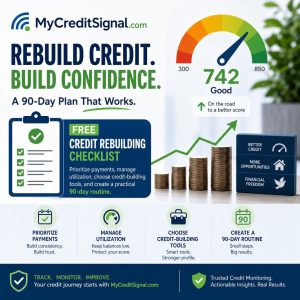
Those steps also double as a weekly checklist:
- Open one reporting account.
- Put one small recurring charge on it.
- Enable autopay.
- Make a pre-statement payment if needed.
- Track your timeline monthly.
Mistakes that drag out the process
Using too much of a small limit
Behavior: Running up a large portion of a starter card because the limit is low. Consequence: High utilization can depress your score even when you pay on time. Fix: Keep the reported balance well below 30% and ideally closer to the low end of the range when possible.
Opening several accounts at once
Behavior: Applying for multiple cards or loans because you want to speed up the process. Consequence: Too much new credit on a thin file can make your profile look unstable and shorten your average account age. Fix: Start with one account, build several months of clean history, then reassess.
Ignoring the statement closing date
Behavior: Paying by the due date but letting a high balance report first. Consequence: Your score may reflect higher utilization than you expected. Fix: Learn your statement date and make an extra payment before it closes if the balance is creeping up.
Choosing a product without confirming it reports
Behavior: Signing up for a credit-building product based only on marketing. Consequence: You may spend time and money without adding useful bureau data. Fix: Verify reporting and read the terms before opening anything.
What most articles miss about building good credit
Most content online answers the easy version of this question: when can you get a score? The harder and more useful question is when can you build a score that actually improves your options.
Here are the nuances that matter:
- A first score is not the same as strong approval odds. A lender may want more depth, especially for larger loans.
- Different models can produce different answers. FICO and VantageScore are not interchangeable in every lending context.
- Authorized user status can help some people, but not all lenders weigh it the same way. If that route is on your list, read these authorized user tips first.
- Credit-builder loans are not always faster. They can add payment history, but they may not be the best first move if cash flow is tight or fees are involved. For tradeoffs, see this breakdown of whether credit-builder loans are worth it.
Another thing most articles skip is the difference between what to do first and what to do later. First, get one reporting account and protect on-time payments. Later, think about optimizing utilization across more than one line. First, build a boring pattern. Later, expand your profile if there is a reason.
FAQ
How long does it take to get a usable credit score from nothing?
A first score may appear in about 4 to 6 months after reporting activity begins, but the exact timing varies by lender, bureau, and scoring model.
Do secured credit cards really help build credit?
They can, especially when they report to the bureaus and you make on-time payments while keeping utilization low. The Federal Reserve identifies secured cards as common credit-building products.
Can I build good credit fast if I spend more on the card?
No. Spending more does not build credit faster. Consistent on-time payments and lower utilization are usually more helpful than high spending.
If you want to turn this timeline into an action plan, these resources are the most useful next stops:
- Credit score simulator to test how balances and payment patterns may affect your profile.
- Financial goal timeline planner to work backward from an apartment, car, or card application date.
- Build credit from scratch the smart way for a broader beginner playbook.
- Credit utilization calculator guide for examples on how reported balances can change your score path.
Get weekly credit tips, tool updates, and practical guides – free.
The bottom line
If you are wondering how long to build credit, the honest answer is that a first score may show up within a few months, but good credit takes a little more patience. The timeline usually starts around 4 to 6 months for a first score, then improves with on-time payments, low utilization, and account age. You do not need a complicated system. You need one reporting account, one simple payment routine, and enough time for those good habits to become visible on your file.
Your next step is straightforward: choose a reporting starter product, keep the balance low, and set up autopay this week. Then let consistency do what speed cannot.


Leave a Reply
You must be logged in to post a comment.