
If you have never had a credit card or loan, building credit can feel backwards. Landlords, card issuers, and lenders want to see history before approving you, but you need approval to create that history in the first place. This guide is for people starting with a blank file, not rebuilding after major damage. You will learn what actually creates a score, how long the process usually takes, what first account to consider, and which mistakes can slow you down.
The big idea is simple: credit starts when at least one reported tradeline begins sending data to the credit bureaus, then grows as you stack on-time payments and keep balances reasonable. FICO says a new credit file often needs about 6 months of reported history before a usable score appears, so the goal is not speed at any cost. The goal is clean, steady data.
Contents
- 1 Who should use this approach
- 2 What actually creates a credit score from nothing
- 3 The first tradeline choices that make the most sense
- 4 The numbers and timelines that matter most
- 5 Your step-by-step plan for the next 30 days
- 5.1 Choose one starter product and verify that it reports
- 5.2 Set a spending rule before the card arrives
- 5.3 Turn on autopay for the full statement balance
- 5.4 Watch your statement closing balance, not just your due date
- 5.5 Add positive nontraditional data if available
- 5.6 Keep the account open and boring for at least 6 months
- 5.7 Review what to do next only after the first score appears
- 6 Three mistakes that slow down new credit files
- 7 What most build credit from scratch articles leave out
- 8 What to do first versus what can wait
- 9 FAQ
- 10 Helpful tools and related resources
- 11 The bottom line
Key Takeaway
If you want to build credit from scratch, start with one reported account, pay every bill on time, keep card balances low, and give the file time to mature.
Who should use this approach
This article fits you if you are new to the U.S. credit system, a student with no credit file, a young adult who has never borrowed, or someone who has cash-flow discipline but no reported borrowing history. It also fits people who have been paying rent, utilities, and phone bills for years but still do not have a standard revolving or installment account showing up as a primary tradeline.
This may not be the best first path if you already have active collections, several charged-off accounts, or a long file with missed payments. In that case, your strategy is different because you are not starting from zero. You are managing a damaged file. Also, if you plan to apply for a mortgage or auto loan immediately, opening several fresh accounts right now can create unnecessary noise in the short term.
If you are unsure how a future balance might affect your score once you have a card, review this credit utilization guide early. It will help you avoid a common beginner mistake: assuming the minimum payment is the only number that matters.
What actually creates a credit score from nothing
A credit score is built from data in your credit file. No file means nothing to score. A blank file usually changes only after a lender reports a tradeline such as a secured credit card or a small loan. The Federal Reserve overview of credit-building products notes that secured cards and small-dollar credit-building products are commonly used to establish history. FICO also explains that once you have enough recent, reported activity, a score can be generated.
Plain English version: you need reported borrowing, not just bill-paying in your checking account, to start most traditional credit scoring. One account can be enough to get the process moving. Then the file gets stronger as three things happen:
- You make payments on time, month after month.
- You keep revolving balances modest relative to your limit.
- Your account ages instead of being replaced by a string of fresh applications.
That is why “open everything you can get” is usually weak advice for a beginner. MyFICO says new credit is about 10% of a FICO score, while length of history is a larger factor over time. If you open several accounts quickly, you may create hard inquiries and a very young average age of accounts without giving any one account time to prove a reliable payment pattern.
The first tradeline choices that make the most sense
If you want a decision framework, use this order: choose the simplest account you can manage, confirm it reports, and avoid products that pressure you into unnecessary fees or fast application stacking.
Secured credit card
A secured card is often the cleanest starting point. You provide a cash deposit, and the issuer gives you a credit line that is often similar to that deposit amount. The deposit lowers the lender’s risk, which can make approval easier for someone with no history. Your job is to use it lightly and pay on time every month.
Example: suppose your deposit is $300 and your statement closes with a $24 balance. That is 8% utilization, calculated as $24 divided by $300. Low usage like that is easier to manage than charging $240 and hoping to pay it down later. Once your account starts aging, a small recurring charge such as a streaming bill can do the job.
Credit-builder or small-dollar loan
Another option is a small installment product designed to help establish payment history. The Federal Reserve describes these products as part of the credit-building landscape for people with thin or no files. These can help if you prefer fixed payments and do not trust yourself with a revolving card. The tradeoff is that you still need room in your budget for the monthly payment and any fees the provider charges.
Utility and phone bill reporting tools
These are not always a substitute for your first main tradeline, but they can be useful support. Experian says consumers can add certain utility and mobile or wireless payment histories through Experian Boost. That can help strengthen a file or establish additional positive data in some situations. Still, many lenders care most about standard revolving and installment history, so think of these tools as a supplement, not your whole plan.
Authorized user status
Being added as an authorized user on someone else’s established credit card can sometimes help you inherit account age and payment history on your report, depending on the issuer and the scoring model in use. But this works best when the primary user has excellent habits. If that person carries high balances or pays late, you may inherit the downside too. It is a shortcut only when the underlying account is strong.
Once you have a starter account, tools like the credit score simulator can help you think through how utilization and timing may affect your profile as the file matures.
The numbers and timelines that matter most
There is no single magic score target for everyone starting out, but there are a few numbers that matter right away.
1. Expect a waiting period
MyFICO says it often takes about 6 months of reported history before a credit score appears for first-time users. That means your first goal is not “hit a high score this month.” Your first goal is “create 6 clean months of data.”
2. Keep new applications limited
Since new credit is about 10% of a FICO score, opening several accounts quickly can work against you, especially when your file is brand new. One solid account is usually enough to begin. Two can make sense later. Five in the first few months usually does not.
3. History becomes more valuable with time
Length of history has a typical weight of about 15% in common FICO breakdowns. That means the account you open today may become more valuable next year than a newer account you open six months from now. Age is an asset in credit.
4. Use a simple utilization formula
If your card has a $200 limit and your statement balance is $20, your utilization is 10%. If the statement balance is $100, your utilization is 50%. Lower statement balances are generally easier on scores than high ones. This is why a tiny recurring bill plus full monthly payoff works so well for many beginners.
If you want to understand score tracking once your file is active, it is worth reading about credit monitoring alerts so you know what changes to watch and what not to overreact to.
Your step-by-step plan for the next 30 days
Choose one starter product and verify that it reports
Pick either a secured credit card or a legitimate credit-building loan. Before applying, confirm that the provider reports to the major bureaus. Do not apply to multiple cards on the same weekend just to see what sticks. One application is a plan. Four is usually panic.
Set a spending rule before the card arrives
Decide in advance what will go on the account. A good beginner rule is one small recurring charge you already budget for, such as a phone bill or streaming service. If your limit is $300, charging $15 to $30 is easier to manage than using most of the line.
Turn on autopay for the full statement balance
This is one of the highest-value moves you can make this week. Payment history matters much more than trying to game tiny score swings. Full-balance autopay helps you avoid interest, late payments, and mental load. If full autopay is not possible, set calendar reminders and keep a cash buffer in checking.
Watch your statement closing balance, not just your due date
Many beginners pay on time but still report a high balance because they wait until the due date. If your goal is lower utilization, make a payment before the statement closes. Example: on a $500 limit, paying down a $180 balance before statement close can lower the amount reported, which may help scores.
Add positive nontraditional data if available
If you have consistent utility or phone payments, look into options like Experian Boost through Experian. This should not replace your main tradeline strategy, but it can add helpful positive history in some cases.
Keep the account open and boring for at least 6 months
Boring is good here. Do not close the card because you are not using it heavily. Do not chase rewards offers immediately. Let the file season. A clean 6-month stretch is far more useful than jumping from account to account.
Review what to do next only after the first score appears
After a score is generated, then decide whether a second account makes sense. If your budget is stable and your first account is well managed, a second tradeline may eventually add depth. If you are still adjusting to regular payments, keep the first setup and extend the streak.
That plan gives you at least five concrete actions you can take this week: pick one reporting product, define one recurring charge, enable autopay, time a pre-statement payment, and check whether utility or phone data can be added. None of those require perfect income or expert-level financial knowledge.
Three mistakes that slow down new credit files
Opening too many new accounts too fast
Behavior: applying for several cards or loans in a short period because you want a thicker file immediately. Consequence: more inquiries, a younger average age of accounts, and more chances to miss a payment while juggling new due dates. Fix: start with one reported account and revisit expansion only after 6 months of clean history.
Using most of a small limit every month
Behavior: charging $200 on a $250 secured card because the limit feels manageable. Consequence: high reported utilization, which can pressure scores even when you pay on time. Fix: keep the reported statement balance much lower by using the card lightly or making an extra payment before the statement closes.
Behavior: asking to be added to a family member’s card without checking how they manage it. Consequence: you may end up linked to high balances or inconsistent payment habits. Fix: only consider this if the primary user has a long, clean history and low balances, and still build your own primary tradeline too.
Closing the first account too early
Behavior: shutting down your starter card once you qualify for something better. Consequence: you may lose a useful anchor account and shorten the long-term age of your active profile. Fix: if the account has no harmful cost and fits your budget, keep it open and active with a tiny recurring charge.
What most build credit from scratch articles leave out
Many articles skip the tradeoff between speed and stability. Yes, you can sometimes build faster by combining a secured card, an authorized user account, and reported utility data. But faster is not always better if your income is inconsistent or your budgeting system is weak. A single late payment can matter more than a bunch of clever setup tactics.
Another missed point is that newer data sources are changing. FICO announced in 2025 that some scores now incorporate BNPL data to better assess first-time and newer-to-credit consumers. You can read that directly from FICO’s announcement. That does not mean BNPL is automatically a smart credit-building tool for everyone. It means the scoring landscape is evolving, and behavior on newer products may matter more over time than it used to.
There is also the issue of immigration and thin-file consumers who have strong financial habits but no U.S. borrowing record. For these readers, the best first move is often not a premium rewards card chase. It is a plain starter product that reports consistently and is easy to keep current.
What to do first versus what can wait
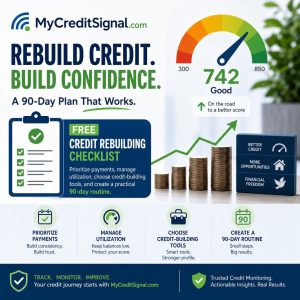
If you are overwhelmed, use this checklist in order.
- Do first: open one reporting account, set autopay, keep balances low, and mark statement and due dates.
- Do next: consider utility or phone reporting tools and monitor account activity for errors or surprise balance spikes.
- Do later: think about adding a second tradeline only after your first score appears and your budget system is steady.
- Probably skip for now: multiple new applications, premium cards with high expectations, and any product you do not fully understand.
If you want to explore more site resources, the credit mix analyzer can help you think through account variety later on, while the broader tools section is useful once you have active accounts to manage.
FAQ
What is the best first step to build credit from scratch?
For most beginners, the best first step is opening one reporting starter account, often a secured credit card, and setting full-balance autopay right away.
How long does it take to get a credit score with no history?
MyFICO says it often takes about 6 months of reported history before a usable score appears, though timelines can vary by file and scoring model.
Do utility and phone payments help build credit?
They can help in some cases through programs such as Experian Boost, but they are usually best used as support for, not a replacement for, a main credit account.
Use these resources to turn the plan into action:
- Credit score simulator to test how balances and timing may affect your profile.
- Credit mix analyzer to understand when a second type of account may add depth later.
- Credit utilization guide for a deeper look at how statement balances can influence scores.
- Credit monitoring alerts explained so you know which account changes deserve attention.
Get weekly credit tips, tool updates, and practical guides – free.
The bottom line
To build credit from scratch, you do not need a complicated stack of products. You need one reported account, six months of clean payment history, and a system that keeps balances and due dates under control. That is the foundation.
Start with the simplest account you can manage well. Then make the process boring on purpose: low usage, automatic payments, and patience. If you do that, you are not just trying to get a score to appear. You are building the habits that make the score stronger over time.


Leave a Reply
You must be logged in to post a comment.