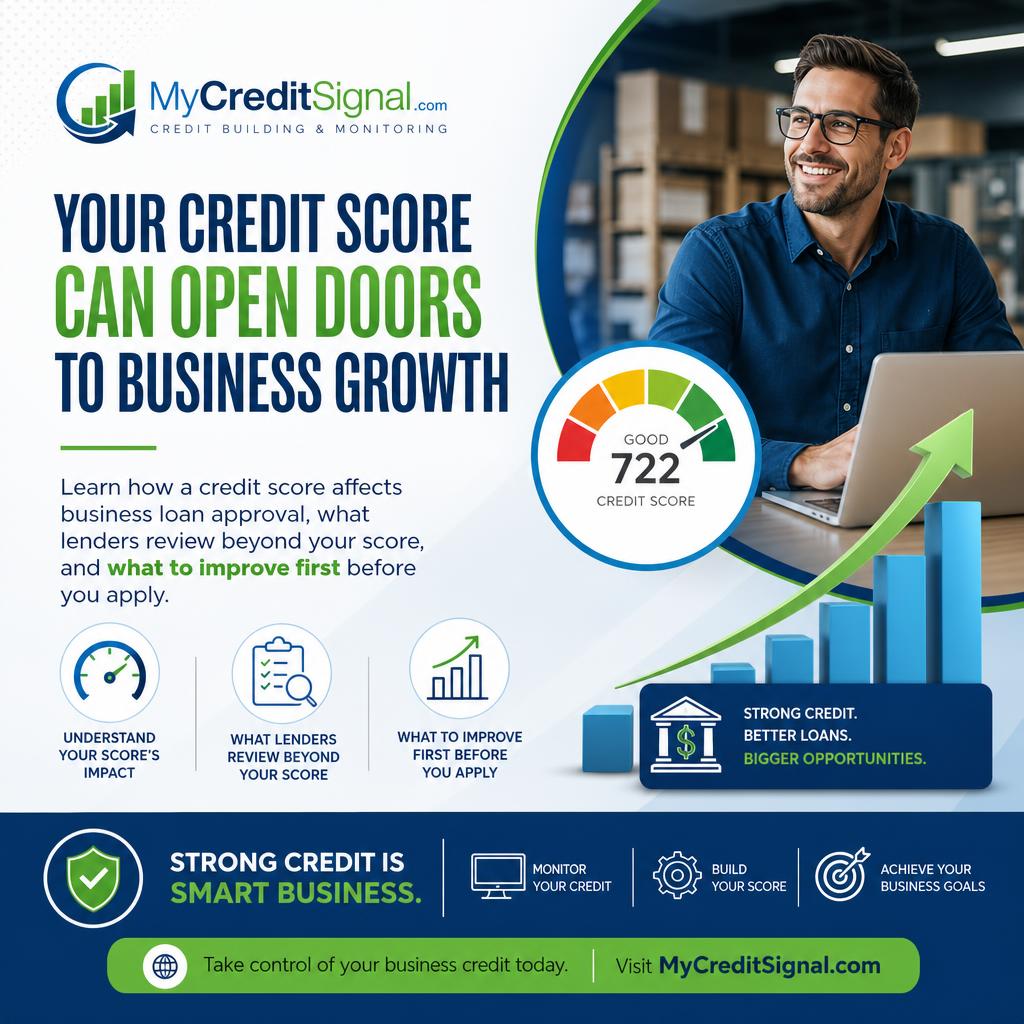
You can have a solid business idea, a real customer need, and even steady early revenue, then still get stuck at the financing step because the lender sees more risk than you expected. That is where the phrase credit score business loan becomes very real. If you are trying to start a business, buy equipment, open a location, or smooth out cash flow, your personal credit score can matter, but it is rarely the only thing that matters.
This guide is for founders, side-hustlers moving into a formal business, and owners applying for funding in the next few months. You will learn how lenders actually use personal and business credit, what numbers matter most, where newer SBA changes may shift the process, and what to improve first so you do not waste time applying too early.
Contents
- 1 Who should pay close attention to this
- 2 Why lenders do not treat your personal score as the whole story
- 3 Personal credit versus business credit in a startup loan decision
- 4 The numbers and thresholds that matter most
- 5 A simple framework to decide what to fix first
- 6 What to do this week before you apply
- 6.1 Check where your personal score stands right now
- 6.2 Separate business and personal cash flow immediately
- 6.3 Strengthen vendor and supplier payment habits
- 6.4 Build a repayment case, not just a loan request
- 6.5 Review your monthly debt load on both sides
- 6.6 Choose lenders based on fit, not just speed
- 6.7 Delay the application if your file is improving fast
- 7 Mistakes that make approval harder
- 8 What many articles miss about the 2026 SBA change
- 9 When this advice may not apply
- 10 FAQ
- 11 Helpful tools and related resources
- 12 The bottom line
Key Takeaway
Your credit score can influence business loan approval, but lenders usually weigh it alongside cash flow, repayment history, revenue stability, and your business credit file, so the smartest move is to strengthen the full application, not just chase one score.
Who should pay close attention to this
This article matters most if you are in one of these groups:
- You are starting a business and expect to use a bank loan, credit union loan, SBA-backed financing, or vendor credit.
- Your business is under 18 months old and you do not yet have much business credit history.
- You have decent income or revenue but worry that your personal credit score is holding you back.
- You plan to apply for less than $350,000 through an SBA 7(a) Small Loan channel and want to understand how changing underwriting rules could affect you.
- You want to separate business and personal borrowing decisions before taking on debt.
This may be less relevant if you are fully self-funding, raising only equity capital, or operating a cash business with no intention of borrowing. It is also not the right playbook if your immediate need is fixing severe personal debt strain before you can safely take on business obligations. In that case, work on your personal profile and monthly cash flow first.
If your personal score needs work, a tool like the credit score simulator can help you estimate which actions may matter most before you submit applications.
Why lenders do not treat your personal score as the whole story
Many borrowers assume business financing works like a personal credit card application: you apply, a score is pulled, and you get an instant yes or no. Small-business underwriting is usually more layered than that.
According to the FDIC Small Business Lending Survey, lenders commonly use a mix of business credit data, cash flow, and repayment history rather than relying only on a personal credit score. That means a 700-plus personal score may help, but it does not automatically outweigh weak revenue, uneven deposits, or a business with little operating history.
Business credit data also has its own lane. Experian notes that a business credit score such as Intelliscore Plus is designed to assess the likelihood that a company will pay on time. Business scores are built to reflect factors such as trade behavior, supplier payments, and cash-flow-related patterns more than consumer models do.
Here is the practical takeaway: lenders are usually trying to answer three questions at once.
- Can you repay? They look at cash flow, revenue stability, and debt burden.
- Will you repay? They review personal and business credit behavior.
- What happens if the business hits a rough patch? They consider industry risk, time in business, and sometimes collateral or owner support.
That is why someone with a modest personal score but strong business deposits may still have a path, while someone with excellent personal credit but weak business numbers may still get denied.
For readers already focused on improving core score factors, My Credit Signal also has a related guide on how cosigning affects your credit risk. That matters because personal obligations you take on outside the business can still influence how lenders see your repayment capacity.
Personal credit versus business credit in a startup loan decision
When you are new, lenders often rely more heavily on your personal credit because the business has not generated enough history yet. Experian materials indicate that under 18 months of data, business credit scores may be less predictive for startups or very new firms. In plain English, a thin business file does not tell the lender enough, so your personal track record becomes more important.
Once your business has more established payment behavior, lenders may review a separate business report from agencies such as Experian, Equifax, or TransUnion, and in some cases trade-based scores such as PAYDEX. These reports can support your application, especially if they show on-time payments and stable vendor relationships.
A simple comparison helps:
- Personal credit score: Reflects your consumer borrowing behavior. For a founder, it can influence approval, pricing, guarantee terms, or whether the lender wants more documentation.
- Business credit score: Reflects how the business handles obligations with vendors, suppliers, and other business accounts. It can strengthen the file and show that the company is becoming independently creditworthy.
- Cash flow and revenue stability: Often the deciding layer because they show whether loan payments fit the business reality.
This is one reason a business owner should not stop at score chasing. If your business checking account is volatile, receivables are late, or expenses spike unpredictably, underwriting can still get tighter even if your credit score improves.
The numbers and thresholds that matter most
There is no one universal cutoff that guarantees a yes. Different banks, credit unions, online lenders, and SBA partners set their own standards. Still, a few numbers from current research help frame the conversation.
The FDIC survey context notes that a personal FICO score around 700 is often cited by banks as favorable for traditional small-business lending. That does not mean 699 is a denial or 701 is approval. It means the closer you are to or above that level, the less likely your score is to be the first problem in a conventional application.
On the business side, Experian states that Intelliscore Plus scores range up to 750, with higher scores indicating lower predicted risk of payment delinquency. Again, the exact lender interpretation can vary.
There is also a major process threshold to know if you are considering SBA financing. Guidance summarized by NAGGL notes that for 7(a) Small Loans under $350,000, the SBA began shifting away from mandatory SBSS use in early 2026, moving toward lender-led analysis under SOP 50 10 8. You can review that change here: SBA SBSS sunset guidance.
What does that mean for you? A few things:
- A single automated score may carry less weight in some small SBA loan decisions than it did before.
- Lenders may put more emphasis on their own internal credit analysis.
- Borrowers with stronger cash flow but weaker personal credit may have more room to explain their file.
Results can vary by lender, credit profile, loan size, and scoring model. That is especially true if your business is new or operates in an industry lenders see as cyclical or higher risk.
A quick working example
Say you want to borrow $120,000 to launch or expand a service business. You have a personal score near 700, but only 10 months in business. Your business file is thin, so the lender may lean harder on your personal score, bank statements, and deposit history. If the business shows stable monthly inflows and controlled fixed expenses, that could help offset the limited age of the business.
Now change only one variable: same score, same business age, but revenue swings sharply month to month and owner draws are inconsistent. The file now looks riskier because the repayment path is less clear. Same score, different underwriting outcome.
If you are comparing payment options before applying, the loan comparison calculator can help you test how different loan structures may affect monthly affordability.
A simple framework to decide what to fix first
Before you apply, sort your file into three buckets: score, story, and statements.
- Score: Is your personal score high enough that it will not dominate the conversation? If not, start there.
- Story: Can you explain what the loan is for, how it produces revenue, and why now is the right time?
- Statements: Do your business bank activity, revenue pattern, and existing obligations support repayment?
If two of those three are weak, do not rush the application. If one is weak and two are solid, you may still have a workable file depending on the lender and loan type.
What to do this week before you apply
Check where your personal score stands right now
If your score is far below a level lenders often view favorably, that is useful information, not bad news. It tells you whether to pause and improve your profile first. Review your balances, recent payments, and any personal obligations that could make you look stretched. If you are not sure which move helps most, use the credit score simulator to test likely impact before applying.
Separate business and personal cash flow immediately
Open and consistently use a dedicated business account if you have not already. Lenders want to see the business as a real operating entity, not a side account mixed with household spending. Clean account separation also makes it easier to show revenue consistency and expense control.
Strengthen vendor and supplier payment habits
If you use trade accounts, pay them on time and keep records organized. Business credit models are built to capture business payment behavior. Even if your file is still thin, building a positive pattern now can support future financing needs. Experian explains that business-focused models are designed around company payment behavior and cash-flow-related activity, not just consumer-style borrowing patterns.
Build a repayment case, not just a loan request
Write down the loan amount, the exact use of funds, and how the business will make the payment each month. Be specific. A lender is more comfortable with “this equipment increases output and supports signed demand” than with “I want working capital just in case.” The clearer your use of funds, the easier it is for underwriting to see the path to repayment.
Review your monthly debt load on both sides
Lenders often consider repayment history and debt burden alongside credit. List your personal monthly obligations and business fixed costs. If one payment reduction or one paid-off balance would materially improve your monthly margin, do that before applying. If you need help understanding how revolving balances can affect your score, this My Credit Signal guide on using a credit utilization calculator is a smart next read.
Choose lenders based on fit, not just speed
Traditional banks may emphasize stronger documentation and stability. Some lenders are more comfortable with newer businesses if cash flow is clear. SBA-participating lenders may also interpret current guidance differently within their internal underwriting process. Ask what they weigh most: personal score, time in business, business deposits, or industry performance.
Delay the application if your file is improving fast
If one or two targeted actions in the next 30 to 60 days could materially strengthen your profile, waiting may be worth it. For example, lowering revolving balances, cleaning up account separation, or stacking a few more months of steady business deposits can change the conversation meaningfully.
Mistakes that make approval harder
Applying with no clear use of funds
Behavior: Asking for a broad amount without connecting it to revenue or operations. Consequence: The lender sees uncertainty and may question whether the debt fits the business. Fix: Tie the request to inventory, equipment, expansion, or working capital needs with a simple repayment explanation.
Assuming a strong personal score overrides weak business cash flow
Behavior: Focusing only on your score while ignoring unstable deposits or high fixed costs. Consequence: You may clear the credit screen but still fail underwriting. Fix: Strengthen bank statement quality, reduce unnecessary expenses, and show a more reliable payment capacity.
Waiting too long to build business credit relationships
Behavior: Running everything through personal accounts and cards for too long. Consequence: Your business stays invisible from a credit perspective, which can limit future financing options. Fix: Establish business accounts, use vendor credit responsibly where appropriate, and pay on time.
Ignoring personal obligations outside the business
Behavior: Taking on new personal debt, cosigning, or carrying high card balances right before applying. Consequence: Your repayment picture can weaken even if the business is improving. Fix: Keep your personal profile steady during the application window and avoid optional new obligations.
What many articles miss about the 2026 SBA change
A lot of coverage frames the SBSS sunset as either a huge win or a non-event. The reality is more nuanced. The change for certain 7(a) Small Loans under $350,000 does not mean credit suddenly stops mattering. It means some lenders may rely less on one automated score and more on internal analysis under SOP 50 10 8.
That could help borrowers who have a thin file or personal credit that does not fully reflect current business strength. But it can also mean lenders ask harder questions about your business operations, revenue stability, and repayment assumptions. In other words, the process may become more flexible for some applicants and more documentation-driven at the same time.
The broader lending environment also keeps evolving. FFIEC and Federal Reserve-related releases point to ongoing monitoring of underwriting criteria and lending availability across 2024 and 2025. So if you hear blanket claims like “only your score matters” or “scores no longer matter,” treat them cautiously.
When this advice may not apply
There are a few edge cases where the typical personal-score-plus-business-metrics model works differently.
- Very early startups with almost no operating history: Lenders may rely heavily on owner credit, outside income, guarantees, or a business plan because the company has not produced enough data yet.
- Asset-backed borrowing situations: Equipment, inventory, or other collateral may change the underwriting mix.
- High-growth but irregular businesses: A lender may care less about one month of strong revenue than about consistency over time.
- Owners recovering from past personal credit issues: You may still qualify with the right lender if current business performance is strong, but pricing or documentation requirements may differ.
If you are working on a broader credit reset before borrowing, My Credit Signal also has a practical article on bankruptcy credit score impact over time, which can help you understand how past credit events may continue to affect lending decisions.
FAQ
Do banks pull business and personal credit for a small business loan?
Often, yes. Many lenders review business credit reports and the owner’s personal credit, especially for newer businesses where the company file is limited.
If my business is new, does my personal credit matter more?
Usually yes. With under 18 months of business data, lenders may lean more on personal credit, cash flow, and your broader repayment profile because the business file is less predictive.
Will the SBA SBSS change make it easier to get approved?
Possibly for some borrowers, but not automatically. The shift away from mandatory SBSS use for certain small 7(a) loans may give lenders more flexibility, yet they still perform credit analysis and may scrutinize cash flow even more closely.
If you want to turn this into a practical plan, start with these resources:
- Credit score simulator to estimate which credit moves may help before a loan application.
- Loan comparison calculator to test payment scenarios and compare borrowing options.
- How to cosign a loan without wrecking your credit if outside obligations could affect your business borrowing profile.
- Credit utilization calculator guide if revolving balances are dragging your score before you apply.
Get weekly credit tips, tool updates, and practical guides – free.
The bottom line
Your credit score can affect your ability to start a business with borrowed money, but it is only one part of the lender’s decision. Most lenders want to see a complete picture: your personal credit, your business credit if available, your cash flow, your repayment history, and whether the loan purpose makes sense.
If you want the highest-impact next step, do not start by sending out applications. Start by tightening your file. Check your score, separate business finances, strengthen payment habits, and make sure the numbers support the story you are telling. Then compare loan options carefully and apply when your profile gives you the best chance of a yes on terms you can actually afford.

Leave a Reply
You must be logged in to post a comment.