
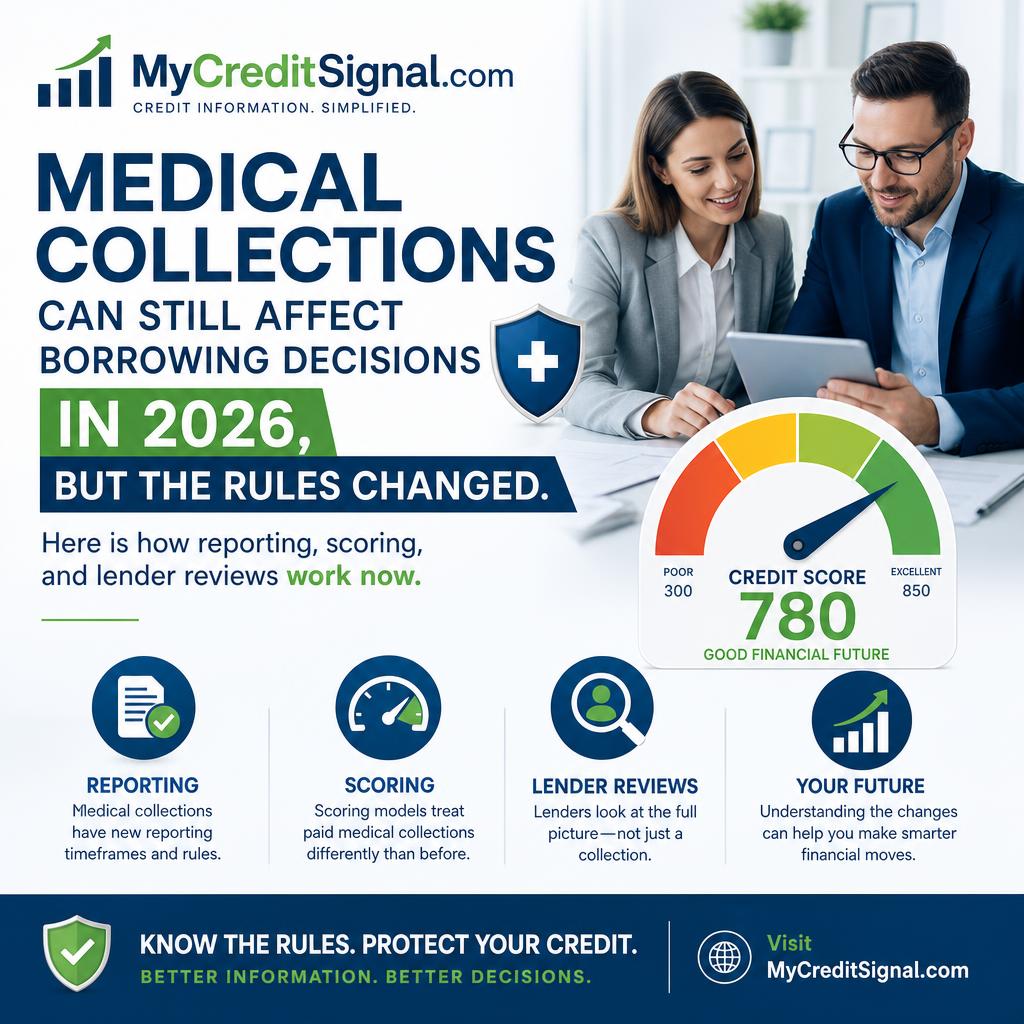
You get a preapproval offer, apply for a loan, and then wonder why the terms are worse than expected. One possible reason is an old medical collection that is still being seen somewhere in the lending process. That is exactly why people are searching for medical collections credit score rules in 2026.
This guide is for anyone with unpaid, paid, or recently settled medical bills who wants to know what still matters now. The short version is that medical collections usually carry less weight than they used to, thanks to bureau policy changes in 2023 and a broader CFPB rule finalized in 2025. But less weight does not mean no risk. Some entries may still appear during transition periods, some lenders use scoring models differently, and underwriting decisions can go beyond a single score.
By the end, you will know what changed, which thresholds matter, how to prioritize your next moves, and which free tools on My Credit Signal can help you plan the next week without guessing.
Contents
- 1 Who should care about medical collections in 2026
- 2 What changed for medical collections after 2023 and 2025
- 3 How medical collections affect your credit score now
- 4 The thresholds and timelines that matter most
- 5 What to do this week if you have medical collections
- 5.1 Check whether the medical collection is actually reporting
- 5.2 Sort the account into one of three buckets
- 5.3 Map your application timeline
- 5.4 Build a settlement or payoff plan you can actually afford
- 5.5 Target the biggest score drag first
- 5.6 Track changes for one full reporting cycle
- 5.7 Make a first-versus-later list
- 6 Mistakes that still cost people points and approvals
- 7 What many articles leave out about 2026 underwriting
- 8 When this advice does not fully apply
- 9 FAQ
- 10 Helpful tools and related resources
- 11 The bottom line on medical collections and your score
Key Takeaway
In 2026, medical collections are generally less damaging than before, but you still need to monitor your reports, understand the under $500 rule, and prepare for lender-specific underwriting differences.
Who should care about medical collections in 2026
This article is most useful if you fall into one of these groups:
- You had a hospital, urgent care, ambulance, lab, or specialist bill sent to collections.
- You paid or settled medical debt and want to know whether it still affects your score.
- You plan to apply for a mortgage, auto loan, personal loan, or credit card soon.
- You are rebuilding after collections and want to know whether medical debt should be your first priority.
- You have multiple debts and need to choose what to address this month versus what can wait.
This may be less useful if your issue is mainly about non-medical collections, heavy credit card utilization, or recent late payments. In those cases, other score factors may matter more right now. If high card balances are the bigger problem, review a practical credit utilization guide first. If recent delinquencies are pulling your score down, start with a plan to recover from late payments.
What changed for medical collections after 2023 and 2025
The biggest reason this topic feels confusing is that the rules changed in layers.
First, the three major credit bureaus announced voluntary industry changes that reduced the credit-report impact of medical collections. According to bureau updates summarized by TransUnion, Equifax, and Experian, medical collection accounts under $500 stopped being reported, and the waiting period before medical debt could appear on reports was extended.
Then the CFPB took another step. In January 2025, the agency finalized a rule restricting how medical debt information can be used by creditors and limiting what consumer reporting agencies can report about medical debt under Regulation V. The CFPB said the goal was to reduce the harmful role of medical debt in credit decisions and scoring outcomes for many consumers, as explained in its official final rule announcement.
That means the 2026 reality is not the same as the 2021 or 2022 reality. Medical collections are no longer treated as a simple one-size-fits-all negative mark. Some debts were removed from reporting entirely, some became less influential in modern scoring, and some lenders now place less emphasis on them in underwriting. But there is still variation in implementation, reporting cycles, and model use.
How medical collections affect your credit score now
Think of medical collections in 2026 as a three-layer issue: reporting, scoring, and underwriting.
Layer 1: Reporting
If a medical collection does not appear on your credit reports, it generally cannot directly affect standard credit scores generated from those reports. The 2023 bureau changes reduced reporting for smaller balances, especially under $500. That is a major practical shift.
Layer 2: Scoring
If a medical collection does appear, the impact depends on the score model. The research context shows that FICO and VantageScore do not always treat medical debt the same way, and newer models may de-emphasize it compared with older approaches. FICO has also explained that medical debt has received different treatment versus other collection debt in various score versions, as noted in its medical debt guidance.
So if one lender pulls a score model that largely discounts medical collections while another uses a model or workflow that reacts more strongly, your results can differ. That is why two applications in the same month can produce different outcomes.
Layer 3: Underwriting
A score is not the whole file. A lender may look at total debts, recent collections, reserve cash, and application risk. The 2025 CFPB rule further limits the use of medical debt information in credit decisions, but the practical impact can still vary while systems, compliance processes, and lender policies catch up. The FDIC has also indicated that banking guidance and industry practice increasingly de-emphasize medical collections, but consumers should still monitor for remaining entries during transitional periods.
A simple decision framework is this:
- If the medical debt is under $500: first check whether it is even reporting.
- If it is over $500 and unpaid: assume it may still matter somewhere in the process and review your timeline before applying.
- If it is paid or settled: the effect may be reduced, but do not assume same-day score relief.
- If your credit cards are maxed out: utilization may be hurting you more than medical collections right now.
If you want a rough before-and-after estimate, test different scenarios with the credit score simulator to see how score factors may interact.
The thresholds and timelines that matter most
You do not need dozens of numbers to understand this topic. You need the right few.
Threshold 1: $500
The most important line is $500. Major bureaus stopped reporting medical collections under that amount. If your balance was $499, that is very different from $501. When borrowers ask why one account still matters and another does not, this threshold is often the answer.
Threshold 2: 15 million consumers
The CFPB found that about 15 million Americans had at least one medical bill on their credit reports, roughly 5% to 6% of consumers, with aggregate balances exceeding $40 billion to $50 billion. That scale matters because it shows this is not a niche issue. It affected millions of households, which helps explain the regulatory push. Source: CFPB research on medical bills on credit reports.
Threshold 3: Reporting delay and update cycles
The bureaus also lengthened the time before medical debt could appear. That gives consumers more room to resolve insurance processing or billing issues before a collection is reported. But once an account is updated, the timing of removal or reclassification still depends on reporting cycles between the collector, bureau, and lender pull date. In practice, that means you should not plan a major application around an assumption that a change will show up instantly.
A realistic example
Suppose you have a 690 score, one credit card at 72% utilization, and a medical collection for $650 that was recently paid. Will the score jump fast? Maybe, maybe not. The paid medical collection may become less significant, especially under newer scoring treatment, but your high utilization could still be the larger drag. In that case, paying down a card from 72% to below 30% may help more than waiting and hoping the medical update does everything for you.
That is why the smartest move is usually not “medical debt first no matter what.” It is “medical debt plus the biggest score lever.”
What to do this week if you have medical collections
Here is a practical sequence that keeps you from wasting time on the wrong task.
Check whether the medical collection is actually reporting
Do not assume. The under $500 policy and later rule changes mean some balances that once would have shown up may no longer appear. Start by reviewing your current reports and any lender adverse-action notices you recently received.
Sort the account into one of three buckets
Bucket A is under $500. Bucket B is over $500 and unpaid. Bucket C is paid or settled. This simple sorting tells you what deserves immediate attention. Bucket B deserves the most urgency if a loan application is coming soon.
Map your application timeline
If you need credit in the next 30 to 90 days, focus on what can visibly improve your file fastest. That may include lowering card balances, avoiding new late payments, and confirming any recent medical debt updates have posted. If you are not applying soon, you have more room to prioritize cash flow and avoid squeezing your budget too hard.
Build a settlement or payoff plan you can actually afford
A medical collection should not push you into missing rent or card minimums. Use the collection settlement budget planner to compare payment options against your monthly cash flow. A plan you can sustain beats a one-month scramble that creates new delinquencies.
Target the biggest score drag first
If your cards are near their limits, utilization may outweigh the collection in the short term. If you also have fresh late payments, address those behaviors immediately. Medical collections matter, but they are now one part of a broader score picture.
Track changes for one full reporting cycle
After payment, settlement, or a bureau update, give the system time to reflect the change. Use your credit monitoring routine to watch for status changes instead of guessing based on one lender result.
Make a first-versus-later list
First: stop new late payments, bring utilization down, confirm whether the medical collection is reporting, and decide whether you need a lender application soon. Later: optimize small score gains, compare score versions, and refine longer-term credit-building habits.
If you are already in rebuild mode after other collections, this guide on how to rebuild credit after collections can help you decide what belongs in your 30-day versus 90-day plan.
Mistakes that still cost people points and approvals
Assuming all medical debt disappeared automatically
Behavior: You hear about new rules and stop checking your reports. Consequence: An over-$500 account or transitional entry may still be considered somewhere in the application process. Fix: Verify what is on your file before applying, especially for larger loans.
Paying a collection and expecting instant score recovery
Behavior: You pay today and apply for credit tomorrow. Consequence: Reporting cycles may not have updated yet, and the lender may see older data. Fix: Allow time for updates to post and focus on other quick wins like utilization reduction while you wait.
Ignoring bigger score factors
Behavior: You fixate on one medical collection while carrying very high card balances or adding new late payments. Consequence: Your overall score may stay weak even after the medical issue improves. Fix: Prioritize the factor causing the largest current damage, then circle back.
Overcommitting cash to one debt
Behavior: You drain your checking account to deal with a medical collection. Consequence: You may miss other bills and create fresh negatives. Fix: Set a payment plan that protects essentials and minimums first.
What many articles leave out about 2026 underwriting
Most quick explainers stop at “medical debt matters less now.” That is true, but incomplete.
What they miss is that less important is not the same as irrelevant. Underwriting can still involve document review, internal risk models, or manual overlays. A lender may care more about your total pattern than about a single medical entry. Someone with one old paid medical collection and low utilization may look much stronger than someone with no collections but several recent 30-day late payments.
Another detail many articles skip is model variation. A score from one source may not match the score your lender uses. Research context specifically notes differences between FICO and VantageScore treatment of medical debt. So do not build your plan around one score screenshot.
And if you already paid the medical debt, the next question is not just “is it gone?” It is “what else on my file is still suppressing my score?” For more on the after-payoff side, read Medical Debt Credit Impact After Payoff.
When this advice does not fully apply
There are a few cases where you need a slightly different lens.
- You are not borrowing soon: You may be better off protecting cash flow and avoiding new negatives rather than rushing to optimize every point this month.
- Your main issue is recent late payments: Those may matter more than a reduced-impact medical collection.
- Your account is below $500: The immediate question is whether it appears at all, not how heavily it is scored.
- Your lender uses stricter internal review: Even with less medical debt emphasis, approval terms can still vary.
Consumer protections also matter here. The CFPB and FTC note that medical debt collection rights and reporting rules interact with federal laws such as the FCRA and FDCPA, and patient protections under related federal guidance remain important. A good plain-language starting point is the CFPB consumer guidance on medical debt collection and credit reporting.
FAQ
Does medical debt under $500 affect my credit score in 2026?
Usually, medical collections under $500 are not reported by the major bureaus because of the 2023 industry changes. If it is not on your report, it generally cannot directly affect standard report-based scores.
Will paying medical collections raise my score right away?
Not always. Paid or settled medical debt may become less harmful, but reporting updates take time and your score may still be limited by card balances, late payments, or the scoring model used.
Do lenders still care about medical collections after the 2025 CFPB rule?
Many lenders and models place less emphasis on medical debt now, but underwriting still varies. That is why you should check your reports and strengthen the rest of your credit profile before applying.
- Credit score simulator to test how different credit moves may affect your profile.
- Collection settlement budget planner to fit a medical debt payment strategy into your real monthly cash flow.
- How to rebuild credit after collections for a broader recovery plan beyond one account.
- Medical Debt Credit Impact After Payoff for what happens after you pay or settle.
Get weekly credit tips, tool updates, and practical guides – free.
The bottom line on medical collections and your score
In 2026, medical collections are no longer the automatic credit landmine they once were. The $500 reporting threshold change, the broader CFPB rule finalized in 2025, and scoring model differences all mean many consumers will see less damage than they would have a few years ago. But the safe move is still to verify what is on your reports, understand your application timeline, and focus on the factor hurting you most right now.
If you only do three things this week, do these: confirm whether the collection is reporting, lower any very high card utilization, and use a tool to map the cost of payoff or settlement before you commit cash. That combination gives you a more accurate picture and a better chance at improving both your score and your approval odds.



Leave a Reply
You must be logged in to post a comment.