
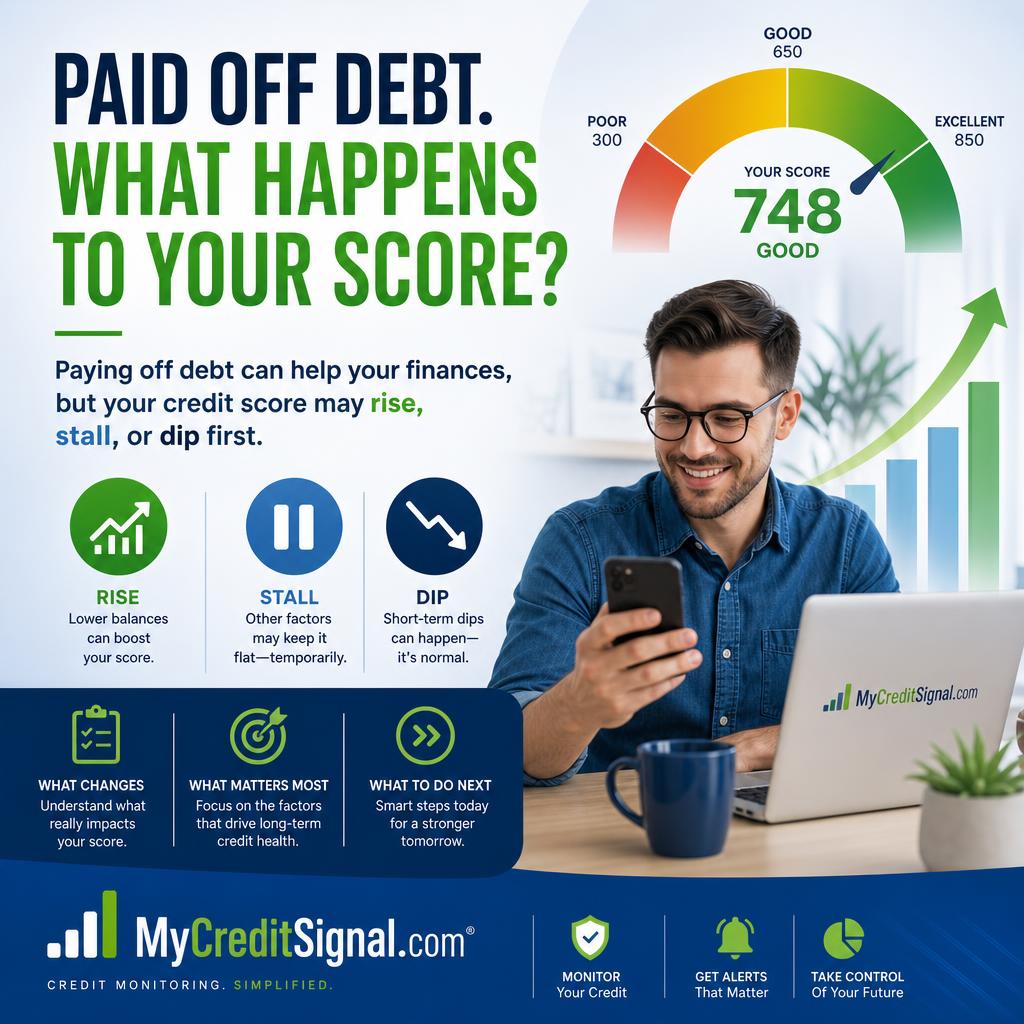
You finally clear the last balance. No credit card debt, no auto loan, no personal loan payment hanging over next month. Then you check your score and it does not jump the way you expected. In some cases, it barely moves. In others, it drops for a while. That confuses a lot of people.
If you are wondering what happens to your credit when you pay off all debt, this guide is for you. You will see why the score reaction can be mixed, which score factors matter most, what numbers to watch, and how to protect your credit while still moving toward a debt-free life.
Contents
- 1 Who should care about this question
- 2 Why paying off all debt does not always boost your score right away
- 3 The score mechanics that matter most after a payoff
- 4 The numbers and thresholds worth watching
- 5 A simple decision framework before you pay the final balances
- 6 Your step-by-step plan for paying off debt without hurting your score more than necessary
- 6.1 List every account by type and current status
- 6.2 Calculate your utilization before you send extra payments
- 6.3 Target the balances that improve both money and score
- 6.4 Do not auto-close paid credit cards unless there is a strong reason
- 6.5 Time your payoff around major applications
- 6.6 Protect the habit that matters most after payoff
- 6.7 Reassign the old payment amount on purpose
- 7 Mistakes to avoid after you become debt-free
- 8 What most articles miss and when this advice changes
- 9 FAQ
- 10 Helpful tools and related resources
- 11 Final takeaway
Key Takeaway
Paying off debt is usually great for your finances, but your credit score can rise, stay flat, or dip temporarily depending on payment history, utilization, account mix, and the scoring model used.
Who should care about this question
This matters most if you are about to pay off a large balance and have a major application coming up soon, such as a mortgage, car loan, refinance, or new credit card. It also matters if most of your score improvement strategy has been built around paying balances down and you expect an instant reward.
This article is especially useful for:
- People paying off their last credit card balance
- Borrowers finishing an auto loan, student loan, or personal loan
- Anyone deciding whether to close paid-off accounts
- Home buyers trying to improve both score and debt-to-income before applying
It may be less useful if your main issue is missed payments rather than balances. The Consumer Financial Protection Bureau says paying bills on time remains the single most important factor in a credit score, and that lines up with myFICO’s breakdown showing about 35% of a FICO score comes from payment history and about 30% from amounts owed. If late payments are your problem, start there first. For a deeper look at timing damage, read this late payments credit score timeline guide.
If your debt is already in settlement status, your recovery path can look different than a standard payoff plan. In that case, this recovery guide after settlement is a better fit.
Why paying off all debt does not always boost your score right away
Credit scores do not reward the emotional milestone of becoming debt-free. They measure risk using data points on your report. That means the score reacts to how your accounts now look, not how proud you feel about paying them off.
Here is the simple version:
- Paying on time helps most. That is the biggest driver over time.
- Lower balances can help a lot. This mainly shows up through lower credit utilization on revolving accounts like credit cards.
- Paying off installment loans can be neutral or mixed. Once a loan is paid off, the account may eventually no longer help your active credit mix the same way.
- Closing a paid card can backfire. If it reduces your total available credit, your utilization can rise even if you owe less.
Experian notes that paying off debt does not guarantee an immediate score increase and can even cause a brief dip in some cases. That often surprises people who assume every payoff automatically equals a better score. The Federal Trade Commission also emphasizes that paying off debt should be viewed through long-term financial health, not just short-term score swings.
If your focus is mainly on card balances, review warning signs of a utilization spike and compare your scenario with the credit use thresholds that tend to matter most.
The score mechanics that matter most after a payoff
Think of payoff impact in two buckets: revolving debt and installment debt.
Revolving debt such as credit cards
This is where score movement is often fastest. Credit utilization is the percentage of your available credit you are using. If you have a total credit limit of $10,000 and balances of $2,500, your utilization is 25%.
Formula: total balances divided by total credit limits = utilization
Using the example above: $2,500 divided by $10,000 = 25%
Lower utilization generally helps. Huntington says the 30% level is a practical guideline, while the highest-scoring borrowers often keep utilization in the single digits, roughly 0% to 9%.
That means paying a card from 68% utilization down to 8% can have a very different impact than paying a small installment loan to zero.
Installment debt such as auto, student, and personal loans
With installment debt, you are not dealing with revolving utilization the same way. You may still benefit from lower debt obligations and improved cash flow, but the score result can be smaller or slower. In some cases, paying off your only active installment loan changes your credit mix and may cause a temporary drop.
That does not mean paying off the loan was a mistake. It means the score is reacting to a changed profile.
Closed versus open accounts
A paid-off credit card that stays open can preserve your available credit. A paid-off credit card that you close can shrink your total limit and make your remaining balances look larger by percentage. Experian’s credit education materials specifically warn that fully paying off and closing accounts can reduce total available credit and potentially lower a score temporarily.
The numbers and thresholds worth watching
If you want to predict what may happen next, focus on these four checkpoints.
1. Payment history still outranks everything else
If you made every payment on time while paying debt down, you likely built the most important score factor. If you missed payments during payoff, the balance reduction may not outweigh that damage in the short run. According to myFICO, payment history carries about 35% of the score, more than any other category.
2. Utilization can change your score faster than most people expect
The practical benchmarks many lenders talk about are simple:
- Above 30% can start to look riskier
- Below 30% is a common target
- Single digits, around 0% to 9%, are often strongest for top-tier profiles
Example: suppose you have two cards.
- Card A limit: $6,000 with a $3,000 balance
- Card B limit: $4,000 with a $1,000 balance
Total limit is $10,000. Total balance is $4,000. Your utilization is 40%.
If you pay off $3,500 and leave $500 total, utilization falls to 5%. That can be positive for your score once updated.
But if you then close Card B, your total limit drops to $6,000. If the $500 remains on Card A, utilization becomes about 8.3%, still fine. If instead you had left a $1,500 balance, utilization would jump to 25% after closure. Same debt, different score picture.
Use the credit score simulator to model how balance reductions and card closures can affect your profile before you make the move.
3. Reporting timing matters
A payoff is not always reflected instantly. Experian notes some payoff-related changes can take 1 to 2 months to show up on credit reports, depending on the account and reporting cycle. If you pay off a balance today and apply for a loan next week, the lender may still see the old numbers.
4. Mortgage approval is not score-only
If you are paying off debt because a mortgage application is near, remember that the FTC says lenders may also consider your down payment, income, and debt-to-income. Paying debt off can help your monthly cash flow and DTI even if your score only moves a little. That is why score strategy and borrowing strategy are not always the same thing. For a side-by-side look, read DTI vs credit score and what matters more.
A simple decision framework before you pay the final balances
Use this quick framework:
Pay first now if the debt has a high interest rate, the balance is hurting utilization, or the payment is straining your cash flow.
Pause and plan first if closing the account may shrink your available credit, if you have a mortgage application within the next few weeks, or if the account is your only active revolving line.
Keep the account open after payoff if it is a no-annual-fee credit card and you can manage it responsibly.
Care less about short-term score movement if paying off the debt improves your monthly budget, lowers stress, and reduces the chance of missed payments going forward.
Your step-by-step plan for paying off debt without hurting your score more than necessary
List every account by type and current status
Make one page with each debt, whether it is revolving or installment, the current balance, the credit limit if applicable, the interest rate, and whether the account will stay open after payoff. This takes the guesswork out of the process and shows which payoff actions change utilization versus which mainly change cash flow.
Calculate your utilization before you send extra payments
Add all credit card balances and divide by all credit card limits. Do this again card by card, because both overall and individual card utilization can matter. If you are above 30%, paying cards down may help more quickly than paying off an installment loan first.
Target the balances that improve both money and score
If two debts cost similar interest, prioritize the one that drops utilization the most. For example, paying a maxed-out card from 90% to 20% may do more for your score than paying a small fixed loan to zero. If you need help staying consistent, use the debt payoff milestone tracker to map your next payoff checkpoints.
Do not auto-close paid credit cards unless there is a strong reason
If a card has no annual fee and you can avoid overspending, keeping it open can protect your available credit. A tiny recurring charge and automatic full payment can keep the account active without creating debt. If the card has a costly annual fee or tempts you to overspend, the decision may be different.
Time your payoff around major applications
If you plan to apply for a mortgage or auto loan soon, pay balances early enough for the lower amounts to report. Since some changes can take 1 to 2 months to appear, waiting until the last minute may not help the way you expect.
Protect the habit that matters most after payoff
Once the balances are gone, set every remaining account to autopay at least the minimum due. Paying off debt helps, but the next score gains usually come from clean payment history month after month. According to the CFPB, on-time payments remain the biggest factor.
Reassign the old payment amount on purpose
If you used to pay $350 per month toward debt, decide now where that $350 goes next. Split it between emergency savings, sinking funds, and one small recurring charge paid in full on an open card. This helps you avoid running balances back up and protects the credit progress you just made.
Mistakes to avoid after you become debt-free
Closing every paid card at once
Behavior: You pay cards off and immediately shut them all down. Consequence: Your total available credit can collapse, which may raise utilization on any remaining balances and trigger a temporary score drop. Fix: Keep no-fee cards open if you can manage them responsibly, especially older accounts that support your overall profile.
Expecting instant score gains from loan payoff alone
Behavior: You pay off an installment loan and expect a sharp jump the same week. Consequence: You may be disappointed or make unnecessary changes because the score does not move right away. Fix: Give reporting time to update and judge the result together with your lower monthly obligations, not by score alone.
Ignoring statement dates while paying down cards
Behavior: You make a big payment after the statement cuts and assume the lower balance will be reported immediately. Consequence: The credit bureaus may still receive the higher statement balance, delaying any utilization benefit. Fix: Know your statement closing dates and try to lower balances before the issuer reports.
Using the freed-up cash flow to rebuild balances
Behavior: Once debt is gone, spending expands to fill the gap. Consequence: Utilization climbs again and your financial flexibility disappears. Fix: Decide in advance where each former debt-payment dollar will go so your progress sticks.
What most articles miss and when this advice changes
Most articles stop at yes, paying off debt is good. That is true financially, but the scoring side needs more nuance.
Another missing piece is this: being debt-free is not automatically the same as being score-optimized. A person with zero balances and one closed card can have a different score profile than a person with zero balances, three open cards, years of on-time history, and single-digit utilization reporting regularly. The right goal depends on whether you are optimizing for peace of mind, borrowing power, or both.
If your goal is top-tier credit maintenance after payoff, this guide to maintaining an 800 credit score gives a useful benchmark for what strong ongoing habits look like.
FAQ
Does paying off a credit card always raise my score?
No. It often helps if it lowers utilization, but the result can vary by profile, statement timing, and whether the account stays open.
Why did my score drop after I paid off a loan?
A paid-off installment loan can change your active account mix, and some scoring models may react with a small temporary dip even though your finances improved.
How long does it take for payoff to show on my credit report?
It depends on the lender and billing cycle, but some changes may take 1 to 2 months to appear, according to Experian guidance.
If you want to turn this into an action plan, start with these resources:
- Credit score simulator to estimate how lower balances or account changes may affect your profile
- Debt payoff milestone tracker to organize the order and timing of your final payments
- Utilization spike warning signs if card balances are the biggest threat to your score
- DTI vs credit score if you are preparing for a major loan application
- CFPB credit score guide, myFICO score factors, and FTC credit score overview for authoritative background on score factors and lending decisions
Get weekly credit tips, tool updates, and practical guides – free.
Final takeaway
Paying off all debt is usually a strong financial move, but your credit score may not celebrate in a straight line. The biggest wins often come from preserving on-time payments, lowering utilization, avoiding unnecessary account closures, and giving updates time to report.
If you are about to make your final payoff, do one thing first: calculate how the move changes your utilization and whether any card should stay open. That small step can help you become debt-free without giving away avoidable score points.



Leave a Reply
You must be logged in to post a comment.