
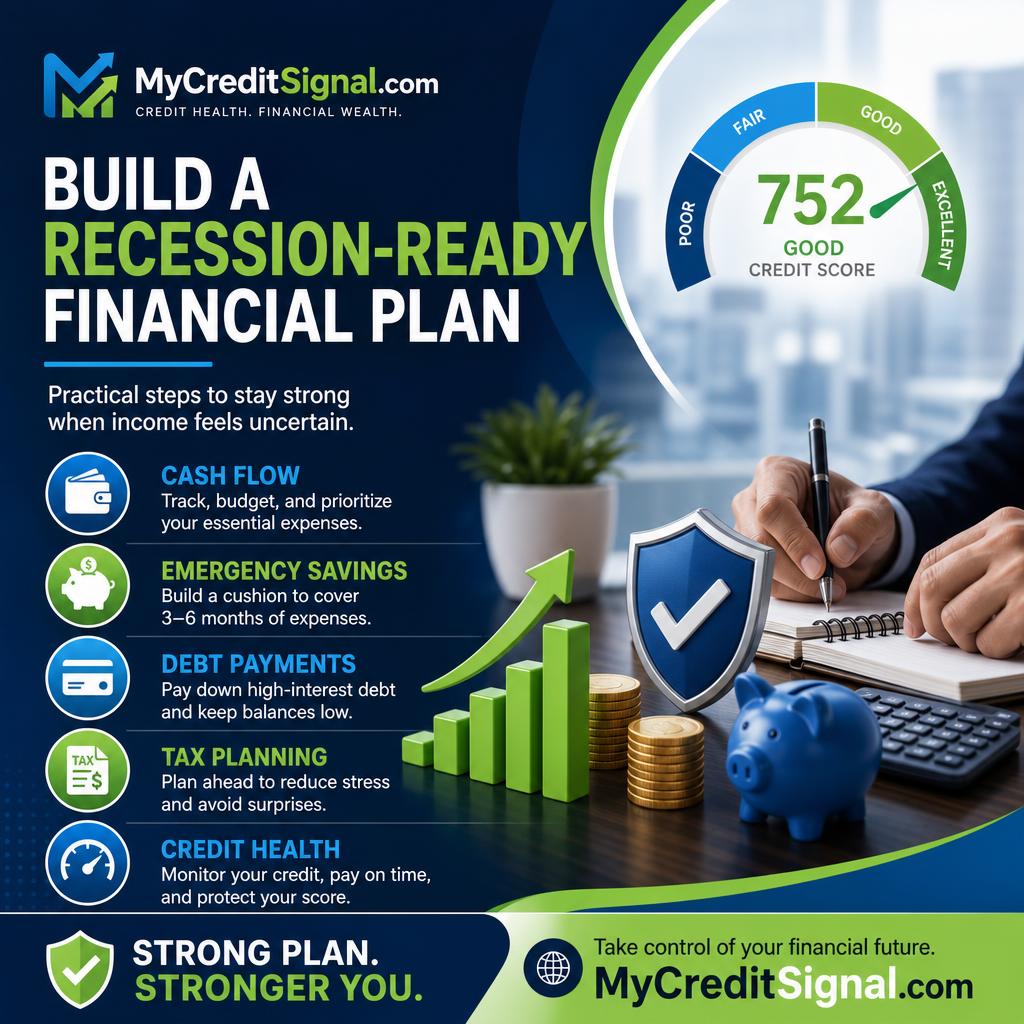
If your income dropped next month, would you know which bills to protect first? Recession-proof finances in 2026 do not require predicting the economy; they require building enough flexibility to handle an income interruption, a large bill, or higher borrowing costs without missing essential payments. This preparedness guide is for households that want a practical order of operations for cash flow, savings, debt, taxes, and credit health.
The goal is simple: identify essential expenses, create accessible reserves, reduce avoidable financial pressure, and keep your credit accounts current. You can start with a one-week plan even if a full emergency fund is not yet possible.
Contents
- 1 Who needs a recession-ready money plan?
- 2 What does recession-proofing your finances actually mean?
- 3 How large should your emergency fund be?
- 4 Which bills and debts should come first?
- 5 How can new credit score models affect your 2026 plan?
- 6 What should you do first, and what can wait?
- 7 Your seven-day recession preparedness plan
- 8 Mistakes that can weaken financial resilience
- 9 What can this advice miss?
- 10 Frequently asked questions
- 11 Helpful tools and next steps
- 12 Build resilience one decision at a time
Key Takeaway
Protect cash flow first, build an emergency reserve steadily, and treat on-time debt payments as a priority while your income is uncertain.
Who needs a recession-ready money plan?
A recession-ready plan is especially useful if your income depends on commissions, tips, overtime, one employer, seasonal work, or a small business. It also helps renters facing a lease renewal, homeowners carrying variable costs, and anyone with limited savings or several required debt payments.
You may need a different emphasis if your income is highly stable and your cash reserves are already strong. In that case, the priority may be reviewing insurance, tax withholding, investment risk, or estate documents rather than aggressively cutting everyday spending. A plan should reflect your actual risks, not a generic checklist.
What does recession-proofing your finances actually mean?
Recession-proofing means increasing your ability to keep paying essential expenses during an income or market shock. It is not a promise that your job, investments, or credit score will be unaffected. It is a framework for making fewer rushed decisions when conditions change.
Use four layers:
- Cash flow: Know the minimum amount required to keep housing, utilities, food, transportation, insurance, and debt payments current.
- Liquidity: Keep emergency money accessible rather than placing every dollar in an account that is difficult or costly to access.
- Debt control: Avoid adding expensive balances while preserving required payments and protecting your credit profile.
- Income and tax resilience: Keep records current, understand workplace benefits, and respond early if a tax bill or income change creates stress.
The Federal Reserve’s household well-being research and its 2026 Financial Stability Report both underscore why resilience planning matters: financial vulnerability varies widely across households, income levels, and demographic groups. A useful plan therefore starts with your own essential expenses and risks.
How large should your emergency fund be?
Financial guidance commonly points to an emergency fund covering 3–6 months of essential living costs. “Essential” means the expenses you would protect during a disruption, not every purchase in a normal month.
For example, suppose your essential monthly costs are $3,000. A 3-month reserve would be $9,000, while a 6-month reserve would be $18,000. If you currently have $1,500, do not treat the gap as a reason to give up. First establish a small accessible cushion, then direct a repeatable amount toward the larger target.
Your target should be closer to the higher end when replacing your income may take longer, your household relies on one earner, your expenses are difficult to reduce, or you have health, caregiving, or housing risks. A household with more stable income and flexible costs may choose a lower initial target, then build from there.
Use the emergency fund calculator to turn your essential monthly expenses into a specific savings target. Revisit the target after a job change, move, new dependent, or major debt payoff.
Which bills and debts should come first?
During uncertainty, pay in this order: essential living costs, minimum debt payments, insurance and required obligations, then extra debt payments and discretionary goals. This order preserves basic stability and reduces the chance that a temporary cash shortage becomes a larger credit problem.
Make a list of every required payment and its due date. Separate obligations into three groups:
- Must protect: Housing, utilities, food, transportation needed for work, insurance, and minimum payments on credit accounts and loans.
- Review quickly: Subscriptions, services, and optional commitments that can be paused or reduced.
- Delay if necessary: Extra principal payments, nonessential purchases, and goals that compete with basic liquidity.
Paying extra toward debt can reduce interest and improve your balance position, but draining your only cash reserve to do it can leave you more exposed. The right choice depends on the interest cost, your cash cushion, and the likelihood of an income interruption.
For a deeper comparison of competing priorities, review emergency savings versus debt payoff. The practical decision rule is: if missing a payment would create immediate housing, transportation, legal, or credit consequences, protect that payment before making optional extra payments.
How can new credit score models affect your 2026 plan?
A credit score model is a mathematical system lenders use to estimate credit risk. FICO 10T uses trended data with a 24-month look-back, while VantageScore 4.0 and the newer VantageScore 5.0 are part of a broader shift toward models using additional data and longer-term patterns.
That change does not mean every consumer’s score will automatically fall. The FHFA and Freddie Mac materials describe an evolving, phased housing-finance environment in which newer models and historical scores may both remain relevant in different contexts. The transition timeline for broader mortgage use remains subject to ongoing policy updates.
For consumers, the practical response is not to chase one score. Keep balances manageable, pay on time, avoid unnecessary applications, and review your finances across all revolving accounts. These habits can provide stronger signals across different scoring approaches, although results vary by credit profile, lender, and scoring model.
VantageScore reported that 85% of lenders were referencing newer tri-bureau scores in the 2026 industry discussion. A tri-bureau score uses information from Equifax, Experian, and TransUnion. That figure describes lender references, not a guarantee that every lender uses the same model for every application.
What should you do first, and what can wait?
When money is tight, sequence matters more than trying to fix everything at once. Do first the actions that prevent missed payments and reveal your minimum monthly needs. Do later the actions that optimize interest or long-term growth after your basic cash flow is stable.
- First: Calculate essential monthly expenses and list all required payment dates.
- Next: Automate or schedule minimum payments where your cash flow allows, leaving room to review the account before the due date.
- Then: Build or replenish accessible emergency savings.
- After that: Reduce optional spending and direct sustainable surplus toward high-cost debt or other priority goals.
- Finally: Review taxes, benefits, insurance, and longer-term investing once the immediate plan is working.
This sequence is not a mandate to stop every financial goal. It is a way to avoid putting a long-term optimization ahead of a short-term obligation.
Your seven-day recession preparedness plan
Complete these actions this week. Each step creates information or flexibility you can use immediately.
Measure your bare-minimum budget
Review recent transactions and write down the monthly cost of housing, utilities, food, transportation, insurance, healthcare, and required debt payments. Label each item essential, reducible, or optional. Do not use a guessed number; use your actual bills and statements.
Set a cash reserve milestone
Use the 3–6-month guideline as the long-term range, then choose a first milestone you can reach without missing bills. Put the money in an accessible savings account and name the purpose clearly so it is less likely to be spent casually.
Create a payment calendar
Record the due date, minimum payment, balance, and interest information for each debt. If paydays and due dates do not align, contact the creditor before a problem occurs to ask what payment-date options or hardship information may be available.
Cut recurring expenses with a restart rule
Pause or reduce services you can live without, but decide in advance when you will review each change. A restart rule prevents temporary cuts from becoming a source of confusion and helps you restore useful services when cash flow improves.
Check your tax withholding and records
Review whether your withholding still matches your current income and household situation. Keep income, expense, and tax records organized throughout the year. The IRS specifically emphasizes year-round withholding accuracy and recordkeeping as personal circumstances change.
Map your income alternatives
List employer benefits, available paid leave, transferable skills, professional contacts, and realistic backup income options. This is not a prediction of job loss; it is a faster response plan if your hours, clients, or role change.
For a broader view of assets, liabilities, and progress, use the net worth tracker. Net worth is not a replacement for cash flow planning, but it can show whether debt reduction and savings are moving in the right direction.
Mistakes that can weaken financial resilience
Using every dollar to pay debt
Behavior: You send all available cash to a balance and keep nothing accessible. Consequence: A car repair or income gap may force new card debt. Fix: Keep building a basic cash reserve while making required payments, then increase extra debt payments when your liquidity is more secure.
Waiting until a payment is already late
Behavior: You avoid opening statements or contacting a creditor because money is tight. Consequence: You lose time to understand options and may damage your payment history. Fix: Review bills weekly and communicate before the due date whenever possible.
Chasing score changes instead of financial stability
Behavior: You open accounts or move balances solely to pursue a particular score result. Consequence: New applications, fees, or additional debt can increase pressure. Fix: Prioritize on-time payments, manageable balances, and a cash plan; remember that lenders consider income, debt-to-income, collateral, and risk appetite in addition to score.
Ignoring taxes until filing time
Behavior: You do not adjust withholding or maintain records after income changes. Consequence: A tax bill can arrive when your cash flow is already strained. Fix: Review withholding and records throughout the year, and consult IRS guidance early if paying becomes difficult.
What can this advice miss?
No household can eliminate recession risk. A plan built around a 3–6-month reserve may be unrealistic immediately for someone facing unaffordable housing, medical costs, unstable work, or high-interest debt. In that situation, start with a smaller accessible reserve and focus on preventing the most damaging missed payment while seeking qualified help.
Some advice also changes when your income is irregular. Base your essential budget on a conservative income period rather than your strongest month. Separate tax money from spending money if you are self-employed, and keep a larger buffer for expenses that are both necessary and unpredictable.
Investment accounts may be valuable long term, but they are not identical to cash savings. Selling investments during a market decline can create losses or tax consequences. Decide which resources are genuinely accessible before counting them as emergency funds.
Read the IRS guidance on options for paying a tax bill and its advice on year-round tax planning. For broader context on evolving credit-score policies, consult the FHFA credit score policy page.
Frequently asked questions
What does a recession-proof budget look like in 2026?
A recession-ready budget separates essential costs from reducible and optional spending, protects minimum debt payments, and directs available cash toward an accessible emergency reserve. It should also include a response plan for income changes and tax obligations.
How should I adjust credit card payments during a downturn?
Keep required minimum payments current first, avoid adding unnecessary balances, and preserve enough cash for essential expenses. Make extra payments when your reserve and monthly cash flow can support them without creating a new borrowing need.
How will newer credit score models affect mortgage eligibility?
FICO 10T, VantageScore 4.0, and VantageScore 5.0 may evaluate trends and additional data differently, but mortgage eligibility also depends on income, debt-to-income, collateral, lender policy, and the applicable housing-finance transition rules. New models will not automatically lower every consumer’s score.
Helpful tools and next steps
Turn the plan into a routine instead of a one-time exercise. Start with the emergency fund calculator, then track your progress with the net worth tracker. You can also compare your savings priorities with the emergency fund budget plan and revisit the strategy as your income or required expenses change.
The free tools remain available for ongoing planning. If you want a plan tailored to your exact situation, an optional personalized Credit Signal Action Plan can provide a custom 90-day plan while supporting the free tools you use.
Get weekly credit tips, tool updates, and practical guides – free.
Build resilience one decision at a time
Recession-proof finances in 2026 start with visibility: know your essential monthly cost, payment schedule, cash reserve, and backup options. Protect the bills that keep you housed, insured, mobile, and current before optimizing everything else.
Your next step is to complete the essential-expense list today and set a realistic savings milestone. A clear plan cannot remove uncertainty, but it can give you more time, more choices, and fewer expensive decisions if your financial situation changes.



Want to understand your credit report?
Get plain-English explanations with our free AI Credit Analyzer →
Leave a Reply
You must be logged in to post a comment.