
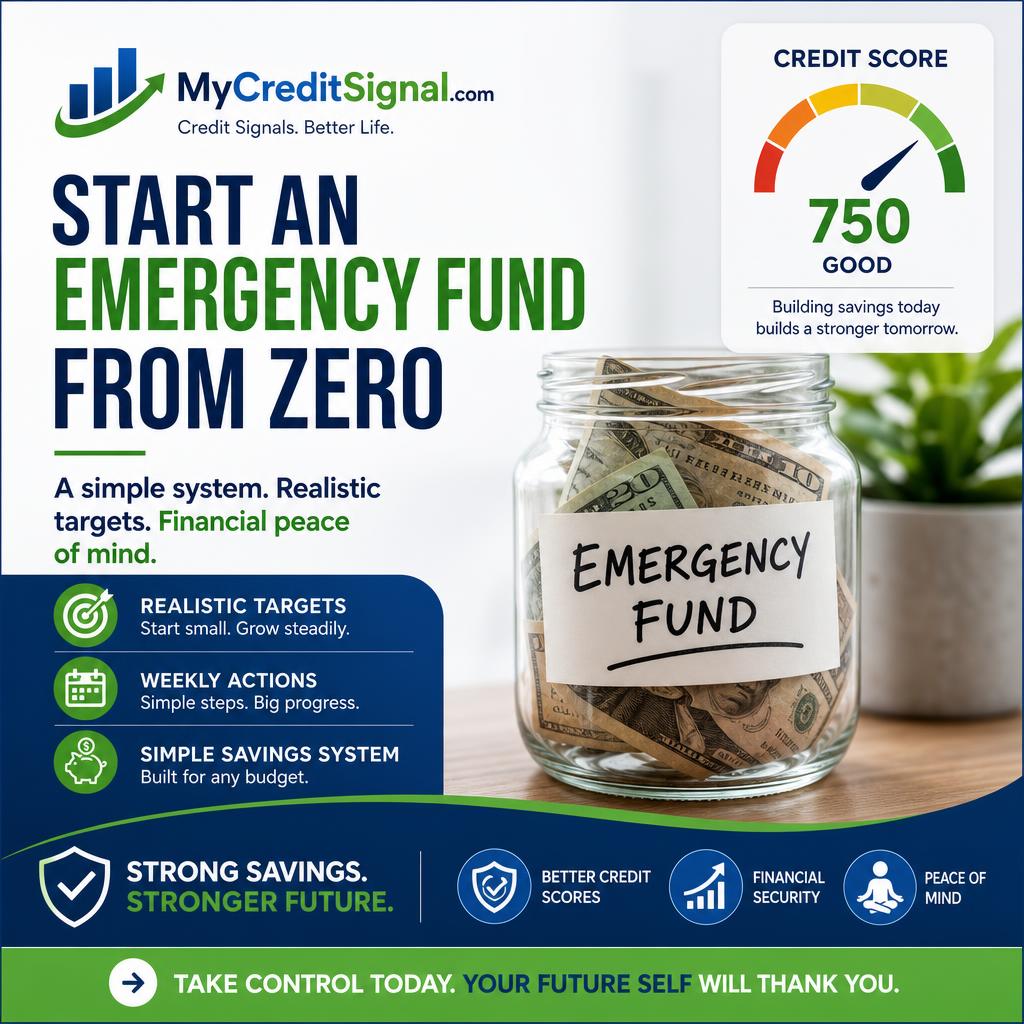
If your account balance drops close to zero between paychecks, the phrase start emergency fund can sound unrealistic. But the real problem is not that you need thousands of dollars right away. It is that one car repair, missed shift, or medical copay can force you onto a credit card or other high-interest debt when you have no cash buffer.
This guide is for people starting from zero or very close to it. You will learn what an emergency fund is, how much to aim for first, what numbers matter, and how to build one with tight cash flow. The goal is simple: get your first layer of protection in place, then grow it without making your budget collapse.
Contents
- 1 Who this is for and who may need a different plan
- 2 Why a zero balance emergency fund problem gets expensive fast
- 3 How this works in plain English
- 4 The numbers and thresholds that matter first
- 5 A step-by-step plan to build your first emergency fund
- 5.1 Open one dedicated savings account
- 5.2 Pick a starter goal you can hit in under six months
- 5.3 Set an automatic transfer on payday
- 5.4 Cut one expense for 30 days and redirect it
- 5.5 Use windfalls instead of absorbing them into spending
- 5.6 Build your weekly cash flow map
- 5.7 Track the target, not just the balance
- 5.8 Rebuild immediately after you use it
- 6 What to do first this week versus later
- 7 Mistakes to avoid when you start from zero
- 8 What most articles miss and when this advice may not apply
- 9 FAQ
- 10 Helpful tools and related resources
- 11 Conclusion
Key Takeaway
You do not need six months saved to begin; a small starter fund, kept separate and funded automatically, can reduce the odds that a normal life disruption turns into expensive debt.
Who this is for and who may need a different plan
This article is for you if any of these sound familiar:
- You have no savings or less than one paycheck in reserve.
- You keep covering surprises with credit cards.
- Your income is steady but your budget has no margin.
- Your income is irregular and some months are tight.
- You want a plan that starts small instead of pretending you can save six months overnight.
You may need a different first move if you are already behind on rent, utilities, car payments, or minimum debt payments. In that case, the immediate priority is stabilizing bills due this month and preventing essential service disruption. An emergency fund still matters, but the sequence may need to be adjusted so you can stop the bleeding first. If you need help organizing bill timing, a budget calendar that matches bills to paydays can make the first month more manageable.
Why a zero balance emergency fund problem gets expensive fast
An emergency fund is a cash reserve set aside for unplanned expenses or income disruptions. The Consumer Financial Protection Bureau explains that this kind of reserve helps reduce the need to rely on high-interest debt when life happens. The point is not to make money on the account. The point is to create breathing room.
That matters because emergencies usually arrive on bad timing, not on a convenient payday. A $250 tire replacement, $90 urgent care bill, or two days without work can stack up quickly. Without cash, you may swipe a card, carry a balance, and still feel behind next month.
Both the CFPB and the FDIC stress two basics: keep the money accessible and keep it separate from everyday spending. That combination protects you twice. It gives you liquidity when you need it, and it makes random spending less likely when you do not.
If you are trying to fit savings into a tight budget, you may also want to read how pay yourself first budgeting works in real life. The same habit that builds long-term savings also helps you get your first emergency cushion started.
How this works in plain English
Think of your emergency fund in layers.
Layer 1 is your starter buffer. This is the first amount that stops small surprises from going straight on a card. For many people, that means aiming for something in the $500 to $1,000 range first. That number is not magical. It is just large enough to absorb many common disruptions while still being realistic enough to reach.
Layer 2 is a stronger cash cushion. CFPB consumer education often frames one month of expenses as a helpful benchmark on the way to a larger goal. Hitting one month changes your stress level because you are no longer one paycheck away from chaos.
Layer 3 is your longer-term reserve. FDIC consumer materials cite the familiar guideline of six months of living expenses as a common target. Not everyone gets there quickly, and not everyone needs to chase that number at the same pace. But it is a useful long-range direction if your income is unstable, your household has one earner, or your job security feels uncertain.
The practical system is simple:
- Choose a separate savings account, ideally a traditional federally insured account for safety and liquidity as recommended by the FDIC.
- Set a starter target.
- Automate transfers, even if the amount feels small.
- Add windfalls like tax refunds, bonuses, gifts, or side income when they show up.
- Use the fund only for true emergencies, then rebuild it after use.
The numbers and thresholds that matter first
When people stall out, it is usually because the target feels too big. So use a short decision framework: first protect this month, then build a starter fund, then grow toward one month, then expand further if needed.
1. Your first target
A practical starter target is often $500 to $1,000. That is enough to create momentum and cover many common disruptions. If even $500 feels impossible, break it down further.
- $500 goal at $25 a week = 20 weeks
- $500 goal at $50 a week = 10 weeks
- $1,000 goal at $40 a week = 25 weeks
- $1,000 goal at $100 from each biweekly paycheck = 10 pay periods
You are not trying to win in one month. You are trying to stop living with a zero-cushion system.
2. One month of essential expenses
After the starter fund, the next useful threshold is one month of core living expenses. This means the bills you must cover to stay stable:
- Housing
- Utilities
- Groceries
- Transportation
- Insurance
- Minimum debt payments
- Necessary child care
If those essentials total $2,400 a month, your next milestone after $500 or $1,000 is $2,400.
3. Six months for a fuller cushion
FDIC consumer guidance explicitly cites six months of living expenses as a common goal. Using the same $2,400 monthly essentials example, a full six-month reserve would be $14,400. That may take time, and that is fine. The point is to know the direction without letting the big number keep you from starting.
4. Where to keep it
For emergency savings, FDIC guidance favors a traditional, federally insured savings account because you need safety and liquidity. In plain English, you want the money protected and easy to access without market risk. This is one area where simplicity beats chasing extra return.
A step-by-step plan to build your first emergency fund
Open one dedicated savings account
Do not mix emergency money with spending money. Open a separate savings account that is easy to transfer into but not so visible that you casually dip into it. Label it clearly, such as Emergency Only. This follows CFPB and FDIC guidance to keep it separate from everyday spending.
Pick a starter goal you can hit in under six months
For most people starting from zero, that means choosing a number between $500 and $1,000. If your budget is extremely tight, start with the first $100, then move to $250, then $500. Shorter milestones make the plan feel real and measurable.
Set an automatic transfer on payday
The CFPB specifically recommends automating transfers into a dedicated savings account because it makes saving easier. Pick a number you can keep going. Even $15 or $25 per paycheck counts. Consistency matters more than trying to impress yourself with one big transfer you cannot sustain.
Cut one expense for 30 days and redirect it
Choose a single category you can pause or trim right now: takeout, delivery fees, app subscriptions, convenience-store stops, or impulse shopping. Redirect the exact amount to savings. If you free up $20 a week, that alone becomes about $80 a month toward your buffer.
Use windfalls instead of absorbing them into spending
CFPB and FDIC materials both highlight windfalls such as tax refunds, bonuses, gifts, and irregular extra income as a fast way to jump-start savings. If you get a refund or bonus, decide the emergency fund percentage before the money lands. That prevents the cash from disappearing into random spending.
Build your weekly cash flow map
You cannot save consistently if every bill hits at once and wipes out your checking account. Use a simple paycheck plan so you know what is left after essentials. A tool like the paycheck budget allocator can help you assign each paycheck before the month gets away from you.
Track the target, not just the balance
Write down your current balance, your next milestone, and how many weeks remain at your current savings rate. If your goal is $500 and you have $120 saved with $25 a week going in, you can estimate the rest of the path. That visibility matters because progress feels slow when you only look at the account once in a while.
Rebuild immediately after you use it
An emergency fund is not ruined because you had to use it. That is the job of the fund. The key is to restart the automatic transfer right away, even if it is smaller for a month or two. Treat replenishing it like a bill to yourself.
If you want help sizing your target, the emergency fund calculator can help you estimate what your starter goal, one-month goal, and bigger reserve might look like based on your expenses.
What to do first this week versus later
Here is the simplest order of operations.
Do this first, this week
- Open or designate a separate emergency savings account.
- Choose your first target: $100, $250, $500, or $1,000.
- Set one automatic transfer from each paycheck.
- Cancel or pause one expense and redirect that amount.
- Decide in advance how you will split any next windfall.
Do this next, over the next 30 to 90 days
- Reach your starter fund target.
- Review your essential monthly expenses total.
- Move toward one month of essential expenses.
- Create separate sinking funds for expected annual or seasonal bills.
Do this later, once the basics are stable
- Increase your automated transfer after raises or debt payoff progress.
- Build toward a larger reserve, potentially up to six months if your situation calls for it.
- Review whether employer-led emergency savings options are available through work, since IRS and Treasury guidance has acknowledged growing employer plan options in recent years.
For a more detailed month-to-month approach, see this emergency fund budget plan, which can help you turn the idea into a repeatable routine.
Mistakes to avoid when you start from zero
Trying to save six months before you save your first $500
Behavior: You fixate on the full long-term goal and do nothing because it feels too big. Consequence: Months pass and you remain exposed to small emergencies. Fix: Start with a realistic first milestone such as $500 to $1,000, then scale up toward one month and beyond.
Keeping the fund in your main checking account
Behavior: You leave emergency money mixed with bill money and spending money. Consequence: The balance gets used for non-emergencies and the fund never grows. Fix: Move it to a separate, accessible savings account so it stays visible enough to track but separate enough to protect.
Waiting for a perfect month to begin
Behavior: You tell yourself you will start after the next paycheck, next bonus, or after expenses calm down. Consequence: The habit never forms and every tough month resets the plan. Fix: Start with an automatic amount small enough to survive a normal month. You can increase it later.
Using the fund for expected expenses
Behavior: You tap emergency savings for birthdays, school shopping, holiday spending, or annual fees you knew were coming. Consequence: A true emergency hits and the cash is gone. Fix: Use sinking funds for planned irregular costs and reserve emergency money for unexpected events or income loss.
What most articles miss and when this advice may not apply
Many articles act like the choice is either save aggressively or pay debt aggressively. Real life is usually messier.
Another missed point: not all households need the same reserve pace. If your income changes week to week, your emergency fund may need to grow faster once your starter buffer is in place. If you are in a stable dual-income household with strong benefits, your path may look different.
There is also a difference between high-interest debt strategy and cash buffer strategy. If your debt is expensive, you may still want some emergency savings before throwing every extra dollar at balances. Why? Because without any cash cushion, the next surprise often sends you right back into more borrowing. If that tradeoff is your main question, read how to think through emergency fund versus debt payoff so you can decide what deserves your next dollar.
Finally, this advice is not about investing short-term emergency cash. A common misconception is that the money should be moved into something riskier for higher returns as soon as you start. FDIC guidance points the other way for emergency savings: prioritize safety and liquidity over return.
FAQ
How much should I save first if I have no savings at all?
A practical first target is often $500 to $1,000. That is enough to handle many common surprises while still being realistic for a first-time saver.
What counts as a real emergency?
Use the fund for unexpected costs or income disruptions, such as urgent car repairs, medical costs, essential home fixes, or a temporary loss of income. Do not use it for planned expenses you knew were coming.
Should I automate savings even if the amount is tiny?
Yes. The CFPB specifically highlights automated transfers as a way to make saving easier. A small automatic amount is usually more effective than waiting to see what is left over.
- Use the emergency fund calculator to map your starter goal, one-month target, and larger reserve.
- Use the paycheck budget allocator to find room for automatic transfers without missing bills.
- Read the emergency fund budget plan for a more detailed savings setup.
- Compare emergency fund building versus debt payoff if you are deciding where your extra cash should go first.
- Review the CFPB emergency fund guide and FDIC consumer savings guidance for authoritative consumer recommendations.
Get weekly credit tips, tool updates, and practical guides – free.
Conclusion
The biggest mistake is thinking you need a big emergency fund before starting one. You do not. You need a separate account, a starter target, an automatic transfer, and a rule for windfalls. That is enough to turn zero savings into a working system.
Start this week with the smallest useful action: open the account, set the transfer, and aim for your first milestone. Once you get that first layer of protection in place, every future money decision gets a little less fragile.


Want to understand your credit report?
Get plain-English explanations with our free AI Credit Analyzer →
Leave a Reply
You must be logged in to post a comment.