
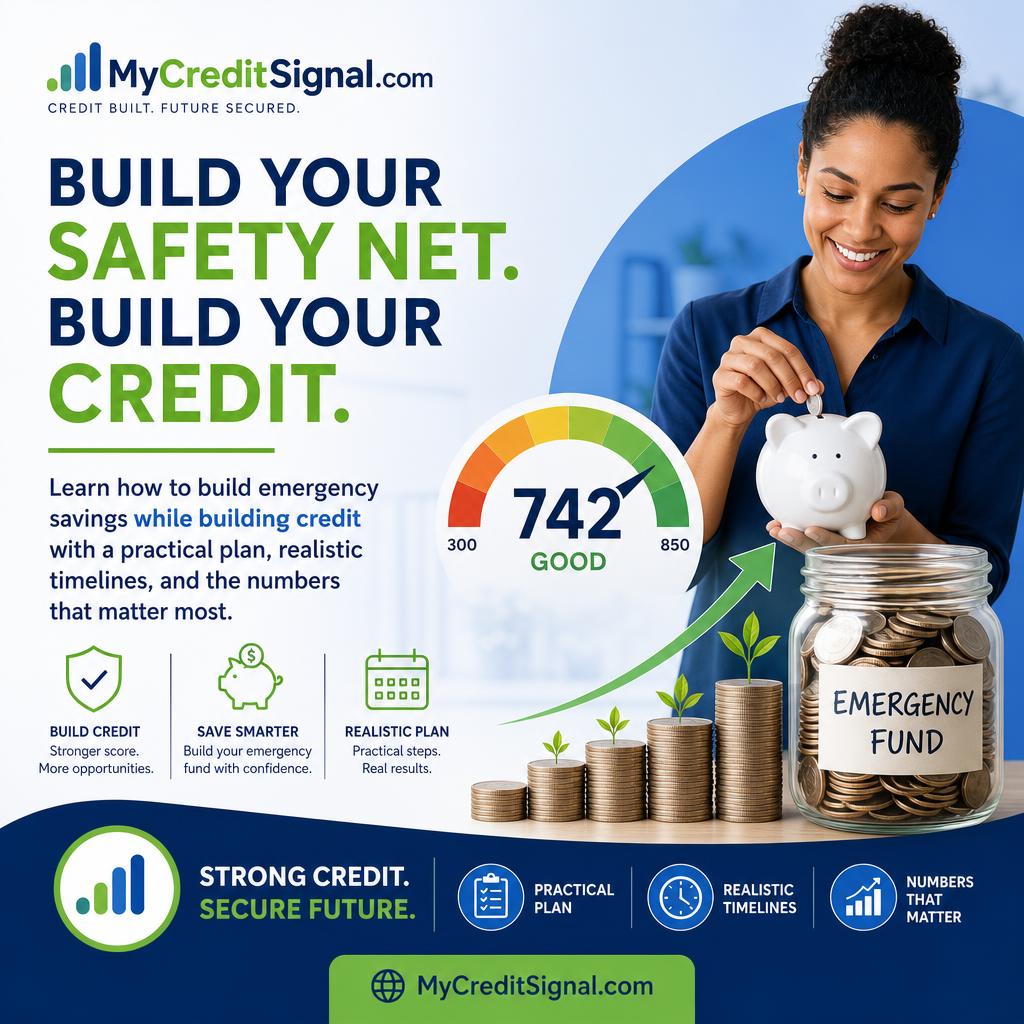
If an unexpected $400 or $800 bill lands this month, many people face the same bad choice: use a credit card and increase balances, or drain checking and hope nothing else goes wrong. That is why savings and credit building work better together than as separate goals. If you are trying to stop living one emergency away from debt while also improving approval odds, this guide is for you.
You will learn how to build a starter emergency fund and a stronger credit profile at the same time, using realistic timelines, safe account choices, and credit-building products that actually report to the major bureaus. The goal is not perfection. It is building a cushion and a track record at once.
Contents
- 1 Who should use this approach
- 2 Why emergency savings can improve your credit plan
- 3 The numbers that matter most
- 4 What to do first and what can wait
- 5 A step by step plan to build both at once
- 5.1 List your essential monthly expenses
- 5.2 Open a separate insured savings account
- 5.3 Automate a transfer on payday
- 5.4 Choose one reporting credit-building product
- 5.5 Keep the card use tiny and predictable
- 5.6 Set every payment to auto pay before the due date
- 5.7 Use windfalls to accelerate savings first
- 5.8 Review the system once a month
- 6 Mistakes that slow down both goals
- 7 What most articles miss
- 8 When this advice does not apply
- 9 FAQ
- 10 Helpful tools and related resources
- 11 Conclusion
Key Takeaway
The smartest plan is to automate even small savings into an insured emergency account while using one low-risk, bureau-reported credit-building tool and making every payment on time.
Who should use this approach
This dual-goal strategy fits people who have some income coming in, little or no emergency savings, and a credit file that needs work. That could include someone starting from zero, someone rebuilding after missed payments, or someone who keeps making progress only to get knocked backward by car repairs or medical costs.
It is especially useful if you are deciding between a secured card and a savings goal and feel like you can only pick one. In many cases, you do not need to choose. The CFPB specifically points to products like secured cards and credit-builder loans as legitimate ways to start or rebuild credit, and regulators also encourage automatic savings habits for emergencies.
This plan may not fit you if you are currently missing essential bills, dealing with active income instability so severe that cash flow changes week to week, or carrying a budget that is already short before any debt payments. In that case, stabilization comes first: housing, utilities, food, transportation to work, and minimum required payments.
If your credit history is very thin and you want more background on starter options, read Build Credit Low Income the Smart Way and How Long to Build Credit From Zero. Those guides help you choose a product without overcommitting your budget.
Why emergency savings can improve your credit plan
Most people think of emergency savings and credit scores as two separate projects. In real life, they are connected. An emergency fund helps protect the habits that keep your credit healthy.
Here is the simple version:
- Savings reduce the odds of late payments when an unplanned bill shows up.
- Savings reduce the need to max out a card, which can affect utilization and score performance.
- Credit-building products create reported payment history if the lender or card issuer sends data to the bureaus.
- Automation removes willpower from the process, which the FDIC recommends for building emergency funds.
This matters because both FICO and VantageScore rely on credit data reported through the three nationwide bureaus: Experian, Equifax, and TransUnion. Those bureaus feed the scoring systems lenders use to make decisions. As Experian explains in its overview of VantageScore and bureau data, model inputs and scoring methods continue to evolve. That means the exact score impact of your actions can vary by profile and by scoring model, but on-time payments and controlled balances remain core habits.
A good decision framework is this: protect cash first, then add one reporting credit tool, then scale both slowly. If you try to build credit with no cash buffer at all, one emergency can undo months of progress.
If card balances are part of your plan, it also helps to understand utilization. Our credit utilization guide can help you avoid the common mistake of building payment history while accidentally carrying balances too high for your comfort.
The numbers that matter most
You do not need a huge savings balance to begin. What matters is choosing a target that gives you traction.
Emergency fund target
A common benchmark is three to six months of living expenses. The Federal Reserve tracks household progress on emergency savings, and consumer guidance often uses three months as a practical minimum and six months as a stronger cushion. Your exact target depends on income stability. Someone with variable pay or a single income household may want to lean toward the higher end over time.
If that number feels too large, break it into phases:
- Phase 1: a starter cushion for smaller disruptions.
- Phase 2: build toward one month of essential expenses.
- Phase 3: build toward three months.
- Phase 4: stretch toward six months if your job or income is less predictable.
You can estimate your target with the emergency fund calculator and then turn the result into a monthly savings number.
Where to keep the money
The FDIC encourages emergency savings to sit in safe, separate insured accounts, such as savings or money market accounts, rather than blending into daily spending money. Recent FDIC materials also referenced approximate national average savings rates around 3 to 3.5%, though actual rates vary by institution. Credit unions also offer insured savings products through the NCUA system, with consumer education available at MyCreditUnion.gov.
Credit-building timeline
Credit progress is rarely instant. The CFPB notes that some credit-building products may take three to five years to graduate to unsecured status depending on issuer policies and account history, but that does not mean you wait years to see any benefit. Reported, on-time payments can begin establishing positive history much earlier. The key is consistency, not speed.
A realistic example
Suppose your essential monthly expenses are $2,000. A three-month emergency fund target would be $6,000. If you automate $100 a month, you are building the habit, but the target will take time. If you automate $200 a month, you reach $2,400 in a year. If a tax refund, bonus, or side-income month lets you add more, the timeline shortens. At the same time, you could use one small secured card for a recurring bill and pay it in full every month, which builds payment history without forcing a large spending change.
That is the right mindset: build the system first, then let time do its job.
What to do first and what can wait
When people try to improve everything at once, they usually overreach. Use this order instead.
- Do first: open a dedicated emergency savings account, set up automatic transfers, and choose one credit-building product that reports to the bureaus.
- Do next: set a single recurring charge on the card or begin the loan payment schedule, then automate the payment.
- Do later: increase savings amounts, ask about graduation from secured to unsecured, or expand to a second product only after the first one is easy to manage.
If you already have a secured card and want to know when moving up makes sense, see Secured to Unsecured Card Upgrade Guide.
A step by step plan to build both at once
List your essential monthly expenses
Total the bills you would still need to pay during a crisis: rent, utilities, groceries, insurance, transportation, minimum debt payments, and basic childcare if applicable. Ignore optional spending for this calculation. Your three-month target equals that monthly number multiplied by three. This gives you a concrete savings goal instead of a vague idea.
Open a separate insured savings account
Keep emergency money outside your checking account so it is less tempting to spend. Look for an FDIC-insured bank or an NCUA-insured credit union account. The account does not need to be fancy. It needs to be safe, separate, and easy to automate.
Automate a transfer on payday
Set up an automatic transfer the same day your paycheck lands. Even a small recurring amount builds momentum because it turns saving into a system rather than a monthly debate. The FDIC specifically encourages automatic saving plans because they reduce the need for constant self-control.
Choose one reporting credit-building product
Use either a secured card or a credit-builder loan, not both at once unless your budget is very stable. The CFPB highlights both as valid tools for building or rebuilding credit when payments are reported to the major bureaus. Before opening anything, confirm reporting and total cost. If your income is tight, compare options with the ideas in Credit Builder Loans Worth It or Not.
Keep the card use tiny and predictable
If you choose a secured card, use it for one recurring expense such as a streaming bill, phone plan, or small subscription you already budget for. Then pay the statement balance in full. This builds payment history without turning the card into an emergency crutch.
Set every payment to auto pay before the due date
The most important credit-building habit is on-time payment. Automating at least the required payment lowers the chance of a miss. If you use a secured card, paying in full is better for avoiding interest and keeping balances manageable. If you want to visualize possible score effects over time, try the credit score simulator, remembering that results can vary by profile and scoring model.
Use windfalls to accelerate savings first
Tax refunds, overtime, side income, rebates, or gift money can move your emergency fund faster than monthly transfers alone. If you have no cash cushion, adding windfalls to savings usually beats increasing card spending. One practical exception: if a required payment is at risk of being late, protect that first.
Review the system once a month
Check three things: did the savings transfer happen, did the credit payment post on time, and did your budget stay realistic. This is also a good time to update your emergency fund target if your rent or other core costs changed. For a broader framework, our emergency fund budget plan can help you map irregular expenses and funding priorities.
Those eight steps give you at least five concrete actions you can take this week:
- Calculate essential monthly expenses.
- Open a separate savings account.
- Start one automatic transfer.
- Verify bureau reporting before opening a credit-building product.
- Put one small recurring bill on the card or set the loan payment.
- Turn on auto pay.
- Send your next windfall to savings.
Mistakes that slow down both goals
Using a credit card as your only emergency fund
Behavior: skipping savings because available credit feels like a backup plan. Consequence: one repair or medical bill can push balances up, raise utilization, and make repayment harder. Fix: build a separate cash reserve, even if the opening transfer is small, so emergencies do not automatically become revolving debt.
Opening multiple new accounts too fast
Behavior: getting a secured card, a store card, and a credit-builder loan all within a short period. Consequence: more moving parts, more fees or deposits, and a higher chance of a missed payment. Fix: start with one product you can manage comfortably, then expand only after six to twelve months of clean history if needed.
Keeping emergency money in checking
Behavior: leaving the fund mixed with grocery money, subscriptions, and everyday debit card spending. Consequence: the money gets used for non-emergencies and the fund never grows. Fix: move it to a separate insured savings account so the money is still accessible but not sitting in your daily spending lane.
Choosing a product without confirming reporting
Behavior: assuming every starter card or loan helps build credit. Consequence: you may pay fees or tie up a deposit without adding useful payment history to your file. Fix: confirm that the account reports to the major bureaus before you apply or fund it.
What most articles miss
Many articles treat emergency savings as a giant finish line and credit building as a completely different race. The real issue is cash flow resilience. A $50 or $100 automatic transfer does not look dramatic, but it can stop you from swiping a card for every unexpected cost.
Another point many guides skip: not all credit-building tools fit the same person.
- A secured card may be better if you want flexible monthly use and can pay the balance in full.
- A credit-builder loan may be easier if you prefer one fixed payment and do not want revolving credit temptation.
- No new product at all may be the best move temporarily if your budget is unstable and one extra due date would increase stress.
There is also a tax-angle opportunity some people overlook. The IRS Saver’s Credit can reward eligible low- to moderate-income taxpayers for retirement contributions. It is not an emergency-fund tool directly, but if your budget improves later, it can support a broader savings system. Just do not redirect emergency-fund money into retirement too early if you have no cash buffer at all.
When this advice does not apply
There are situations where the usual playbook needs adjustment.
If you are a student, a beginner, or someone with very limited income, keep the setup as simple as possible. More accounts do not equal better credit if the budget cannot support them. Credit results also vary by credit profile and scoring model, so compare your progress against your own baseline, not someone else’s timeline.
FAQ
What is the best way to start an emergency fund if I have bad credit?
Open a separate insured savings account and automate a small transfer from each paycheck. Bad credit does not stop you from saving, and savings can reduce the chance of new late payments or high card balances.
Can a secured credit card help my score while I save?
Yes, if it reports to the major bureaus and you pay on time. Use it lightly, keep the spending predictable, and avoid treating it as your emergency fund.
Should I open a credit-builder loan or a secured card first?
Choose the option with the simpler payment setup, lower total cost, and confirmed bureau reporting. A secured card suits people who can pay in full each month. A credit-builder loan can suit people who prefer a fixed installment.
Use these resources to turn the plan into numbers and next actions:
- Emergency fund calculator to estimate a target based on your monthly essentials.
- Credit score simulator to explore how different habits may affect your score over time.
- Emergency fund budget plan for mapping your monthly cash flow.
- Build Credit Low Income the Smart Way if your budget is tight and you need low-cost options.
- Credit Builder Loans Worth It or Not if you are comparing starter products.
Get weekly credit tips, tool updates, and practical guides – free.
Conclusion
You do not need to wait until your emergency fund is perfect before you start building credit, and you do not need to pause all saving just to chase a score. The better move is to connect the two goals: automate cash into a separate emergency account, pick one safe credit-building tool that reports to the major bureaus, and make every payment on time.
Start with the first step today. Calculate your essential monthly expenses, set up one automatic transfer, and choose the single credit product your budget can support. That combination gives you something more valuable than a quick fix: resilience and momentum.

Leave a Reply
You must be logged in to post a comment.