
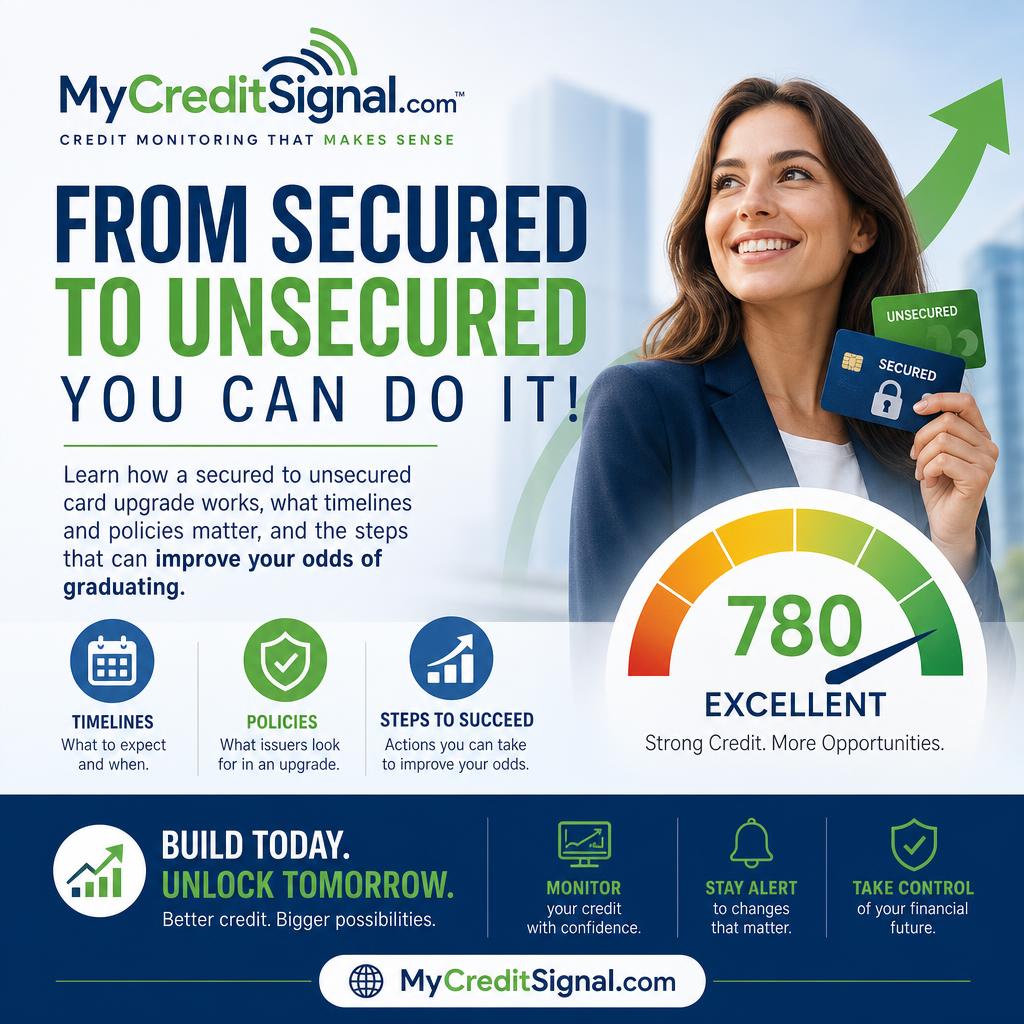
You put down a few hundred dollars for a secured card, used it carefully, and now you want the next step to pay off. The question is not just whether a secured to unsecured card move is possible. It is whether your issuer offers it, when reviews happen, and what habits actually improve your chances. This guide is for people building or rebuilding credit who want to keep momentum without wasting time or tying up a refundable deposit longer than necessary.
By the end, you will know how graduation works, what numbers matter, what to do this week, and when it may be smarter to keep your secured card open while also qualifying for something better. If you are still choosing your starter account, read secured credit cards that actually build credit first so you can pick a card with stronger upgrade potential.
Contents
- 1 Who should care about moving from secured to unsecured
- 2 How secured card graduation actually works
- 3 The numbers and thresholds that matter most
- 4 A simple decision framework before you push for an upgrade
- 5 Step by step plan to improve your chances this week
- 5.1 Check your issuer’s policy in writing
- 5.2 Lower your reported balance before the next statement closes
- 5.3 Set autopay for at least the minimum due
- 5.4 Use the card lightly but regularly
- 5.5 Track whether a higher limit would change your utilization
- 5.6 Check if your card behavior says ready now or later
- 5.7 Ask for a review at the right time
- 5.8 Decide what to do with the old account before closing anything
- 6 Mistakes that slow down graduation
- 7 What most articles miss about the secured to unsecured card move
- 8 What to do first versus later
- 9 FAQ
- 10 Helpful tools and related resources
- 11 Conclusion
Key Takeaway
A secured card can lead to an unsecured card, but graduation depends on issuer policy, steady on-time payments, and low utilization rather than simply waiting a fixed number of months.
Who should care about moving from secured to unsecured
This topic matters most if you opened a secured card to establish credit, rebuild after a rough patch, or start fresh after a major life event. That includes people coming back from bankruptcy, recent immigrants building U.S. credit, and beginners who could not qualify for a traditional card right away. If that is your situation, these related guides may help too: rebuild credit after bankruptcy with a plan and immigrant credit building in the US.
You should care even more if your deposit is money you would rather move to savings, emergency cash, or debt payoff. According to TD Bank, secured cards require a cash deposit that typically sets the credit limit, and that deposit is typically refundable when the account graduates to unsecured or is closed in good standing. That means the upgrade is not just about prestige. It can free up real cash.
This advice may be less useful if your current secured card never graduates and has weak terms, or if your income and credit profile are now strong enough to qualify for a solid unsecured card elsewhere without waiting. In that case, the decision becomes whether to keep the secured card open for history and available credit, or close it and recover the deposit once you have a better card in hand.
How secured card graduation actually works
A secured credit card is backed by a deposit. A standard unsecured card is not. The Federal Reserve Bank of Philadelphia explains that secured accounts are generally reported to the credit bureaus the same way as other revolving tradelines, which means the credit-building mechanics are familiar: pay on time, keep balances low, and let positive history stack up.
Graduation or upgrade means the issuer converts your account, or approves you for a related unsecured product, after reviewing your payment history and overall risk. Discover notes that many issuers offer a pathway to graduate from secured to unsecured status and may refund the deposit when the upgrade occurs. But it also states that automatic graduation is not guaranteed. Some issuers review accounts and upgrade automatically, some require you to ask, and some may require a new application for an unsecured card instead.
That difference matters. If your lender does not offer automatic graduation, waiting quietly for a year may accomplish nothing. You need to know which of these models you have:
- Automatic review model: The issuer checks your account after a set period of strong use and may upgrade you without a new application.
- Request-based model: You have to call or message the issuer and ask whether your account is eligible.
- Apply-again model: Your secured card stays secured, and when you qualify, you apply separately for an unsecured card.
The practical lesson is simple: your timeline is controlled by both your habits and your issuer’s rules.
If you are still early in your credit journey, compare your expectations with how long to build credit from zero. It helps set a realistic pace for when a stronger card may be possible.
The numbers and thresholds that matter most
There is no universal score cutoff or guaranteed month count for graduation, so avoid any article that promises one. What we do know from current issuer and regulator guidance is more useful than a guessed score target.
1. Deposit size
TD Bank says deposit amounts commonly range from $200 to $2,000 for secured cards, usually matching the initial credit limit. If your deposit is $200, your limit is often $200. If it is $500, your limit is often $500. That small limit makes utilization easy to mess up.
Example: with a $300 limit, a $120 reported balance means 40 percent utilization on that card. With a later upgrade to a $1,000 unsecured limit, the same $120 balance becomes 12 percent on that card. TD Bank notes that a higher unsecured limit can improve utilization ratios if balances stay low.
2. Review timing
Discover says many programs review accounts for a possible unsecured upgrade after 3 to 6 months of on-time use. That is not a promise, but it gives you a planning range. It also means your first 90 to 180 days matter more than many people realize.
3. Utilization
Lower utilization is generally more favorable for credit scoring. The exact impact varies by credit profile and scoring model, but high balances relative to your limit can make an otherwise good account look strained. My Credit Signal’s credit utilization guide explains why both overall and card-level usage matter.
A simple working rule: if your secured limit is small, make multiple payments during the month so the reported balance stays modest. This is especially helpful on $200, $300, or $500 limits where ordinary spending can spike utilization fast.
4. Deposit refund timing
Both TD Bank and Discover indicate that the deposit is typically refunded when the account graduates or is closed in good standing. Typically does not mean instantly. Some issuers return it after the statement cycle closes or after any remaining balance is fully paid. That is another reason not to depend on the refund for next week’s rent or groceries.
For a broader credit-building overview, the Consumer Financial Protection Bureau and the Federal Reserve both recognize secured products as legitimate ways to establish or rebuild credit when used responsibly.
A simple decision framework before you push for an upgrade
Use this quick checklist in order.
- First: Does your issuer clearly offer graduation, reviews, or a related unsecured product?
- Next: Have you put together a clean streak of on-time payments for at least several months?
- Then: Are your reported balances low enough that your card does not look maxed out?
- After that: Would a higher limit genuinely help, or are you mainly trying to recover the deposit?
- Finally: If your issuer does not graduate cards, would applying elsewhere give you a better product without closing this account too early?
If you answer no to the first question, your plan may shift from waiting for a product change to building enough strength to qualify for an unsecured card elsewhere.
Step by step plan to improve your chances this week
Check your issuer’s policy in writing
Log in to your account, search the card terms, and call customer service if needed. Ask three direct questions: Does this card graduate automatically, when are accounts reviewed, and is a new application required for an unsecured card. Write down the answers and the date. This prevents months of passive waiting.
Lower your reported balance before the next statement closes
If your limit is small, even everyday spending can create high utilization. Make a mid-cycle payment so the balance that reports is much lower than the amount you spent. For example, if your limit is $300 and you have already spent $140, pay down a chunk before the statement date instead of waiting for the due date.
Set autopay for at least the minimum due
The Federal Reserve and FTC both emphasize responsible use, especially on-time payments and low utilization. Autopay protects the most important habit. You can still make extra payments manually during the month, but minimum autopay reduces the odds of an accidental late payment.
Use the card lightly but regularly
Put one or two predictable purchases on the card, like a streaming bill or gas, then pay them off. This creates a pattern of activity without pushing usage too high. If your spending tends to spike, keep the secured card for small recurring charges only.
Track whether a higher limit would change your utilization
Run a before-and-after scenario using the credit score simulator and check whether your current spending would look healthier with more available credit. This is especially useful if your balances are reasonable in dollars but look high only because your limit is tiny.
Check if your card behavior says ready now or later
Take the secured card readiness quiz to see whether you should ask for a review now, keep building history for a few more cycles, or plan for a separate unsecured application.
Ask for a review at the right time
If your issuer reviews after 3 to 6 months, do not wait indefinitely. Once you have several months of on-time use and low balances, contact the issuer and ask whether your account is eligible for graduation or whether there is a related unsecured product you can move into.
Decide what to do with the old account before closing anything
If you do qualify for a new unsecured card elsewhere, think about whether to keep your secured account open until the new line is active and your deposit refund is safely back in your bank account. Closing too early can reduce available credit. Read what to consider before closing old credit cards before you make that call.
Mistakes that slow down graduation
Waiting for automatic graduation without confirming it exists
Behavior: Assuming every secured card upgrades after a fixed timeline. Consequence: You may leave your deposit tied up for months even if the issuer never graduates accounts automatically. Fix: Confirm the policy now and put the review month on your calendar.
Using a tiny limit like it is a normal rewards card
Behavior: Running most of your monthly spending through a $200 or $300 limit. Consequence: The card can report very high utilization, which may work against your goal. Fix: Put only small recurring bills on the card or make multiple payments each month.
Closing the secured card before the next move is set
Behavior: Closing the account as soon as you think you are ready for an unsecured card. Consequence: You can reduce available credit too soon and create a cash-flow gap if the deposit refund takes time. Fix: Keep the secured card open until the unsecured account is active and you understand the refund process.
Chasing rewards too early
Behavior: Applying for several unsecured cards mainly for points or cash back before your profile is ready. Consequence: You can pile up unnecessary denials and still end up stuck with the same secured card. Fix: Prioritize clean history, low utilization, and issuer fit first. Rewards can come later.
What most articles miss about the secured to unsecured card move
The biggest missed point is that graduation and approval are not the same thing. You might graduate within the same account, get moved to a related card, or have to apply for an entirely separate unsecured card. That means the right strategy depends on the issuer.
The second missed point is that an upgrade may help most because of utilization, not because scoring models reward the word unsecured. The Philadelphia Fed notes that secured and unsecured cards are treated as revolving lines; the key differences come more from limit and account history than from product label alone. So if your issuer upgrades you but leaves the limit nearly unchanged, the benefit may be modest. If the limit meaningfully rises while balances stay low, the benefit may be larger.
The third missed point is that this advice does not apply equally to everyone. If you carry balances month to month, a higher limit can make overspending easier. If you need strict guardrails, the secured setup may actually serve you better for a while longer.
What to do first versus later
If you want a clear order of operations, use this sequence.
Do first: confirm the issuer policy, lower your reported balance, set autopay, and build several clean months of activity.
Do next: ask for a review once you are inside the likely review window and your recent statements look strong.
Do later: compare other unsecured options only after you know whether your current issuer offers a decent upgrade path. If it does not, then a separate application may be worth it.
This order matters because it keeps you from making reactive decisions. Many people either ask too early with high balances or wait too long without learning the rules.
FAQ
Can I graduate from a secured card to an unsecured one?
Yes, many issuers offer a pathway, but not all do. Some upgrade accounts automatically, some require you to request a review, and some require a separate unsecured application.
How long does it usually take?
It varies by issuer. Discover says many programs review after 3 to 6 months of on-time use, but there is no universal timeline or guarantee.
Do I always get my deposit back when I upgrade?
The deposit is typically refunded when the account graduates or is closed in good standing, according to TD Bank. The exact timing depends on the issuer and whether any balance is still owed.
If you want to turn this into an action plan, start with the secured card readiness quiz to see whether you should ask for graduation now or keep building. Then model a possible higher-limit scenario with the credit score simulator. For more context on keeping balances low, review the credit utilization guide. And if you are comparing your current starter card with better long-term options, the article on secured credit cards that actually build credit is a useful checkpoint.
For authoritative background, see the TD Bank guide on transitioning from secured to unsecured, Discover’s explanation of unsecured card graduation pathways, and the FTC’s consumer advice on secured versus unsecured cards.
Get weekly credit tips, tool updates, and practical guides – free.
Conclusion
A secured to unsecured card move can be a smart next step, but it is not a passive one. The best outcomes usually come from knowing your issuer’s rules, keeping utilization low on a small limit, paying on time every month, and asking for a review when your recent history is strong. The product label alone is not the magic. Better limits, returned deposit money, and cleaner utilization are the real wins.
Your next step is simple: confirm whether your current card actually graduates, then spend 15 minutes lowering your reported balance strategy for the next statement. If your habits are already solid, use the readiness quiz and ask for a review. If not, give yourself a few more clean months and make the upgrade work in your favor when it counts.

Leave a Reply
You must be logged in to post a comment.