
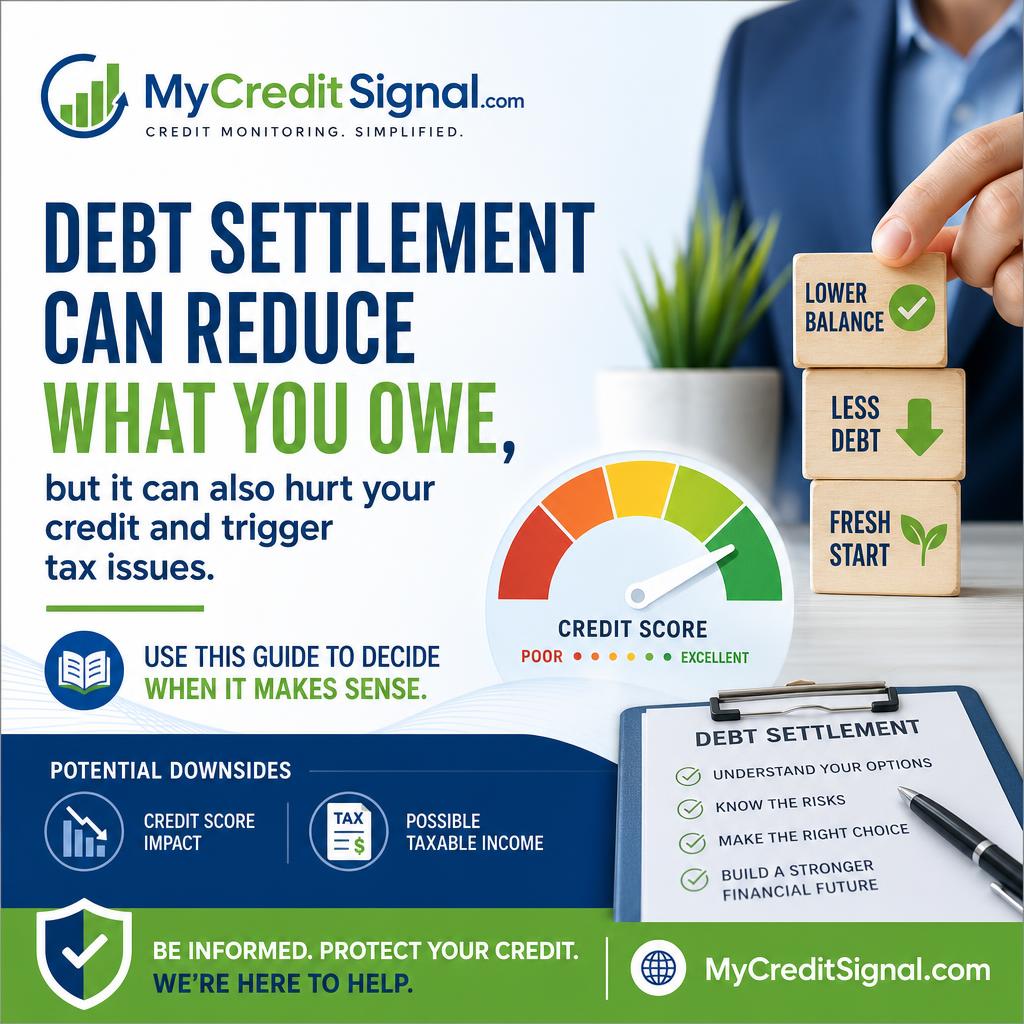
If you are behind on unsecured debt and every payment plan still leaves you short, debt settlement can look like the only exit. Sometimes it is a realistic option. Sometimes it is an expensive detour that damages your credit, creates tax complications, and delays a better solution.
This guide is for readers comparing debt settlement options and trying to decide whether settling is actually the best move. You will learn how settlement works, what numbers matter, when the tradeoff may be worth it, and what to do first this week before you agree to anything.
Contents
- 1 Who should seriously consider debt settlement
- 2 What debt settlement actually does to the debt
- 3 The decision test that tells you if settlement is your best option
- 4 The numbers and thresholds that matter most
- 5 What to do first this week before you contact anyone
- 6 A step-by-step plan to decide and act carefully
- 6.1 Build a one-page debt snapshot
- 6.2 Compare settlement against two alternatives
- 6.3 Set a hard affordability number
- 6.4 Review scam risk before sharing money or data
- 6.5 Negotiate only after you know your fallback plan
- 6.6 Read the agreement for finality and reporting terms
- 6.7 Prepare for recovery immediately after resolution
- 7 Mistakes that make debt settlement options worse
- 8 What most articles miss about debt settlement
- 9 When debt settlement is probably not your best option
- 10 FAQ
- 11 Helpful tools and related resources
- 12 The bottom line
Key Takeaway
Debt settlement usually makes the most sense only when you cannot afford full repayment, can handle the credit damage, and have reviewed safer alternatives first.
Who should seriously consider debt settlement
Debt settlement is not a general money-saving hack. It is a damage-control strategy. It is usually most relevant for people with unsecured debt such as credit cards, personal loans, or collection accounts who are already struggling to keep up.
You may be a real candidate if most of these apply:
- You are already behind, or you expect to fall behind soon.
- You cannot realistically pay the full balance through minimum payments or a standard repayment plan.
- You do not qualify for a lower-rate consolidation loan, or the payment would still be too high.
- You can build at least some lump-sum cash for negotiation.
- You understand that your credit may take a meaningful hit.
You may need a different approach if any of these fit better:
- Your credit is still stable and you can repay in full with a lower-interest strategy.
- You are mostly dealing with temporary cash flow problems, not permanent payment failure.
- You need to protect your credit for a near-term mortgage, car loan, or apartment application.
- Your debts are secured, tax-related, or other categories that do not behave like typical unsecured settlement cases.
Before you go deeper into settlement, it helps to compare whether a payoff structure or refinance path could solve the problem with less damage. If you need that side-by-side view, read this guide to debt consolidation loan basics and how to refinance high-interest debt the smart way.
What debt settlement actually does to the debt
Debt settlement means you and the creditor or collector agree that a payment for less than the full amount will satisfy the account. In plain English, you are asking the other side to accept less money now instead of continuing to pursue the full balance.
That sounds simple, but the path matters. Many settlements happen after an account has become seriously delinquent. Experian notes that settlement discussions often follow accounts that are already 83 to 90 or more days past due, and those late payments themselves can drag down your score before any settlement is finalized. Experian also notes that settled debt can harm credit and remain on reports for up to seven years. That is why settlement is usually not a first-choice option for someone who still has other workable paths.
The CFPB says negotiating with a debt collector can be part of a strategy, but consumers should understand the risks and be careful with debt-relief services that ask for money upfront or make broad promises. The FTC has also warned that some debt-relief and settlement services are scams and highlights red flags around upfront fees and misleading guarantees. You can review that guidance directly at the CFPB settlement negotiation page and the FTC debt-relief scam resource.
A simple way to think about debt settlement options is this:
- Best-case use: reduce a balance you truly cannot repay in full.
- Main cost: credit damage, lost time, and possible tax issues.
- Main risk: choosing settlement when a less harmful option was still available.
If your first problem is simply that you do not know the full size of your balances or how long payoff would take, start there. This debt calculation and payoff guide can help you map the total before you decide whether settlement is even necessary.
The decision test that tells you if settlement is your best option
Here is a practical framework. Ask these four questions in order, not all at once.
1. Can you repay in full within a realistic timeline?
If the answer is yes, settlement is usually not your best option. Full repayment usually protects your future borrowing options better than settling.
2. Can you lower the payment without going delinquent?
This could mean consolidation, refinancing, or credit counseling. The CFPB specifically points consumers to alternatives such as credit counseling, debt consolidation, and structured repayment arrangements before assuming a lump-sum settlement is the answer. See the CFPB comparison here: credit counseling versus debt settlement and debt consolidation.
3. Are you already in deep delinquency with no affordable recovery path?
If yes, settlement becomes more defensible. Once the account is already badly behind, some of the credit damage has already happened.
4. Can you handle the after-effects?
You need to be ready for three things: a possible score drop, possible tax paperwork, and the need to rebuild after the debt is resolved.
If you answer no to questions 1 and 2, yes to question 3, and yes to question 4, debt settlement may be your best option among imperfect choices.
The numbers and thresholds that matter most
You do not need perfect forecasting to evaluate debt settlement options, but you do need a few key numbers in front of you.
Your full balance versus your available cash
Settlement often works only if you can offer meaningful money within a limited time. If you owe $12,000 across old credit card accounts but can realistically gather only $300 over the next month, you may not be ready to negotiate from strength. If you can gather a lump sum over time, your position changes.
Your delinquency timeline
Experian notes that serious delinquency often precedes settlement, commonly around 83 to 90 or more days past due. That matters because the credit cost may already be building before the account is settled. If you are still current, you are deciding whether settlement damage would be self-inflicted. If you are already far behind, you are deciding whether settlement reduces a problem that is already in motion.
Your credit timeline
If you expect to apply for a mortgage, auto loan, or apartment soon, settlement may be poorly timed. Negative information related to debt settlement can remain on a credit report for up to seven years under typical reporting practices, according to Experian. Results vary by credit profile and scoring model, but the broad point is the same: this is not a short-term cosmetic move.
Your tax exposure
The IRS says canceled debt can create taxable income unless an exclusion applies, and lenders may issue Form 1099-C. That means a settlement that reduces what you owe today could still create a tax question later. Review the IRS guidance at Tax Topic 431 if you think part of your balance may be forgiven.
A simple example
Imagine you owe $8,500 on an account that you cannot repay in full. You are already several months behind, your score has been hit, and you have $3,000 available from savings and side income. In that case, settlement might be worth evaluating because:
- The account is already distressed.
- You have enough cash to make a real offer.
- The alternative is prolonged nonpayment or a payment plan you still cannot afford.
Now compare that with someone who owes the same $8,500 but is still current and could qualify for a lower-rate consolidation payment. For that person, settlement may create avoidable damage.
What to do first this week before you contact anyone
Before negotiations start, separate urgent actions from later actions. This keeps you from making a stressed decision.
Do first
- List every unsecured debt with balance, creditor, account status, and days past due.
- Calculate how much cash you could realistically access for a settlement fund.
- Review whether a structured payoff plan is still workable.
- Check whether you are protecting essentials like rent, utilities, food, and insurance first.
Do later
- Trying to optimize your score before the debt problem is contained.
- Applying for multiple loans if your income does not support them.
- Paying a settlement company before you understand the fee structure and risks.
If you need a practical worksheet for the cash side of this decision, use the collection settlement budget planner. If you are still comparing settlement with a standard payoff timeline, the debt-free date calculator helps you estimate whether full repayment is still within reach.
A step-by-step plan to decide and act carefully
Build a one-page debt snapshot
Write down each unsecured account, its balance, whether it is current or delinquent, and your minimum payment if one still applies. Your goal is not perfection. Your goal is to see whether the problem is temporary or structural.
Compare settlement against two alternatives
Force yourself to compare settlement with at least two other paths: a lower-rate consolidation or refinance option, and a structured repayment or counseling option. If one of those lets you repay in full without skipping essentials, settlement may not be your best option.
Set a hard affordability number
Decide the most cash you can use without draining rent money, emergency essentials, or required bills. If using $2,000 today means you cannot cover next month, that is not an affordable settlement fund.
Review scam risk before sharing money or data
The FTC warns consumers to watch for debt-relief companies that charge upfront fees, promise guaranteed outcomes, or pressure you to stop communicating. If a company rushes you, step back. Reputable arrangements should be transparent and understandable.
Negotiate only after you know your fallback plan
Your fallback may be a payment arrangement, credit counseling, or pausing negotiations while you save more cash. Without a fallback, you are more likely to accept terms you cannot keep.
Read the agreement for finality and reporting terms
Make sure the agreement clearly states what amount resolves the account and that the creditor or collector will treat the balance as satisfied based on the agreed terms. You also want clarity on whether any remaining amount may be canceled and reported for tax purposes.
Prepare for recovery immediately after resolution
Once the debt is resolved, shift quickly into rebuild mode: on-time payments on remaining obligations, controlled utilization, and a realistic monthly budget. Settlement should solve a crisis, not become a repeat cycle.
Mistakes that make debt settlement options worse
Choosing settlement before testing repayment alternatives
Behavior: jumping straight to settlement because it sounds cheaper. Consequence: you may accept avoidable credit damage even though consolidation, counseling, or repayment could have worked. Fix: compare at least two full-repayment paths before making a settlement decision.
Ignoring the tax side of forgiven debt
Behavior: treating a reduced balance as pure savings with no follow-up. Consequence: a canceled amount may create tax reporting questions, including a possible Form 1099-C. Fix: review IRS Tax Topic 431 and keep every settlement document.
Paying a debt-relief company upfront
Behavior: sending fees before services are clearly delivered. Consequence: you risk losing money, delaying action, or getting trapped in a scam. Fix: follow CFPB and FTC guidance, ask for clear terms, and be skeptical of guarantees.
Settling while you still need top-tier credit soon
Behavior: settling an account right before applying for housing or major financing. Consequence: the negative reporting and prior delinquency can weaken approval odds. Fix: if a major application is near, explore whether another route preserves your credit better.
What most articles miss about debt settlement
Many articles frame settlement as a simple percentage discount decision. Real life is messier. The better question is not just, “Can I pay less?” It is, “What problem am I solving, and what new problems might I create?”
Three often-missed points matter here:
- Credit damage may start before the settlement itself. If serious delinquency is already part of the path, your score may have dropped before any agreement is signed.
- The right option depends on timing. Someone who needs credit access in the next year may value stability more than short-term balance reduction.
- Settlement results vary by creditor. The CFPB notes that terms can differ, and alternatives such as counseling, consolidation, or structured repayment may be better fits depending on the lender and your cash flow.
If your next move is organizing a realistic payoff system, this debt payoff plan guide can help you avoid sliding back into the same cycle after any settlement or repayment decision.
When debt settlement is probably not your best option
Debt settlement usually does not fit well in these situations:
- You are current on payments and still have a workable path to full repayment.
- You could refinance or consolidate into an affordable payment.
- You are trying to protect your credit for a near-term loan or apartment.
- You have not built any cash for negotiation.
- You are relying on a company promise rather than your own verified numbers.
It may fit better when you are already deep into delinquency, cannot repay in full, and need a contained way to resolve unsecured debt without pretending the old payment schedule is still realistic.
FAQ
Will debt settlement hurt my credit more than leaving the debt unpaid?
It depends on timing and your credit profile. If the account is already seriously delinquent, some damage may already be done. But settlement can still be negative for credit, and effects can vary by scoring model.
How long can a debt settlement stay on my credit report?
Experian says negative information tied to settlement can remain on reports for up to seven years under typical reporting practices.
Can a settled debt create a tax bill?
Yes, it can. The IRS says canceled debt may be taxable unless an exclusion applies, and you may receive Form 1099-C.
Use these if you want to make a cleaner decision instead of guessing:
- Collection settlement budget planner to decide what you can safely offer.
- Debt-free date calculator to compare settlement against full repayment timing.
- Calculate total debt and build a payoff plan if you still need a full snapshot of balances.
- How to handle debt collectors calmly if your accounts are already with collectors.
Get weekly credit tips, tool updates, and practical guides – free.
The bottom line
Debt settlement options make the most sense when you are not choosing between good and bad. You are choosing between bad and less bad. If you can still repay in full through a safer structure, that is usually the stronger long-term play. If you cannot, and the account is already seriously distressed, settlement may be a practical way to contain the damage.
Your next step is simple: map your balances, calculate what cash you can actually commit, and compare settlement against at least two alternatives before you agree to anything. A clear decision now can save you from a longer recovery later.



Want to understand your credit report?
Get plain-English explanations with our free AI Credit Analyzer →
Leave a Reply
You must be logged in to post a comment.