
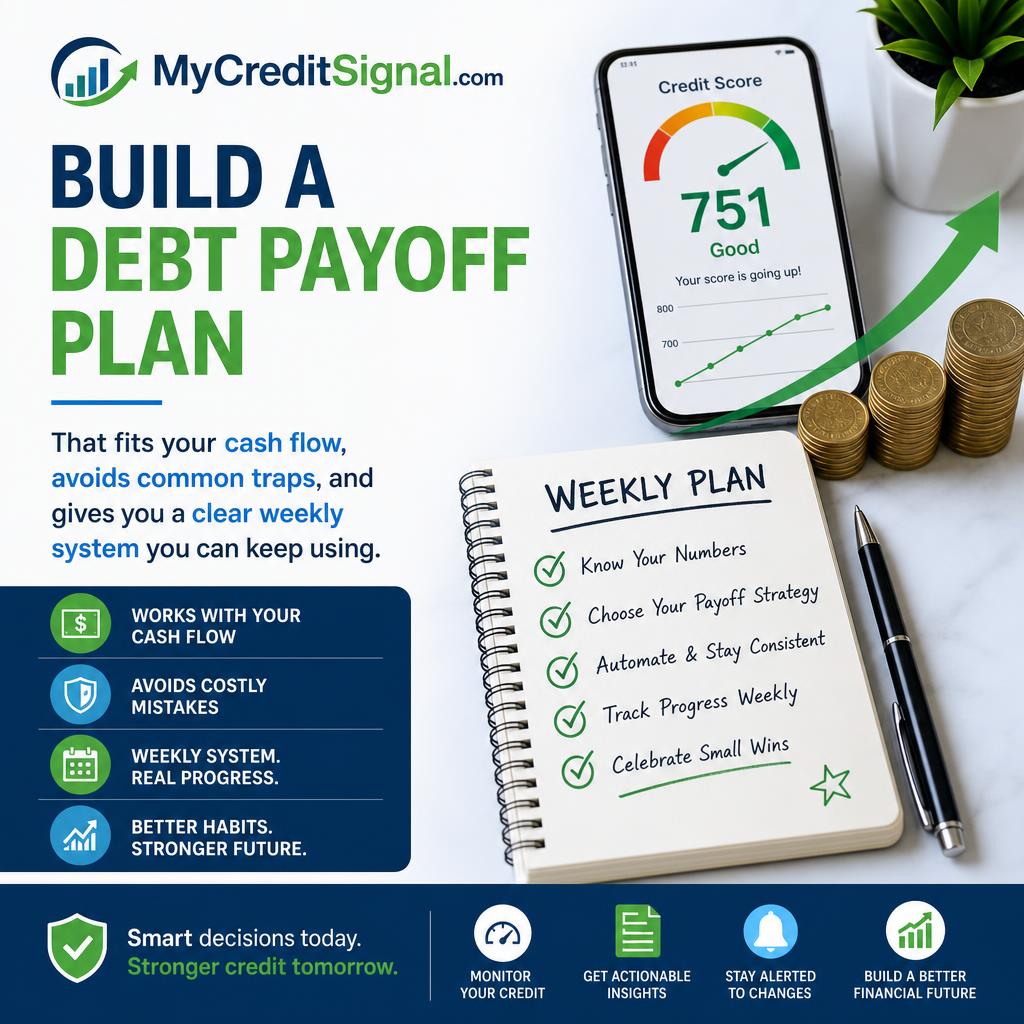
If your debt payoff plan falls apart by the second paycheck, the problem usually is not motivation. It is usually math, timing, and a plan that does not match real life. A workable debt payoff plan has to fit your bills, your due dates, and the amount of extra cash you can actually send each month without creating a new emergency.
This guide is for people juggling credit cards, personal loans, medical bills, or even tax debt who want a practical system they can keep following. You will learn how to build a debt payoff plan from the ground up, choose what to pay first, decide how much emergency cash to keep, and avoid costly shortcuts that can backfire.
Contents
- 1 Who this debt payoff plan is for
- 2 The core rule that makes a payoff plan stick
- 3 The numbers that matter before you send an extra dollar
- 4 What to do first versus later
- 5 A step by step debt payoff plan you can start this week
- 5.1 Build your full debt inventory
- 5.2 Match due dates to your pay schedule
- 5.3 Choose one payoff method and stop switching
- 5.4 Set one fixed monthly extra payment
- 5.5 Create a weekly 10 minute money reset
- 5.6 Use windfalls with a preset rule
- 5.7 Track progress by milestones, not just balances
- 5.8 Know when to consider outside help
- 6 Mistakes that quietly wreck a debt payoff plan
- 7 What most articles miss about debt payoff plans
- 8 When this advice does not fully apply
- 9 FAQ
- 10 Helpful tools and related resources
- 11 Conclusion
Key Takeaway
A debt payoff plan sticks when you list every debt, base your monthly target on real cash flow, pick one payoff order, and review it weekly instead of relying on willpower alone.
Who this debt payoff plan is for
This approach works best if you have steady or somewhat predictable income, at least minimum payments covered, and unsecured debt you want to reduce with a clear schedule. That includes people with a mix of credit cards, medical balances, personal loans, or collection-related payoff decisions where the main challenge is organizing payments and freeing up cash flow.
It is especially useful if you have tried a payoff method before and quit because the numbers felt too aggressive. A written plan creates a target you can measure. The CFPB emphasizes starting with a complete debt inventory before choosing a strategy, including balances, interest rates, minimum payments, and due dates. That foundation matters more than any trendy method.
This article may not be enough on its own if you are already missing core living expenses, facing foreclosure or repossession, or dealing primarily with tax debt that needs a formal arrangement. In those cases, you may need a nonprofit credit counselor or direct help from the IRS for tax balances. The IRS notes that payment plan options may be available when you cannot pay immediately, including some plans of up to 180 days for qualifying situations at IRS payment plan guidance.
The core rule that makes a payoff plan stick
A debt payoff plan is not just a list of balances. It is a monthly operating system. In plain English, that means four things:
- You know every debt you owe.
- You know your minimum total due every month.
- You decide exactly where extra money goes.
- You repeat the process every week until the balances are gone.
The reason many plans fail is simple: people choose a method first and do the inventory later. That is backwards. The CFPB debt worksheet exists for exactly this reason. It helps you map balances, payments, and cash flow before you make payoff decisions. If you want a practical companion to this article, start by tracking milestones and timelines with the debt payoff milestone tracker.
Once your inventory is accurate, you can pick a payoff order. If you are deciding between motivation and interest savings, read this comparison of debt snowball vs avalanche for examples and tradeoffs. The best method is the one you can keep funding month after month.
The numbers that matter before you send an extra dollar
Before you attack one balance, calculate three numbers.
1. Your minimum payment floor
Add every minimum payment due this month. If card A is 95 dollars, card B is 60 dollars, a medical plan is 75 dollars, and a personal loan is 210 dollars, your minimum floor is 440 dollars. That is the amount your budget must protect first.
2. Your monthly debt attack amount
Now calculate how much extra money you can send without guessing. Formula:
Take-home pay minus essential bills minus minimum debt payments minus a small buffer equals extra debt money.
Example:
- Take-home pay: 3,400 dollars
- Rent, utilities, groceries, transport, insurance: 2,350 dollars
- Minimum debt payments: 440 dollars
- Small buffer for irregular costs: 110 dollars
That leaves 500 dollars for extra debt payoff. Your monthly debt payoff plan is not 900 dollars because that sounds ambitious. It is 500 dollars because that is what your budget can repeatedly support.
3. Your debt-free timeline
Use the debt free date calculator to estimate payoff timing based on your real monthly number. If the date feels too far away, your next move is not to panic. It is to choose one of three levers: raise income, cut expenses, or lower interest through a legitimate option.
What to do first versus later
If your brain is jumping between six money problems, use this simple decision framework.
Do first
- List every debt with balance, rate, minimum, and due date.
- Make sure minimums are covered.
- Keep a small cash buffer so one surprise expense does not push you back to a credit card.
- Choose one target debt and one payoff order.
- Automate minimums if your income timing allows it.
Do later
- Looking into refinancing or consolidation after you know your numbers.
- Trying aggressive payoff challenges.
- Adding extra payments from side income once that income proves consistent.
- Exploring nonprofit debt management if rates and payments are still too high after budgeting.
This order matters. The FDIC emphasizes practical budgeting and expense control alongside debt reduction, especially when income is stretched. A good plan starts with stability, not heroics.
If your budget itself is weak, tighten that first. A realistic spending system makes debt payoff easier to sustain, which is why articles like this guide to a frugal budget that still feels abundant can be helpful before you increase your debt target.
A step by step debt payoff plan you can start this week
Build your full debt inventory
Write down each account, current balance, interest rate if known, minimum payment, and due date. Do not round. Do not estimate. The CFPB specifically recommends a complete and accurate inventory before selecting a payoff strategy. This week, gather your statements and create one single list in notes, a spreadsheet, or a worksheet.
Match due dates to your pay schedule
A plan breaks when the bills hit before the paycheck. Put every minimum payment on a calendar tied to your actual paydays. If you get paid on the 1st and 15th, split your debt obligations across those checks where possible. This week, list which debts get paid from paycheck one and which from paycheck two.
Choose one payoff method and stop switching
If your biggest problem is staying motivated, snowball may help because quick wins can keep you engaged. If your biggest problem is interest cost, avalanche usually saves more over time. If you need help comparing both, review debt snowball vs avalanche with real examples. This week, choose one method and write down your target account.
Set one fixed monthly extra payment
Pick an extra amount you can sustain for at least the next 90 days. That may be 75 dollars, 150 dollars, or 500 dollars. Consistency matters more than a dramatic first month. This week, decide on your fixed extra payment and schedule it the day after your last major bill clears.
Create a weekly 10 minute money reset
Every week, check four things: account balances, upcoming due dates, available cash, and whether any extra money can go to the target debt. This is where plans become sticky. You do not need a monthly crisis meeting. You need a short weekly reset. This week, put that session on your calendar.
Use windfalls with a preset rule
Tax refunds, bonuses, gifts, or side income can speed things up, but only if you decide the rule before the money arrives. A simple rule is to send part to your emergency buffer and part to debt. This week, choose your rule in writing so you do not spend the money by default.
Track progress by milestones, not just balances
Milestones keep you from feeling stuck when balances move slowly. Good milestones include paying off one account, dropping below a psychological threshold, or cutting total minimum payments. This week, set your first three milestones inside the milestone tracker so progress stays visible.
Know when to consider outside help
If you can cover essentials but interest and minimums are still eating your budget alive, a debt management plan through a reputable nonprofit agency may be worth reviewing. The FTC explains that these plans are commonly used for unsecured debt and are often structured around your budget, sometimes with reduced interest and fees negotiated with creditors. Typical plan duration often runs 3 to 5 years depending on the terms and total debt. This week, if your math still does not work, make a shortlist of nonprofit counseling questions before talking to anyone.
Mistakes that quietly wreck a debt payoff plan
Using your highest hope instead of your real cash flow
Behavior: Setting an extra payment based on your best month instead of your usual month. Consequence: You fall short, miss the target, and start swiping again to cover basics. Fix: Base your plan on a repeatable monthly amount and treat bonus income as optional acceleration, not the foundation.
Putting every spare dollar to debt with no buffer
Behavior: Draining checking to send one large payment. Consequence: A car repair, copay, or utility spike sends you back into new debt. Fix: Keep a small cash cushion before going all-in. This is especially important if your income is variable or your month has frequent surprise expenses.
Falling for risky debt relief marketing
Behavior: Signing up for a service that promises quick reduction without clearly explaining fees, credit impact, or tax consequences. Consequence: You may pay unnecessary fees, damage your credit further, or face tax issues from canceled debt. Fix: Review official guidance first. The FTC warns against abusive practices and misleading claims, and the CFPB notes that some debt-relief options can leave you worse off.
Changing methods every month
Behavior: Switching from snowball to avalanche to settlement ideas every time motivation drops. Consequence: Your payments become inconsistent and your timeline gets blurry. Fix: Pick a strategy, commit for at least one full billing cycle, and evaluate based on results, not mood.
What most articles miss about debt payoff plans
Most advice treats all debt as if it behaves the same. It does not. A credit card balance with a high rate is different from a medical payment plan, and both are different from tax debt. Your payoff plan should reflect those differences.
Another thing many articles miss is the short-term credit tradeoff question. Paying debt is generally good for long-term financial health, but the exact credit reporting impact can vary by account type, utilization changes, and your broader credit profile. That is one reason a plan should prioritize on-time payments and sustainable balances instead of chasing a guaranteed score jump.
And finally, some people do need structured outside help. A debt management plan is not the same as debt settlement. The FTC describes DMPs as programs often administered through reputable nonprofit counseling agencies, with payments based on budget and possible coordination with creditors on interest and fees. That is very different from high-pressure settlement pitches.
When this advice does not fully apply
If your debt problem is really an income problem, no payment method alone will solve it. You may need to increase earnings, reduce housing or transportation costs, or pause aggressive extra payments until your cash flow stabilizes.
If your biggest balance is medical, you may need a separate budgeting approach around payment timing and care costs. In that case, this guide to budgeting medical bills without panic may help you build a plan that works alongside your payoff strategy.
FAQ
What is the best debt payoff plan for mixed credit card and medical debt?
Start with a full inventory, protect all minimum payments, then choose one target order. Many people focus extra money on the highest-interest credit card first while keeping agreed medical payments current, but your best order depends on rates, payment pressure, and how tight your cash flow is.
Will a debt payoff plan improve my credit score fast?
Not on a guaranteed timeline. Credit impact varies by account type, utilization, payment history, and scoring model. A better goal is steady on-time payments and lower balances over time.
Should I use a debt management plan or debt settlement?
If you are comparing the two, review nonprofit debt management first. Debt settlement can be risky and may involve credit and tax consequences, while DMPs are commonly structured around your budget and may reduce interest or fees through creditor coordination.
Use these resources to turn your plan into a system you can actually follow:
- Debt payoff milestone tracker to break a long plan into visible wins.
- Debt free date calculator to estimate payoff timing based on your real monthly payment.
- Debt snowball vs avalanche best method if you need help choosing your payoff order.
- How to pay off 10000 of debt in 12 months for a more aggressive challenge format once your core budget is stable.
Get weekly credit tips, tool updates, and practical guides – free.
Conclusion
A debt payoff plan that sticks is not built on hype. It is built on a complete debt list, a realistic monthly number, one clear payoff order, and a weekly check-in that keeps you honest before problems snowball.
If you do one thing today, gather every balance and minimum payment into one list. Then run your timeline in the debt free date calculator and set your first milestone. Once the plan is visible, it gets much easier to follow through.



Want to understand your credit report?
Get plain-English explanations with our free AI Credit Analyzer →
Leave a Reply
You must be logged in to post a comment.