 Skip to content
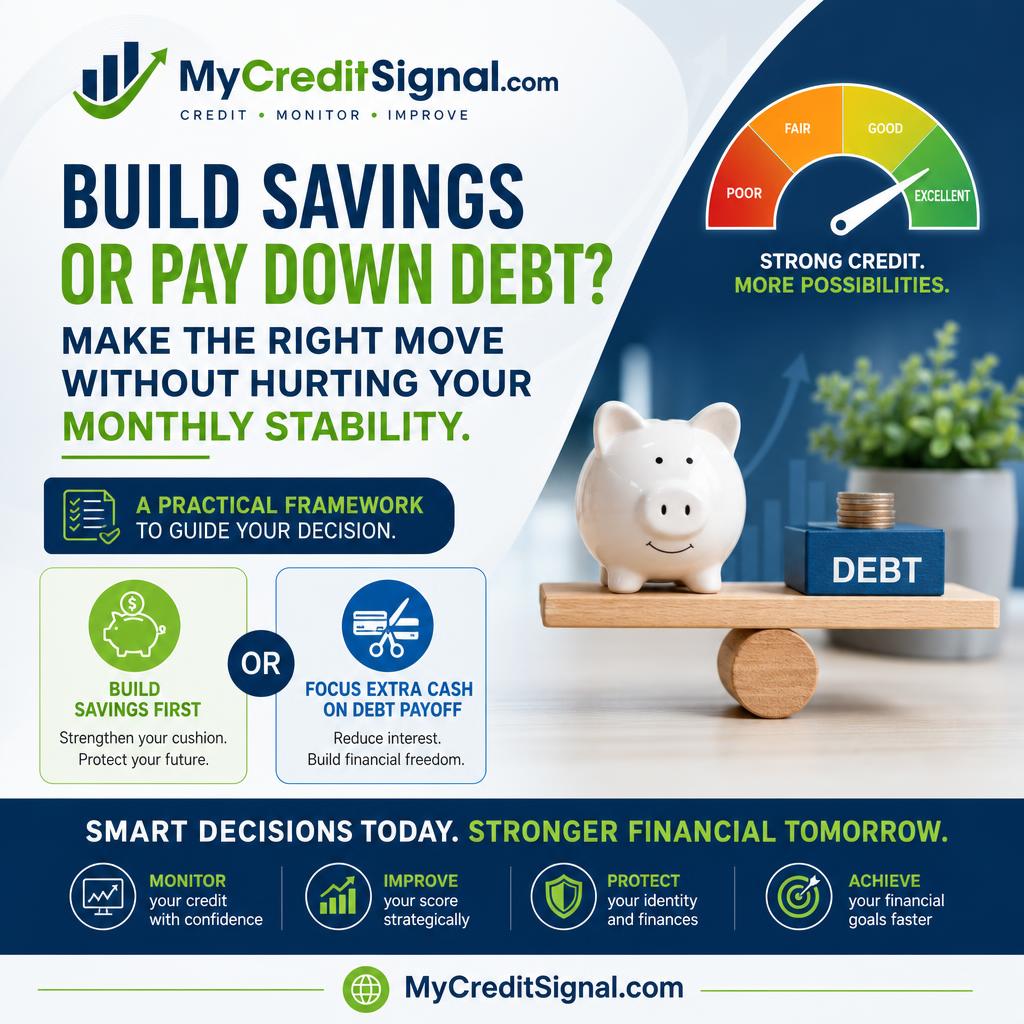
You have extra money this month, but not enough to do everything. Maybe it is $200 after bills. Do you send it to your credit card, keep it in savings, or split it? That is the real question behind saving vs paying debt, and the wrong choice can leave you exposed either way. Put every extra dollar toward debt and one car repair can send you right back to borrowing. Save too aggressively while expensive balances sit there, and interest keeps eating your progress.
This guide is for people who want a practical decision framework, not vague advice. You will learn how to decide what comes first, which numbers matter most, when to split your money, and how to build a plan you can actually keep. If you want help comparing payoff styles after this, read how to choose a debt payoff strategy.
Contents
- 1 Who this decision framework is for
- 2 The core tradeoff most people miss
- 3 The numbers and thresholds that should drive your choice
- 4 A quick decision framework you can use in 10 minutes
- 5 A realistic example with numbers
- 6 What to do first this week and what can wait until later
- 7 A step by step plan for balancing saving and debt payoff
- 8 Mistakes that make this choice harder than it needs to be
- 9 What most articles miss and when this advice does not apply
- 10 FAQ
- 11 Helpful tools and related resources
- 12 The bottom line on saving vs paying debt
Key Takeaway
In most cases, build a small emergency buffer first, then target high-interest debt aggressively while continuing steady savings so one surprise expense does not undo your progress.
Who this decision framework is for
This article is most useful if you have both of these at the same time: debt that costs you money every month and a savings balance that feels too small for real-life surprises. That includes people with credit card balances, personal loans, car loans, student loan payments restarting, or tax balances they are trying to fit into a monthly plan.
It is especially relevant if:
- Your budget has a little room each month, but not enough to fully save and fully pay off debt at the same speed.
- You keep making progress on debt, then swipe a card again when something breaks.
- You are unsure whether to keep cash in savings while interest charges keep posting.
- You need a rule for what to do first versus later.
This framework may not be enough on its own if you are already behind on essentials like rent, utilities, groceries, or minimum debt payments. In that case, your first priority is stabilizing cash flow, not optimizing between saving and debt payoff. Likewise, if your debt includes taxes, review current IRS payment options at IRS payment plan guidance because those balances can have different timelines and consequences than standard consumer debt.
The core tradeoff most people miss
The saving vs paying debt debate is not really about choosing one forever. It is about reducing your most expensive financial risk first.
There are two major risks:
- No cash buffer risk: an unexpected bill pushes you back onto credit.
- High interest debt risk: balances keep growing or take longer to pay off because interest keeps accruing.
The Consumer Financial Protection Bureau says an emergency fund can reduce reliance on high-interest credit when unexpected expenses hit, which lowers the chance of taking on new debt. That matters because a plan that only works when nothing goes wrong is not much of a plan. See the CFPB emergency fund guide here: building an emergency fund.
At the same time, debt still has a real cost. If your extra cash sits in savings while expensive debt remains, you are buying safety but delaying payoff. The goal is not perfection. The goal is sequencing.
A simple way to think about it:
- First: stop the cycle of new borrowing.
- Second: reduce the debt doing the most damage.
- Third: grow savings from basic protection to a fuller reserve.
If you need a weekly system to stay consistent while doing this, this debt payoff plan that actually sticks can help you turn the framework into a routine.
The numbers and thresholds that should drive your choice
You do not need a perfect spreadsheet to decide. You need a few thresholds.
1. Can you handle a $400 surprise without borrowing
The Federal Reserve uses a $400 emergency expense as a benchmark in its household well-being research. In the latest reporting, 63% of adults said they would cover a $400 emergency with cash or its equivalent, while 13% said they would be unable to pay it by any means. Those numbers tell you something practical: if a $400 bill would force you into new debt, savings should move up your priority list. Source: Federal Reserve Economic Well-Being report and Federal Reserve release.
2. Do you have at least a starter emergency fund
CFPB guidance points toward several months of essential expenses as a longer-term emergency fund target, with 3 months often used as a common benchmark. That does not mean you need to hit 3 months before paying debt. For most people, the practical first threshold is much smaller: enough to cover a modest emergency so every surprise does not go on a card.
A good decision rule is:
- If you have no emergency savings or almost none, build a starter buffer first.
- If you can cover small emergencies already, shift harder toward debt.
- If your job or income is unstable, keep a larger cash cushion while paying debt more gradually.
3. How expensive is the debt
This is where math matters. A high-interest balance usually deserves faster action than low-cost debt. You do not need an exact industry threshold to see the difference. If your credit card interest is adding noticeable charges each month, extra payoff can produce immediate savings on future interest. If the debt is low-cost and predictable, the urgency to attack it may be lower than the urgency to avoid another borrowing event.
4. Has your monthly payment load changed recently
Household spending shifts when debt payments restart or increase. Federal Reserve analysis on resumed student loan payments shows debt obligations can affect spending behavior, which in turn changes how much households can save or put toward debt payoff. If a required payment recently came back, your plan should adjust before you commit extra money too aggressively. Source: Federal Reserve note on debt payments and spending.
A quick decision framework you can use in 10 minutes
Here is a plain-English framework for saving vs paying debt.
Choose savings first for now if all three are true: you cannot cover a $400 emergency without borrowing, your income is uneven or uncertain, and you are still making all minimum debt payments on time.
Choose debt first for now if all three are true: you already have a basic emergency cushion, your income is fairly stable, and your debt is adding meaningful interest or keeping your cash flow tight.
Split your extra money if: you have some savings but not much, you have debt that is costly but not immediately unmanageable, and you need progress in both areas to stay consistent.
That split could be as simple as sending part of your extra cash to savings and the rest to your top-priority debt. The point is not the exact ratio. The point is that the split should solve your real bottleneck. If small emergencies keep knocking you off track, savings is the bottleneck. If interest charges keep slowing everything down, debt is the bottleneck.
Once you decide which balance to target first, a structured payoff method matters. If you are comparing motivation versus math, read debt snowball vs avalanche for a practical breakdown.
A realistic example with numbers
Assume your monthly essentials are $2,000 and you have $250 left each month after minimum payments and regular bills.
Case A: You have $0 in emergency savings and one credit card balance. A $400 car repair would go straight on the card. In this case, sending the full $250 to debt may look disciplined, but it leaves you fragile. A better first move is building a starter buffer until you can handle at least a small surprise without borrowing. If you put $250 a month into savings, you reach $400 in less than two months.
Case B: You already have enough to handle that $400 surprise and your monthly life is fairly stable. Now the same $250 probably works harder attacking debt, because you have reduced the chance of re-borrowing for a small emergency.
Case C: You have $300 in savings, irregular freelance income, and several debts. Here a split approach may work better than an all-or-nothing choice. Put some extra cash into savings until your short-term buffer feels usable, then increase the share going to debt.
The lesson is simple: the right move depends less on ideology and more on whether your current cash reserves can absorb normal life disruptions.
What to do first this week and what can wait until later
Many people get stuck because they try to solve the whole problem in one month. Instead, separate immediate moves from later moves.
Do first
- Make sure every minimum payment is covered.
- Check whether you could handle a $400 emergency in cash today.
- Set a starter savings target if the answer is no.
- Pick one debt for extra payments instead of spreading small amounts everywhere.
- Set one automatic transfer so progress happens without weekly decisions.
Do later
- Expanding your emergency fund toward several months of expenses.
- Speeding up low-priority debt once the most expensive or most risky balances are under better control.
- Refining your payoff method for motivation or efficiency.
If you want a concrete way to estimate your reserve goal, use the emergency fund calculator. If you are leaning toward debt payoff after that, the debt-free date calculator can show how extra payments may change your timeline.
A step by step plan for balancing saving and debt payoff
List your nonnegotiable monthly expenses
Add up housing, utilities, food, transportation, insurance, and minimum debt payments. This tells you what your cash flow has to support before you allocate any extra money. If your essentials are uncertain, use a conservative estimate.
Test your current emergency readiness
Ask one blunt question: could you cover a $400 expense today without using credit? If not, start with savings. That benchmark is practical because it reflects how households are commonly measured in Federal Reserve research.
Build or protect a starter buffer
Before aggressive payoff, set aside enough cash to avoid putting your next ordinary surprise on a credit card. Keep it in a safe, accessible account. Do not invest this money or lock it somewhere hard to reach.
Choose one debt target
After your starter buffer is in place, direct extra money toward one priority debt. Usually that is the balance causing the most financial drag, whether because of interest cost, payment pressure, or variable-rate risk. Keep paying minimums on everything else.
Automate both sides of the plan
Set one automatic transfer to savings and one automatic extra debt payment, even if one of them is temporarily small. This prevents month-end guesswork. If your current season calls for heavier savings, make the debt extra smaller. If debt payoff is the priority, do the opposite.
Review after any payment shock
If student loan payments resume, a tax bill appears, or another required payment changes, recalculate your plan immediately. Debt payment changes can alter spending behavior and reduce how much room you actually have for goals.
Increase the less urgent goal after the first win
Once you can handle a small emergency and your top debt is moving, start raising the slower side of the plan. That might mean growing savings toward a longer-term emergency fund or increasing debt payoff once your income stabilizes.
Seven specific actions you can take this week:
- Check your current savings balance today.
- Write down whether you could cover a $400 emergency without borrowing.
- Calculate one month of essential expenses.
- Set an automatic transfer to savings or debt for your next payday.
- Pick one debt to receive all extra payments.
- Pause one optional expense category for one week and redirect that amount.
- Run your numbers with both My Credit Signal tools linked above.
Mistakes that make this choice harder than it needs to be
Going all in on debt with no cash buffer
Behavior: sending every extra dollar to balances while savings stays near zero. Consequence: the next repair, medical copay, or travel emergency can send you back to the card you were trying to pay off. Fix: build a starter emergency reserve first, then increase debt payments once small surprises are less likely to restart borrowing.
Saving aggressively while ignoring expensive debt forever
Behavior: piling up cash long after you already have a usable short-term cushion. Consequence: interest charges continue to drain monthly cash flow and extend payoff time. Fix: once you can absorb modest emergencies, redirect more of your extra money to the debt that is costing you the most.
Splitting payments across every balance
Behavior: sending small extra amounts to multiple debts at once. Consequence: you may feel productive, but progress can become too diluted to change your monthly reality. Fix: choose one target debt and concentrate your extra payments there while maintaining minimums on the rest. For help sequencing several cards, see how to pay off multiple credit cards smartly.
Not updating the plan when required payments change
Behavior: keeping the same savings and payoff targets after a student loan bill returns or another obligation rises. Consequence: your budget can quietly break, leading to missed goals or new debt. Fix: review the plan whenever your required payments shift.
What most articles miss and when this advice does not apply
Another nuance: some households need emotional momentum as much as financial logic. If saving a few hundred dollars helps you stop swiping the card in panic, that is not irrational. It is building stability. On the other hand, if you already have cash reserves and still hesitate to attack debt, you may be over-prioritizing comfort at the cost of slower progress.
The best framework is the one that reduces your chance of backsliding while still moving your net worth in the right direction.
FAQ
Should I save for emergencies or aggressively pay off debt first?
If you cannot handle a modest emergency without borrowing, start with a starter emergency fund. If you already have a usable buffer and your debt is costly, shift more aggressively toward payoff.
What is a practical emergency fund rule of thumb?
Use two layers. First, build a starter buffer large enough to cover a small surprise. Longer term, CFPB guidance often points to several months of essential expenses, with 3 months commonly used as a benchmark.
When is it better to split money between saving and debt?
A split approach works well when you have some savings but still feel exposed, or when your income is less predictable. It lets you reduce borrowing risk without stopping debt progress entirely.
Use these resources to turn the decision into a working plan:
- Emergency fund calculator to estimate how much cash reserve you may want.
- Debt-free date calculator to see how extra payments can affect your payoff timeline.
- Choose a debt payoff strategy if you are deciding how to attack balances after your savings buffer is in place.
- Debt payoff plan that actually sticks if you need a repeatable weekly system.
- How to pay off multiple credit cards smartly if your main problem is payoff order across several cards.
Get weekly credit tips, tool updates, and practical guides – free.
The bottom line on saving vs paying debt
You do not need to pick a side forever. You need to solve the bigger risk in front of you. If one surprise expense would force new borrowing, savings comes first for now. If you already have a workable buffer, expensive debt likely deserves the bigger push. And if your situation sits in the middle, a split plan is often the most realistic answer.
Start by checking whether you could cover a $400 emergency today. Then use that answer to decide your next dollar’s job. A clear sequence beats a perfect theory every time.



Want to understand your credit report?
Get plain-English explanations with our free AI Credit Analyzer →
Leave a Reply
You must be logged in to post a comment.