Choosing between a secured auto loan and an unsecured personal loan is not just a question of interest rate. The central difference is what backs the debt: secured debt is tied to an asset that a lender may take after default, while unsecured debt has no pledged asset. This guide is for anyone comparing borrowing options, trying to understand existing balances, or deciding how a loan could affect financial risk.
You will learn how collateral changes the lender’s risk, why a lower rate does not automatically make a loan safer for you, how both debt types can affect credit, and what to check before signing an agreement.
Contents
- 1 Who should care about secured versus unsecured debt?
- 2 What is the difference between secured and unsecured debt?
- 3 Which costs and credit factors matter most?
- 4 How should you choose between the two loan types?
- 5 What should you do first this week?
- 6 What mistakes make the comparison go wrong?
- 7 What does secured versus unsecured debt leave out?
- 8 Questions borrowers ask about secured and unsecured debt
- 9 Tools to compare your borrowing choices
- 10 The bottom line
Key Takeaway
Secured debt may offer better terms because collateral reduces lender risk, but it puts a specific asset at stake; unsecured debt protects no pledged asset but can still lead to collections or legal action after default.
Who should care about secured versus unsecured debt?
This comparison matters if you are shopping for a car loan, mortgage, personal loan, credit card, or credit-building product. It is especially useful when two offers look similar but differ in collateral, interest cost, fees, or consequences if your income changes.
Borrowers with limited credit history may see more secured options because collateral gives a lender another way to manage risk. Someone with stronger credit may qualify for an unsecured loan without pledging an asset. Neither option is automatically best. The right choice depends on the purpose of the borrowing, the payment you can sustain, and what you are willing to put at risk.
This guide is not a substitute for reading your loan contract or asking a lender for required disclosures. If you are already behind, contact the lender early and review the agreement before assuming that refinancing or adding collateral will solve the problem.
What is the difference between secured and unsecured debt?
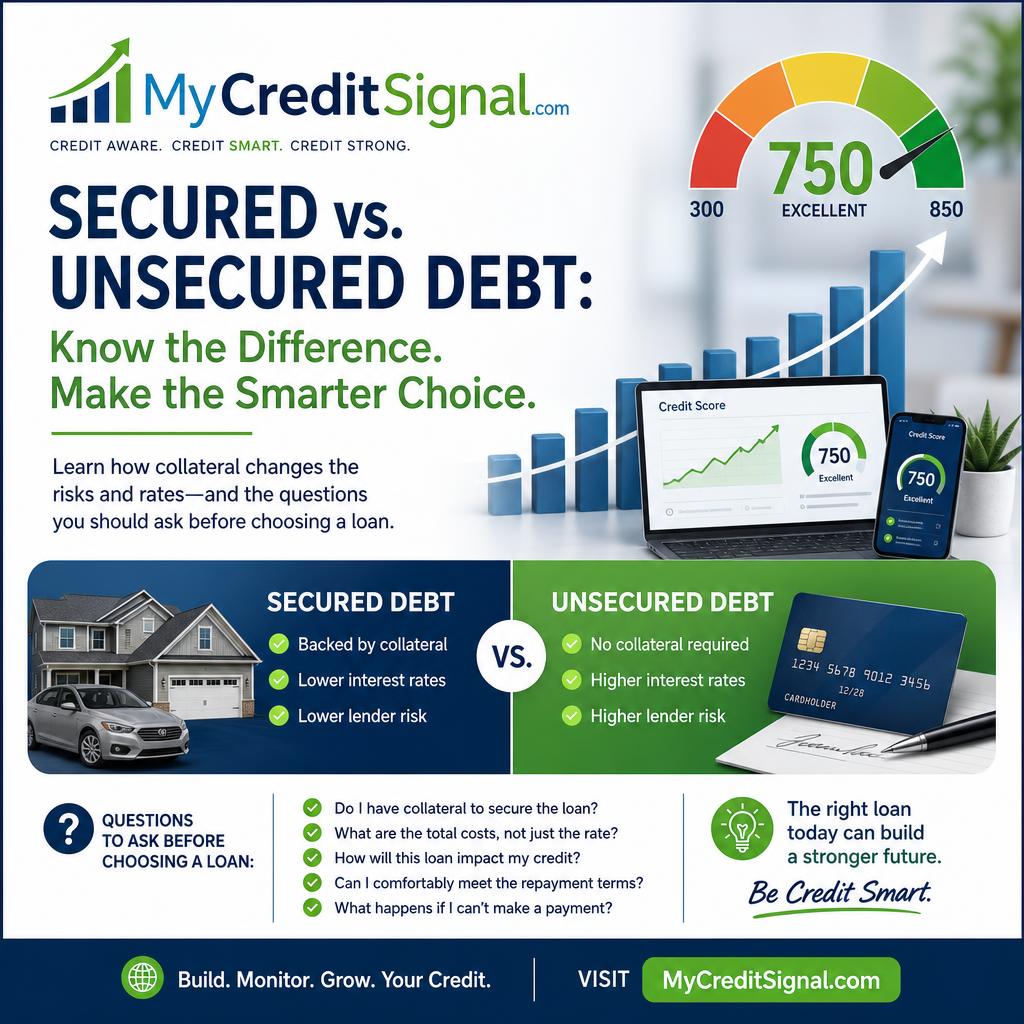
Secured debt is a loan backed by collateral, which is an asset pledged to support repayment. An auto loan commonly uses the car as collateral, while a mortgage uses the home. If the borrower defaults, the lender may generally pursue possession of the pledged asset according to the contract and applicable law.
Unsecured debt is not tied to a pledged asset. Most credit cards and some personal loans are unsecured. Approval and pricing rely more heavily on the borrower’s creditworthiness, income, and ability to repay. If the borrower defaults, the lender cannot simply seize a pledged car or home because none was provided. The lender may still use collection activity or pursue legal remedies.
The CFPB financial terms glossary defines the basic distinction as collateral versus no pledged asset. The FDIC also explains that many consumer loans can be structured as either secured or unsecured, depending on the product and lender.
How does collateral change the risk?
Collateral changes who faces the most direct loss after default. With secured debt, you may lose the asset connected to the loan. With unsecured debt, you do not have a pledged asset at risk, but the unpaid balance can still result in collection efforts, lawsuits, or damage to your credit history.
That tradeoff is easy to miss when a secured loan has a lower advertised rate. A lower rate can reduce borrowing cost, but it does not remove the consequences of missing payments. Consider both the monthly payment and the importance of the asset to your housing, transportation, or work.
Which costs and credit factors matter most?
The interest rate is only one part of the comparison. Before selecting either debt type, evaluate the annual percentage rate, origination or account fees, required collateral, repayment schedule, late-payment consequences, and whether the payment fits your budget during a difficult month.
MyFICO reports that the amount of debt category influences about 30% of a FICO Score. That does not mean secured debt is harmless or unsecured debt is automatically damaging. Credit scoring models consider factors such as payment history, amounts owed, utilization, and debt types. Results vary by credit profile and scoring model.
Credit utilization is the ratio of current revolving debt to available revolving credit. It is most directly associated with credit cards and other revolving accounts, not a fixed installment balance such as a mortgage or auto loan. A high card balance can lower a score regardless of whether another loan is secured.
For example, imagine a borrower comparing a $10,000 secured loan with a $10,000 unsecured personal loan. The secured option may have a lower rate because the lender has collateral, but the borrower must ask what asset is pledged and what happens after missed payments. The unsecured option avoids that specific collateral risk, but it may cost more and still create serious credit and collection consequences if payments stop.
How should you choose between the two loan types?
Use this simple decision framework: choose secured borrowing only when the collateral is appropriate, the payment is comfortably manageable, and the lower-cost terms justify putting that asset at risk. Consider unsecured borrowing when protecting a specific asset matters more than potentially receiving the lowest rate, and when the payment still fits your cash flow.
Start with the purpose of the money. A mortgage or auto purchase naturally involves an asset that can serve as collateral. A medical expense, moving cost, or general household need may be financed with an unsecured product, depending on approval and terms. Do not pledge a home or vehicle merely to make a payment look smaller without examining the full consequences.
Next, compare the offers on equal terms. Ask for the total amount borrowed, APR, fees, payment amount, number of payments, total repayment amount, collateral requirement, and default provisions. The Federal Reserve notes that secured small-dollar loans often have lower interest rates than unsecured personal loans because of collateral, but actual pricing depends on underwriting and product design.
What should you do first this week?
A good comparison starts with facts you can verify, not with the lowest headline rate. Complete these actions in order.
List the purpose and essential asset
Write down why you need the money and whether the borrowing is connected to a car, home, or other asset. Mark the asset as essential, useful, or replaceable. Avoid pledging an essential asset until you understand the default terms.
Calculate a payment you can actually carry
Review your current monthly obligations, income, and necessary expenses. Use a conservative payment amount rather than the maximum a lender offers. You can compare loan scenarios with the loan comparison calculator before discussing an offer.
Check your debt-to-income picture
Debt-to-income ratio compares monthly debt obligations with gross monthly income. Calculate it before applying so you can see how a new payment changes your borrowing picture. The debt-to-income calculator can help organize the numbers.
Request the full terms in writing
Ask the lender to identify the collateral, interest rate or APR, fees, payment schedule, late-payment policy, and what default may trigger. Do not rely on a verbal description of what happens if payments are missed.
Compare total cost and worst-case outcome
Put the secured and unsecured offers side by side. Then answer two questions: How much will each option cost if paid as agreed, and what could I lose if my income falls or the loan becomes unaffordable? This prevents a lower rate from hiding a larger personal risk.
Protect your credit after choosing
Set up reminders or automatic payments for at least the required amount, keep revolving balances manageable, and review your account statements. Payment history and debt management matter for both secured and unsecured accounts.
If the borrowing is part of a broader payoff effort, read this practical guide to mastering debt payoff strategies before adding another account. A new loan can change your monthly cash flow even when it lowers the rate on an existing balance.
What mistakes make the comparison go wrong?
Mistake 1 Choosing only by the interest rate
Behavior: Selecting the offer with the lowest advertised rate without reviewing collateral or fees. Consequence: You may accept a lower-cost loan that puts an essential asset at risk or costs more than expected after fees. Fix: Compare APR, total repayment, collateral, and default terms together.
Mistake 2 Treating unsecured debt as consequence-free
Behavior: Assuming that no collateral means missed payments do not matter. Consequence: Unpaid unsecured debt can lead to collection activity, legal action, and negative credit consequences. Fix: Contact the lender early if a payment problem is developing and review your available options.
Mistake 3 Assuming a secured loan builds credit automatically
Behavior: Taking a secured account because it sounds credit-friendly, then carrying high balances or missing payments. Consequence: Credit results depend on reported payment behavior, utilization where applicable, debt levels, and the scoring model. Fix: Use only an account you can manage consistently and confirm how the lender reports the account.
Mistake 4 Pledging an asset to solve a cash-flow problem
Behavior: Using a home or vehicle as collateral without fixing the monthly budget gap. Consequence: The loan may postpone the problem while increasing the stakes of default. Fix: Identify the cause of the shortfall first and borrow only when the payment plan is sustainable.
What does secured versus unsecured debt leave out?
The label alone does not tell you whether a loan is affordable, fairly priced, or appropriate. Two unsecured loans can have very different rates and fees. Two secured loans can carry different collateral rules and default procedures. Your credit history, income, lender policies, loan purpose, and product design all influence the offer.
Credit-building products also require careful reading. A secured credit card usually requires a deposit that supports the credit line, but it is still a revolving account rather than an installment loan. A secured card can help establish or rebuild credit when used responsibly, but it does not guarantee an immediate score increase. Payment history and utilization remain important.
Debt type can contribute to a lender’s view of risk, but no single account category guarantees approval or a particular score change. FICO and VantageScore use different models, and lenders may use different versions or additional underwriting information.
Questions borrowers ask about secured and unsecured debt
Do secured loans hurt my credit score more or less than unsecured loans?
Neither type automatically hurts or helps more. Payment history, debt levels, revolving utilization, account age, and the scoring model generally matter more than the secured or unsecured label. A missed payment can create credit problems on either type of account.
What happens to collateral if I default on secured debt?
The lender may be able to take possession of the pledged asset under the loan agreement and applicable law. Review the contract for the default process, and contact the lender promptly if you expect difficulty paying.
Can unsecured debt still lead to legal action?
Yes. Unsecured debt has no pledged asset for a lender to seize directly, but collection efforts or a lawsuit may still be possible. The FTC explains that federal consumer protections govern many debt collection practices.
Tools to compare your borrowing choices
Use the loan comparison calculator to organize payment and cost scenarios, then check how a new obligation affects your overall debt picture with the debt-to-income calculator. These free tools can help you compare before an application creates a hard inquiry or a new account.
For broader guidance on choosing what to pay first, see how to prioritize debt payoff the smart way. If you want a personalized plan for your exact situation, the optional personalized Credit Signal Action Plan is available as a one-time paid resource; the free tools remain free.
Get weekly credit tips, tool updates, and practical guides – free.
The bottom line
Secured debt uses collateral and may offer lower interest rates because the lender has an asset supporting repayment. Unsecured debt does not require a pledged asset, but default can still affect your credit and lead to collection or legal action. The best choice is the one whose payment fits your budget and whose worst-case consequence you fully understand.
Before accepting an offer, compare the total cost, required collateral, credit implications, and default terms. Start with the loan comparison calculator, check your debt-to-income ratio, and make the decision based on sustainable cash flow rather than the lowest advertised rate.
Want to understand your credit report?
Get plain-English explanations with our free AI Credit Analyzer →
Leave a Reply
You must be logged in to post a comment.