
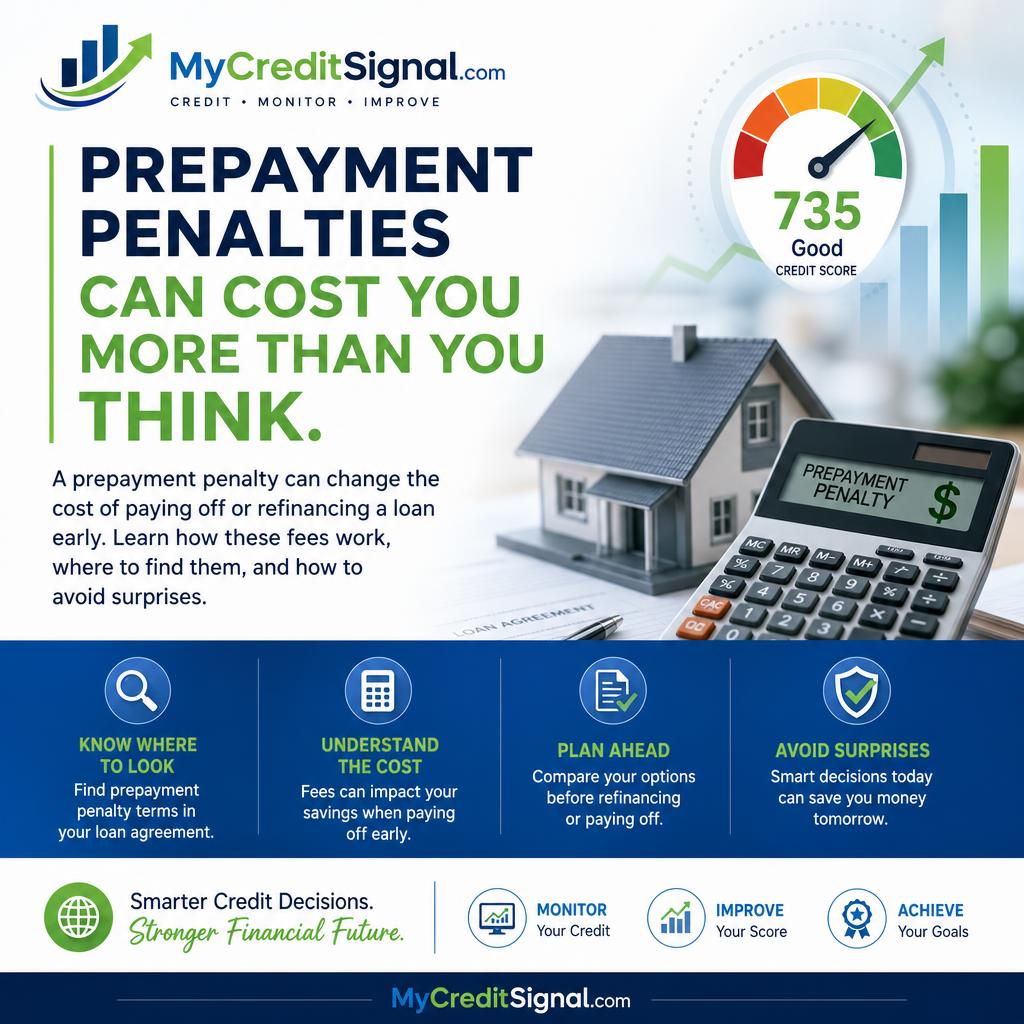
You may be ready to pay off a mortgage, refinance an auto loan, or send a large extra payment, only to discover a fee for doing it early. A prepayment penalty is a charge a lender may impose when you pay all or part of a loan before the scheduled end of its term. This guide is for borrowers comparing loans, considering refinancing, or preparing an early payoff. You will learn where the penalty appears, how to compare it with your potential savings, and what to ask before signing.
The practical answer is simple: do not assume a penalty exists, but do not assume it does not. Read the loan agreement and required disclosures, confirm the exact payoff amount with the lender, and compare every fee with the interest or other costs you expect to avoid. Many government-backed loans and some other products restrict or prohibit these charges, but the loan type and contract control your decision.
Contents
- 1 Who needs to check for a prepayment penalty?
- 2 What is a prepayment penalty in plain English?
- 3 How much could the penalty add to your payoff?
- 4 Where can you find the penalty terms?
- 5 Which loans are more likely to restrict the fee?
- 6 Your decision framework for paying early or refinancing
- 7 What should you do this week?
- 8 Prepayment penalty mistakes that can cost you
- 9 What can change the answer?
- 10 Frequently asked questions
- 11 Helpful tools and related resources
- 12 The bottom line
Key Takeaways
- A prepayment penalty is a fee for paying a loan early, either in full or sometimes in part.
- Mortgage disclosures must state whether a penalty applies and describe its terms.
- Some penalties decline or end during a defined period; certain high-cost mortgage rules restrict them more tightly.
- Before refinancing or making a large payment, compare the penalty with the savings and request the lender’s payoff figure.
Who needs to check for a prepayment penalty?
Anyone planning to end a loan early should check. That includes a homeowner weighing a refinance or sale, a borrower receiving money that could reduce principal, and an auto or personal-loan customer considering an early payoff. The fee can affect whether a seemingly attractive refinancing offer actually reduces total cost.
Borrowers who plan to keep a loan until its scheduled end may have less immediate concern, but the clause can still matter if their plans change. A job move, home sale, inheritance, business payment, or lower-rate refinance can turn an overlooked term into a real cost.
This advice is not a substitute for reading the contract. State law, federal rules, lender policy, loan purpose, and loan program can all affect the result. If you are comparing offers, ask the lender for a version with no prepayment penalty and compare the complete costs rather than focusing only on the interest rate.
What is a prepayment penalty in plain English?
A prepayment penalty is a fee charged when a borrower pays all or part of a loan earlier than scheduled or during a specified penalty period. The charge must be disclosed in the loan documents, and the formula can vary by product and lender.
Some contracts describe the fee as a percentage of the remaining balance. Others specify an amount or use a formula tied to the timing of the payoff. The penalty may recede or end after a defined period. It is separate from the regular interest you owe through the payoff date, although the final payoff amount can include both interest and any applicable penalty.
For mortgages, the Loan Estimate is an important comparison document. Regulation Z requires mortgage disclosures to identify whether a prepayment penalty applies and explain relevant terms, including the period in which it can apply. The Consumer Financial Protection Bureau’s Regulation Z disclosure rules provide the regulatory framework.
How much could the penalty add to your payoff?
The exact amount depends on the contract. A useful first calculation is: estimated penalty equals the remaining balance multiplied by the stated percentage. If a contract uses a percentage and the stated rate is 2%, a remaining balance of $100,000 would produce a $2,000 estimated penalty before confirming the lender’s exact formula. That example illustrates the math only; your contract may use a different method or impose no penalty.
Some high-cost mortgage rules have included a maximum penalty of 0-2%, depending on the product and applicable regulation. A 2% figure is not a universal mortgage limit, and it should never be used as a substitute for the written terms. Ask the lender whether the fee is based on the original balance, remaining balance, amount prepaid, or another calculation.
Compare the penalty with the benefit you expect. For a refinance, estimate the interest and other savings over the period you expect to keep the new loan, then subtract the old loan’s penalty and refinancing costs. If the savings do not exceed the added costs, refinancing may not improve your position.
For a planned extra principal payment, ask whether partial prepayments are allowed and whether a minimum amount triggers the fee. Some loans allow small, frequent extra principal payments even when a penalty clause exists, but you must confirm the rule with the lender.
Where can you find the penalty terms?
Start with the section titled prepayment, early payoff, payoff charge, or similar language in the promissory note or mortgage agreement. Then compare it with the Loan Estimate and other closing disclosures. The documents should explain whether the charge applies, how it is calculated, and how long it can remain in effect.
Do not rely only on a verbal statement from a salesperson. Ask for the answer in writing and save the document with your loan records. If two documents appear inconsistent, pause and ask the lender to explain which term governs before signing.
For a current loan, request a written payoff quote for the date you are considering. A mortgage payoff amount can include principal, interest through a stated date, a prepayment penalty, and other charges. For an auto or personal loan, review the contract and ask customer service whether an early payoff fee applies. The CFPB guidance on prepaying a loan recommends checking the contract because rules differ by product.
Which loans are more likely to restrict the fee?
Many mortgage products cannot impose a prepayment penalty, while certain loan types and high-cost mortgage provisions restrict or prohibit penalties after a defined period. Some government-insured or government-guaranteed loans generally do not allow these fees, but you should verify the specific program and loan documents.
HOEPA is part of the Home Ownership and Equity Protection Act. In plain English, it provides protections for certain high-cost mortgages and restricts some loan terms, including prepayment penalties. Restrictions can depend on the product, timing, and applicable requirements, so avoid treating a general rule as a promise about your individual loan.
Auto loans and personal loans can also include prepayment penalties, although they are not universal. Product rules vary more widely, which makes the contract especially important. A penalty-free option may be available, but it can come with a different rate or other costs. Compare the total price rather than selecting solely by the absence of a fee.
Your decision framework for paying early or refinancing
Use a three-part test: contract, cost, and flexibility. First, confirm the penalty and the dates when it applies. Second, calculate the total savings after the fee and all new loan costs. Third, consider whether you value the ability to make extra payments or exit the loan later.
Choose to proceed when the payoff or refinance benefit is clear after all charges and the contract gives you acceptable flexibility. Wait or negotiate when the penalty consumes much of the expected savings, when the lender cannot explain the terms, or when you may need to sell or refinance during the penalty period.
For an organized comparison, use the loan comparison calculator to review competing loan costs, then use the refinance break-even calculator to estimate how long savings take to recover the upfront costs. The results are estimates, so include the lender’s confirmed penalty and payoff quote in your final decision.
What should you do this week?
The order matters. Confirm the contract before shopping for a new loan, and confirm the payoff amount before authorizing a large payment. These actions can help you avoid a costly surprise.
Find the early-payoff language
Search your loan documents for prepayment penalty, early payoff, or similar wording. Mark the fee formula, the penalty period, and any exception for partial payments.
Ask the lender five direct questions
Ask whether the fee applies, how it is calculated, when it ends, whether extra principal payments trigger it, and what the payoff amount would be on your target date. Request the answers in writing.
Request a dated payoff quote
Choose the date you are considering and ask for the total amount needed to pay off the loan then. Check whether the quote lists a penalty separately from principal and accrued interest.
Compare total costs
Put the current loan’s penalty, remaining interest, and other payoff costs next to the proposed loan’s fees, interest, and terms. Do not compare rates alone.
Ask for a penalty-free alternative
Before accepting an offer, ask whether the lender can remove the penalty or provide another product without one. Compare the complete terms because a fee-free option may have different costs.
Document your final choice
Save the contract, disclosures, payoff quote, and written answers. If you proceed, verify how the payment will be applied and obtain confirmation when the loan is closed or reduced.
Prepayment penalty mistakes that can cost you
Looking only at the interest rate
Behavior: Choosing a loan with a lower rate without checking early-payoff terms. Consequence: A later refinance or sale can create a fee that eliminates the expected savings. Fix: Compare the rate, fees, penalty, and likely holding period together.
Assuming every early payment is treated the same
Behavior: Sending a large extra principal payment without asking whether partial prepayment is restricted. Consequence: The payment may trigger a charge or be applied differently than expected. Fix: Confirm the lender’s partial-payment policy before sending the money.
Relying on a general government-loan rule
Behavior: Assuming a loan is penalty-free because it is associated with a government program. Consequence: A different loan type or contract provision may produce an unexpected cost. Fix: Verify the exact program and read the signed disclosures.
Skipping the payoff quote
Behavior: Estimating the payoff from the balance shown on a statement. Consequence: Daily interest, fees, or a penalty can make the actual amount different. Fix: Request a quote dated for the payoff you plan to make.
What can change the answer?
The same strategy does not fit every borrower. A penalty may be worth accepting if the savings from a refinance or sale are substantially greater and you expect to complete the transaction during the penalty period. Conversely, a penalty-free loan may be more valuable to someone who expects to move, refinance, or receive irregular funds.
Government-insured and government-guaranteed loans generally cannot include prepayment penalties under applicable regulatory guidance, but the phrase generally matters. Loan program status, transaction type, and the actual documents should be verified. The Federal Reserve guidance on prepayment penalties provides background on restrictions affecting certain federally regulated loans.
Rules also differ between mortgages and non-mortgage loans. A personal loan contract may use a different fee structure from a mortgage, and an auto lender may handle extra payments differently from a mortgage servicer. If the language is unclear, ask the lender for a plain-English explanation and consider professional advice before signing a high-cost agreement.
Frequently asked questions
How long do prepayment penalties typically last?
The period is set by the loan documents. Certain HOEPA and high-cost mortgage restrictions use a two-year timeframe, while other products may use different terms or prohibit the fee entirely. Check the contract for the exact end date.
Can refinancing avoid a prepayment penalty?
Refinancing does not automatically remove a penalty because paying off the old loan may trigger its early-payoff clause. A new loan without a penalty can improve future flexibility, but compare the old penalty and all refinancing costs with the expected savings.
Do auto loans and personal loans have prepayment penalties?
They can, but penalties are not universal and the rules differ by product. Review the contract and ask the lender whether the fee applies before making an early payoff or large extra payment.
Use the loan comparison calculator when evaluating a new offer, and use the refinance break-even calculator to see when upfront costs may be recovered. For broader payoff planning, review the debt avalanche method for saving interest and debt payoff strategies.
These free tools can organize the numbers, but they cannot replace the lender’s written payoff quote. Enter the confirmed penalty and fees once you have them.
Get weekly credit tips, tool updates, and practical guides – free.
The bottom line
Prepayment penalty explained simply means this: paying early can have a price, but the price is not automatic and it is not always allowed. Find the clause, confirm the calculation and end date, and compare the fee with the savings from paying off or refinancing.
Your next step is to request a written payoff quote and review it beside the proposed loan’s total costs. That small check can turn an uncertain early-payoff decision into a clear comparison.



Want to understand your credit report?
Get plain-English explanations with our free AI Credit Analyzer →
Leave a Reply
You must be logged in to post a comment.