
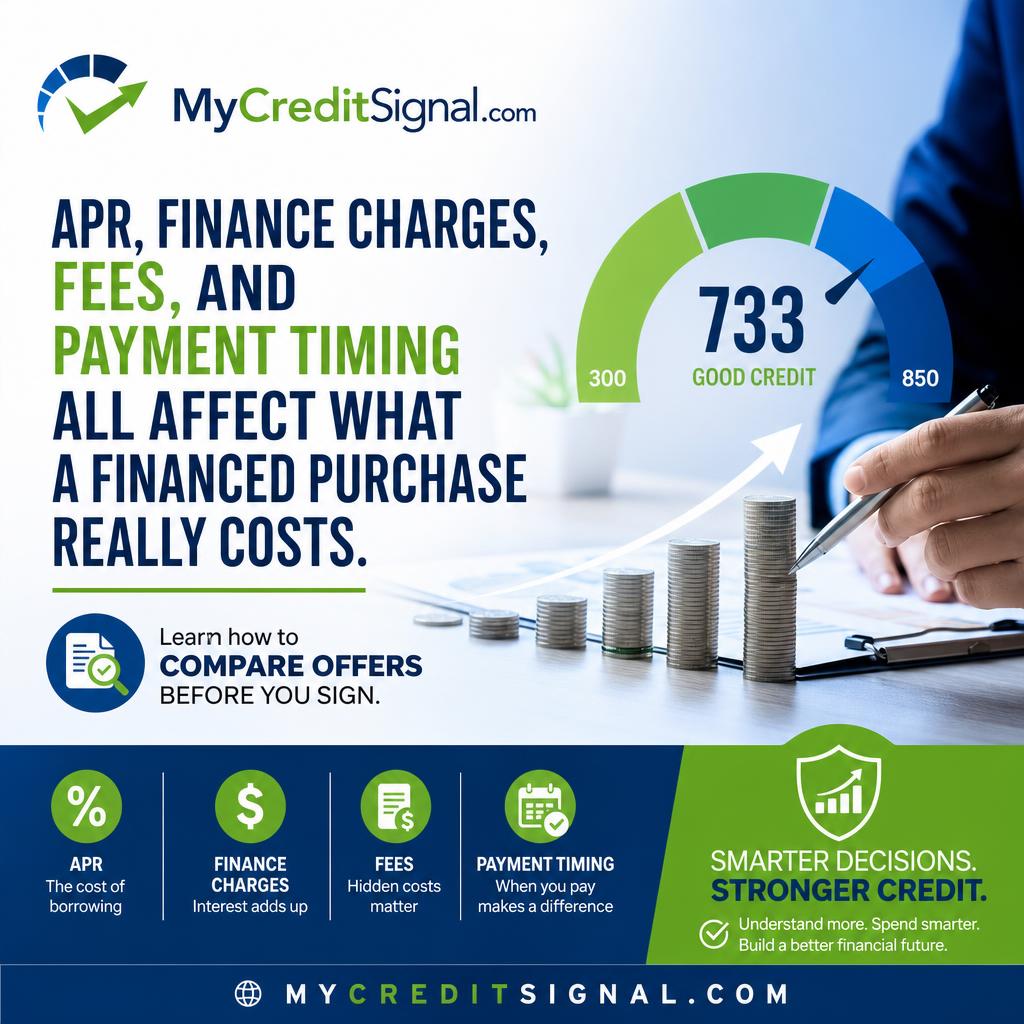
A purchase financed over time costs more than its sticker price because borrowing can add interest, fees, and other finance charges. The clearest way to measure that cost is to compare the annual percentage rate, or APR, the finance charge in dollars, the amount financed, and the payment schedule. This guide is for anyone comparing a loan, a credit card purchase, dealership financing, or another offer before committing to a payment.
By the end, you will have a practical way to identify the real cost of financing, compare offers from different lenders, and decide what to review first. You will also know why a lower advertised interest rate does not always mean a cheaper deal.
Contents
- 1 Who needs to calculate the cost of financing?
- 2 What is the difference between APR and the finance charge?
- 3 Why can the same purchase have different financing costs?
- 4 Which numbers should you compare first?
- 5 How do you judge whether the payment fits your budget?
- 6 A decision framework for choosing an offer
- 7 Your five-action financing checkup this week
- 8 Three financing mistakes that raise the real cost
- 9 When APR is not the whole story
- 10 Frequently asked questions about financing cost
- 11 Helpful tools and official resources
- 12 Conclusion
Key Takeaways
- APR includes interest and certain fees, so it is usually more useful than the nominal interest rate for comparing offers.
- The finance charge is the dollar amount paid to obtain credit, while APR expresses the annualized cost as a percentage.
- Compare the same amount financed and repayment period before choosing the offer with the lower overall cost.
- Review payment timing, promotional terms, and possible penalties before signing.
Who needs to calculate the cost of financing?
Anyone borrowing to make a purchase should care about the cost of financing, especially when the payment looks affordable but the repayment period is long. This includes shoppers considering auto loans, personal loans, store financing, credit card purchases, and short-term borrowing.
The calculation is particularly important when two lenders advertise different terms. A bank, credit union, dealership, finance company, or retailer may present the offer differently, but standardized disclosures are designed to help you compare the price of credit. The Consumer Financial Protection Bureau explains that APR is the standardized comparison measure for the total cost of credit and generally includes interest plus certain fees.
This approach may not be enough by itself for someone deciding whether to make the purchase at all. If the payment would crowd out rent, utilities, minimum debt payments, or essential savings, the first question is affordability rather than which lender has the lowest APR. Financing comparison helps you choose among affordable options; it does not turn an unaffordable purchase into a safe one.
What is the difference between APR and the finance charge?
APR is the yearly cost of borrowing expressed as a percentage, including interest and certain fees. A finance charge is the dollar amount paid to obtain credit, excluding repayment of principal. You need both figures because one supports percentage-based comparison and the other shows the cost in dollars.
For example, an offer can show the amount financed, the finance charge, the total of payments, the payment schedule, and the APR. The amount financed tells you how much credit is being provided. The finance charge tells you how much the credit costs in dollars. The total of payments combines the principal and the finance charge over the stated schedule.
The nominal interest rate is not the same as APR. A lender can quote a lower interest rate while charging fees that increase the APR. This is why the CFPB advises consumers to compare APR rather than relying only on the interest rate.
These disclosures are connected to the Truth in Lending Act, commonly called TILA. TILA requires lenders to present important cost-of-credit information in a uniform manner for many open-end and closed-end credit products. Open-end credit includes revolving accounts such as credit cards. Closed-end credit includes loans with a fixed amount and repayment schedule, such as many auto and personal loans. The FDIC explains how TILA disclosures support comparison shopping.
Why can the same purchase have different financing costs?
The same purchase can produce different financing costs because lenders may offer different APRs, fees, repayment periods, payment structures, or promotional terms. Your credit profile, the amount borrowed, the type of credit, and the lender’s pricing can all affect the offer.
Loan term is also important. A longer repayment schedule may reduce the required payment while extending the time interest can accrue. A shorter schedule may require a larger payment but can reduce the time the balance remains outstanding. You should compare both the monthly payment and the total finance charge rather than treating either figure as the complete answer.
Dealer financing and bank financing can differ as well. The CFPB notes that the financing source can affect the stated rate and total cost, while APR disclosure gives you a common comparison point. Ask for the complete written terms from each source instead of comparing a dealer’s monthly payment with a bank’s advertised rate.
Which numbers should you compare first?
Start with the amount financed, APR, finance charge, total of payments, payment amount, payment frequency, and repayment length. These figures answer different questions, so skipping one can produce a misleading comparison.
- Amount financed: How much credit are you actually receiving after permitted deductions and financed charges?
- APR: What is the annualized cost of credit, including interest and certain fees?
- Finance charge: How many dollars will the credit cost over the stated terms?
- Total of payments: How much will you pay if you follow the schedule through its end?
- Payment schedule: When are payments due, and how often will they be withdrawn or billed?
- Promotional terms: Does a temporary offer change later, or does it require a particular payment behavior?
A useful comparison formula is simple: total of payments minus amount financed equals the stated cost paid over the life of the credit. That result should be checked alongside APR because the formula depends on the same disclosed terms and does not explain every feature of the agreement.
Use the loan comparison calculator to place competing offers side by side. Enter matching information whenever possible, then investigate any large difference in APR, finance charge, or total payments.
How do you judge whether the payment fits your budget?
A payment fits your budget only when it can be made alongside essential expenses, existing obligations, and a reasonable cash buffer. Do not judge affordability by the payment alone; include the purchase’s ongoing costs and the possibility that income or expenses may change.
For a vehicle, that broader review may include insurance, fuel, maintenance, registration, and taxes. For a financed appliance or home improvement, it may include installation, service, or replacement costs. For a credit card purchase, the cost depends heavily on how quickly you pay the balance and whether the account remains subject to interest.
Write down your available monthly cash after essential spending and existing required payments. Then compare the new payment with that amount. If the payment would leave no room for irregular expenses, a lower payment created by a longer term may not solve the underlying problem. It may simply keep the obligation in your budget for longer.
A decision framework for choosing an offer
Use a first, next, later framework to avoid getting distracted by a low advertised payment.
- First: Confirm that the purchase and payment fit your cash flow. Eliminate offers that require you to skip essentials or rely on uncertain income.
- Next: Compare APR, finance charge, total payments, and payment timing for offers covering the same amount.
- Later: Review optional products, early payoff rules, promotional conditions, and whether making extra payments changes the cost.
Choose the offer that is affordable and has the lowest cost under terms you can realistically follow. A lower APR is not helpful if the payment schedule is incompatible with your paydays or the contract includes a condition you cannot meet.
Your five-action financing checkup this week
Collect the full disclosures
Ask each lender or seller for the written offer showing APR, finance charge, amount financed, payment amount, total payments, and repayment schedule. Do not rely on a verbal quote or a payment shown without supporting terms.
Separate price from credit cost
Write down the purchase price and the amount financed separately. Then identify any down payment, trade-in value, financed fees, or optional products so you can see what is being borrowed.
Compare matching offers
Use the same purchase amount and, when possible, the same repayment period in each comparison. Use the APR to daily rate converter if you need help understanding how an annualized rate relates to a shorter period, while remembering that the contract APR remains the primary comparison figure.
Test the payment against real cash flow
Review recent spending and list the new payment beside existing obligations and recurring purchase costs. Check whether the payment is due before or after your main income arrives.
Ask about flexibility before signing
Ask whether extra payments are applied to principal, whether any prepayment penalty applies, and what happens if a promotional period ends. Confirm the answers in the contract rather than relying on a salesperson’s summary.
Make a payoff priority
If you already have expensive debt, decide whether the new purchase should wait. When you are paying several balances, the debt avalanche method for saving interest can help you prioritize balances by cost while keeping required payments current.
Three financing mistakes that raise the real cost
Choosing the lowest monthly payment
Behavior: Selecting the offer with the smallest payment without reviewing the term or total payments. Consequence: You may pay for the purchase longer and incur a larger finance charge. Fix: Compare payment, APR, finance charge, and total payments together.
Comparing interest rates instead of APRs
Behavior: Treating the nominal interest rate as the complete borrowing cost. Consequence: Fees may make the offer more expensive than a higher-rate offer with fewer charges. Fix: Use APR for the initial comparison, then inspect the fee disclosures.
Accepting a promotional offer without reading the exit terms
Behavior: Focusing on the introductory rate or payment while ignoring what happens afterward. Consequence: The cost or payment structure may change when the promotion ends. Fix: Record the promotional period, later terms, and required payment behavior before accepting.
Ignoring payment timing
Behavior: Assuming an affordable monthly amount will work regardless of its due date. Consequence: A poorly timed payment can strain cash flow and increase the risk of late payment. Fix: Match the due date to your income schedule when the lender permits it and keep the due date visible in your budget.
When APR is not the whole story
APR is designed for comparison, but it is not a guarantee that every borrower will experience the same final cost. Credit cards are open-end credit, so the balance, purchases, payments, and interest charges can change over time. A closed-end loan is easier to model when the rate and payment schedule are fixed, but the contract still controls the details.
Short-term loans deserve special caution. A loan can have a short nominal term and still show a very high APR because APR annualizes the cost. The CFPB specifically warns that payday and other short-term loans can look less expensive when viewed only through the short borrowing period. Always review the dollar finance charge and repayment obligation, not just the time until the first payoff date.
Early payoff also requires a contract check. Paying early may reduce future interest in many consumer loans, but some agreements can include prepayment provisions or other conditions. Ask how an extra payment is applied and whether any fee applies before sending additional money.
Frequently asked questions about financing cost
Why does APR matter when shopping for financing?
APR matters because it standardizes the annualized cost of credit and includes interest plus certain fees. It lets you compare offers more fairly than comparing nominal interest rates alone.
Why might two lenders offer different APRs for the same amount?
Lenders can price the same amount differently because of their fees, underwriting, loan terms, product type, and assessment of the borrower. Compare the complete disclosures for the same amount and repayment period.
How should I use the finance charge when budgeting?
Use the finance charge to understand the total dollar cost of borrowing over the stated terms, then use the payment schedule to plan cash flow. The finance charge does not replace checking the APR or the contract’s conditions.
Helpful tools and official resources
Start with the loan comparison calculator when you have more than one written offer. The APR to daily rate converter can help translate an annualized rate into a shorter-period view for learning purposes.
For a clear explanation of interest rate versus APR, review the CFPB explanation of APR and interest rate. The FDIC TILA examination guidance explains why lenders disclose APR and finance charges in a uniform way. You can also review the Federal Reserve consumer credit data for independent information about credit conditions and lending categories.
Get weekly credit tips, tool updates, and practical guides – free.
Conclusion
The real cost of financing is not just the advertised interest rate or the monthly payment. Compare APR, finance charge, amount financed, total payments, payment timing, and contract conditions before deciding.
Your next step is to gather the complete disclosures for the purchase, enter matching offers into a comparison tool, and test the resulting payment against your actual cash flow. A few minutes of comparison can help you choose financing that is both less expensive and easier to manage.


Want to understand your credit report?
Get plain-English explanations with our free AI Credit Analyzer →
Leave a Reply
You must be logged in to post a comment.