
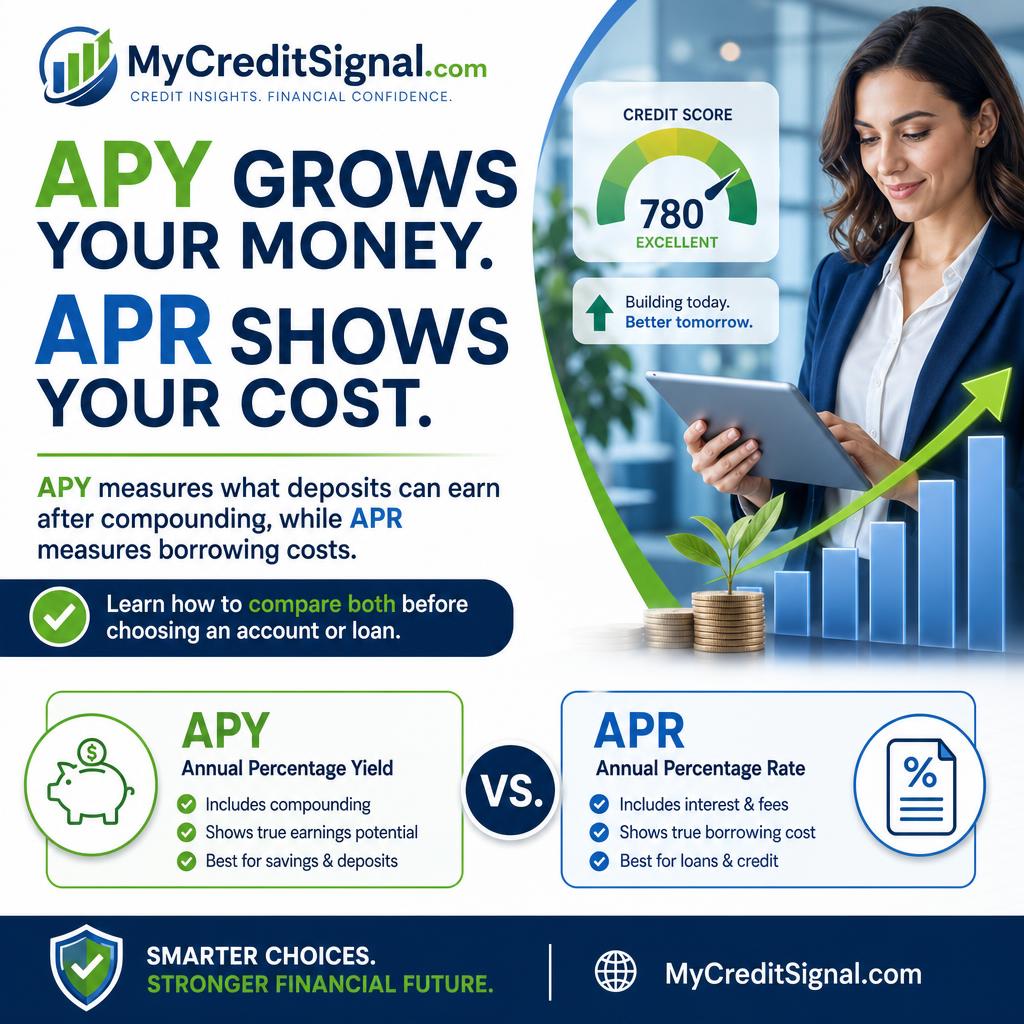
You are comparing a savings account showing one percentage and a loan showing another, and both sound like annual costs or returns. The practical distinction is simple: APY measures the yearly return on money you deposit after compounding, while APR measures the yearly cost of money you borrow, including interest and most fees. This APY vs APR explained guide is for anyone choosing a savings account, certificate of deposit, credit card, personal loan, or mortgage. By the end, you will know which number to use, what it leaves out, and how to compare offers without relying on an attention-grabbing rate alone.
APY and APR are not interchangeable. APY belongs primarily on deposit products; APR belongs primarily on credit and loan products. Comparing the right number with the right product can help you estimate earnings, identify borrowing costs, and ask better questions before opening an account or accepting an offer.
Contents
- 1 Who needs to understand APY versus APR?
- 2 What does APY mean on a savings account?
- 3 What does APR mean on a loan or credit card?
- 4 Why can APY be higher than the stated interest rate?
- 5 How should you compare APRs and total loan costs?
- 6 What numbers matter most for savers and borrowers?
- 7 What should you do first this week?
- 8 Which APY and APR mistakes cost people the most?
- 9 What does APY versus APR leave out?
- 10 APY versus APR frequently asked questions
- 11 Helpful tools and resources
- 12 Make the percentage work for your decision
Key Takeaway
Use APY to compare potential deposit earnings and APR to compare borrowing costs, then check fees, terms, compounding, and total payments before deciding.
Who needs to understand APY versus APR?
Anyone deciding whether to save, borrow, or pay down debt can benefit from understanding the difference. A saver uses APY to compare how much an account may earn. A borrower uses APR to compare the yearly cost of credit. Someone managing both needs to consider the tradeoff between earning interest on available cash and reducing interest charged on debt.
This comparison is especially useful if you are:
- Choosing between savings accounts with different compounding schedules or account terms.
- Comparing personal loans, auto loans, mortgages, or credit card offers.
- Deciding whether cash should remain in savings or be used to reduce expensive debt.
- Reviewing an offer that advertises a low interest rate but lists separate fees.
- Building a financial plan and need to understand the difference between money working for you and money costing you.
You may need a more specialized approach if the product has a promotional rate, a variable rate, an unusual fee schedule, or a short introductory period. In those cases, neither one headline percentage tells the entire story. Read the account agreement or loan disclosure and compare the actual dollars involved.
What does APY mean on a savings account?
APY, or annual percentage yield, is the actual yearly return on a deposit when compounding is taken into account. Compounding means previously credited interest can itself earn interest. When an account compounds more than once per year, its APY can be higher than its nominal interest rate because APY incorporates that compounding effect.
For example, a bank might describe an account using an interest rate and an APY. The interest rate is the stated rate used to calculate interest, while APY expresses the annual result if the money remains deposited and the account follows its stated compounding and crediting terms. APY is therefore the more useful figure for comparing deposit products on an apples-to-apples basis.
The Federal Reserve explains APY as a rate of return that accounts for compounding. The Federal Reserve APY overview provides the regulatory calculation concepts behind deposit disclosures.
What does APR mean on a loan or credit card?
APR, or annual percentage rate, is the annual cost of borrowing expressed as a percentage and generally includes interest plus most applicable fees. It is designed to provide a broader cost comparison than the interest rate alone. A loan can have a stated interest rate and a higher APR because the APR reflects certain charges associated with obtaining the credit.
For a credit card, APR commonly helps describe the cost of carrying a balance. If you pay the statement balance in full according to the card terms, you may avoid interest on purchases during a grace period, but the exact rules depend on the account agreement. A card’s APR does not tell you how much interest you will pay without knowing the balance, payment timing, and fees.
For a mortgage or installment loan, APR can make two offers easier to compare because it incorporates interest and certain costs. The Consumer Financial Protection Bureau explanation of mortgage APR distinguishes the interest rate from the broader annual percentage rate.
Why can APY be higher than the stated interest rate?
APY can be higher than the nominal interest rate when interest compounds more than once each year. The reason is that credited interest becomes part of the balance used for later interest calculations. The difference depends on the stated rate and compounding frequency, so do not assume that every account with the same nominal rate has the same APY.
Consider two deposit offers with the same stated interest rate. If one compounds more frequently, it may show a slightly higher APY. Rather than calculating the difference yourself, compare the disclosed APY first, then examine whether the rates are fixed or variable, whether a minimum balance applies, and how often interest is credited.
For deposits, APY is useful because it turns compounding into a single annual comparison number. It does not mean the account pays that entire percentage as a simple, upfront bonus. The timing of deposits and withdrawals still matters.
How should you compare APRs and total loan costs?
Start with APR, but do not stop there. A careful loan comparison also reviews the amount borrowed, repayment term, monthly payment, origination charges, recurring fees, prepayment rules, and total payments over the life of the loan.
Suppose Offer A has a lower APR but a longer repayment term, while Offer B has a higher APR but a shorter term. Offer A might have a lower monthly payment but still produce more total interest because the balance remains outstanding longer. Conversely, a lower APR can be valuable if the loan amount and term are the same. The right comparison depends on matching the major variables.
Use this decision framework:
- Same amount and same term: the lower APR is usually the stronger starting point, subject to fees and terms.
- Different terms: compare monthly payment and total payments, not APR alone.
- Different fees: identify which fees are included in APR and which are not.
- Variable rate: ask how and when the rate can change and what could cause the payment to rise.
- Credit card: compare purchase, balance-transfer, and cash-advance APRs separately when more than one applies.
The CFPB advises consumers to make careful comparisons using APR and total cost information. The CFPB APR guidance explains why APR may exceed an advertised interest rate and why total cost still deserves attention.
What numbers matter most for savers and borrowers?
The most important number depends on which side of the transaction you are on. For a deposit, begin with APY. For a loan, begin with APR and total payments. Then check the details that can change the result.
For deposit accounts
- APY: the main annual return comparison after compounding.
- Balance requirements: a minimum balance can determine whether you receive the advertised APY.
- Rate type: a variable APY can change, so today’s figure may not last.
- Access rules: withdrawal restrictions or early-withdrawal penalties may matter more than a small rate difference.
- Account term: a CD may offer a stated APY in exchange for keeping funds deposited for a set period.
Research context includes an indicative national savings APY of 6%, while a separate regulatory example references a typical short-term CD APY of 4% for illustrative disclosure purposes. These figures are not universal offers. Actual APYs vary by institution, product, balance, and date, so use the current disclosure for the specific account you are considering.
For credit products
- APR: the annual borrowing-cost comparison.
- Fees: application, origination, annual, transfer, or other charges may affect your actual cost.
- Term: a longer term can lower the payment while increasing the time interest accrues.
- Promotional period: a temporary rate may change after the introductory period.
- Total payments: the clearest dollar measure of what the loan costs if you follow the scheduled repayment.
Credit scores can influence the APR a lender offers, but the score alone does not determine the full cost. Mainstream FICO scores generally use a 300–850 range, and a score around 670 is often described as a starting point for good credit in commonly cited FICO ranges. Lenders may use different scoring models, so results can vary by credit profile, model, product, income, debt, and application details.
What should you do first this week?
Use the following sequence to turn the comparison into a decision. Do the first three actions before applying for a new loan or moving a large deposit.
Identify whether you are saving or borrowing
Write down the product category first. If money is going into an account, focus on APY. If money is being advanced to you, focus on APR, fees, and total payments. This prevents the most basic comparison error.
Collect the complete disclosures
Save the account rate sheet or loan estimate for each option. Record the APY or APR, fee amounts, term, rate type, minimum balance, and any promotional end date. Do not compare a detailed offer with a headline advertisement.
Put the offers on the same basis
For savings, compare the same starting balance and expected holding period. For loans, compare the same borrowed amount and, when possible, the same repayment term. If the terms differ, write down both monthly payment and total scheduled payments.
Calculate the practical dollar effect
Estimate what the deposit could earn or what the loan could cost under each offer. A rate difference matters only in relation to your balance, loan amount, and time. Use the APR to daily rate converter when you need to translate an APR into a daily-rate estimate for planning.
Check flexibility before chasing the headline rate
Ask whether you can withdraw funds, make extra loan payments, or change the account without a penalty. A slightly better APY may not fit money you need soon, and a lower APR may not be worthwhile if the fees or repayment restrictions do not fit your budget.
Review the decision after one billing or statement cycle
Confirm that the rate, fee, payment, and balance behavior match the disclosure. For a credit card, check whether interest or a fee appeared. For a deposit, verify the credited interest and whether the account met its conditions.
If you are comparing multiple loans with different terms, the loan comparison calculator can help organize the payment and cost tradeoffs. If debt is already competing with savings goals, review the debt avalanche method before deciding where extra money should go.
Which APY and APR mistakes cost people the most?
Mistake 1 Comparing APY with a loan APR
Behavior: Treating the two percentages as if they measure the same thing. Consequence: You may mistake a deposit yield for a borrowing cost or choose the wrong product. Fix: Use APY for deposit earnings and APR for credit costs.
Mistake 2 Choosing the lowest advertised number
Behavior: Selecting a loan based only on the interest rate or a savings account based only on a promotional APY. Consequence: Fees, balance rules, or a changing rate can make the real outcome less favorable. Fix: Read the disclosure and compare total payments or actual account conditions.
Mistake 3 Ignoring the repayment term
Behavior: Comparing APRs while overlooking that one loan lasts longer. Consequence: A lower payment can hide a higher total cost. Fix: Compare the amount borrowed, term, monthly payment, APR, fees, and total payments together.
Mistake 4 Assuming APY is guaranteed forever
Behavior: Building a long-term plan around today’s variable savings APY. Consequence: Future earnings may be lower after the institution changes the rate. Fix: Treat a variable APY as current information, not a permanent promise, and revisit it periodically.
What does APY versus APR leave out?
Both figures are useful summaries, but neither replaces the full product terms. APY does not tell you whether the account is convenient for your cash needs, whether the rate can change, or whether a withdrawal restriction applies. APR does not necessarily capture every cost in every situation, and the actual dollars paid depend on your balance, payment behavior, loan term, and fees.
APR also may not predict your personal credit card cost if you pay in full, because interest can depend on whether you carry a balance and how the card’s grace period works. Likewise, APY may not describe your actual return if you add or withdraw money during the year. These figures are comparison tools, not personal guarantees.
Also remember that a lower borrowing cost is not automatically the best choice if the payment is unaffordable. Missing payments can create additional fees and financial stress, while stretching a loan term can keep debt in your budget longer. Choose an offer you can manage consistently, not merely the one with the most attractive percentage.
APY versus APR frequently asked questions
What is the difference between APY and APR?
APY measures the annual return on deposited money after compounding. APR measures the annual cost of borrowed money and generally includes interest plus most fees.
Why can APY be higher than the stated savings rate?
APY can be higher because it includes the effect of compounding. When interest is credited more than once per year, previously credited interest can contribute to later earnings.
Is a lower APR always the cheapest loan?
No. The lowest APR is a strong starting point when loan amounts and terms match, but total cost also depends on fees, term, payment schedule, and other conditions. Compare total payments before choosing.
Do all lenders use the same credit score model?
No. FICO and VantageScore are common U.S. scoring models, and lenders can use different versions or models. A score and resulting APR can therefore vary by lender, product, and credit profile.
Helpful tools and resources
Use the loan comparison calculator to organize competing loan offers, and try the APR to daily rate converter when you want a daily planning estimate. For related debt decisions, the minimum payments cost guide explains why making only required payments can extend repayment and increase interest.
For authoritative background, review the Experian APR versus APY overview and the Federal Reserve’s APY calculation guidance. Deposit advertisements also have disclosure requirements: the CFPB states that when APY appears in an advertisement, the term annual percentage yield must be stated at least once.
Get weekly credit tips, tool updates, and practical guides – free.
Make the percentage work for your decision
The central rule is easy to remember: APY tells you what a deposit may earn, while APR tells you what borrowing may cost. Use those figures as the opening comparison, then verify compounding, fees, balance requirements, rate changes, repayment length, and total dollars.
This week, gather the disclosures for the account or loan you are considering, put the offers on the same basis, and run the numbers before making a move. A clear comparison will not remove every financial tradeoff, but it can help you avoid choosing a product based on the wrong percentage.



Want to understand your credit report?
Get plain-English explanations with our free AI Credit Analyzer →
Leave a Reply
You must be logged in to post a comment.