
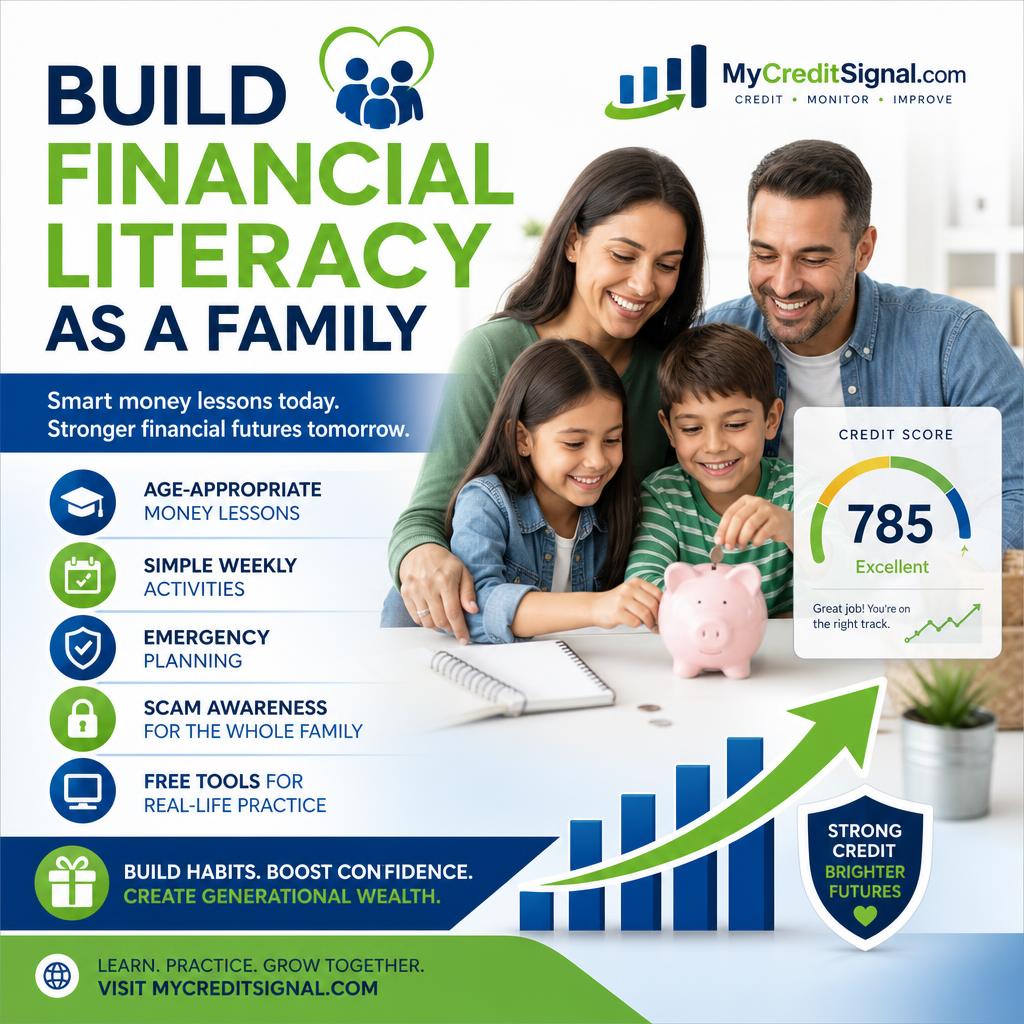
A teenager asks whether a buy-now, pay-later offer is really affordable, while a younger child wants to spend every dollar immediately. Those everyday moments are opportunities to build family financial literacy without turning the home into a classroom. Family financial literacy means developing the knowledge and skills to budget, save, borrow, pay bills, spot scams, and plan for future needs.
This guide is for parents, caregivers, and families who want a practical plan for this year. You will learn what to teach first, how to adapt lessons for different ages, and how to practice money decisions with real household examples. The goal is not to make every family follow one perfect budget. It is to create repeatable conversations and small routines that help each person make safer, more informed choices.
Contents
- 1 Who needs a family financial literacy plan?
- 2 What does financial literacy include at home?
- 3 Which money lessons should come first?
- 4 What numbers should families practice together?
- 5 How can you build family financial literacy this week?
- 6 What mistakes can weaken money lessons?
- 7 What does family financial literacy often miss?
- 8 Which federal resources can families use?
- 9 Family financial literacy FAQ
- 10 Helpful tools for practicing at home
- 11 Make the next money decision a lesson
Key Takeaway
Start with one weekly money conversation, connect lessons to real decisions, and teach budgeting, saving, credit, and scam awareness as related skills.
Who needs a family financial literacy plan?
Any household can benefit from a shared money-learning routine, especially families with children approaching their first job, bank account, debit card, or credit product. It is also useful when a family is adjusting to irregular income, preparing for education costs, or trying to build savings while managing current bills.
Children do not need to know private household details to learn useful principles. You can discuss choices using rounded examples, such as how a grocery budget works or why a family compares prices, without sharing income, account numbers, or sensitive debt information. Teenagers can gradually learn more about payment due dates, interest, borrowing, and the long-term cost of missed decisions.
A different approach may be necessary when money conversations trigger conflict, when a child has a disability that affects decision-making, or when income and expenses change rapidly. In those situations, use shorter lessons, visual aids, trusted professionals, or a private adult planning session before introducing a family activity.
What does financial literacy include at home?
Financial literacy is the knowledge and skills needed to manage money well, including budgeting, saving, borrowing, paying bills, and planning for future financial needs. At home, it works best as a set of connected habits rather than a list of definitions.
Budgeting
Budgeting is deciding where available money should go before it is spent. Show the difference between money coming in, essential costs, flexible spending, savings, and unexpected expenses. A budget is a decision tool, not a judgment about a family’s priorities.
Saving and emergency planning
Saving means setting money aside for a planned goal or an unexpected need. An emergency expense is a sudden, unexpected cost such as a car repair, medical bill, or home repair. Explain that an emergency fund helps a household handle a surprise without immediately relying on new borrowing.
Credit and borrowing
Credit is the ability to borrow money or use a financial product with an agreement to repay. Teach that credit can be useful but is not extra income. A responsible borrower checks the cost, payment schedule, consequences of late payment, and whether the purchase is necessary before agreeing.
Protection from fraud
Fraud awareness belongs in financial education because earning and saving money are only part of managing it. Families should learn to pause when a message creates urgency, asks for secrecy, requests sensitive information, or promises an unusually easy reward.
The federal government maintains a broad financial literacy framework with resources from the CFPB, FDIC, NCUA, FTC, and IRS. The federal financial literacy resource guide is a useful starting point for parents and educators, while the CFPB’s 2024 Financial Literacy Annual Report explains ongoing efforts to support youth and family education.
Which money lessons should come first?
Teach spending awareness and simple budgeting first, then add saving, credit, and fraud prevention as the child’s independence grows. The best order follows the decisions the person is about to make, not an abstract school curriculum.
Use this simple decision framework:
- Need it now? Start with spending choices, needs versus wants, and comparing prices.
- Saving for it? Add goals, timelines, and a visible progress tracker.
- Borrowing for it? Explain repayment, total cost, due dates, and what happens if payment is late.
- Sharing information? Teach privacy, scam signals, and how to verify a request independently.
For children in grades 6–8, the FDIC’s Money Smart parent and teacher guide provides age-appropriate material on real-world money decisions. Money Smart is FDIC’s financial education program for improving money management and financial decision-making.
What numbers should families practice together?
Use actual household decisions when possible, but keep the math simple. A child who receives $20 can practice dividing it among spending, saving, and giving or sharing responsibilities. There is no universal split; the lesson is to make a plan before the money disappears.
For a larger example, suppose a family wants to save $240 for a planned expense. Saving $20 each month reaches that goal in 12 months. Saving $30 each month reaches it in 8 months. The comparison teaches the tradeoff clearly: a faster timeline requires more room in the current budget, while a slower timeline may be easier to maintain.
For an emergency-fund conversation, explain that a $400 unexpected expense is a concrete test of financial resilience. The Federal Reserve reported that 63% of adults could cover a $400 emergency expense with cash or its equivalent in 2024. That figure is a national measure, not a required target for every household. Families should choose a first savings milestone that fits their income, fixed bills, and current obligations.
Credit lessons can also use a formula: total repayment equals the amount borrowed plus interest and applicable fees. Before anyone uses credit, write down the purchase amount, minimum payment, planned payment, due date, and total expected cost. A minimum payment may keep an account current, but paying only the minimum can extend repayment depending on the product and balance.
How can you build family financial literacy this week?
Use the following plan as a seven-day starting point. Each action is short enough to complete without redesigning the whole household budget.
Choose one weekly money meeting
Set aside a consistent time for a brief conversation about one decision. Review an upcoming purchase, a savings goal, or a bill category. Keep the meeting focused on facts and choices rather than blame. Children learn more when adults explain how a decision was made.
Build a simple needs and wants list
Choose a common spending category, such as snacks, entertainment, or school supplies. Ask each family member to sort examples into needs, wants, and flexible choices. Explain that a want is not wrong; it simply competes with other uses for limited money.
Give one goal a visible timeline
Pick a shared goal and write down the target amount, current amount, planned contribution, and review date. If the goal is $240 and the family can save $20 per month, the projected timeline is 12 months. Revisit the plan when income or expenses change.
Practice a paycheck allocation
Use a hypothetical paycheck or an age-appropriate allowance. Assign money to essentials, flexible spending, savings, and future needs. Older teens can practice with a sample paycheck that includes recurring expenses, while younger children can use coins, notes, or a simple written chart. The paycheck budget allocator can help turn the exercise into a practical planning activity.
Run a scam spotting exercise
Show a fictional message that asks for urgent payment or private information. Ask: Who sent it? What does it want? Is there pressure to act immediately? Can the request be verified through an official contact method? The FTC’s Money Matters guidance connects financial literacy with protecting families from scams.
Review one credit decision
For a teenager or adult who is considering credit, compare borrowing with waiting and saving. List the purchase amount, payment schedule, interest, fees, and consequences of paying late. Reinforce that credit decisions should be based on the person’s ability to repay, not simply on an available limit.
Track household progress
At the end of the week, record one completed action and one question to revisit. A net worth tracker can help adults see how savings, balances, and obligations change over time. Children can use a simpler goal chart that focuses on progress rather than account details.
What mistakes can weaken money lessons?
Making every conversation about restriction
Behavior: The lesson focuses only on what the family cannot buy. Consequence: Children may hear budgeting as punishment and avoid future conversations. Fix: Include choices, tradeoffs, and positive goals, such as deciding how to use money for a planned activity.
Teaching credit without discussing repayment
Behavior: A child learns that a card provides purchasing power but not how payments and costs work. Consequence: Borrowing can feel like income, making overspending easier. Fix: Pair every credit lesson with the repayment amount, due date, interest, and a plan for paying the balance.
Using fear instead of verification
Behavior: Adults warn that every unfamiliar message is dangerous without showing how to check it. Consequence: Family members may ignore valid notices or still fall for a convincing scam. Fix: Teach a repeatable pause-and-verify process and never reward urgency with immediate payment.
Assuming one budget fits everyone
Behavior: The household copies a rigid spending formula. Consequence: The plan may fail when income, caregiving, housing, or transportation costs differ. Fix: Teach the underlying process of listing income, prioritizing obligations, choosing goals, and adjusting when circumstances change.
What does family financial literacy often miss?
Financial education is not the same as having abundant resources. The Federal Reserve’s 2024 Survey of Household Economics and Decisionmaking showed that 73% of adults said they were doing okay or living comfortably financially, while emergency-fund readiness and exposure to fraud still varied across households. Literacy can improve decision-making, but it cannot remove every income, health, housing, or caregiving challenge.
Fraud prevention also deserves more attention than it often receives. The Federal Reserve reported that 21% of adults experienced financial fraud in 2024, with credit card fraud the most common type. Families should discuss suspicious requests before a loss occurs, including fake delivery messages, impersonation, payment demands, and offers that require secrecy.
Education costs require another layer of planning. The IRS provides information about the American Opportunity Credit and Lifetime Learning Credit, which are education tax credits that may reduce higher-education costs for eligible students and families. Eligibility depends on the household’s circumstances, so use the IRS family, dependents, and student credit guidance rather than assuming a credit applies.
Which federal resources can families use?
Families do not need to create every lesson from scratch. The CFPB, FDIC, NCUA, FTC, and IRS offer different types of information for budgeting, saving, credit, fraud prevention, and education planning. NCUA’s consumer resources include Money Basics material related to budgeting, saving, and credit building.
Choose resources by the decision in front of you. Use FDIC Money Smart for a structured family lesson, NCUA material for basic money and credit concepts, FTC material for scam awareness, CFPB material for broader financial education, and IRS information when education tax credits are part of the conversation.
Family financial literacy FAQ
At what age should children learn about money?
Children can begin with spending and saving choices as soon as they can understand simple categories. Older children can practice goal setting and budgeting, while teenagers can add bank accounts, employment income, credit, repayment, and scam prevention.
What is the best first family budgeting activity?
Choose one real spending category and list its needs, wants, and flexible choices. Then agree on one short-term goal and decide how the household will track progress. This teaches prioritization without requiring a complete budget overhaul.
How do parents teach teenagers about debt responsibly?
Explain that debt is borrowed money that must be repaid, then review the amount borrowed, interest, fees, payment due date, and total expected cost before discussing a purchase. Compare borrowing with waiting and saving so the teenager can see the tradeoff.
Helpful tools for practicing at home
Use a tool to turn a conversation into a repeatable habit. The paycheck budget allocator is useful for practicing how income can be assigned before spending. The net worth tracker can help adults monitor longer-term progress without making children responsible for private household finances.
For families dealing with changing income, read the guide to budgeting with irregular income. If the immediate priority is building a cash cushion, the emergency fund budget plan offers a focused next step.
All of these free tools and guides can support the same family routine: name the decision, compare the options, choose a manageable action, and review what happened. If you want a plan tailored to your exact situation, the optional personalized Credit Signal Action Plan is another next step; the free tools remain free.
Get weekly credit tips, tool updates, and practical guides – free.
Make the next money decision a lesson
Family financial literacy grows through ordinary practice: planning a purchase, saving toward a goal, checking a repayment schedule, or pausing before responding to a suspicious message. Start with one weekly conversation and one action that fits your household’s current capacity.
This week, choose a category to review, set one measurable goal, and use a free tool to record the plan. Over time, those small routines can make money decisions clearer for children and adults alike.



Want to understand your credit report?
Get plain-English explanations with our free AI Credit Analyzer →
Leave a Reply
You must be logged in to post a comment.