
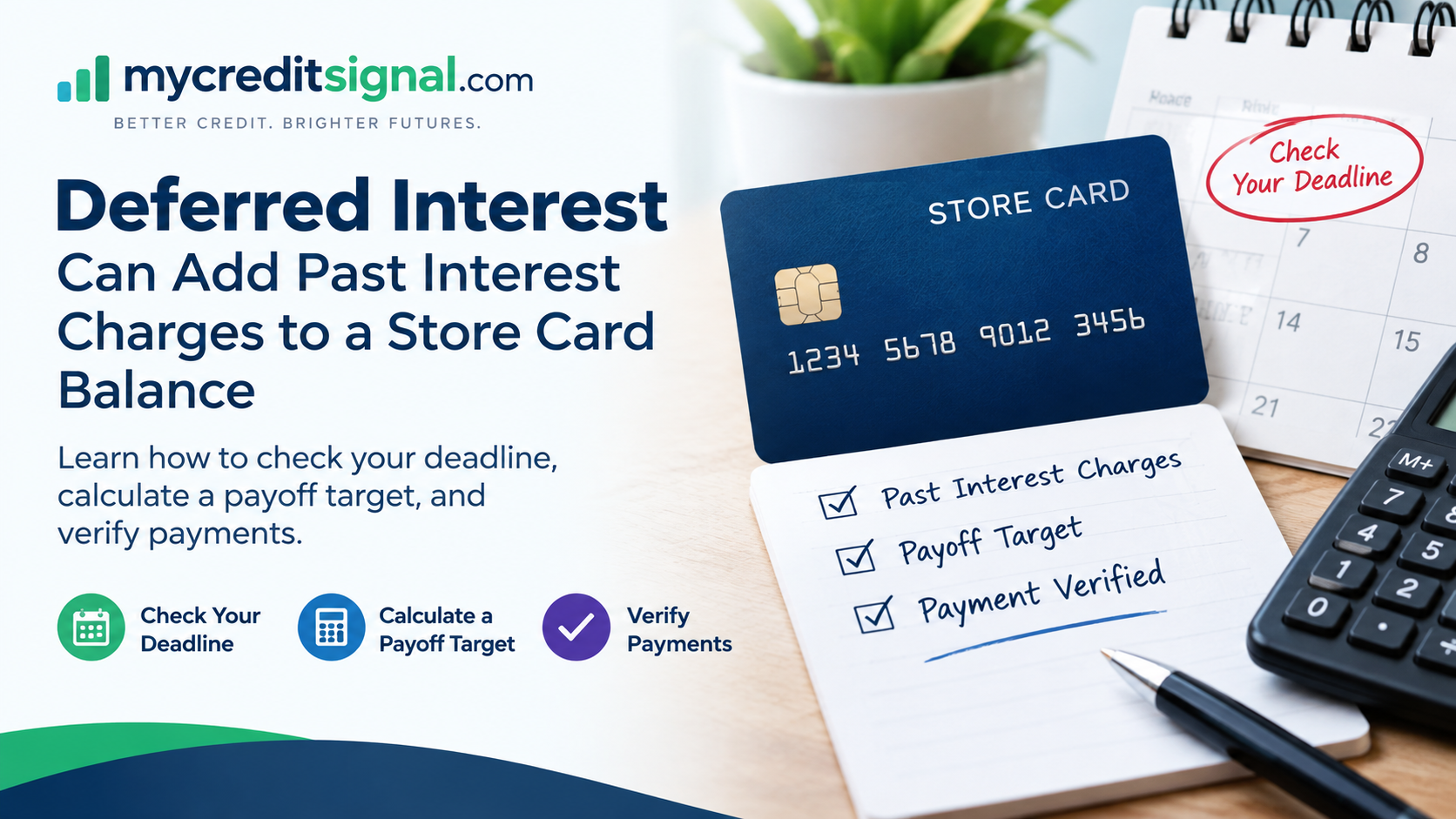
A store card purchase can become more expensive even when you have been making payments. Deferred interest means accumulated interest can be added if you fail to clear the promotional purchase balance by its deadline; avoiding that charge requires paying the qualifying balance in full and meeting the offer’s conditions. (consumerfinance.gov)
If you financed furniture, electronics, or another purchase with a conditional no-interest offer, use this guide to check your terms, build a deadline-based payment schedule, and confirm that your money reaches the intended balance.
Contents
- 1 Who needs a deferred interest payoff check?
- 2 Is deferred interest the same as a 0% APR offer?
- 3 What does missing the payoff deadline cost?
- 4 Should this balance come before other debt?
- 5 Build your payoff file this week
- 6 Payment habits that can derail the plan
- 7 When an early payoff plan is not enough
- 8 Deferred interest questions answered
- 9 Free resources for checking your repayment capacity
- 10 Make the promotional deadline part of your plan
Key Takeaways
- Identify whether your offer uses deferred interest or a genuine introductory interest rate.
- Build your payoff schedule around the promotional expiration date.
- Verify the promotional balance after payments instead of tracking only the card’s total balance.
Who needs a deferred interest payoff check?
Check your offer if the purchase paperwork makes interest relief conditional on full repayment by a specified date. The CFPB identifies wording such as no interest if paid in full within a promotional period as a sign of deferred interest. (consumerfinance.gov)
Start with the account you already have. Pull up the financing receipt, original offer, and latest statement together. Highlight the qualifying purchase, expiration date, and applicable interest rate. Do not try to reconstruct the agreement from what you remember hearing at checkout.
This guide is especially useful if you have been paying the amount shown as due without creating a separate finish date. It is also worth reviewing before adding another promotional purchase to an existing account.
If your immediate problem is affording groceries, housing, and required debt payments, take a different first step. Use our minimum-payment debt survival plan to organize immediate obligations, then contact the issuer about your financing situation. Do not build a promotional payoff schedule that depends on skipping essential expenses.
Is deferred interest the same as a 0% APR offer?
No. A genuine 0% introductory APR offer does not accumulate promotional-period interest for later collection, while deferred interest makes avoiding accumulated interest conditional on meeting the payoff terms. With a true introductory offer, interest generally begins on the remaining balance after the promotion expires. (consumerfinance.gov)
Think of the distinction as a question to ask before you sign: If I still owe money when the offer ends, does interest start then, or can interest from the purchase date become payable?
Ask the issuer to point you to the answer in writing. Save that explanation with your account documents. A clear answer matters more than a salesperson’s description of the monthly payment as affordable.
A promotional balance is the portion of your account covered by a particular offer. For planning, keep that amount separate from the account total. Your working notes should make it possible to answer both questions: what do I owe on the card, and what must I finish paying before this offer expires?
What does missing the payoff deadline cost?
The cost depends on the offer’s interest rate, balance history, and payment timing—not simply the balance left at expiration. The CFPB’s promotional financing comparison illustrates the difference using a $400 television purchase.
In that example, the buyer pays $25 monthly for 12 months, repaying $300 and leaving $100 of principal. Under the deferred interest offer, which uses a 25% rate, approximately $65 of accumulated interest is added, bringing the amount owed to $165. Under the genuine zero-interest offer, the balance remains $100 before subsequent interest accrues. These are the CFPB’s illustrative figures, not a current card offer or a quote for your account. (consumerfinance.gov)
How should I calculate my payment target?
For a planning estimate, divide the remaining promotional principal by the number of payment opportunities you intend to use before your chosen early payoff date. This is a budgeting calculation, not an issuer payoff quote.
Planned reduction per payment = remaining promotional principal ÷ remaining planned payments.
Then check how much of each actual payment will reach that principal. Do not assume your planning result is the entire amount due on a card with other balances or fees. Ask the issuer to confirm the total payment needed to support your intended reduction while satisfying account requirements.
Write the calculation beside the expiration date, not in a separate document you rarely open. Update it whenever you make an extra payment or need to revise the schedule.
Should this balance come before other debt?
Review an approaching deferred interest deadline before deciding where your next extra payment goes. Use the amount needed to finish the promotion and the potential accumulated charge as inputs—not just the card’s current interest line.
A useful decision framework is protect essentials, cover required payments, test the deadline, then allocate extra money. For the deadline test, ask whether your available cash can actually clear the promotional balance without leaving another necessary obligation unfunded.
If the answer is yes, compare completing that payoff with your existing repayment priorities. If the answer is no, contact the issuer before promising yourself that a last-minute payment will solve the problem. Ask for the accumulated interest amount and available options so your next decision uses actual account information.
Our guide to prioritizing debt payoff across competing obligations can help you organize that broader decision. Keep the promotional deadline visible alongside your other debts rather than treating it as an unrelated shopping expense.
Build your payoff file this week
Use the following sequence to turn an offer you vaguely remember into a payment plan you can inspect. Complete the document and budget work first; schedule money only after you understand the target.
Save the offer and statement together
Create a folder labeled with the issuer and purchase. Add the original financing terms, receipt, and current statement. In a separate note, copy the promotional balance, expiration date, and interest rate exactly as displayed. Mark anything unclear as a question rather than filling in an assumption. Keep sensitive account details out of shared budgeting documents.
Confirm the deadline with the issuer
The promotional expiration date can differ from your regular payment due date, according to the CFPB’s deferred interest repayment guidance. Ask which payment method and submission timing will meet the deadline. Put the confirmed expiration date and your earlier personal target on your calendar, with reminders to review progress before either arrives.
Test the target against actual cash
Open your bank activity and list reliable take-home income alongside essential expenses and required payments. Compare the leftover amount with your planned promotional reduction. Leave an explicit line for irregular bills you already expect. Do not count a possible bonus, gift, or sale of belongings as available money until it is actually available.
Ask for payment-allocation instructions
Before sending extra money, ask how the issuer will apply it. Use a specific request: I want this payment to reduce the promotional purchase ending on the date shown here. What instructions must I submit? Record the representative’s explanation and any confirmation. If the requested allocation is unavailable, revise your schedule around the answer instead of assuming the payment will land where you intended.
Schedule payments you can fund
Choose payment dates that fit your income and leave room to verify completion. If you use automatic payments, inspect the amount and funding account before relying on them. Add a calendar task to check the withdrawal and the card account afterward. Treat automation as a way to execute your plan, not as a substitute for checking it.
Verify progress and document completion
After each payment posts, compare the promotional balance with your worksheet. If it did not fall as expected, ask the issuer to explain the allocation before your next payment. When you believe the purchase is paid off, request confirmation that the specific promotional balance has been satisfied. Save the confirmation and review the following statement before archiving your notes.
Payment habits that can derail the plan
Use these checks when reviewing your schedule. Each addresses a different planning failure: an inadequate target, an unverified destination, or money that has not arrived.
Treating the minimum as a payoff schedule
Behavior: Paying only the required minimum and assuming the promotion will finish itself. Consequence: Minimum payments generally will not clear a deferred interest purchase before expiration. Fix: Compare your deadline-based target with the required payment and budget for the difference. (consumerfinance.gov)
Tracking only the total card balance
Behavior: Marking the plan on track whenever the overall balance falls. Consequence: Your worksheet does not tell you whether the specific promotional target was met. Fix: Add a separate promotional-balance column and reconcile it with the issuer’s account information after every scheduled payment.
Relying on a future windfall
Behavior: Leaving the final payoff to an anticipated refund or bonus. Consequence: The plan has no funded alternative if that money arrives late or is smaller than expected. Fix: Build the base schedule around dependable income and use unexpected money only to move the finish date forward.
When an early payoff plan is not enough
An early payoff plan is not enough when the required cash simply does not fit your finances. Identify that gap now rather than designing a schedule you cannot maintain.
For an offer you have not accepted, consider postponing the purchase or comparing financing without the same conditional-interest risk. The FDIC’s credit card guidance suggests that a lower ongoing APR may be a better fit when full repayment within the deferred interest period is unrealistic. That is a comparison to make, not a reason to borrow automatically.
For an existing balance, prepare a short call agenda: your affordable payment, the deadline, the accumulated interest amount, and a request for available repayment options. Ask for any proposed arrangement in writing. Do not put an unconfirmed extension or waiver into your budget.
If you have already missed the deadline, request a current balance breakdown and ask what assistance is available. Focus the conversation on a workable next payment and clear written terms rather than assuming the previous promotion can be restored.
Deferred interest questions answered
Can I pay deferred interest financing off early?
Yes. The CFPB recommends finishing the promotional balance well before expiration. Confirm the amount and payment instructions with the issuer. (consumerfinance.gov)
Does paying nearly all the balance avoid deferred interest?
No. The condition is full repayment of the qualifying promotional balance by the deadline, not repayment of most of it. (fdic.gov)
Will the issuer let me choose where extra payments go?
You can ask, but the issuer may decline your allocation request. Confirm its policy before relying on a particular payment to clear the promotion. (consumerfinance.gov)
Free resources for checking your repayment capacity
Use the free Monthly Cash Flow Calculator to compare income with expenses before committing to a larger payment. Enter your existing debt obligations, then test the additional amount your promotional payoff would require. The calculator estimates available cash; it does not confirm your issuer’s payoff amount or payment allocation.
You can also explore the My Credit Signal free tools library for other repayment scenarios. Read each tool’s assumptions and keep your promotional deadline beside the results. These tools remain free.
Keep the workflow simple: establish what you owe, decide what you can afford, and verify how the payment will be applied. A useful worksheet should support those decisions without making your repayment routine harder to maintain.
Get weekly credit tips, tool updates, and practical guides – free.
Make the promotional deadline part of your plan
The practical goal is a verified finish date, not simply a string of payments. Keep the offer terms, remaining promotional balance, and available cash together so you can spot a shortfall while there is still time to respond.
Start today by opening your latest statement and locating the promotion’s expiration date. Then confirm the payoff target and schedule the first payment your budget can support.


Want to understand your credit report?
Get plain-English explanations with our free AI Credit Analyzer →
Leave a Reply
You must be logged in to post a comment.