
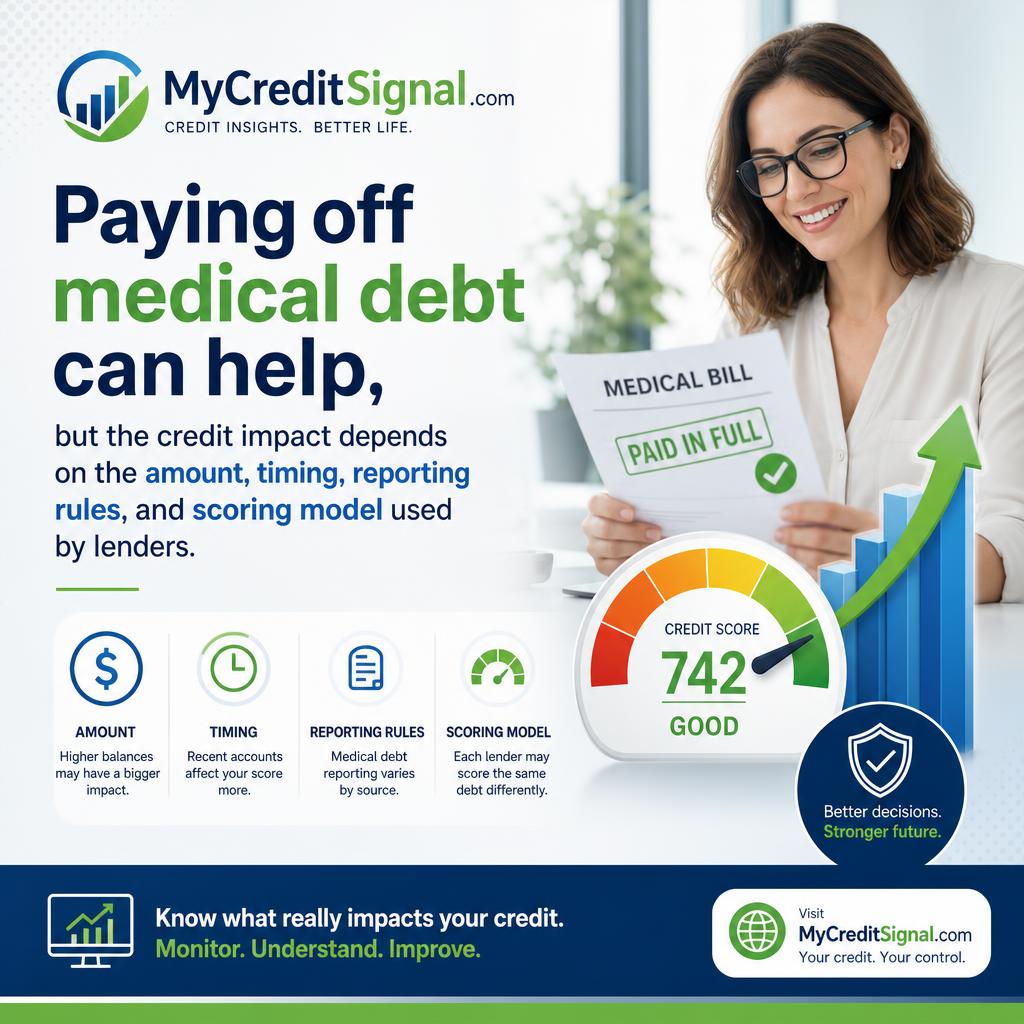
Imagine you finally pay off a medical bill that has been hanging over your budget for months. The balance is gone, but the next question is the one people actually care about: what happens to your credit now? That is exactly what this article covers. If you have paid, settled, or are about to pay medical debt, this guide will help you understand the likely credit impact, what timelines matter, and what steps to take next. The rules around medical debt changed a lot in 2023 through 2025, so the answer today is more nuanced than the old advice most people still repeat online.
In short, paying off medical debt can help your overall financial picture immediately, but the score effect depends on whether the debt was reported, how much it was, when it was sent to collections, and which scoring model a lender uses. Results can vary by credit profile and scoring model.
Contents
- 1 Who should care about paying off medical debt
- 2 Why medical debt works differently from most collections
- 3 What actually happens when you pay it off
- 4 The numbers and timelines that matter most
- 5 A simple decision framework for what to do first
- 6 Your step by step plan this week
- 6.1 Pull your current credit reports and identify whether the medical debt is actually listed
- 6.2 Verify whether insurance or provider adjustments are still pending
- 6.3 Map your next 90 days of borrowing goals
- 6.4 Compare the medical payoff against lowering revolving utilization
- 6.5 Get written confirmation of any payment or settlement terms
- 6.6 Check again after one to three billing cycles
- 6.7 Build a broader recovery plan if the payoff does not move your score much
- 7 Mistakes that can blunt the benefit
- 8 What most articles miss about medical debt and credit
- 9 When this advice may not apply
- 10 FAQ
- 11 Helpful tools and related resources
- 12 The bottom line
Key Takeaway
Paying off medical debt matters most when it prevents or resolves collections, but newer reporting rules mean many medical accounts now have less credit impact than consumers expect.
Who should care about paying off medical debt
This article is for people in four common situations.
- You already paid a medical collection and want to know whether your score could improve.
- You have an unpaid medical bill and are deciding whether to pay now, wait for insurance, or set up a plan.
- You are preparing for a mortgage, auto loan, or apartment application and want to reduce surprises.
- You saw an older medical collection on a credit report and are trying to estimate whether it still matters.
This is probably not the right framework if your main problem is not medical debt but high credit card balances or recent late payments. In those cases, utilization and payment history may move your score faster. If revolving balances are the bigger issue, read this guide to what actually affects your credit utilization ratio and use the credit score simulator tool to compare different payoff moves.
Why medical debt works differently from most collections
Medical debt is unusual because it often starts with a billing delay, an insurance adjustment, a financial assistance review, or a provider balance that changes after the original bill is sent. That is one reason regulators and credit bureaus have treated it differently in recent years.
In April 2023, Equifax, Experian, and TransUnion announced that medical collections under $500 would be removed from consumer credit reports. Earlier changes had already reduced the impact of paid medical collections. The CFPB also reported early effects from low-balance medical collection removals and broader reporting changes in 2023 and 2024, noting that medical debt had previously affected a meaningful share of consumer files. In 2025, the CFPB finalized a rule intended to curb the use and reporting of medical debt in lending decisions, with implementation around 60 days after Federal Register publication.
That does not mean medical debt never matters. It means the old blanket statement, “any medical collection will crush your score for years,” is outdated. Some medical debt may never show up. Some may appear but count less under certain scoring models. And some may still matter, especially during the transition period between rule changes, bureau policies, and lender-specific underwriting.
What actually happens when you pay it off
There are three broad scenarios, and each can lead to a different credit outcome.
Scenario 1: The bill was never reported
If you pay a provider or collection agency before the account is reported to a credit bureau, your score may see no direct change because there was no derogatory item added in the first place. That is still a win. You avoided future damage and removed a financial risk.
Scenario 2: The debt was reported, but newer rules reduce its impact
If the account was a paid medical collection or a balance under $500, there is a stronger chance it may be removed or treated more lightly than non-medical collections, depending on bureau policy and model. For many consumers, paying in this category may not produce a dramatic overnight jump because the reporting system may already have minimized it. But it can still improve your file cleanliness for future underwriting.
Scenario 3: The debt was reported and still visible to a lender or model
This is where payoff can matter more. Independent analyses discussed by the Commonwealth Fund note that removing medical debt from credit reports could improve average scores for affected borrowers by roughly 20 points, though actual results vary. If the medical collection was the main negative item on an otherwise solid file, the effect can be more noticeable. If your file also has maxed-out cards, late payments, or multiple collections, the score gain may be smaller because other negatives still remain.
The numbers and timelines that matter most
When people ask about medical debt credit impact, they usually want a simple answer. The better approach is to focus on four numbers and one timeline.
1. The $500 threshold
The nationwide credit bureaus announced that medical collections under $500 would be removed from consumer reports in 2023. If your balance fell below that threshold, the payoff may matter more for your budget and lender documentation than for your score itself.
2. The one-year window
Recent reporting changes have generally given medical debt more time before it affects credit files. This matters if you are waiting for insurance adjudication, hospital charity care review, or a negotiated balance. A rushed payment decision is not always the best first move if the amount may change.
3. The 20-point example
The commonly cited score improvement of about 20 points is useful only as an illustration, not a promise. If medical debt is your only negative mark, you may see more upside than someone whose file also includes high utilization and recent missed payments.
4. The 60-day implementation window
The 2025 CFPB final rule was described as taking effect around 60 days after Federal Register publication. That means timing matters. During a transition period, consumers can see differences between what a policy intends, what a bureau displays, and what a lender actually pulls.
A practical example
Say you have a $1,200 medical collection, two credit cards, and no missed card payments. Card A has a $2,000 limit with a $1,200 balance. Card B has a $3,000 limit with a $300 balance. Your total utilization is $1,500 divided by $5,000, or 30%.
If you use $1,200 to pay the medical debt, you may clean up an old collection risk, but your utilization stays at 30%. If instead you lower card balances first, your score may react faster in some models because utilization is a live factor. That does not mean ignore the medical debt. It means choose the order based on your near-term goal. If you are applying for a mortgage and the lender flags collections, the medical payoff may come first. If you are trying to improve a general credit score before a card application, reducing utilization may show results faster. For more on recovery after negative items, see this practical plan to rebuild credit after collections.
A simple decision framework for what to do first
Use this quick order of operations.
- First: confirm whether the bill is final or still waiting on insurance, adjustments, or assistance.
- Next: find out whether the account has been reported or is only in provider billing.
- Then: compare the medical balance with your current credit card utilization and your next borrowing deadline.
- After that: choose the move that best fits your timeline, not just the one that feels most urgent emotionally.
- Finally: track your reports and scores over the next one to three statement cycles.
This matters because the best move for a mortgage in 30 days is not always the best move for a general score goal over six months.
Your step by step plan this week
Pull your current credit reports and identify whether the medical debt is actually listed
Do not assume a medical bill is harming your credit just because you received a collection letter. Check whether it appears on your reports and note the amount. If it is under $500, newer bureau policies may already limit its presence or impact.
Verify whether insurance or provider adjustments are still pending
Before paying, confirm that the balance is final. Medical bills can change after insurance processing or financial assistance review. Paying the wrong amount too early can create unnecessary cash flow pressure.
Map your next 90 days of borrowing goals
If you plan to apply for a loan, apartment, or refinance soon, write down the application date. A medical collection payoff may matter more if an underwriter will review your file manually. If you have no upcoming application, you may prioritize the move with the fastest measurable score effect.
Compare the medical payoff against lowering revolving utilization
List every card balance and limit. If your cards are carrying large balances, lowering utilization can sometimes help scores faster than paying a medical account that is already being discounted by newer rules. Use the credit score simulator to test different payoff scenarios.
Get written confirmation of any payment or settlement terms
If you decide to pay, save receipts, confirmation emails, and any settlement letter. You want proof of the date paid and the amount accepted, especially if a lender later asks about the account.
Check again after one to three billing cycles
Credit updates are not always instant. Review your reports and score trends after enough time has passed for the furnisher and bureaus to update. If other factors are dragging you down, do not expect a single medical payoff to fix everything at once.
Build a broader recovery plan if the payoff does not move your score much
If you paid the medical debt and the score barely changes, the real issue may be utilization, age of accounts, or prior delinquencies. The credit rebuilding checklist can help you prioritize the next few actions instead of guessing.
Mistakes that can blunt the benefit
Paying before the balance is finalized
Behavior: paying a medical bill while insurance, charity care, or billing adjustments are still in process. Consequence: you may use cash on a balance that later changes, leaving less money to handle card balances or essentials. Fix: confirm the final patient responsibility first and ask for an itemized final balance before paying.
Expecting every score model to react the same way
Behavior: assuming one lender score reflects how all lenders will view your file. Consequence: you can misread the value of a payoff if another model treats medical debt differently. Fix: treat score gains as model-dependent and focus on both cleaner reports and better overall credit habits.
Ignoring high utilization while focusing only on collections
Behavior: using all available cash to pay medical debt while leaving credit cards near their limits. Consequence: your score may not improve much because utilization remains elevated. Fix: compare both moves side by side and, if needed, split extra cash between a medical payoff and reducing revolving balances.
Assuming paid means instantly invisible
Behavior: paying and then checking your score the next day expecting a major jump. Consequence: frustration and bad follow-up decisions, like opening new accounts too quickly. Fix: allow time for updates and judge progress over several weeks, not 24 hours.
What most articles miss about medical debt and credit
Most articles stop at, “medical debt matters less now,” but that misses the bigger planning issue: payoff order. The best answer depends on what you need your credit to do next.
If your goal is a cleaner underwriting file for a manual review, paying medical debt may be smart even if your score does not jump much. If your goal is maximizing a general-purpose score in the short term, reducing utilization or avoiding new late payments may matter more.
Another nuance is that paid versus unpaid medical debt can be treated differently depending on the model and reporting framework. Some newer systems minimize or exclude paid medical debt, but that does not automatically mean every lender workflow ignores it. The FTC continues enforcement around debt collection and credit reporting practices, which is one reason it is smart to keep documentation of payments and communication. You can review current federal guidance at the FTC credit reporting resource center.
One more edge case: if you are waiting on insurance or provider assistance, the smartest move may be patience plus documentation, not immediate payment. The No Surprises Act and related coordination rules have influenced how providers and insurers handle patient balances, which can reduce unnecessary medical debt reporting in some situations.
When this advice may not apply
There are cases where paying off medical debt is clearly still the right first move, even if the score impact is uncertain.
- You need to stop collections pressure and regain monthly cash flow stability.
- You are dealing with a lender or landlord that manually reviews outstanding collections.
- You want to reduce legal or administrative stress from unpaid balances.
- You have already fixed utilization and on-time payment habits, so the collection is the main remaining issue.
There are also cases where a different first move may be stronger.
- Your cards are heavily utilized and you need a near-term score boost.
- Your emergency fund is close to zero and paying the medical debt would leave you exposed.
- The balance is still being adjusted by insurance or assistance.
If late payments are the bigger drag on your file, a broader recovery strategy may help more than focusing narrowly on one collection account. While this article stays on medical debt, you may also benefit from a structured timeline like this 90-day rebuilding guide after collections.
FAQ
Do medical bills affect my credit score after the 2025 rule?
Often less than before, but not always zero. The 2025 CFPB rule is designed to keep most medical debt out of credit decisions and reports used by lenders, but implementation timing and lender practices can vary.
Will paying a medical collection remove it from my credit report immediately?
Not necessarily. Some paid medical debt may be removed or treated more lightly, but updates still take time and treatment can differ by scoring model and reporting process.
How fast can my score improve after medical debt is removed?
There is no guaranteed timeline or point increase. Some affected borrowers may see improvement after reporting updates, while others may see little change if utilization, late payments, or other negatives are stronger factors.
If you want to turn this information into an action plan, start with these next steps:
- Run payoff scenarios with the credit score simulator.
- Organize your next moves with the credit rebuilding checklist.
- Learn how collections fit into a broader recovery plan in How to Rebuild Credit After Collections.
- Review the latest medical debt reporting changes from the CFPB and the major credit bureaus.
Get weekly credit tips, tool updates, and practical guides – free.
The bottom line
Paying off medical debt can absolutely be the right move, but the credit impact is no longer one-size-fits-all. Thanks to newer bureau policies, CFPB rule changes, and scoring model differences, some medical debt now affects credit far less than it used to. That is good news, but it also means you should make payoff decisions based on your exact situation, not outdated credit myths.
Your best next step is simple: verify whether the debt is reported, confirm the final balance, and compare that payoff against other score levers like card utilization. Then use the right tool to model the tradeoff before sending money. A smarter sequence can protect both your credit and your cash flow.


Leave a Reply
You must be logged in to post a comment.